-
-
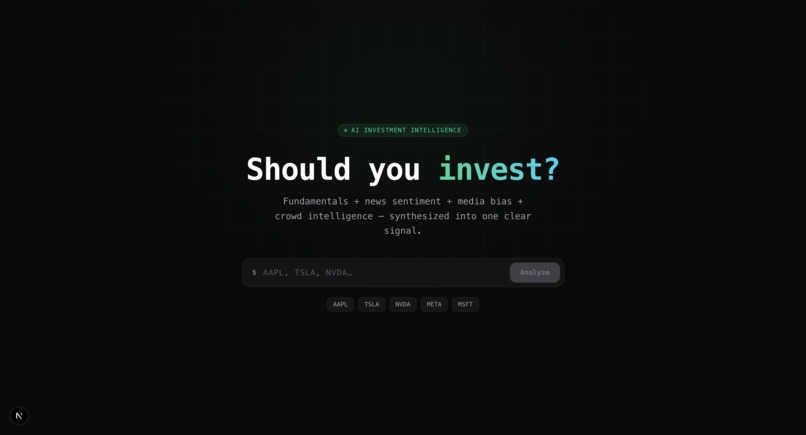
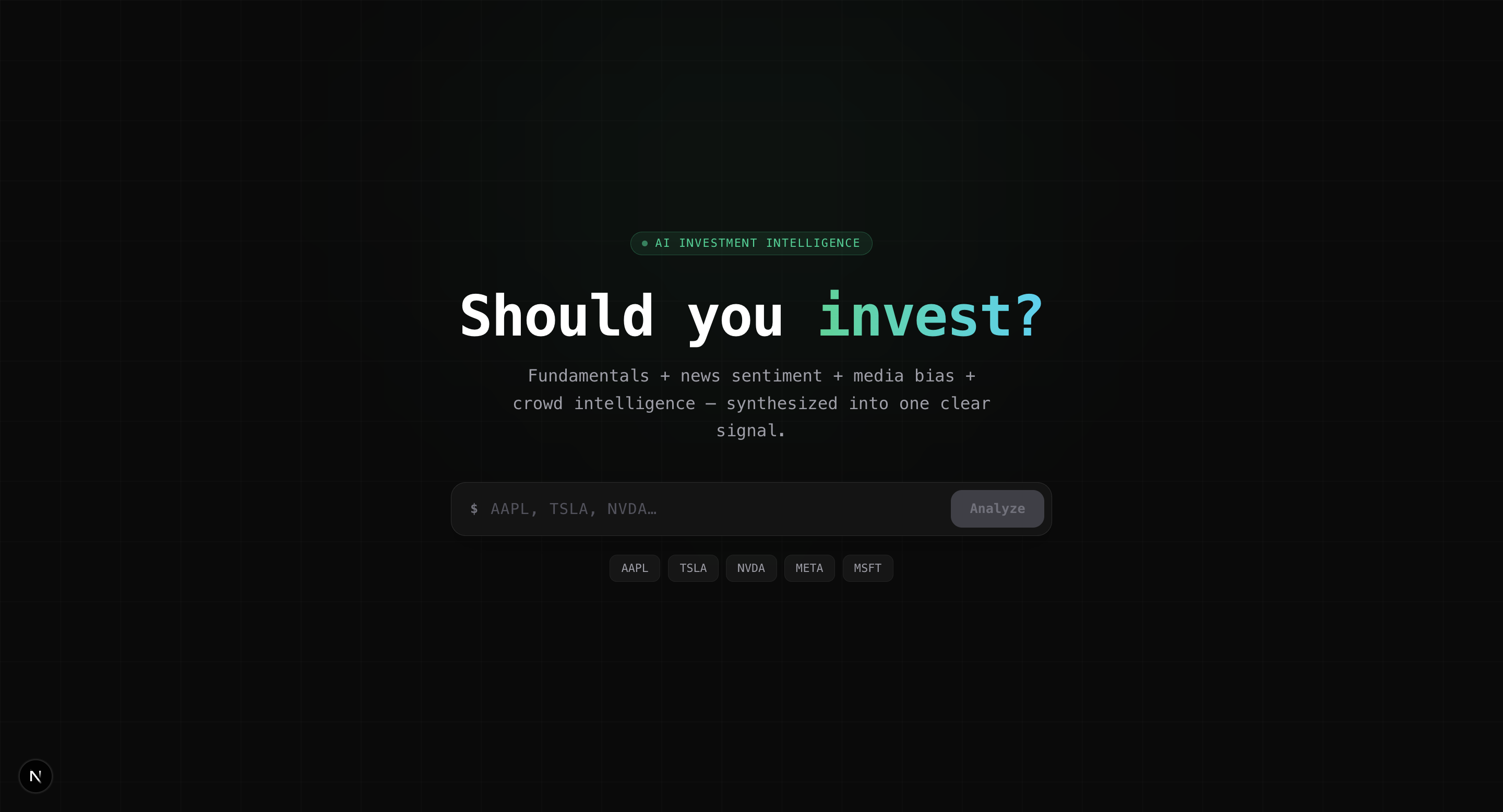
Signal landing page — AI investment agent combining fundamentals, news, sentiment & bias into one clear decision.
-
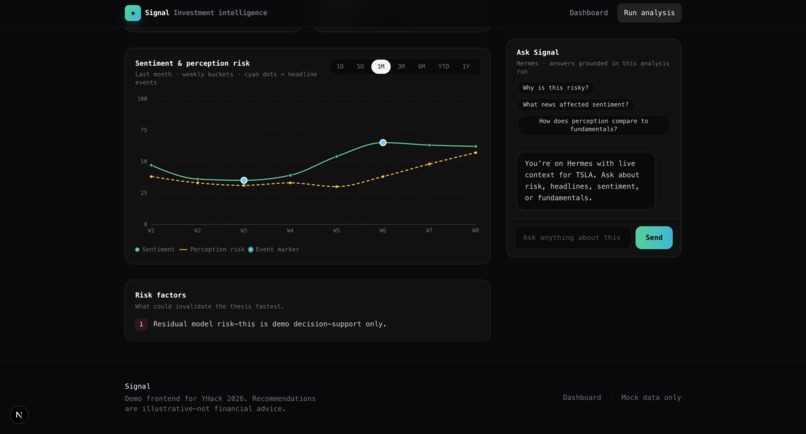
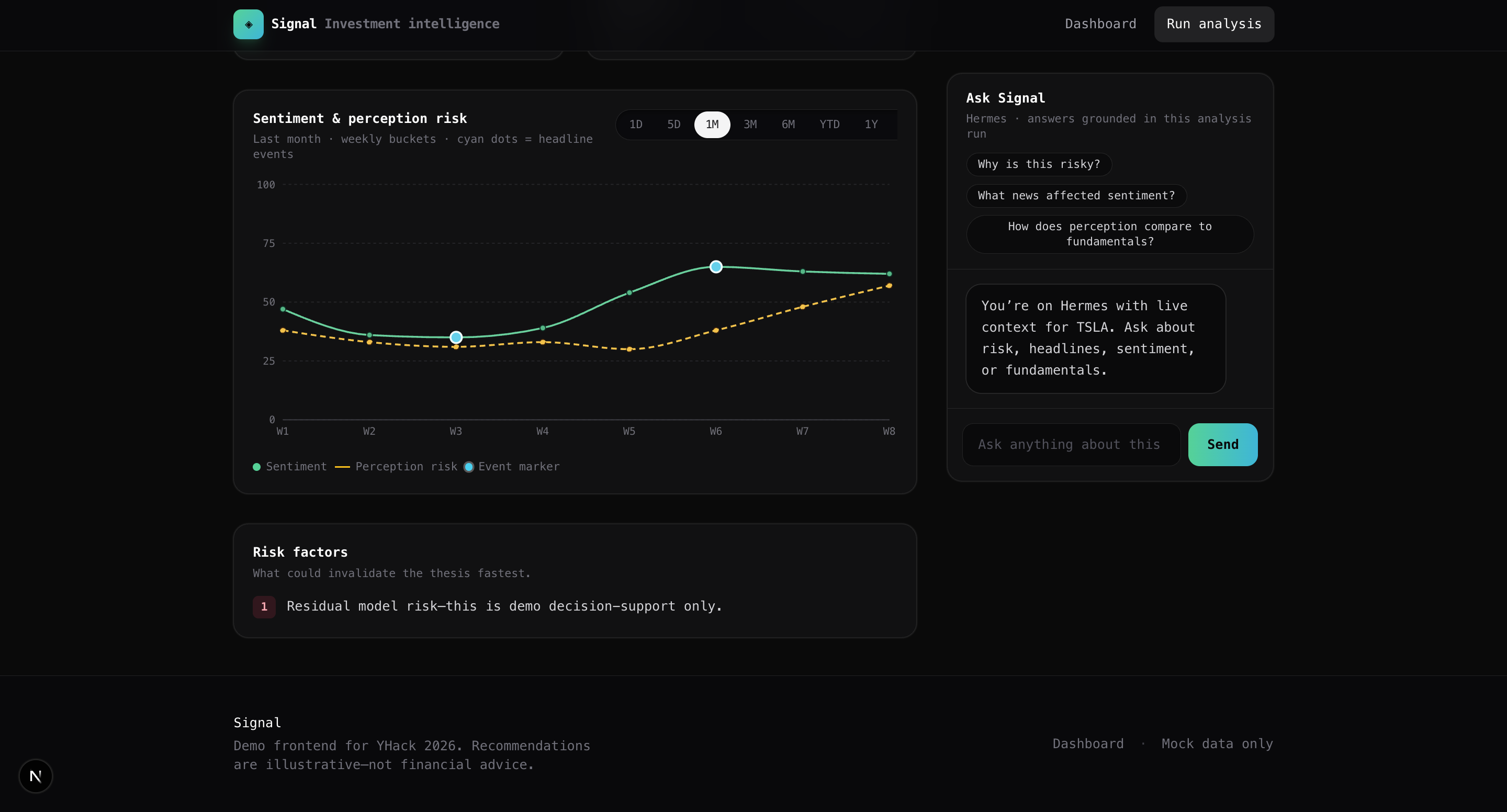
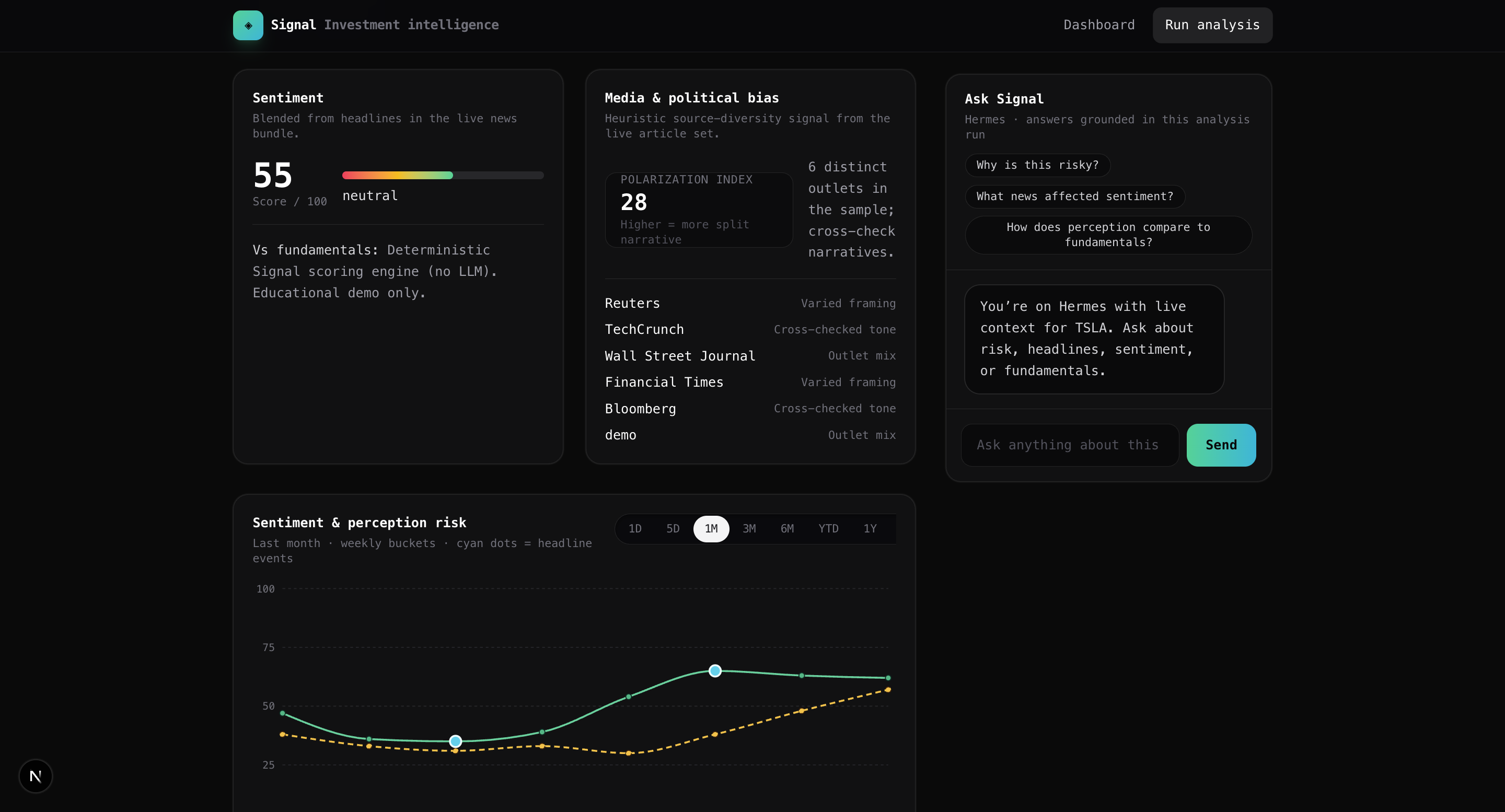
Sentiment & Perception Risk Visual Graph
-
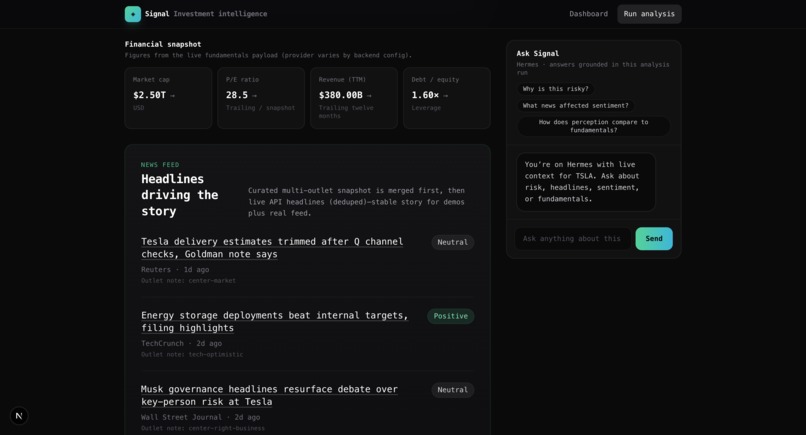
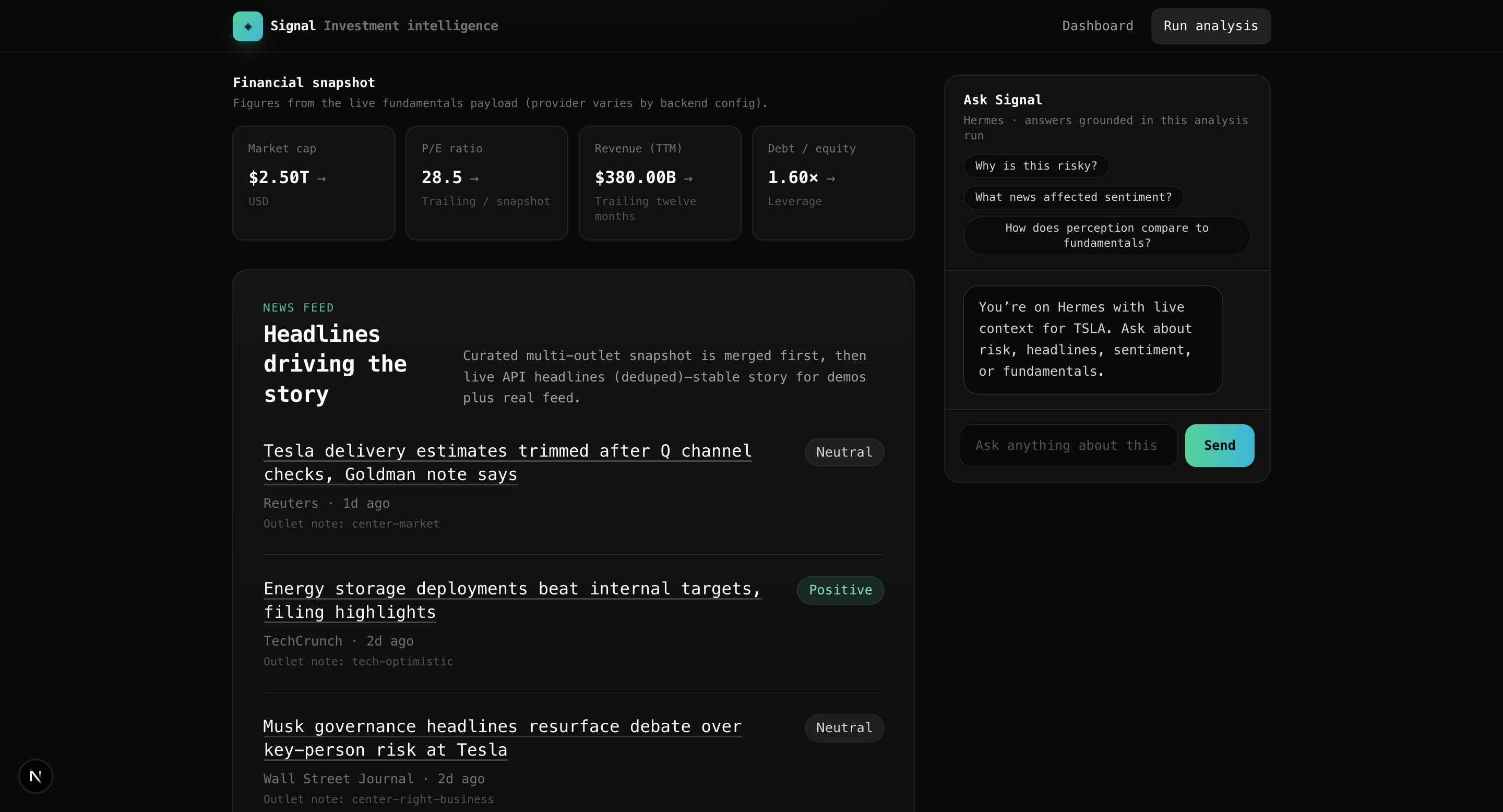
Financial snapshot, narrative-driving headlines, and AI chat assistant for contextual investment insights.
-
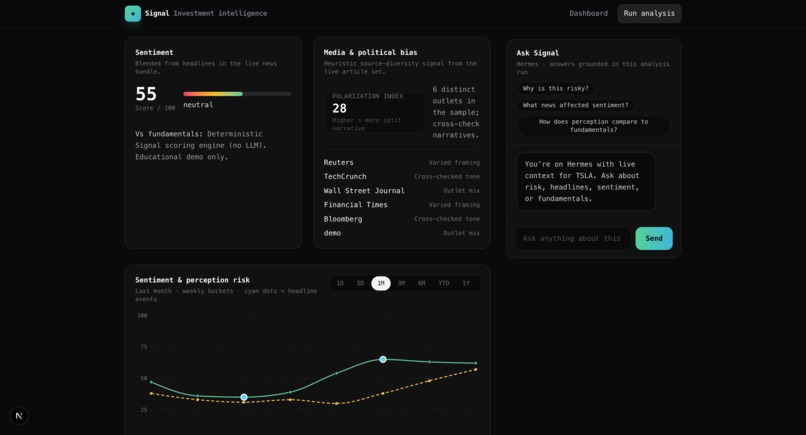
Sentiment Score Breakdown and Media &Political Bias Breakdown
-
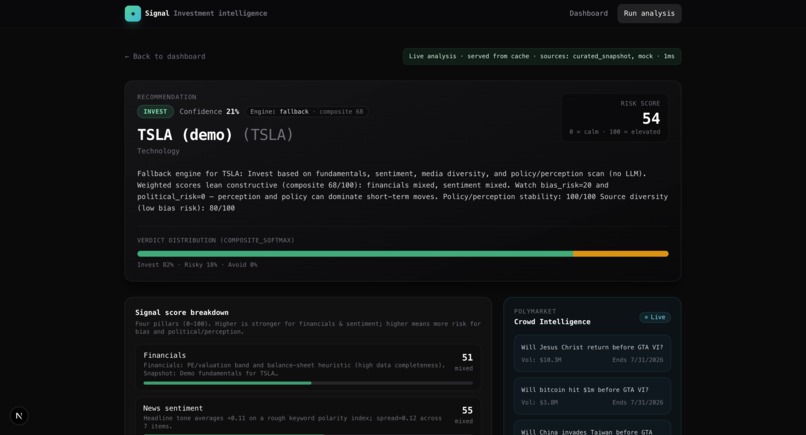
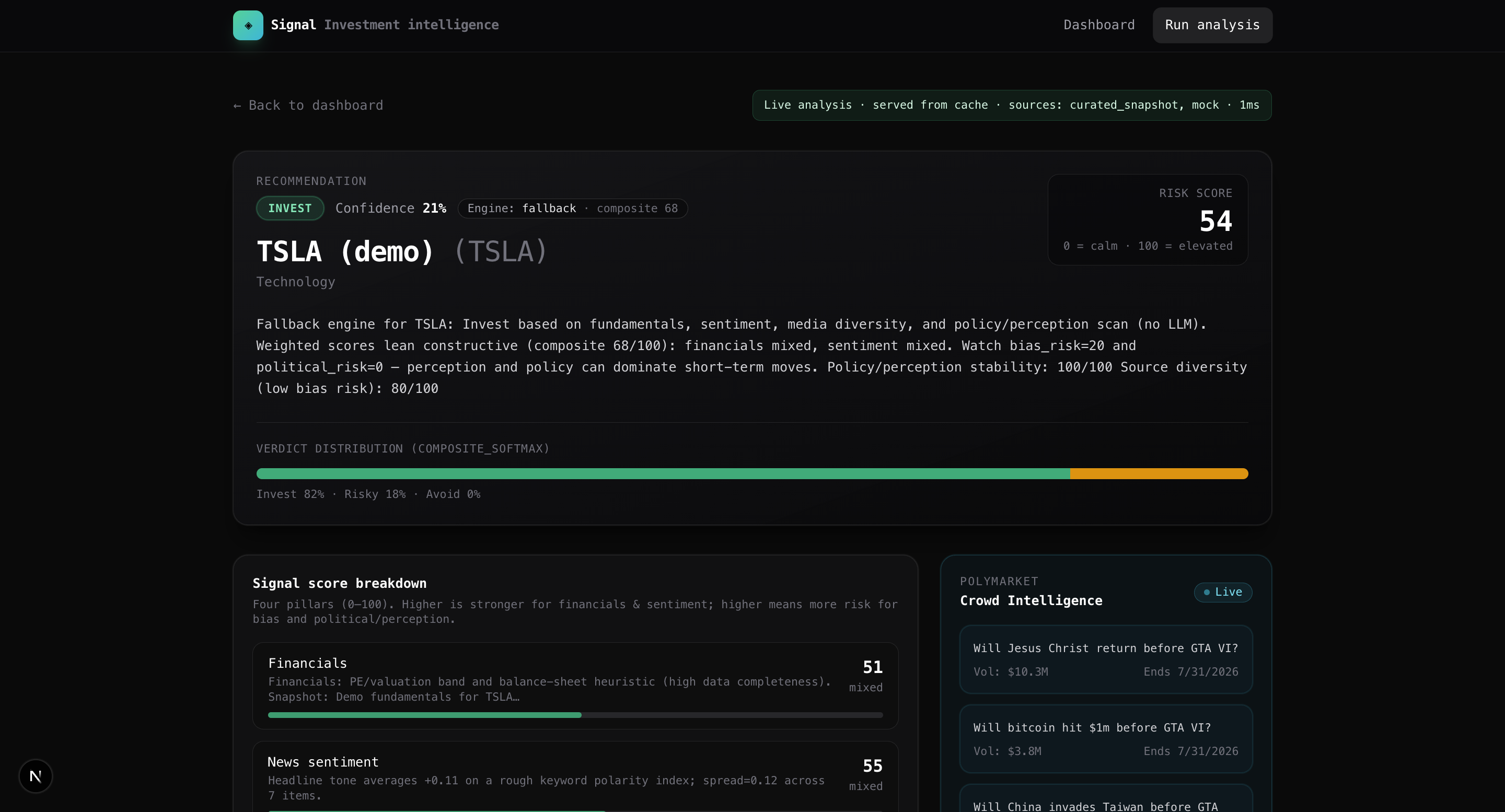
Live analysis with recommendation, risk score, sentiment breakdown, and crowd intelligence integration.
Inspiration
The idea for Signal came from a real investing dilemma.
At a hedge fund, we saw a company with extraordinary financial potential. On paper, the fundamentals were strong. The growth trajectory was compelling. But there was one variable traditional models couldn’t quantify: public perception.
The CEO’s media presence and political visibility significantly influenced how the market viewed the company. Despite strong financials, reputational risk changed the investment decision.
That moment raised a question:
What if an AI agent could analyze not just financial fundamentals, but also public narrative, media bias, and sentiment — the way real investors actually think?
Signal was built to bridge that gap.
What it does
Signal is an AI-powered investment decision agent.
Instead of predicting stock prices, Signal helps users decide whether a company is:
- ✅ Invest
- ⚠️ Risky
- ❌ Avoid
It combines:
- Financial fundamentals
- Real-time news
- Sentiment analysis
- Political/media bias detection
And outputs:
- A clear recommendation
- Structured reasoning
- Key risk factors
- Supporting headlines
- A chatbot for follow-up questions
Signal doesn’t just analyze numbers — it analyzes narrative.
How we built it
Frontend: Next.js + TypeScript + Tailwind
Backend: FastAPI (Python)
Database: MongoDB
AI Layer:
- K2 Think V2 → structured reasoning + decision synthesis
- Hermes (Nous) → conversational explanations
Pipeline:
1. User enters a company.
2. Backend fetches:
- Financial summary (via API)
- Recent news articles
3. NLP layer:
- Sentiment scoring
- Bias detection
4. AI reasoning engine synthesizes:
- Financial signals
- Narrative signals
- Risk profile
5. Output: recommendation + explainable reasoning.
We designed the system to mimic how analysts combine quantitative and qualitative signals.
Challenges we ran into
1. API Integration & Live Data
- Coordinating financial APIs and news APIs in real time
- Handling inconsistent data formats
- Managing rate limits
2. Quantifying Narrative Risk
- Sentiment alone isn’t enough — we had to differentiate between:
- Short-term noise
- Structural reputational risk
3. Avoiding Overengineering
In a 24-hour build, the biggest challenge was deciding what not to build. We prioritized clarity, explainability, and demo impact over complexity.
Accomplishments that we're proud of
- Building a fully functioning AI decision agent in 24 hours
- Creating a system that feels aligned with how real investors think
- Designing an interface that makes complex signals intuitive
- Turning financial + narrative data into actionable insight
Most importantly, we built something meaningful to us — at the intersection of fintech, AI agents, and decision automation.
What we learned
- Markets are driven as much by perception as performance.
- AI agents are powerful when they synthesize multi-modal signals.
- Simplicity wins in hackathons.
- Explainability builds trust.
We also learned how to rapidly integrate APIs, structure AI reasoning prompts, and design for demo impact under tight time constraints.
What's next for Signal
- Add historical narrative-impact tracking
- Integrate prediction market signals
- Build a portfolio-level risk dashboard
- Add “What changed?” alerts when sentiment shifts dramatically
- Deploy as a browser extension for retail investors
Long-term, we envision Signal as a personal AI investment co-pilot — one that understands not just the balance sheet, but the story behind it.
Built With
- canva
- css
- cursor
- fastapi
- godaddy
- groundnews
- hermes
- html
- javascript
- k2thinkv2
- lava
- next.js
- node.js
- polymarket
- python
- react
- tailwind
- typescript
- vercel
- vscode


Log in or sign up for Devpost to join the conversation.