-
-
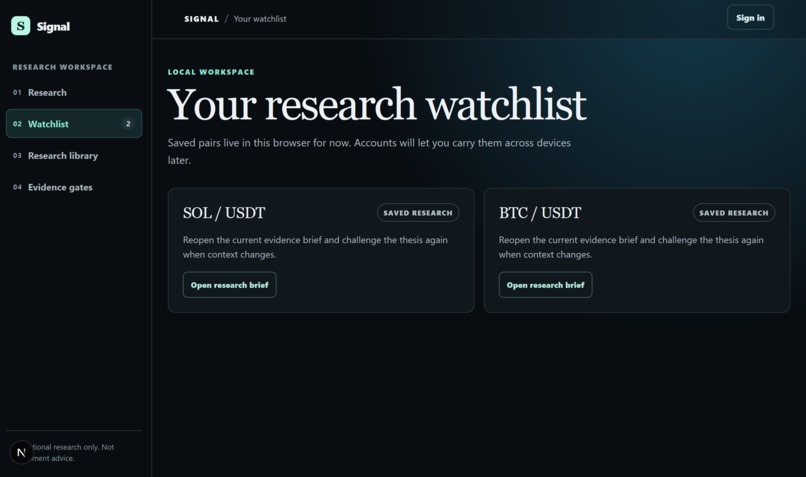
Watchlist
-
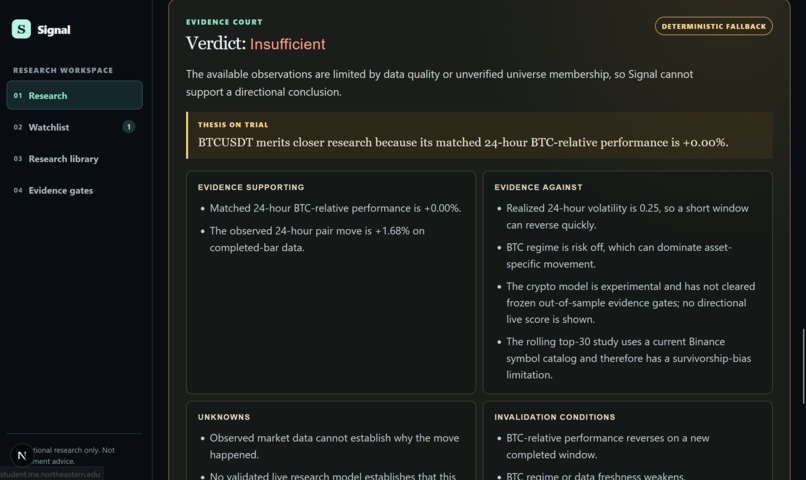
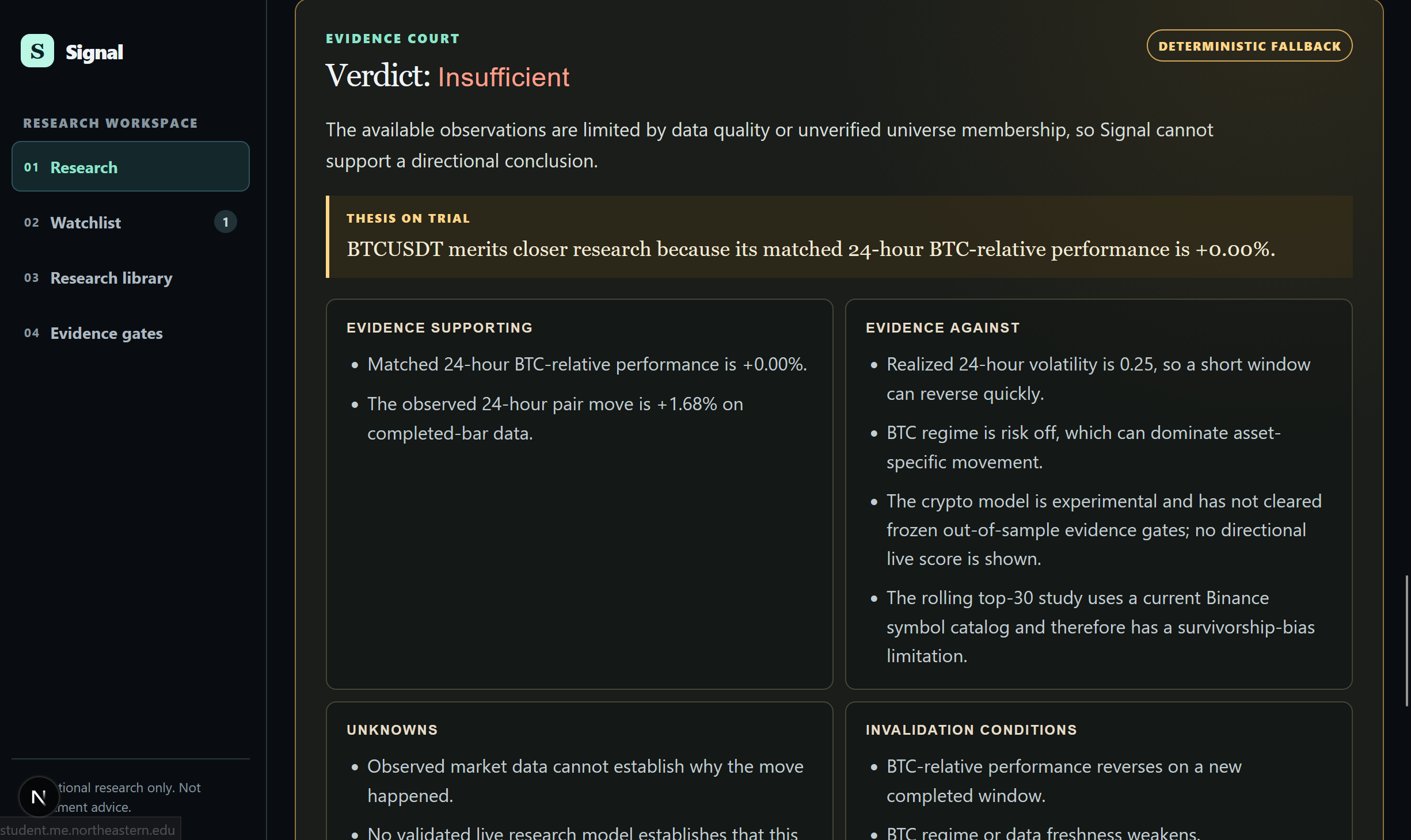
Evidence court
-
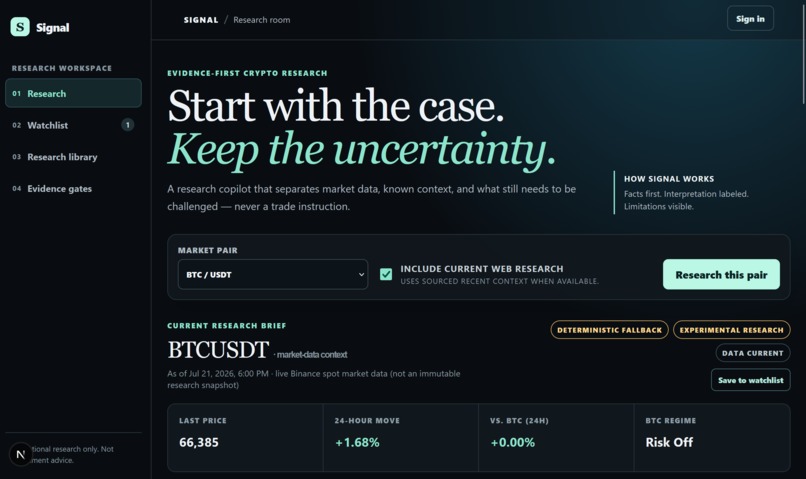
Homepage
-
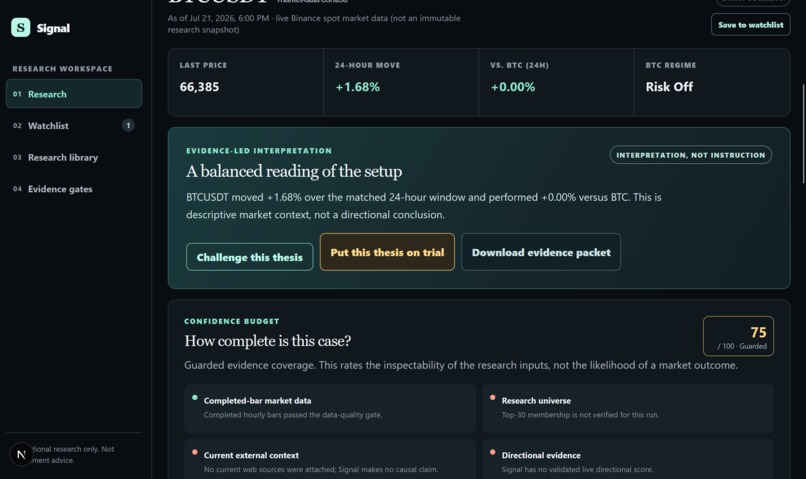
Crypto research
-
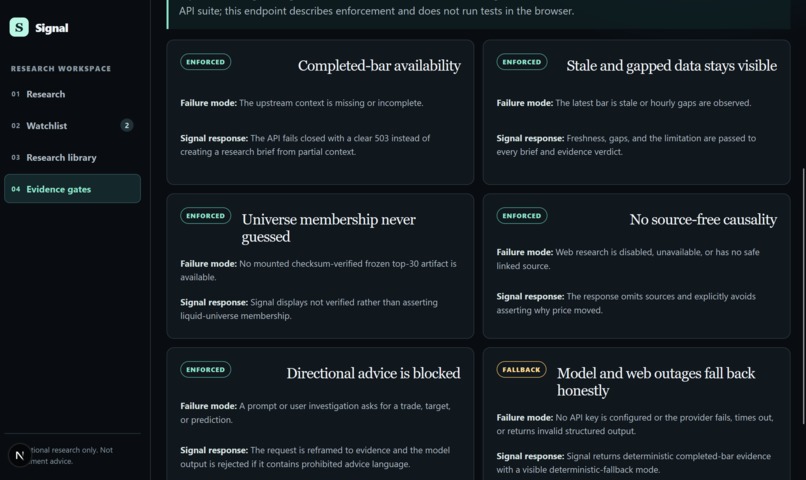
Evidence gates
-
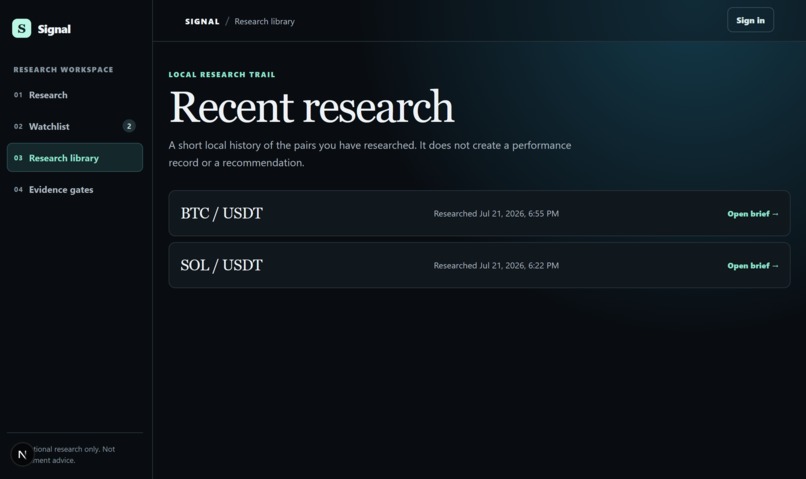
Research history
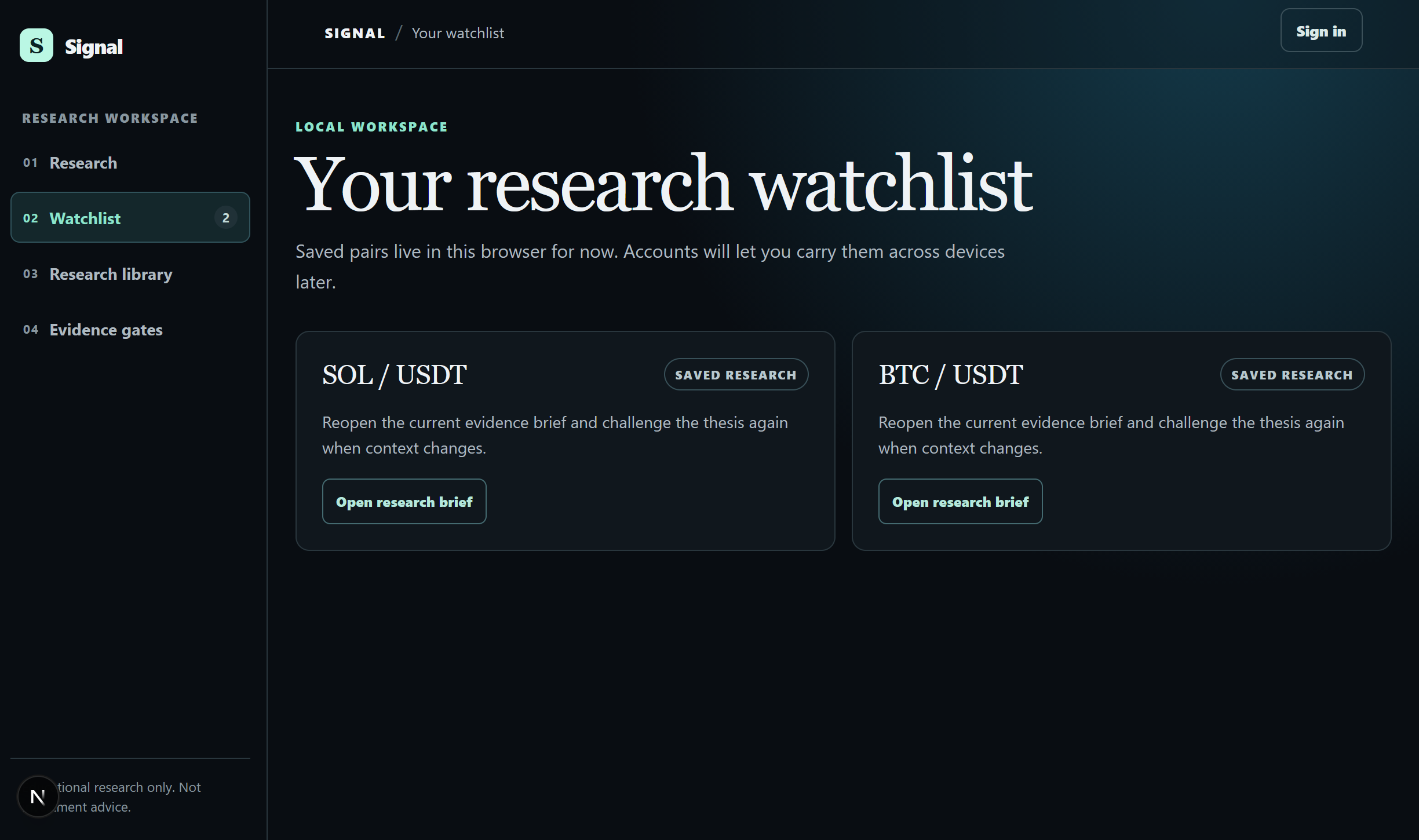
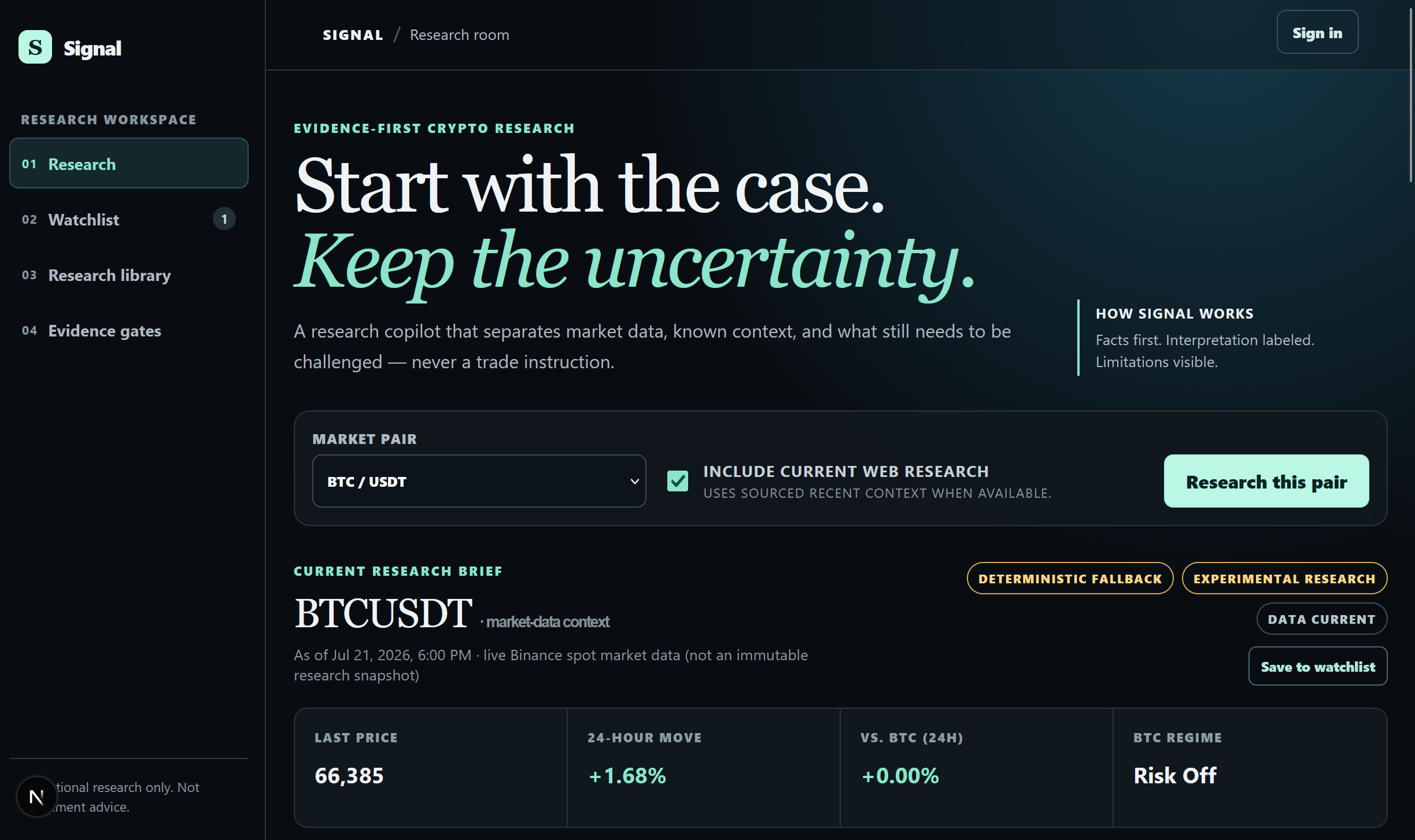
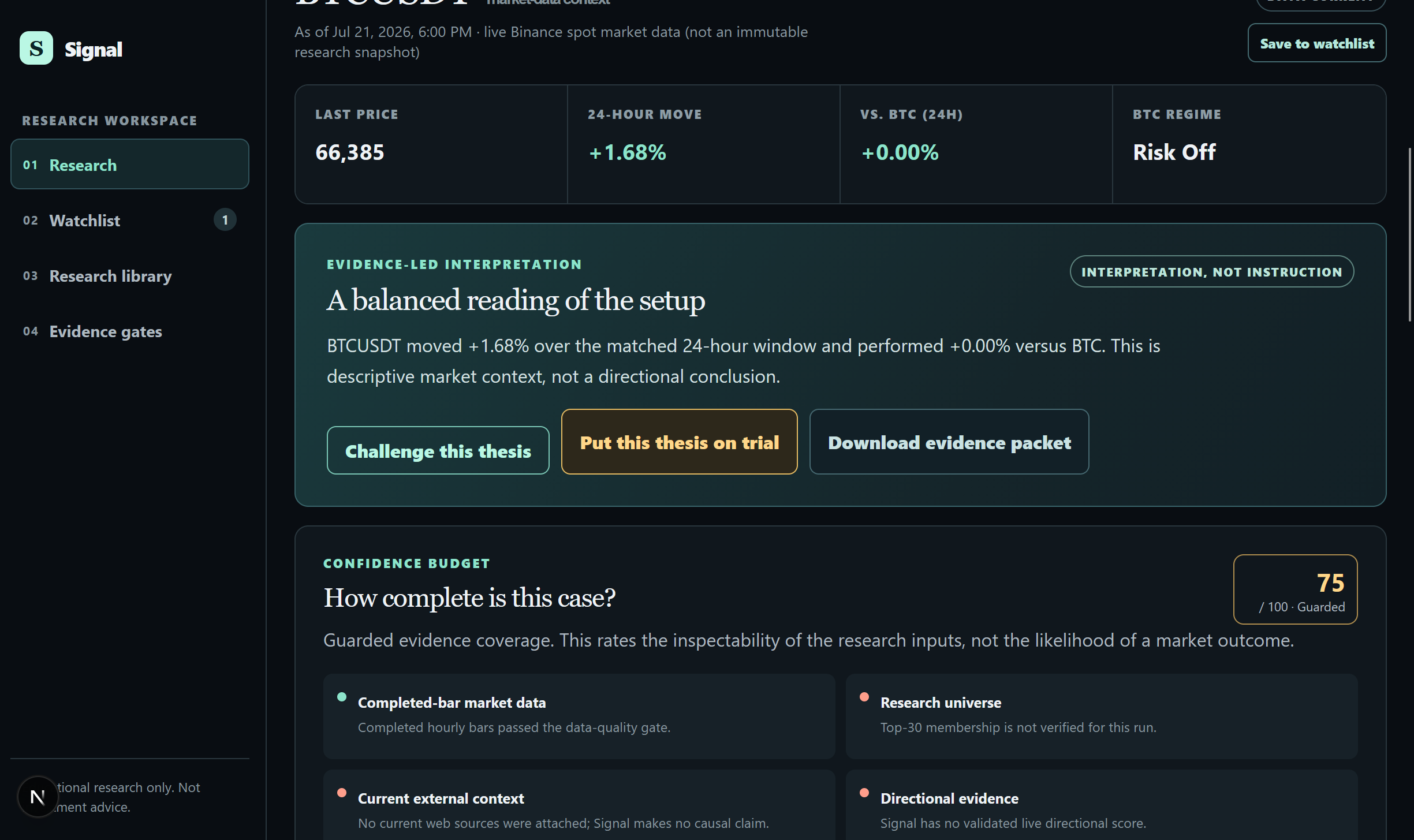

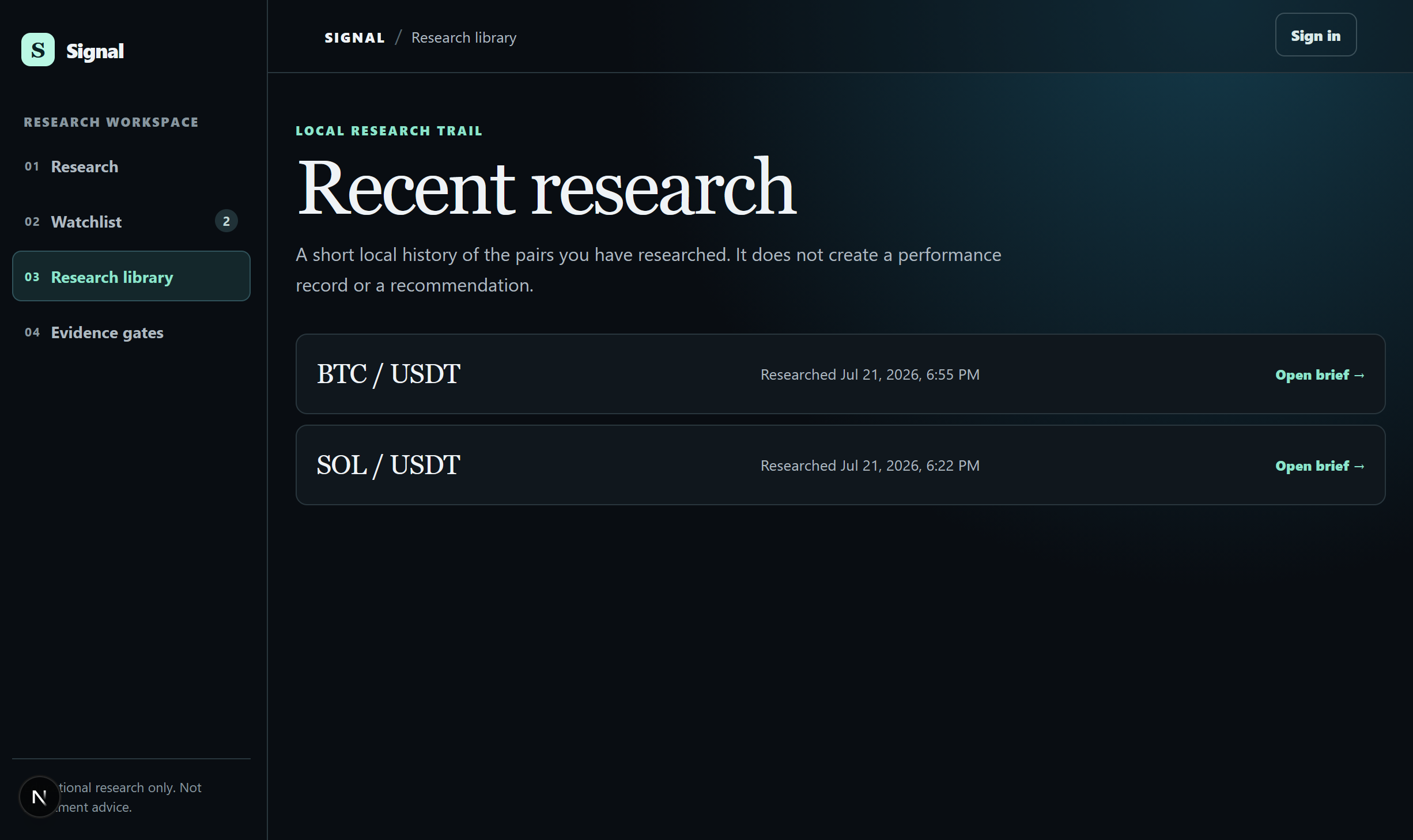
Inspiration - Crypto research often begins with a confident narrative and ends with hidden assumptions. We wanted to build the opposite: a tool that makes evidence, limitations, and counterarguments visible before a user forms an opinion. What it does - Signal turns a crypto pair into an inspectable research case. It provides completed-bar market facts, BTC-relative context, data-quality checks, optional linked web context, risks, unknowns, invalidation conditions, and a clear educational disclaimer. Users can challenge a thesis, put it through Evidence Court, ask bounded investigation questions, test a hypothetical BTC move, export an evidence packet, and revisit pairs through a Watchlist and Research Library. How we built it - We built Signal as a three-part system:
- A Next.js research workspace for the user experience.
- A FastAPI orchestration service for versioned API contracts, policy boundaries, and GPT-5.6 Responses API workflows.
- A separate Quant service that produces deterministic completed-bar crypto facts from Binance spot data or checksum-verified snapshots. GPT-5.6 interprets evidence through strict tools and structured output. Codex helped develop the UI, API contracts, evaluation cases, Docker workflow, and safety tests. Challenges we ran into - The hardest challenge was preventing a polished AI response from becoming an unsupported market claim. We had to separate deterministic facts from model interpretation, make unknowns first-class output, and ensure model or web failures fall back honestly. We also worked through data freshness, hourly gaps, point-in-time universe status, Docker configuration, merge conflicts, and making Supabase authentication optional until valid project credentials are configured. Accomplishments that we're proud of - We are proud that Signal does not simply produce a crypto opinion. Evidence Court challenges Signal’s own thesis. Confidence Budget measures evidence coverage, not confidence in price direction. Counterfactual Lab is explicitly a sensitivity illustration, not a forecast. Evidence Gates makes safety boundaries visible. The app fails closed when completed market context is unavailable. Research packets export visible evidence with a SHA-256 integrity fingerprint. Deterministic fallback mode remains useful when GPT-5.6 or web research is unavailable. What we learned - We learned that trust in AI research comes less from sounding certain and more from showing what was checked, what was not checked, and what could invalidate a conclusion. We also learned that deterministic data boundaries, structured outputs, explicit failure modes, and clear product language are essential when building around financial information. What’s next for Signal - Next, we want to add:
- Supabase-backed syncing for Watchlists and Research Library history.
- Reproducible server-side research replay and evidence-packet storage.
- Stronger source-quality and source-disagreement analysis.
- Regime analogs based on historical completed-bar conditions.
- Research collaboration, dissent notes, and review workflows.
- Calibration reporting for whether Signal’s evidence labels remain appropriately cautious over time.
Built With
- binance-api
- docker
- fastapi
- gpt-5.6
- next.js
- openai-api
- python
- react
- responses-api
- typescript

Log in or sign up for Devpost to join the conversation.