Inspiration
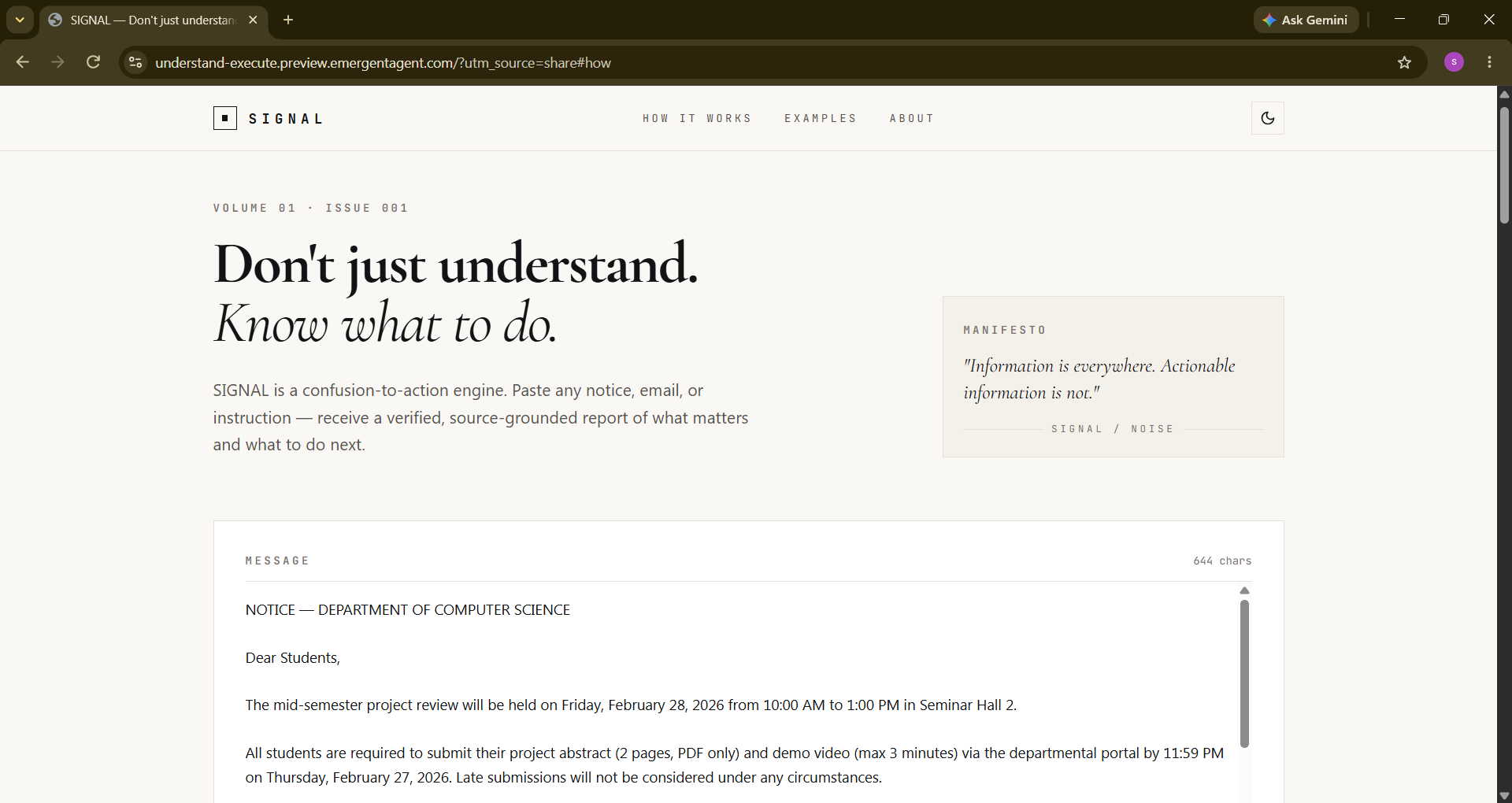
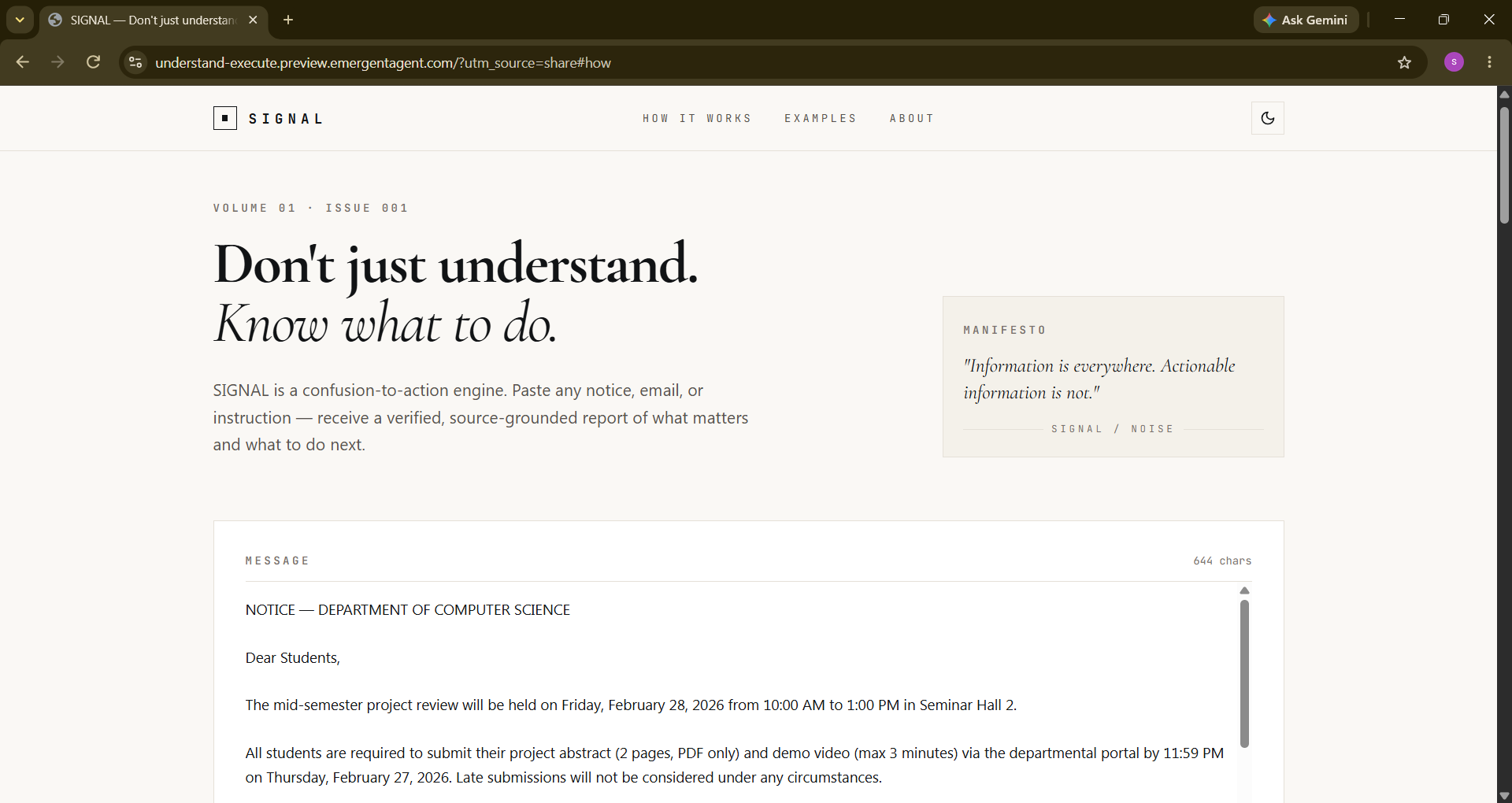
We noticed a simple but common problem: important information is everywhere, but actionable information is not.
College notices, internship updates, emails, messages, and instructions often contain deadlines, requirements, warnings, and multiple steps. The information may be understandable, but figuring out what exactly needs to be done next can still take time and effort.
That led us to a simple question:
What if an AI could turn confusing information directly into action?
That idea became SIGNAL — an AI-powered Confusion → Action engine built around one principle:
Don't just understand. Know what to do.
What SIGNAL Does
SIGNAL takes a message, notice, email, or instruction and transforms it into a structured action-oriented report.
It can identify:
- What the message is about
- What action is required
- Deadlines and important dates
- Required documents or items
- Urgency and why it matters
- Warnings and consequences mentioned in the source
- Current status
- A step-by-step action plan
- A suggested response
- Information that was not provided in the original message
One of our most important design decisions was to make SIGNAL source-grounded.
If a deadline, requirement, contact, or other detail is not present in the original message, SIGNAL does not invent it. Instead, it clearly identifies it as Information Not Provided.
How We Built It
SIGNAL is built as a web application with a simple frontend-to-backend AI pipeline.
Frontend
- HTML
- CSS
- JavaScript
Backend
- Node.js
- Express.js
AI Layer
- Large Language Model integration
- Structured JSON-based analysis
The basic flow is:
User Message → Frontend → Express API → AI Model → Structured Analysis → Validation → Action Report
The frontend sends the user's actual message to the backend. The backend passes it to the AI model with instructions to extract only information supported by the source. The returned structured data is then validated and displayed through SIGNAL's action-oriented interface.
We also used AI-assisted development tools during the build to accelerate code generation, debugging, refinement, and implementation. The project direction, feature decisions, interface design, testing, and final integration were handled by our team.
Challenges We Faced
One of our biggest challenges was making the AI analysis genuinely dynamic.
Initially, it was easy to create predefined examples that looked like AI analysis. However, that would not solve the real problem. We wanted users to be able to enter any message, modify a demo message, and still receive an analysis based on the actual content.
We therefore designed the application around a real API pipeline instead of hardcoded demo responses.
Another challenge was preventing the AI from guessing information. For example, if a notice says "submit before Friday" but doesn't provide the exact date, SIGNAL should not invent one. Handling this reliably required careful prompting, structured output, validation, and explicit missing-information handling.
We also focused on making the interface different from a typical AI chatbot. Instead of creating another chat window, we designed SIGNAL as a professional information dashboard where the result feels more like an actionable report.
What We Learned
Building SIGNAL taught us that creating an AI application is not simply about connecting an API to a user interface.
The difficult part is making the AI output useful, structured, reliable, and understandable.
We learned about:
- Designing structured AI outputs
- Connecting frontend and backend APIs
- Handling asynchronous AI requests
- Validating AI-generated data
- Designing prompts for source-grounded extraction
- Handling missing information safely
- Building responsive interfaces
- Testing AI applications with different types of input
- Using AI-assisted development effectively while still making our own engineering decisions
Most importantly, we learned to think beyond:
"Can AI understand this?"
and instead ask:
"Can AI help someone take the right next step?"
What's Next
SIGNAL is currently focused on turning individual messages into actionable information, but the idea can grow much further.
Future versions could support:
- Browser and email integrations
- Automatic message organization
- Calendar and reminder integration
- Personalized priority detection
- Multi-language support
- Document and PDF analysis
- Mobile applications
- Personal action history and tracking
Our goal is to make SIGNAL a layer between information and action — helping people spend less time figuring out what a message means and more time knowing what to do next.
Built With
- ai
- api
- artificial
- css
- express.js
- generative
- html
- intelligence
- javascript
- language
- large
- models
- node.js
- rest


Log in or sign up for Devpost to join the conversation.