Inspiration
What is the value of knowing something before you know it?
Financial markets are increasingly driven by data which comes at a cost. A prediction-market maker might benefit from an additional dataset, specialized analysis, or intelligence API. Yet purchasing every available piece of research is inefficient, and an AI agent that automatically buys information without considering its value can waste capital.
We were inspired by value-of-information theory, prediction-market microstructure, and the growing intersection of autonomous agents and programmable payments.
Most AI research tools focus on finding or generating answers but we take a step back and ask, Should an agent pay to acquire an answer at all?
That's why we built Signal Freak, an autonomous procurement agent for decision-critical intelligence.
What it does
Signal Freak helps prediction-market makers decide whether purchasing research is justified by their financial exposure.
The agent monitors market conditions, evaluates a maker's inventory and proposed orders, discovers a paid intelligence offer, and compares its price against the potential usefulness of the information.
It can make two decisions:
- Do not buy: The research is too expensive, redundant, stale, or unlikely to affect an actionable decision.
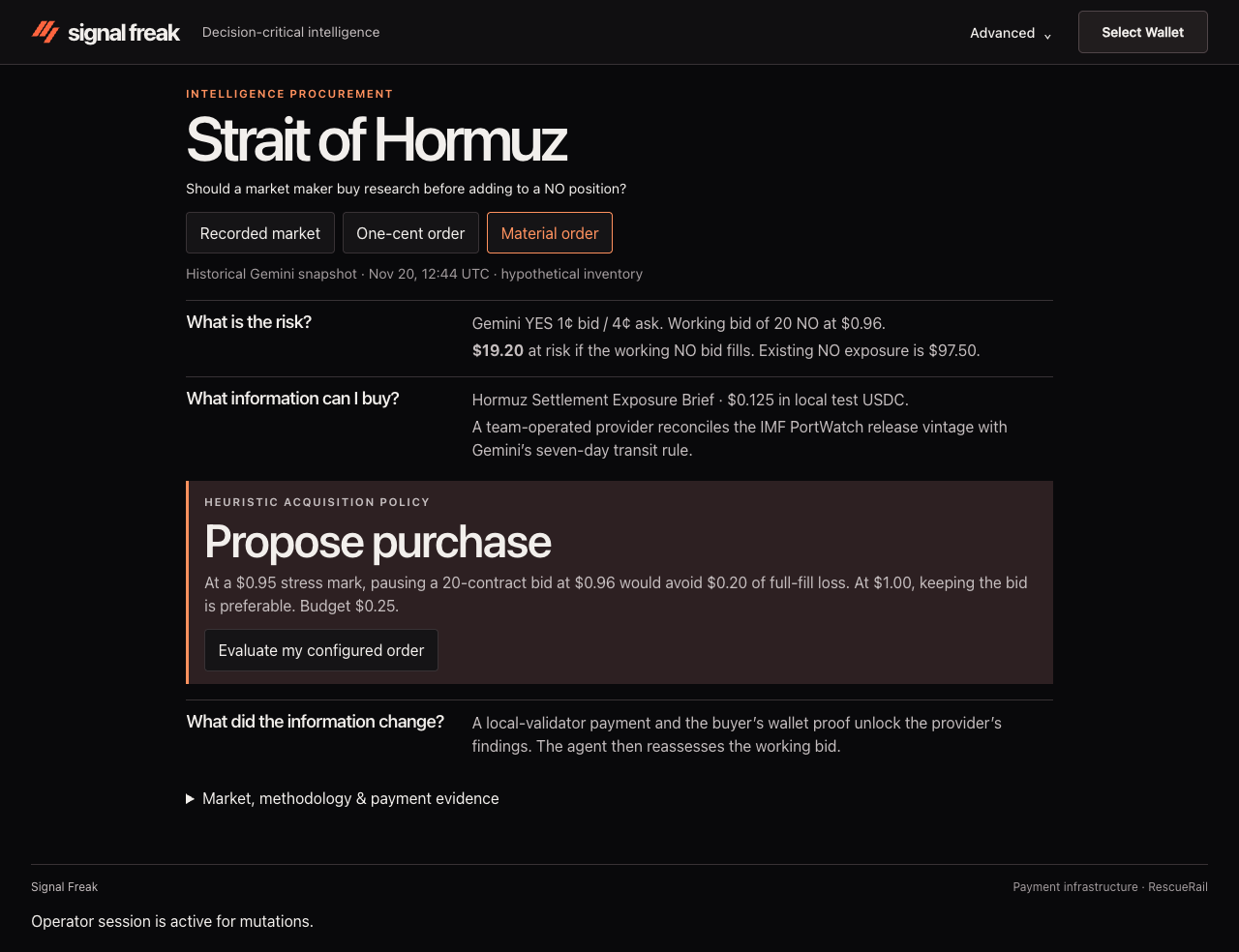
- Propose purchase: The research addresses material uncertainty, satisfies the buyer's budget and risk constraints, and could change a consequential decision.
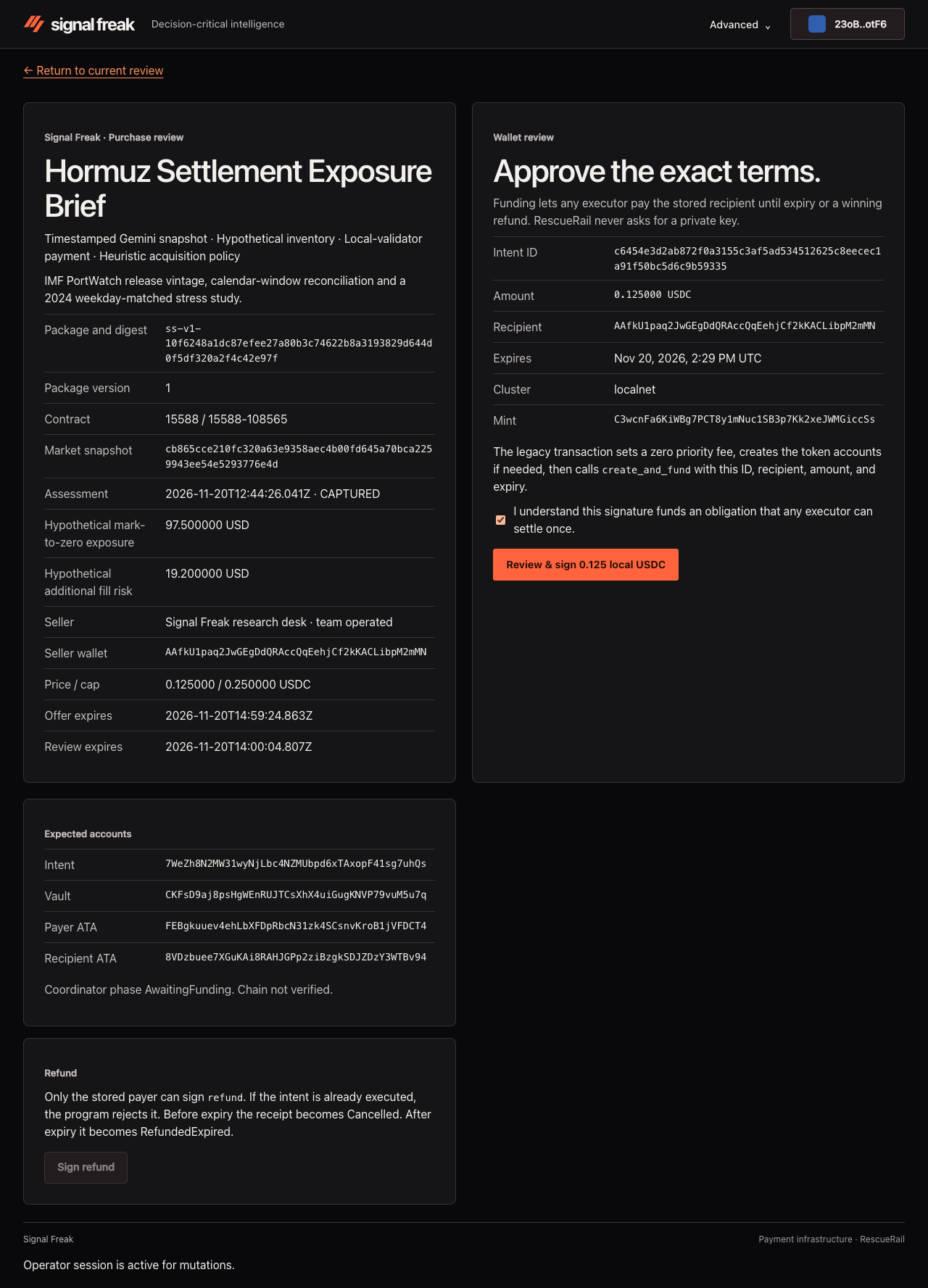
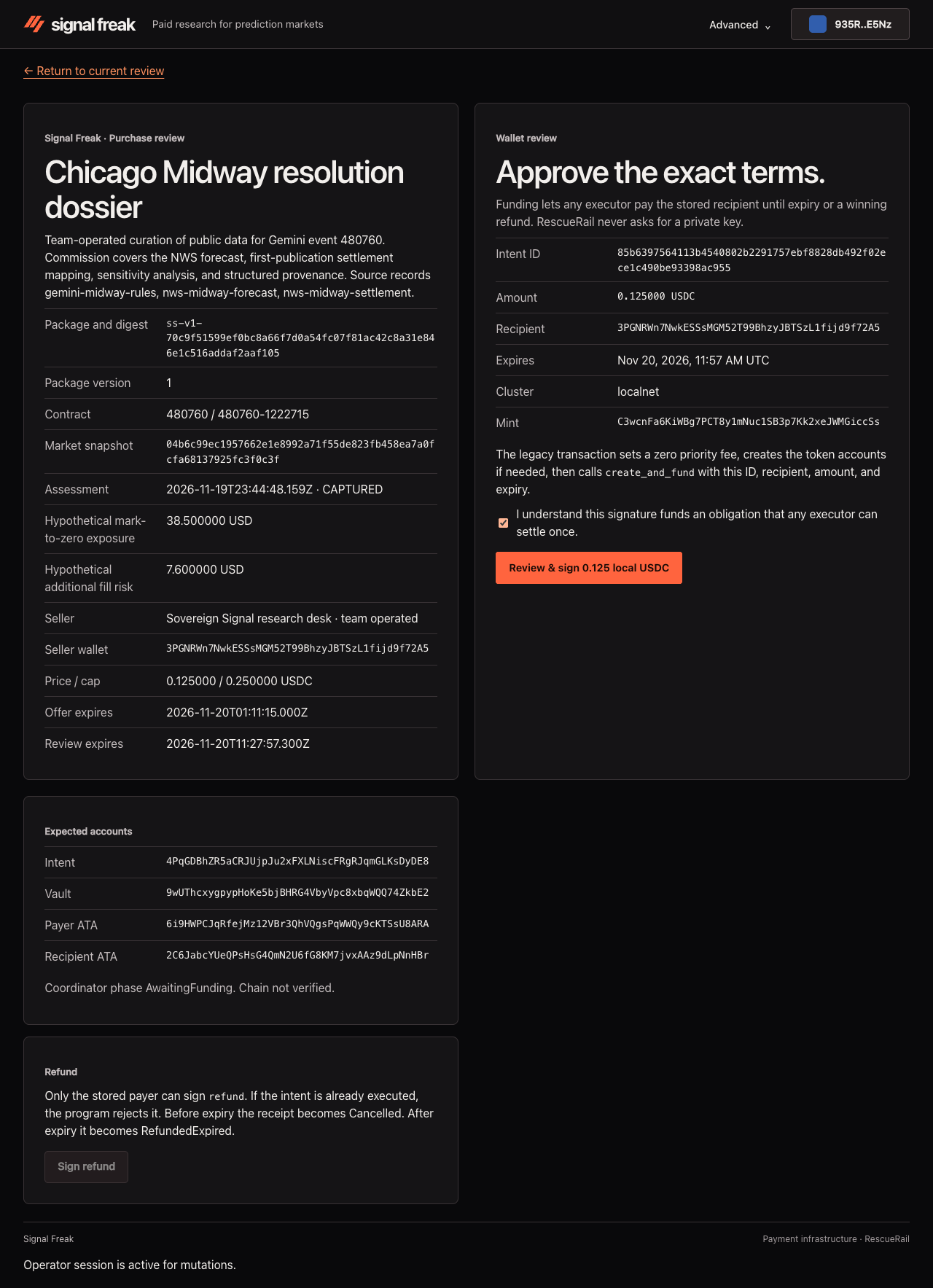
When a purchase is proposed, the buyer reviews and authorizes the exact payment. Solana handles the USDC settlement, and the research provider releases the committed information only after the required payment and buyer-authentication checks.
The agent then evaluates the newly acquired evidence and updates its risk recommendation.
Our primary example involves a Gemini Prediction Markets contract on Strait of Hormuz shipping traffic. A team-operated research API sells an analysis of IMF PortWatch data, publication delays, settlement thresholds, and historical stress scenarios.
For a hypothetical one-cent order, Signal Freak declines a 0.125 USDC research purchase. For a larger proposed order involving 20 NO contracts at $0.96, its heuristic policy and local Ollama model can propose acquiring the research.
The agent does not produce the seller's paid research or inspect its conclusions before deciding whether to buy. That separation is fundamental to the product.
How we built it
Signal Freak combines AI decision-making, market data, research APIs, and Solana payment infrastructure.
Market intelligence: We integrated Gemini Prediction Markets data to retrieve contracts, quotes, and settlement criteria. Our Hormuz research provider uses IMF PortWatch maritime observations to prepare a versioned, source-linked intelligence dossier.
Autonomous procurement: A deterministic risk engine evaluates actionable exposure, research price, budget, freshness, and decision sensitivity. A locally running Ollama qwen3:4b-instruct model makes a bounded purchase proposal or declines the opportunity. The model cannot independently change the authorized payment terms.
Onchain payments: We built an Anchor program on Solana for buyer-authorized USDC payment intents. The payment workflow binds the buyer, seller, amount, and research commitment to the authorized transaction.
Reliable execution: Two recovery workers and a SQLite-backed journal manage uncertain RPC responses, worker failures, and finalized settlement verification. QuickNode Streams provides authenticated observations of onchain activity.
Protected research delivery: The provider holds its paid research separately from the buyer-side agent. After verified payment, the buyer proves control of the paying wallet through a scoped, expiring authentication challenge and retrieves the committed dossier.
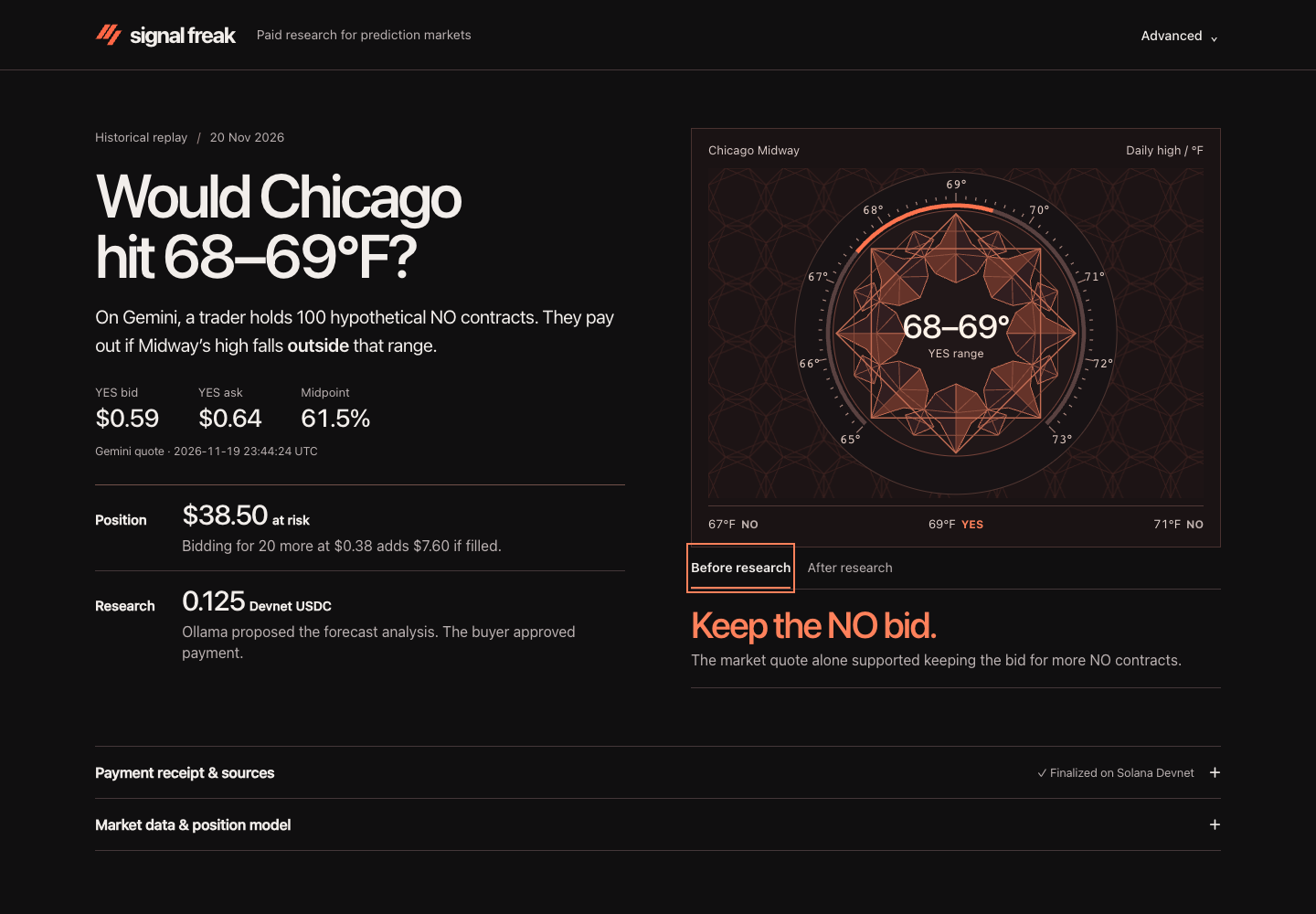
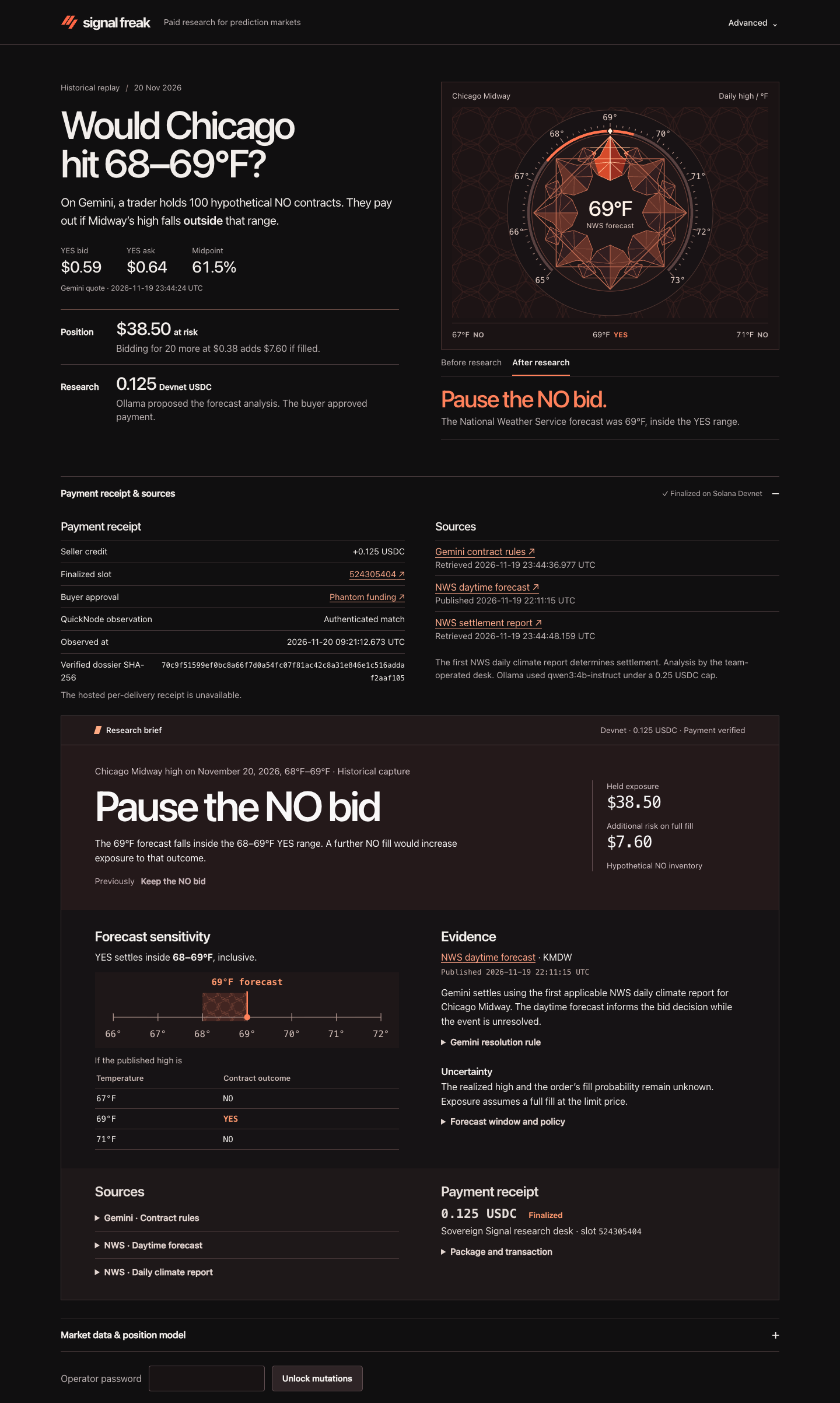
Frontend: We built an infrared-inspired Next.js and React interface that presents the market risk, research offer, procurement decision, payment evidence, and post-purchase assessment.
The Hormuz procurement flow was exercised on a local Solana validator. A separate historical Chicago Midway case demonstrates a real Solana Devnet USDC payment, finalized seller payout, QuickNode observation, and verified research fulfillment.
Challenges we ran into
Making information procurement economically meaningful. Our earliest prototype could propose purchasing research based on total exposure even when the specific order at risk was worth less than the research itself. We revised the policy to consider actionable, cancellable exposure and whether new information could plausibly affect the decision.
Keeping paid research private. An early implementation allowed the buyer-side coordinator to inspect the research package before proposing a purchase. We separated the buyer and provider, limited pre-purchase inputs to public offer metadata, and protected the actual findings behind authenticated delivery.
Handling payment failures safely. Solana RPC acknowledgments can be lost, transactions can expire, and workers can fail between submission and confirmation. We built durable transaction journaling, finalized-chain reconciliation, and recovery paths designed to prevent duplicate payouts.
Securing research access. We added wallet-bound authentication, short-lived capabilities, replay protection, and exact package binding to ensure that the requester is the buyer
Accomplishments that we're proud of
- Built an end-to-end workflow where an AI agent can decline or propose purchasing research without first seeing the protected findings.
- Demonstrated a buyer-authorized Hormuz research purchase, finalized seller payment, protected delivery, and post-purchase risk evaluation on a local Solana validator.
- Implemented worker recovery across transaction uncertainty, including failure scenarios involving lost acknowledgments and interrupted execution.
- Added buyer-bound research authentication and cryptographic verification of delivered research.
- Published a documented open-source implementation with reproducible testing and a security-reviewed public history.
The most important part is that Signal Freak can decide not to spend money. Refusing an unnecessary purchase is a successful outcome in our schema.
What we learned
The biggest lesson was that autonomous payments are only useful when the decision to spend is meaningful.
Making an AI agent send stablecoins is relatively straightforward compared with determining whether the transaction should happen, ensuring the agent doesn't already possess the purchased information, and guaranteeing that the buyer receives the correct product.
We also learned that reliable agentic commerce requires bounded authority, exact purchase commitments, failure recovery, buyer authentication, provider availability checks, and verifiable fulfillment.
Our current procurement policy is not yet a full statistically calibrated value-of-information model. We haven't established enough trading profitability or commercial willingness to pay. Trading profitability and a commercial willingness to pay will require further boundary testing on diverse markets. The production-grade intelligence procurement system is on the horizon.
What's next for Signal Freak
We envision Signal Freak becoming a general-purpose intelligence procurement layer for autonomous financial agents.
Our next priorities are to integrate independent third-party research providers, support competing offers and provider reputation, and develop more rigorous value-of-information estimates using historical decision outcomes.
We also want to expand beyond maritime intelligence into geopolitical risk, contract-resolution analysis, crypto benchmark divergence, and specialized institutional data APIs.
Longer term, the same architecture could serve treasury agents, autonomous trading systems, and other applications where information has a measurable acquisition cost and can influence a financial decision.
Our goal is to make information an asset that autonomous agents can evaluate, purchase, verify, and use responsibly.
Built With
- anchor
- gemini
- imf-portwatch
- javascript
- next.js
- node.js
- ollama
- phantom
- playwright
- quicknode
- qwen3
- react
- rust
- solana
- spl
- sqlite
- typescript
- usdc
- vercel
