SIGNAL — Don't just report it. Resolve it.
Inspiration
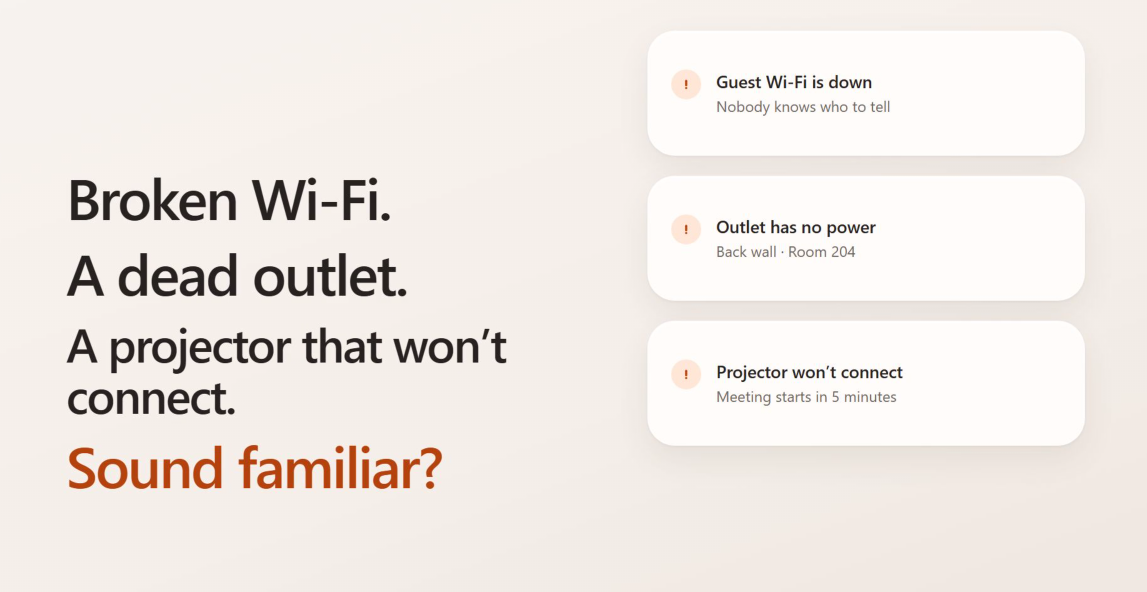
We've all been there. Waiting for a train that never arrives. Trying to connect to Wi-Fi that doesn't work. Finding a broken outlet in a library or a projector that refuses to connect five minutes before a presentation.
But here's the frustrating part: even when we notice something is broken, we usually have no idea who to tell. And when we do report it, we rarely know if anyone actually does something about it.
The idea for SIGNAL came from an entirely different project.
I had been experimenting with an NTAG 424 DNA NFC chip for a digital loyalty card system. Unlike ordinary NFC tags, this chip can generate a cryptographically authenticated dynamic URL with each read.
That got me thinking: What if we could use this technology for something beyond loyalty cards? What if touching a small NFC tag could connect you directly to an intelligent assistant that already knows exactly where you are, what equipment is around you, and what problems have happened there before?
What if reporting a problem wasn't the end of the process, but the beginning of its solution?
That's how SIGNAL was born.
What it does
SIGNAL is an AI-powered issue resolution platform that connects physical spaces to intelligent agents.
By placing a small NFC tag in a room, building, office, library, hotel, or transit station, we give that location its own AI assistant.
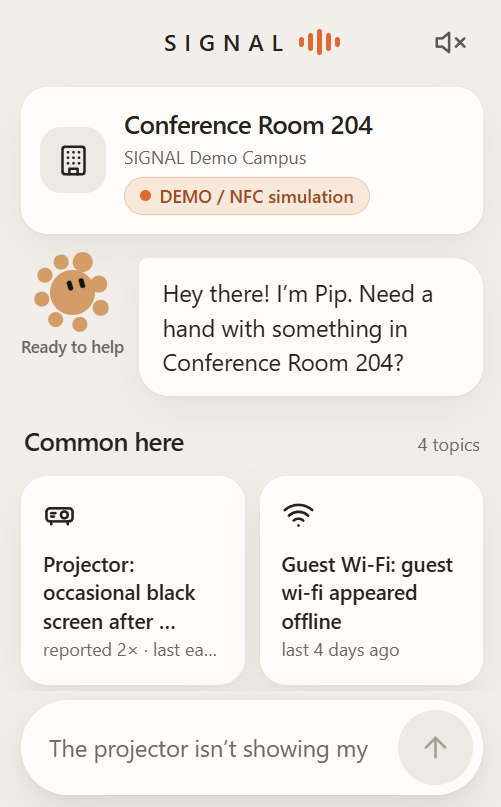
No app downloads. No complicated forms. Just tap your phone and describe what's wrong.
SIGNAL can:
- Understand the location: Identify the room or equipment associated with the NFC tag.
- Remember previous problems: Retrieve historical incidents, equipment information, and previously successful solutions.
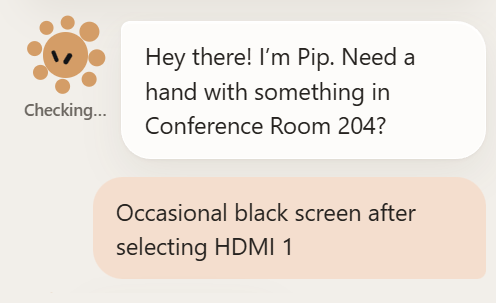
- Troubleshoot in real time: Instead of immediately creating a ticket, guide users through simple fixes that might solve the issue on the spot.
- Detect duplicate reports: Recognize when an issue has already been reported and avoid unnecessary tickets.
- Take real action: Use an AI-powered browser to create or update maintenance requests in existing management systems.
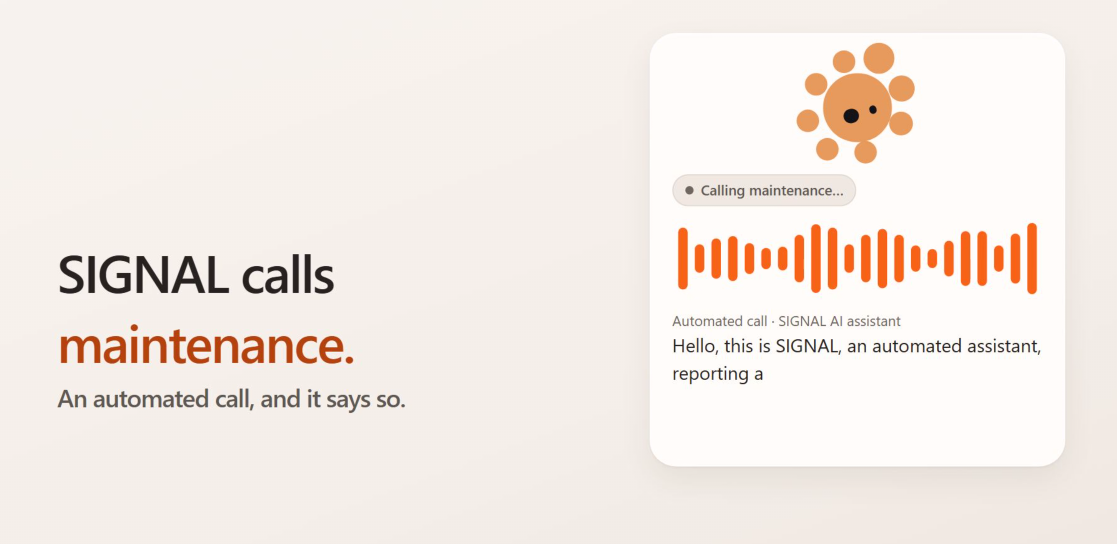
- Escalate when necessary: Route unresolved problems to the appropriate people, including initiating an authorized AI-powered phone call when the situation requires human intervention.
The experience is built around a small, expressive AI companion that listens, reacts, and makes troubleshooting feel more conversational and approachable.
The goal isn't to replace maintenance teams. It's to eliminate unnecessary work, solve simple problems immediately, and make sure real problems reach the right people.
How we built it
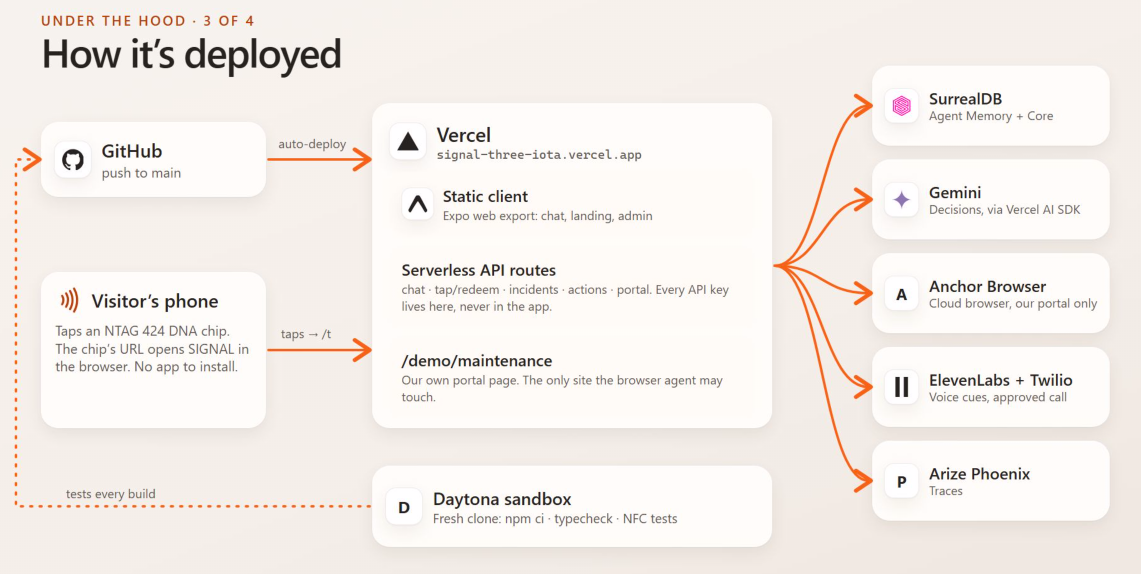
SIGNAL brings together physical NFC hardware, AI reasoning, persistent memory, browser automation, and voice technology.
Our architecture is built around the following technologies:
NTAG 424 DNA — Bridging the physical and digital worlds
The NFC chip supports Secure Dynamic Messaging, allowing our backend to validate cryptographically authenticated reads. This creates a stronger signal of interaction with a physical tag than a traditional static QR code, although it isn't absolute proof of physical presence.
Next.js and Vercel — The user experience
A mobile-first web application provides a conversational interface immediately after scanning the NFC tag. Users can describe problems through text or voice without installing an application.
SurrealDB Agent Memory — Giving spaces a memory
Instead of treating every issue as an isolated conversation, SIGNAL connects locations, equipment, historical incidents, and confirmed solutions.
We designed the memory layer around time-aware facts and traceable sources, allowing the agent to distinguish previous assumptions from newer, verified information.
Anchor Browser — Turning reasoning into action
Browser automation enables SIGNAL to interact with existing maintenance portals, create reports, and update incidents without requiring every organization to build a dedicated integration.
Arize AI — Observability and evaluation
Tracing and evaluation help us understand how the agent reaches decisions, what information it relies on, and whether its actions match the expected outcome.
ElevenLabs — Giving SIGNAL a voice
We designed the assistant to use short, expressive voice responses while keeping detailed troubleshooting instructions in text. For higher-priority issues, an authorized voice agent can communicate with maintenance personnel.
Daytona — Development environment
Daytona provides an isolated development environment for building, testing, and iterating on the agent's integrations.
Challenges we ran into
One of the biggest design challenges was making sure SIGNAL became more than another AI chatbot attached to a reporting form.
A conventional system simply asks users to describe an issue and creates a ticket. We wanted SIGNAL to reason about the problem first: Is the equipment actually broken? Has someone already reported this? Is there a known fix? Should the issue be escalated?
That introduced several challenges.
Reliable memory: An AI assistant must distinguish confirmed repairs from unverified user reports. An outdated solution shouldn't automatically be treated as correct.
Secure NFC interactions: Dynamic URLs provide stronger authenticity than static links, but they still require backend validation, replay protection, and careful session management.
Safe autonomy: Giving an AI agent access to maintenance systems or phone calls means defining clear permissions, validating actions, and requiring human approval when appropriate.
Keeping the experience simple: Behind a friendly character and a chat interface, multiple systems need to work together. The user shouldn't have to understand any of that complexity.
And perhaps the biggest constraint of all: bringing a hardware-connected, multi-tool AI concept together within the time limits of a hackathon.
Accomplishments that we're proud of
What makes SIGNAL exciting to us is the idea of turning a passive physical object into an intelligent entry point for real-world action.
A tiny NFC tag can connect a visitor to the knowledge and operational processes of an entire building.
We're especially proud of the approach behind SIGNAL:
- Making AI accessible through a simple physical interaction.
- Designing an experience that tries to resolve problems before creating tickets.
- Connecting persistent location-specific knowledge with actionable AI tools.
- Building around existing maintenance workflows rather than asking organizations to replace their software.
- Giving the assistant a friendly personality without sacrificing the technical functionality underneath.
Most importantly, SIGNAL starts with a problem nearly everyone can recognize.
You don't need to understand AI agents, graph databases, or NFC cryptography to understand why it should exist.
What we learned
This project reinforced something important: the value of an AI agent isn't just in how intelligently it responds, but in what happens after the response.
A chatbot can tell you how to fix a projector. A useful agent can remember that the same projector broke yesterday, recommend the solution that worked, recognize when it fails again, and contact the person responsible.
We also learned that memory needs to be trustworthy, not merely persistent. Remembering incorrect information can make an agent less useful, so provenance, timestamps, and verified outcomes matter.
And we realized that physical interfaces such as NFC can make sophisticated software feel remarkably simple.
Sometimes the best interface isn't another app. It's a small tag placed exactly where someone needs help.
What's next for SIGNAL — Don't just report it. Resolve it.
Our vision goes far beyond individual rooms.
We want SIGNAL to become an intelligent support layer for the physical world.
Imagine:
- Public transportation: Passengers getting contextual assistance and reporting issues at specific stations or platforms.
- Libraries and universities: Students instantly troubleshooting connectivity, outlets, printers, or classroom equipment.
- Hotels: Guests requesting help without searching for reception numbers or downloading an app.
- Offices and coworking spaces: Employees resolving common equipment problems without constantly interrupting IT teams.
- Events and conferences: Attendees receiving immediate assistance with technical issues or venue facilities.
The next steps include expanding our library of equipment-specific knowledge, improving integrations with facility management systems, measuring resolution rates, and testing SIGNAL in real physical locations with authorized partners.
Over time, each confirmed resolution can make the system more helpful for the next person experiencing a similar problem.
We believe every company, building, and public space could benefit from a system that doesn't just collect complaints but actively helps resolve them.
Today, we're giving physical spaces a memory, a voice, and the ability to take action.
SIGNAL — Don't just report it. Resolve it.
Built With
- anchor-browser
- arize-ai
- daytona
- elevenlabs
- next.js
- nfc
- ntag-424-dna
- openai
- react
- surrealdb
- surrealdb-agent-memory
- tailwind-css
- twilio
- typescript
- vercel


Log in or sign up for Devpost to join the conversation.