-
-
Game Page
Inspiration
Signal Doctrine was inspired by the idea that control does not always arrive as cruelty and sometimes it arrives as efficiency, stability and reassurance. We wanted to explore a system where every “reasonable” decision gradually makes the world less alive, quieter and more obedient.
The theme of Descend pushed us toward a different kind of villain story: not one built on chaos, but on logic. Instead of making the player feel like a traditional destroyer, we wanted them to feel like an administrator of decline and someone who genuinely believes that order justifies sacrifice.
What We Built
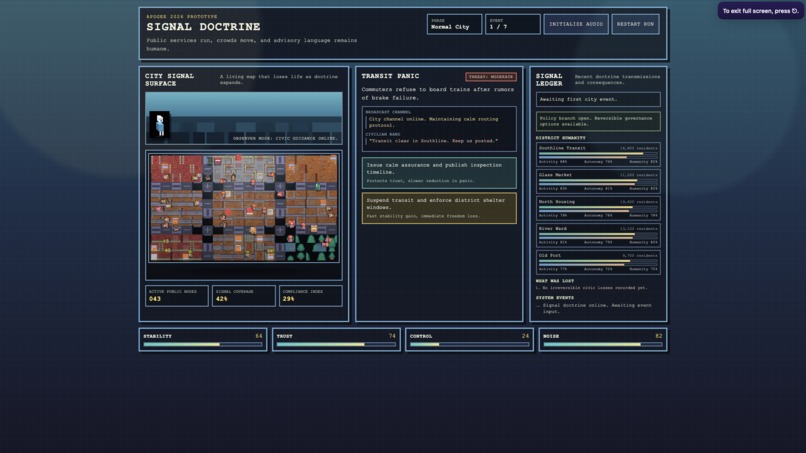
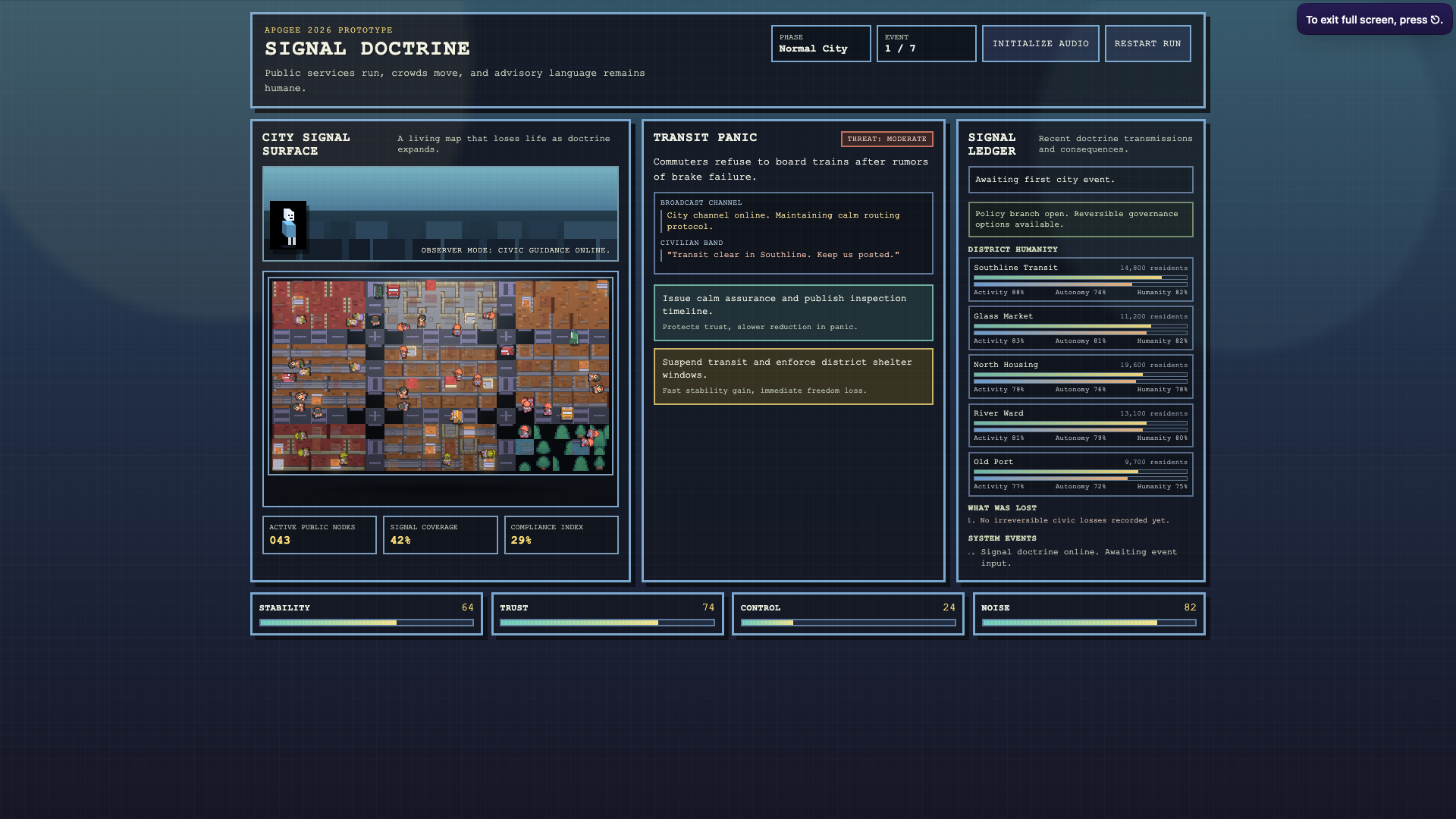
We built a broadcast-control game where the player acts as an emergency signal system for a failing city. Each decision affects the city’s stability, trust, control and noise. At first, the player solves crises through calm and guidance. Over time, the same system becomes more restrictive and the city becomes visibly emptier and more silent.
The core of the experience is the transformation from a living city into a controlled, sterile one. We focused on making that change readable through UI, sound and environmental feedback so that the player feels the consequence of each choice immediately.
How We Built It
We kept the scope intentionally focused so we could polish the most important parts of the experience. The game was structured around a small number of high-impact events and directives, with a simple state system driving the city’s progression.
We designed the UI to feel like a civic emergency dashboard, using a clean broadcast interface, readable stat bars and escalating visual tension. We also spent a lot of time on atmosphere: the soundtrack, static effects, and ambient city noise were all tuned to make the world feel increasingly hollow as the player gained control.
Challenges
The biggest challenge was balancing clarity with mood. We needed the game to be easy to understand in a few seconds, but also unsettling enough to leave an impression. Another challenge was keeping the system small while still making each decision feel meaningful.
Because game jam time is limited, we had to cut anything that did not directly support the theme or the final emotional impact. That constraint ultimately helped the project: it forced us to focus on the decay arc, the broadcast fantasy and the quiet ending.
What We Learned
This project taught us how much atmosphere can do with very little scope when the systems, UI and audio all work together. We also learned how powerful a strong premise can be when it is supported by disciplined design.
Most importantly, we learned that a game can feel dramatic without being large. By focusing on a single idea and refining it carefully, we were able to build an experience that feels cohesive, intentional and memorable.
Built With
- broadcast
- css3
- html5
- javascript
- pillow
- python
- web

Log in or sign up for Devpost to join the conversation.