-
-
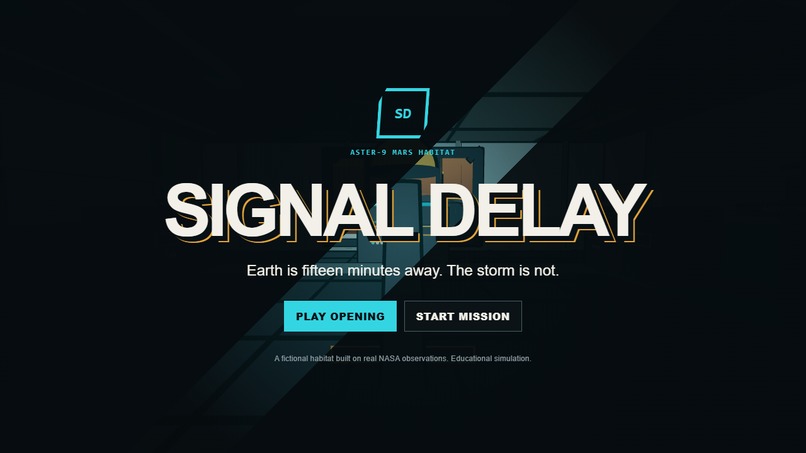
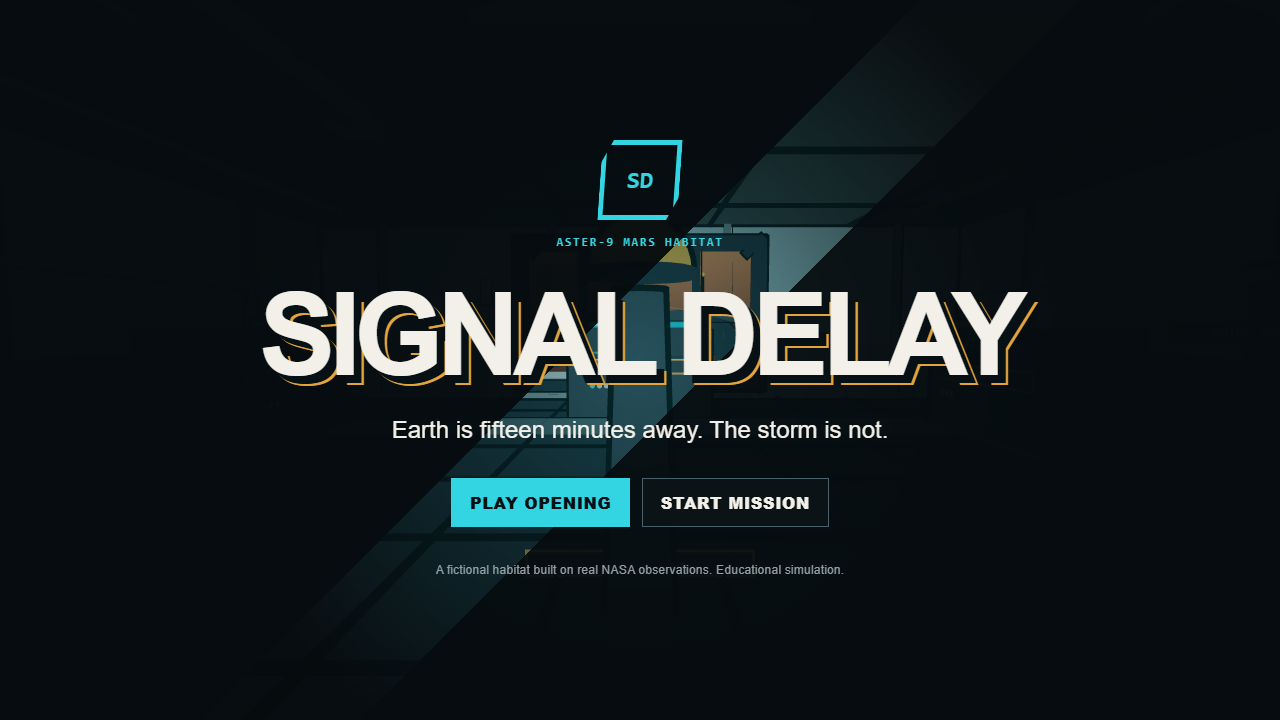
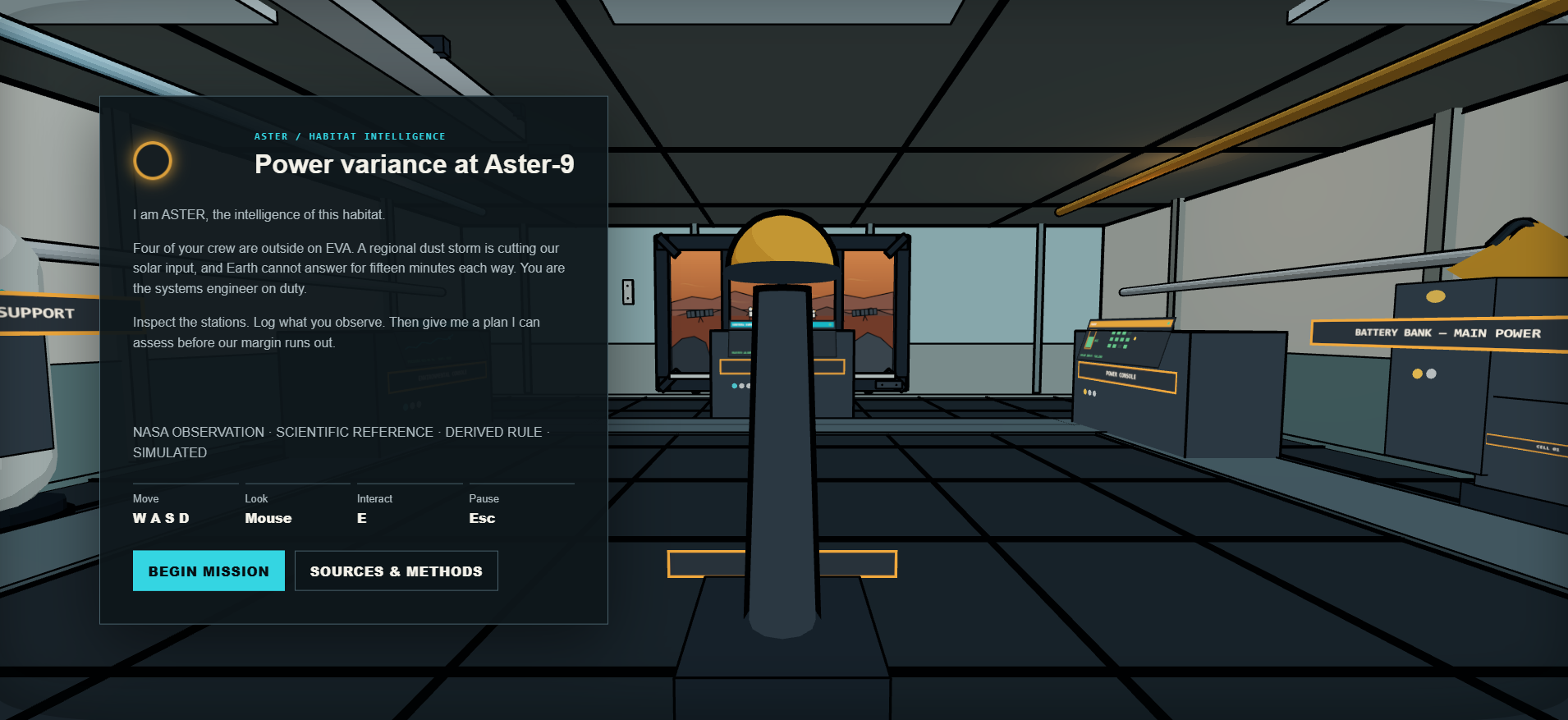
Earth is fifteen minutes away. The storm is not. Title screen — 100% code-drawn, like every visual in the game.
-
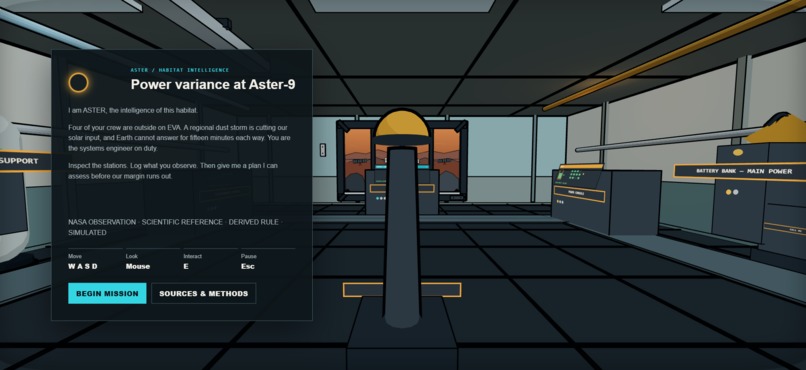
ASTER briefs you: four crew on EVA, a dust storm cutting solar power, a 15-minute signal delay. The decision is yours.
-
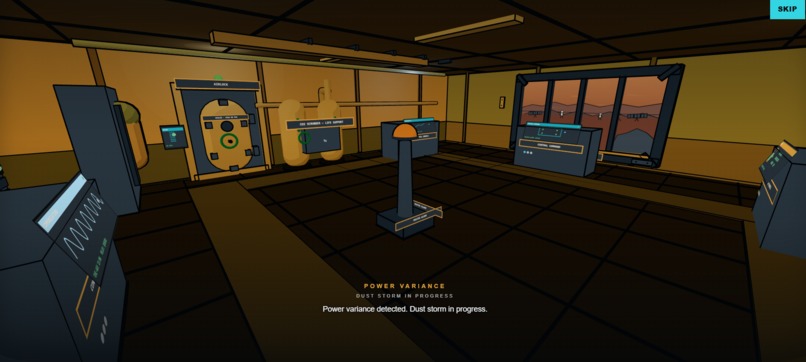
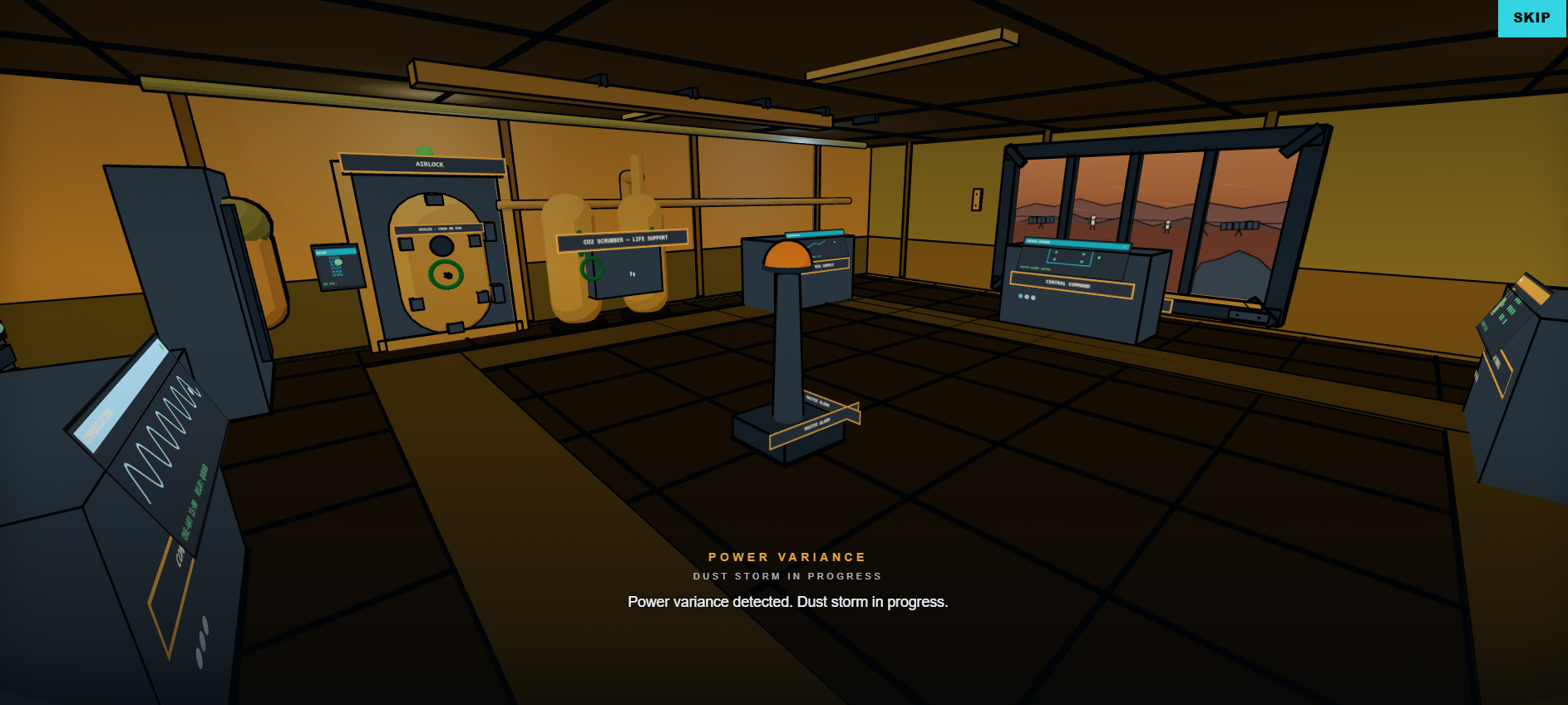
The warning beat: amber wash, POWER VARIANCE, dust storm in progress. The voice-driven opening keeps text and audio in lockstep.
-
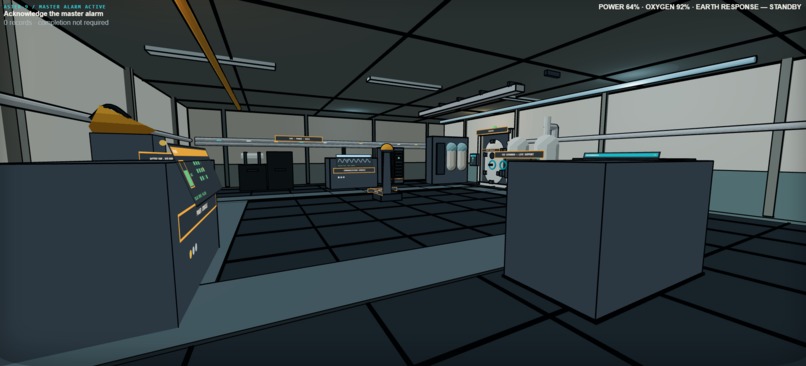
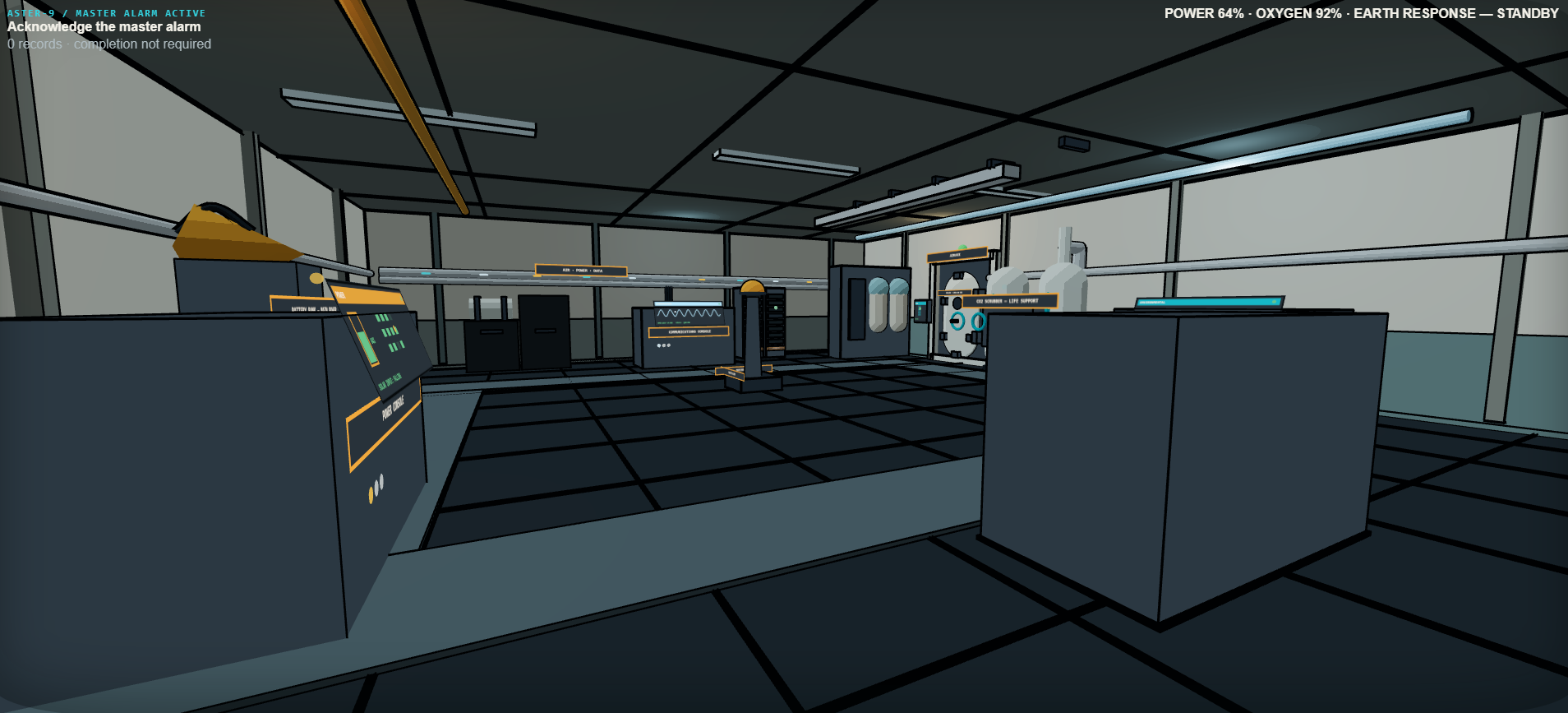
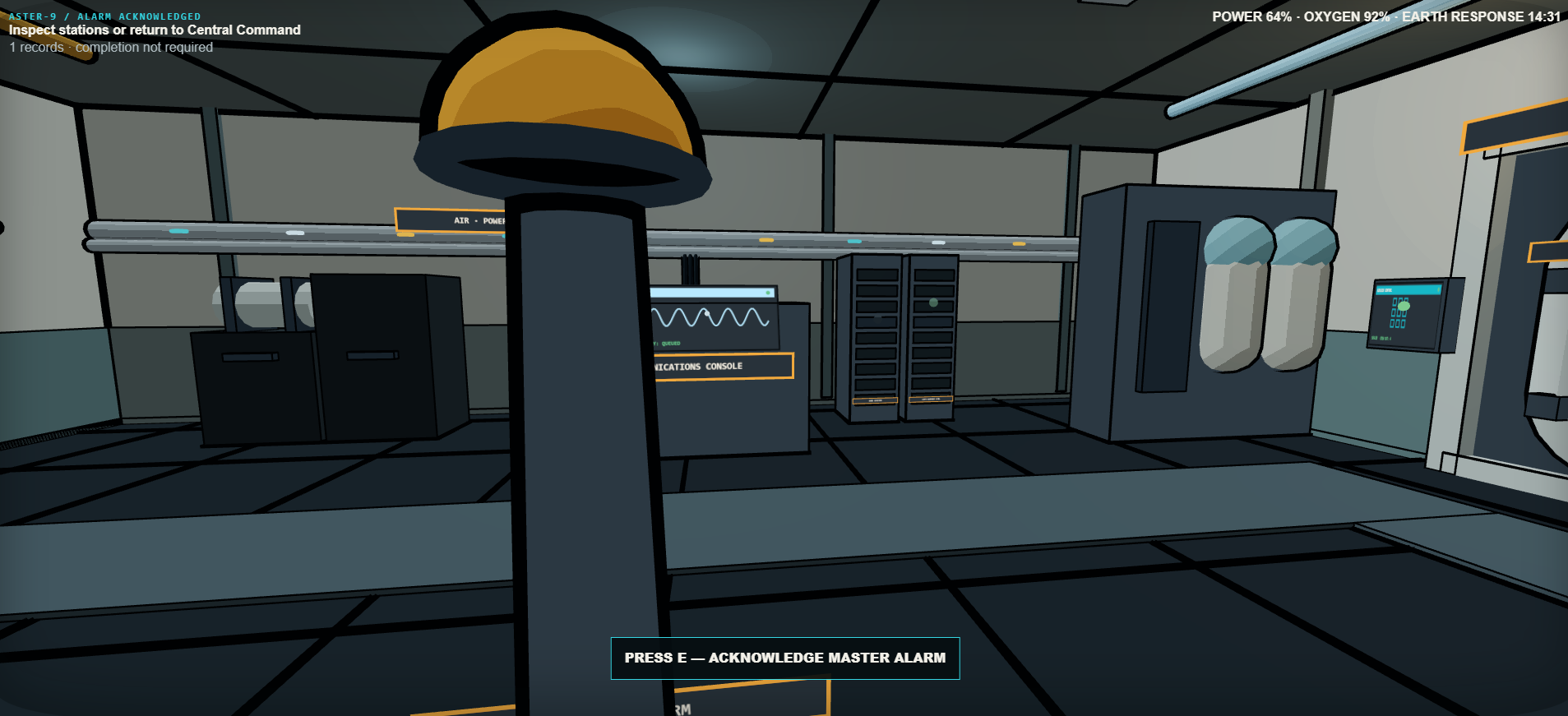
The habitat: cel-shaded, fully labeled, zero external assets. Conduits are color-coded AIR·POWER·DATA — the room teaches its systems.
-
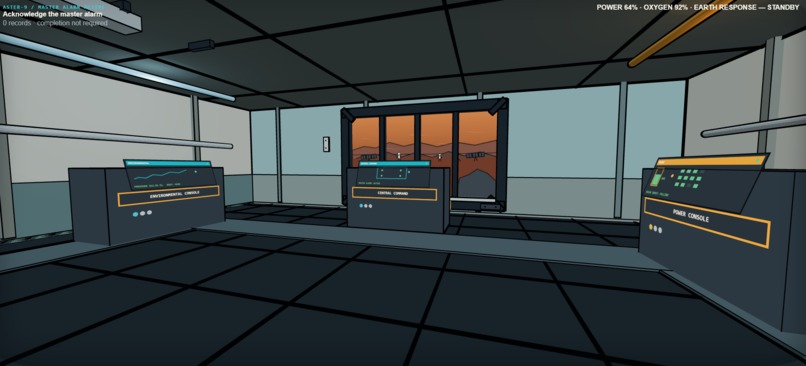
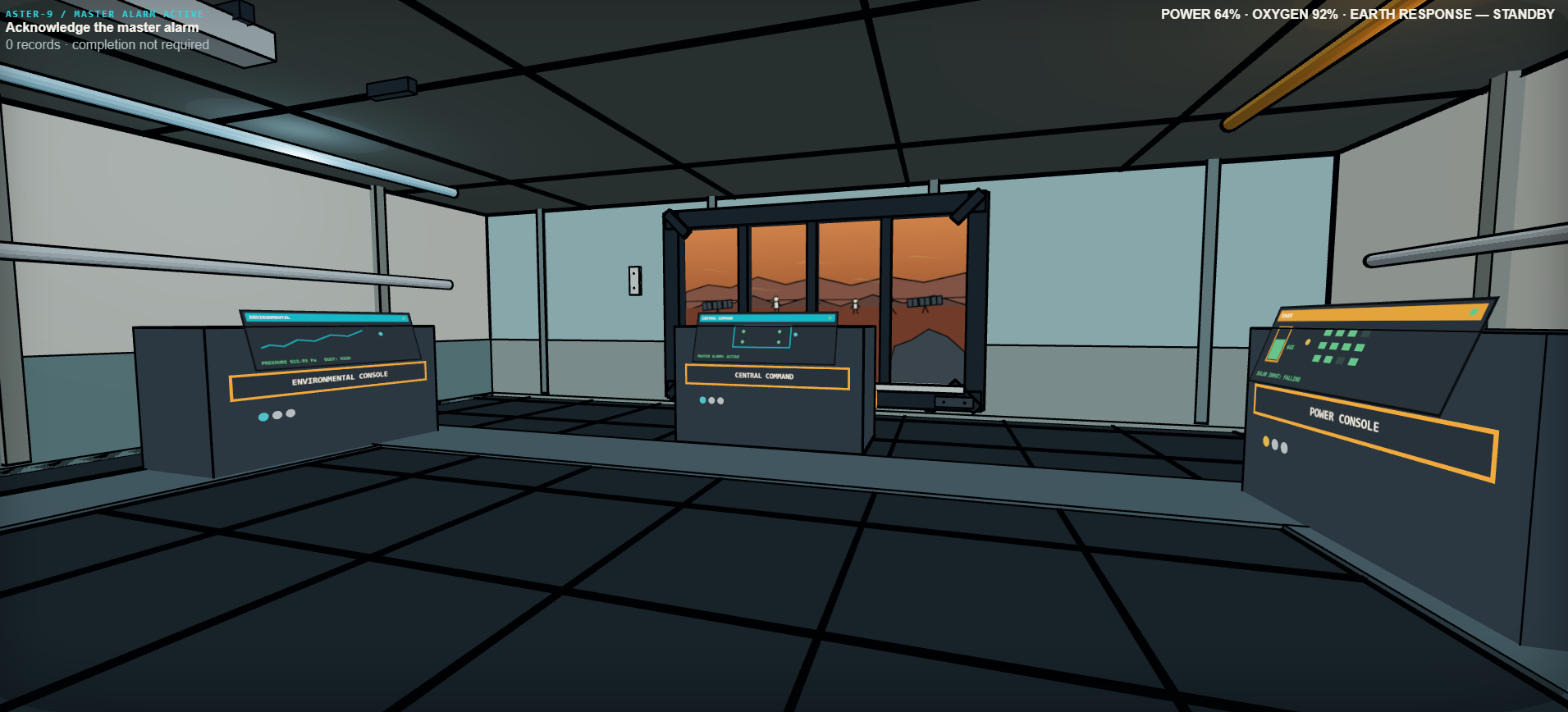
Three stations, one window. Outside: the crew works the arrays in the storm, and the relay mast waits for an Earth that cannot answer yet.
-
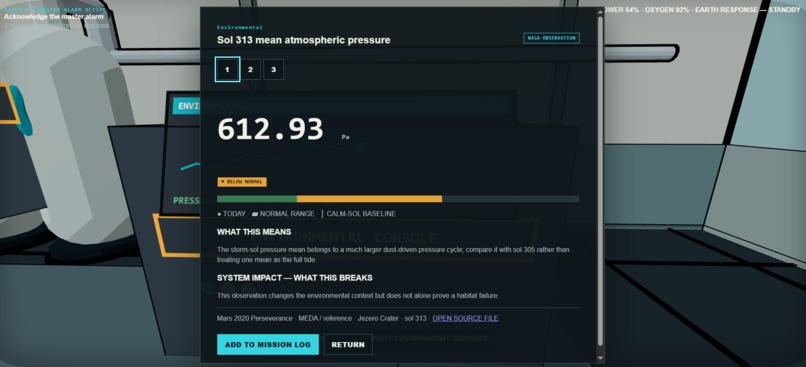
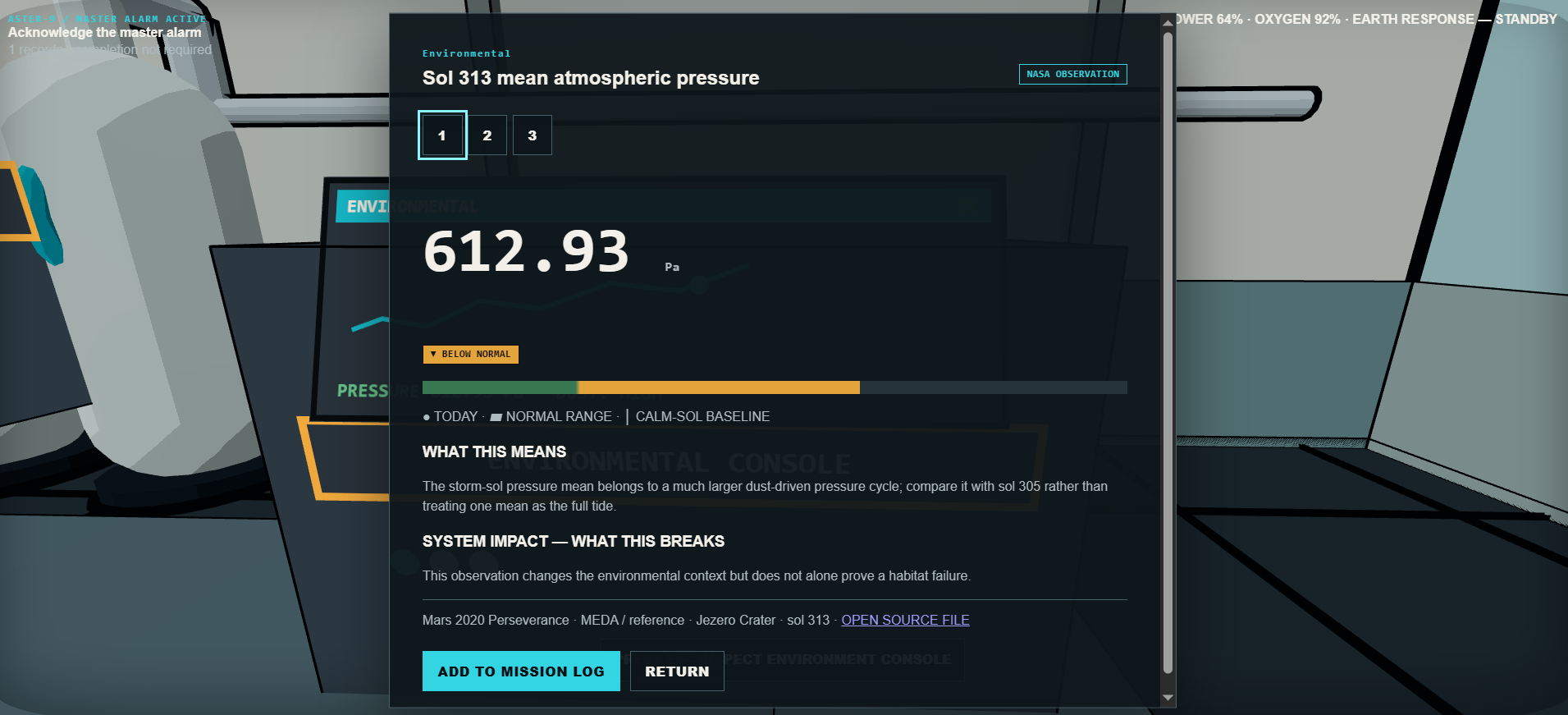
Real NASA data: sol 313 mean pressure, 612.93 Pa. OPEN SOURCE FILE links to the actual record in the PDS archive.
-
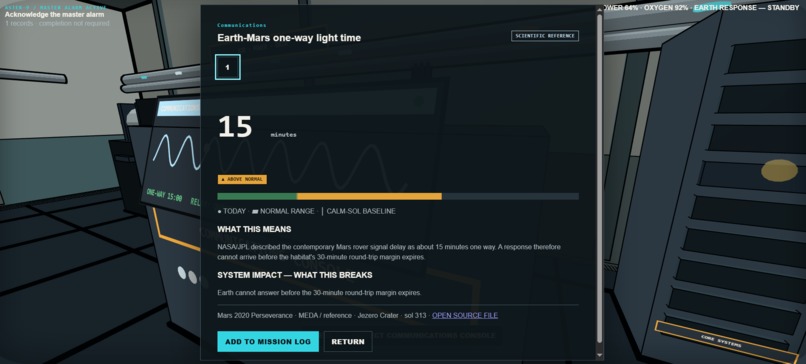
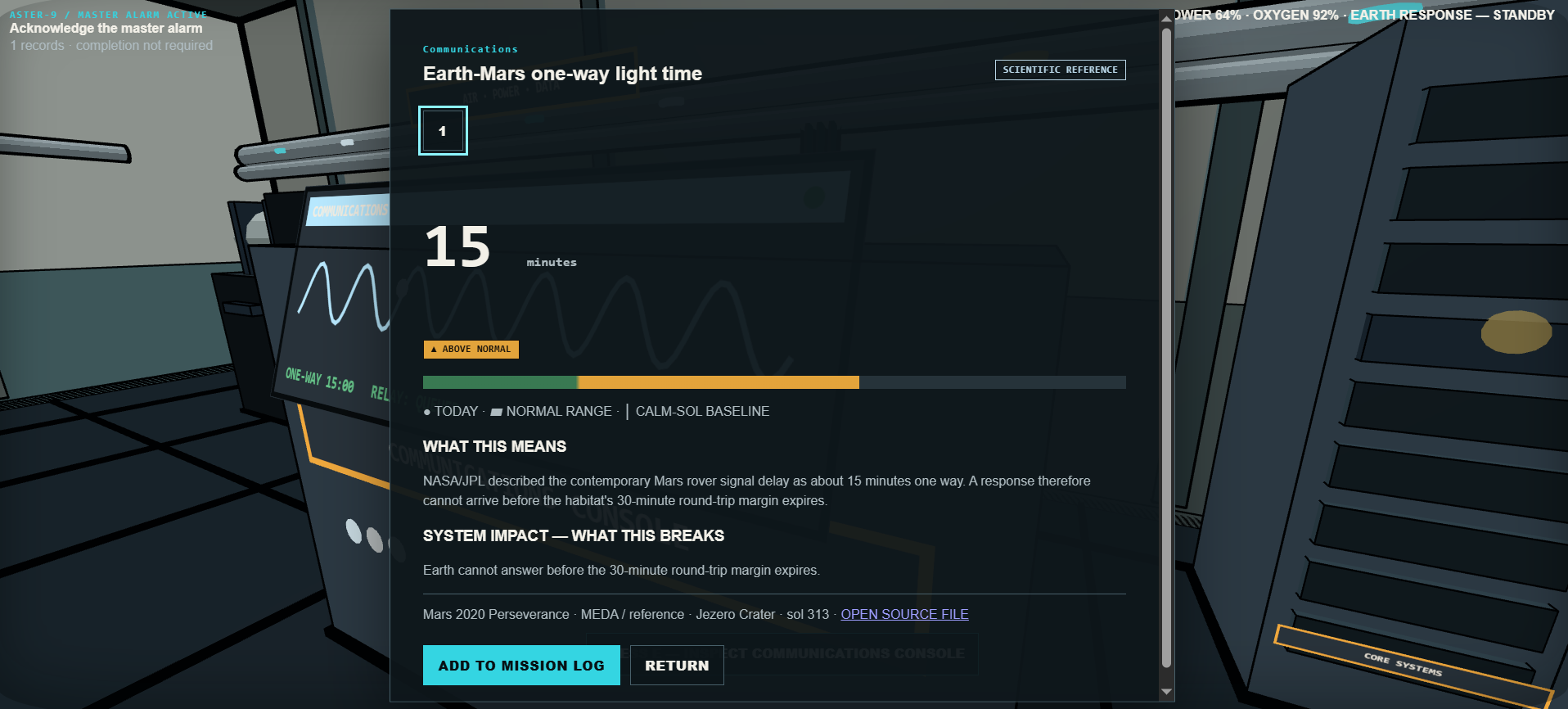
The core constraint: about 15 minutes one-way light time. Earth cannot answer inside your 30-minute decision window.
-
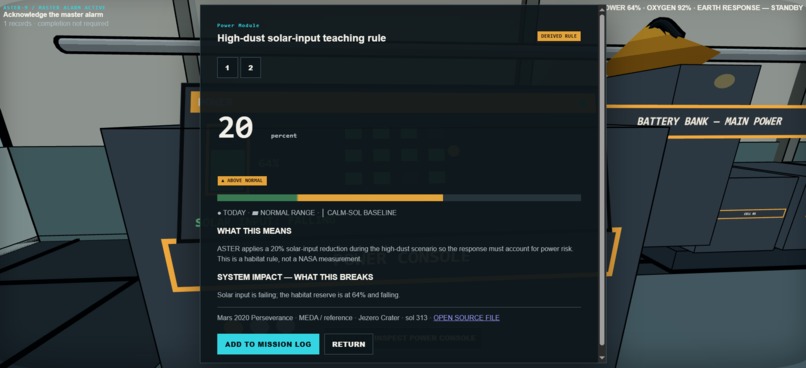
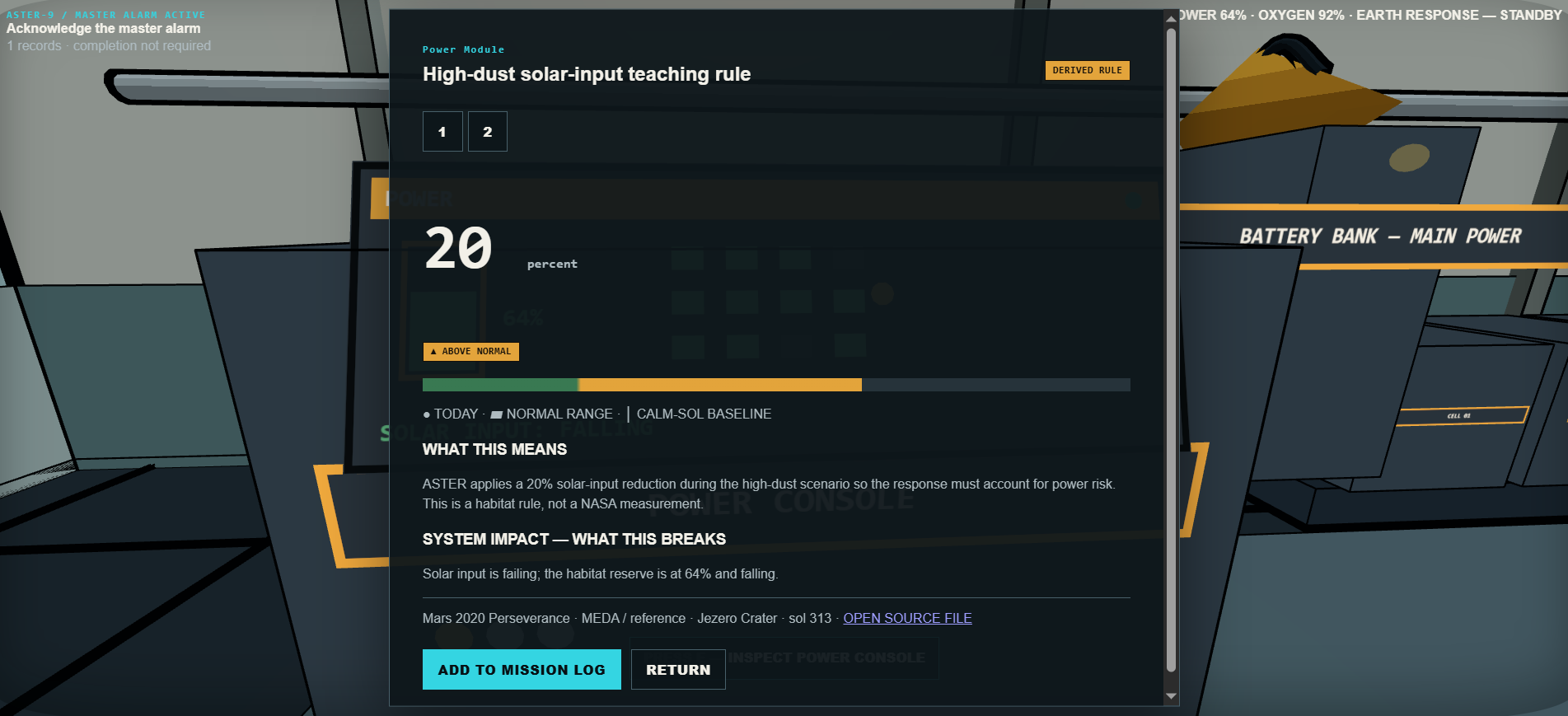
Honest labeling: the 20% solar rule is marked DERIVED RULE — "a habitat rule, not a NASA measurement."
-
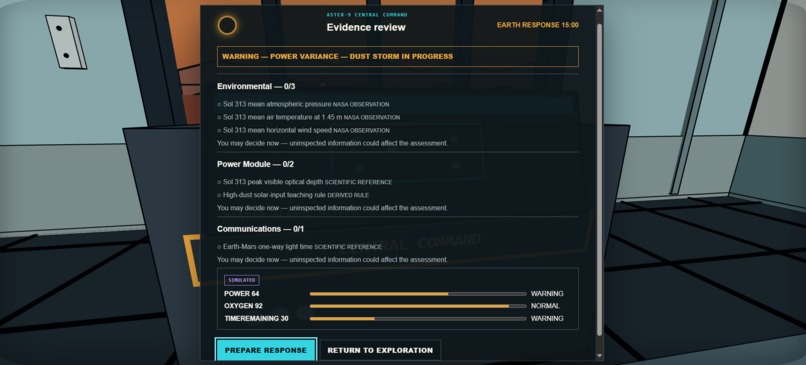
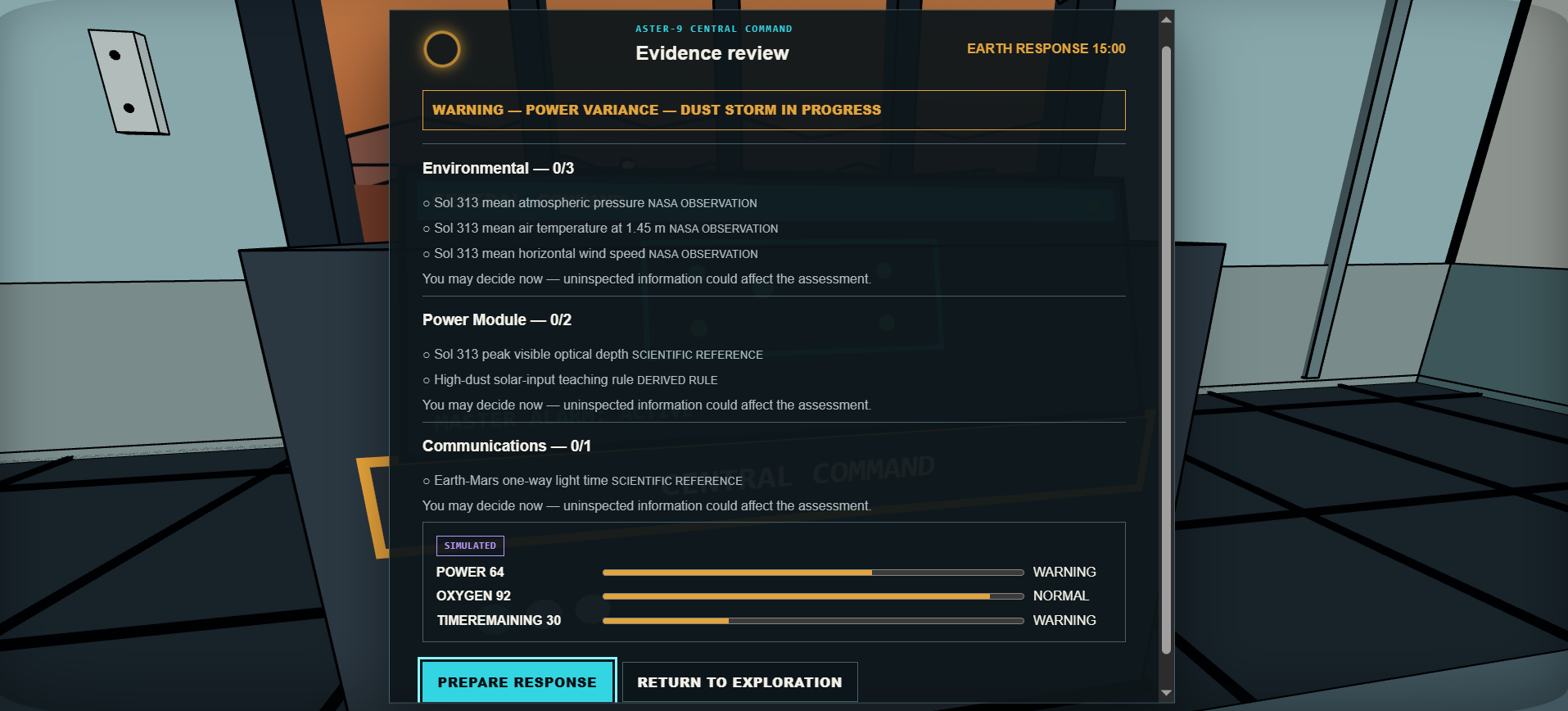
Central Command tracks what you actually inspected. Deciding early is allowed — uninspected evidence may cost you.
-
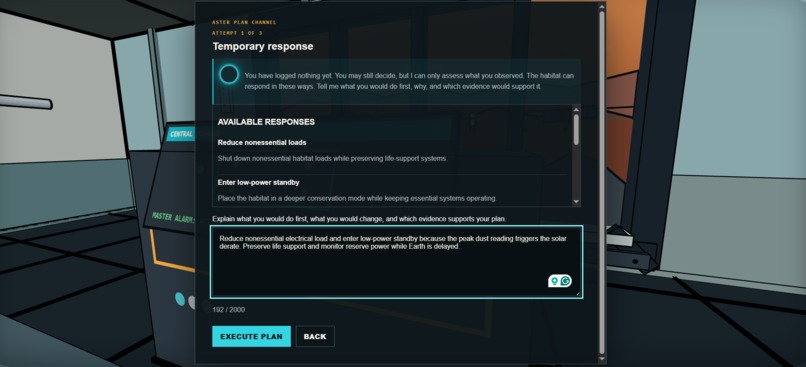
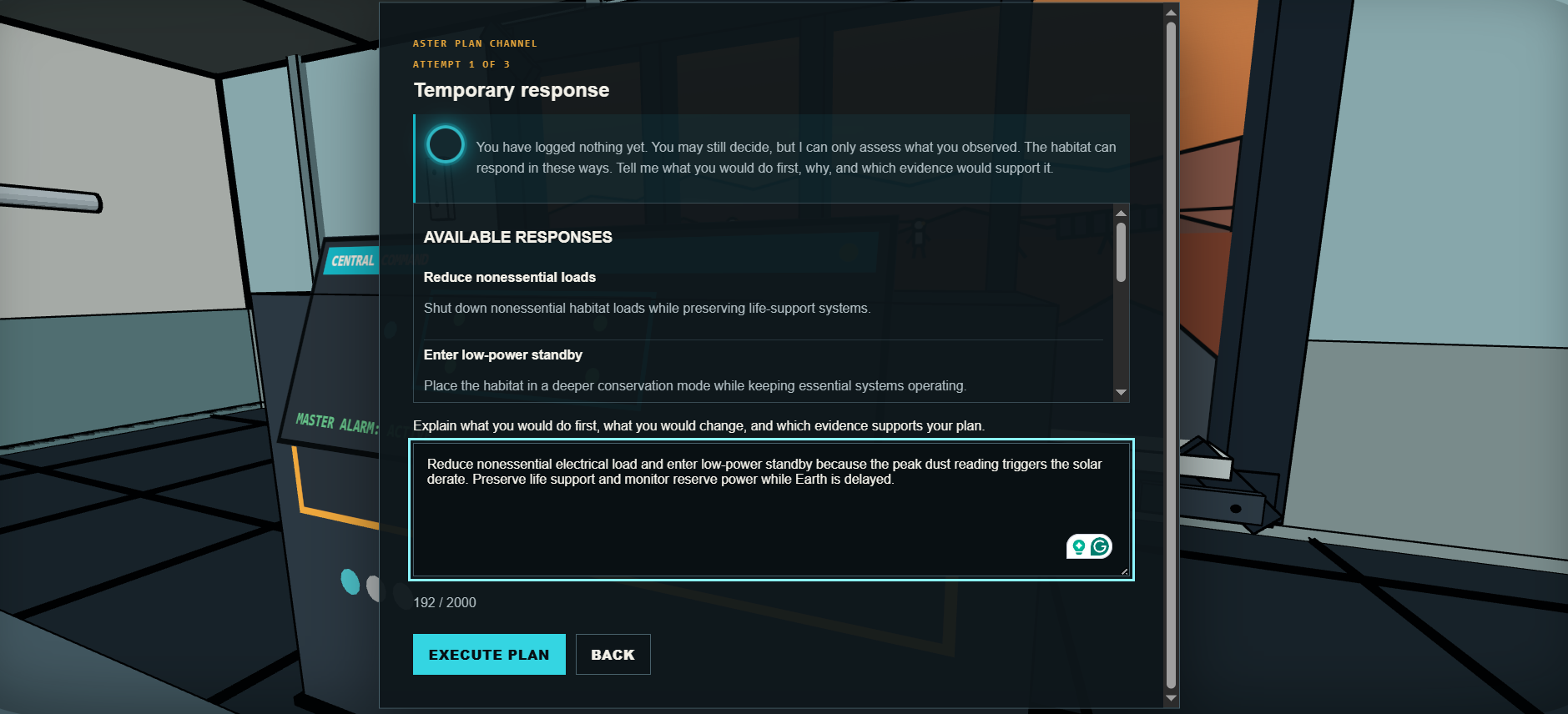
The decision console: ASTER states what it can assess, lists the habitat's real response options, and asks you to justify your plan.
-
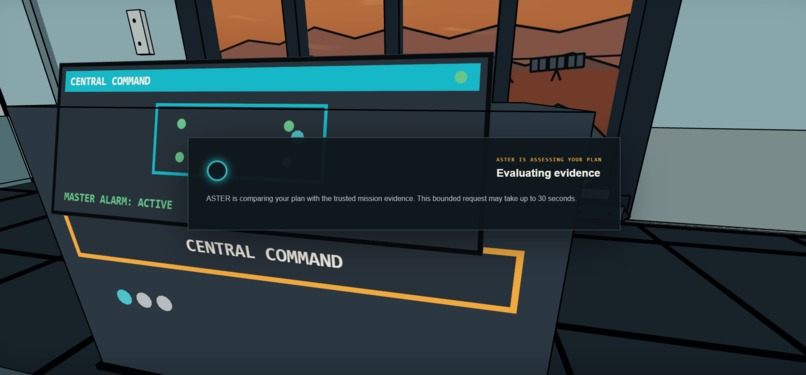
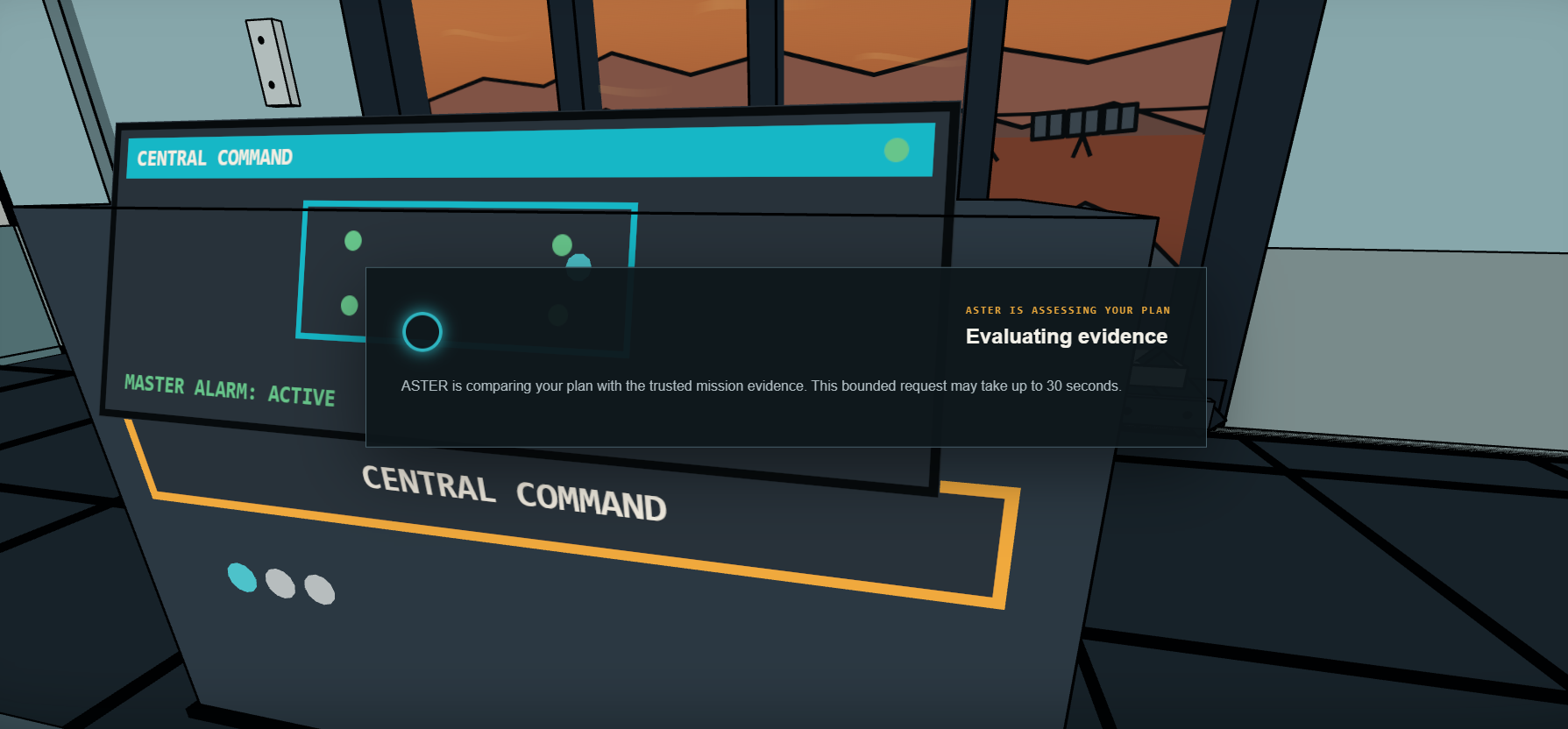
ASTER assesses your plan live — a bounded, security-hardened GPT-5.6 call comparing your words to trusted mission evidence.
-
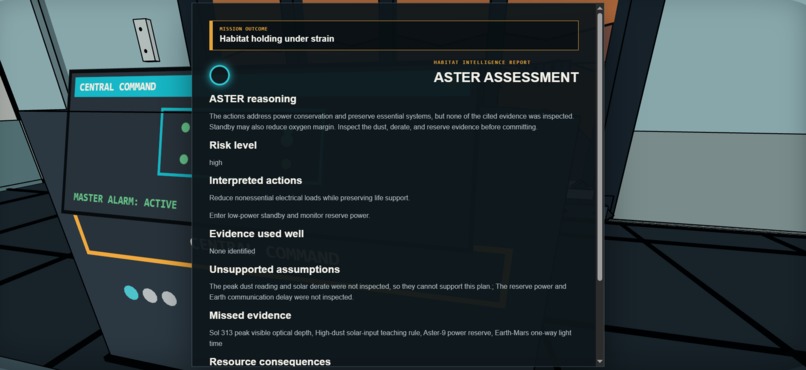
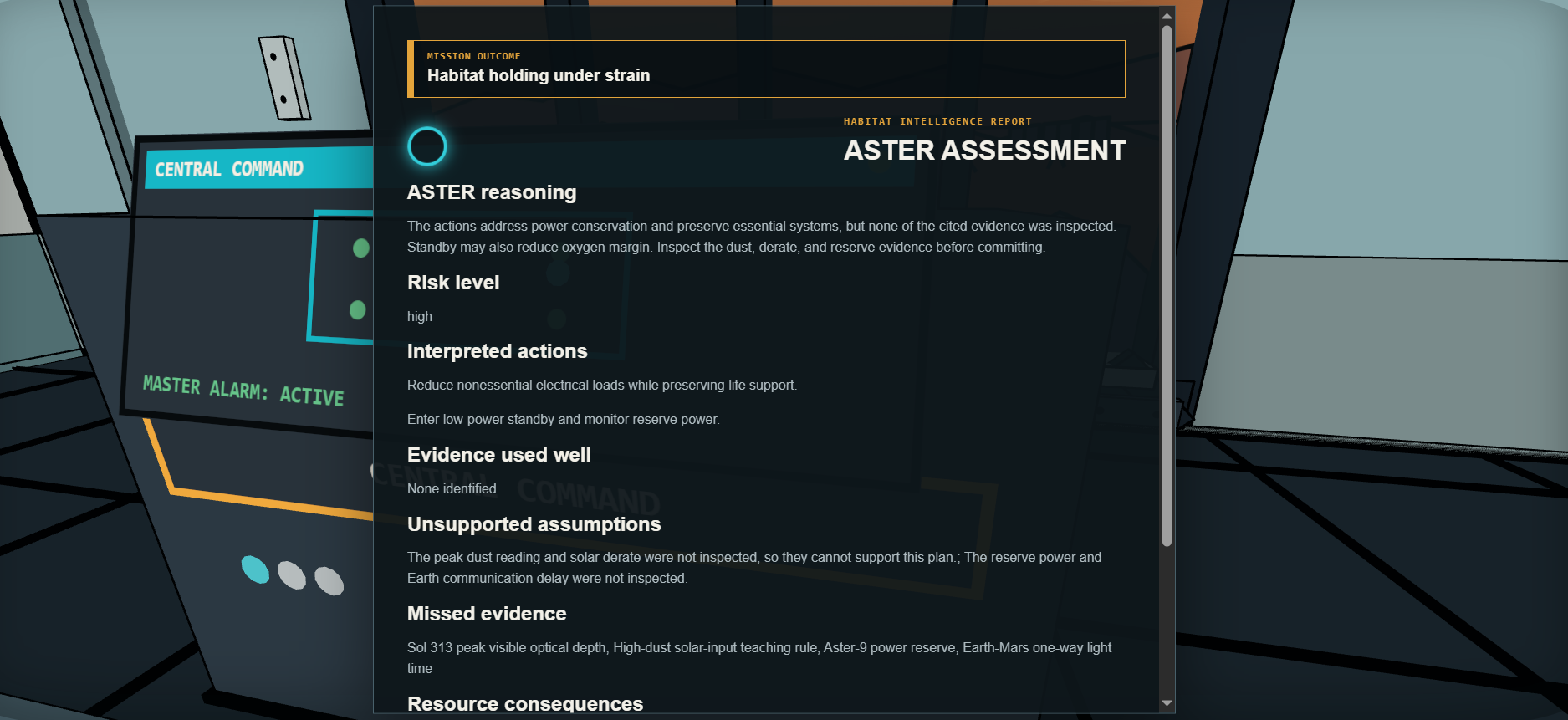
The verdict: Habitat holding under strain. ASTER grades reasoning, risk, interpreted actions — against your logged evidence only.
-
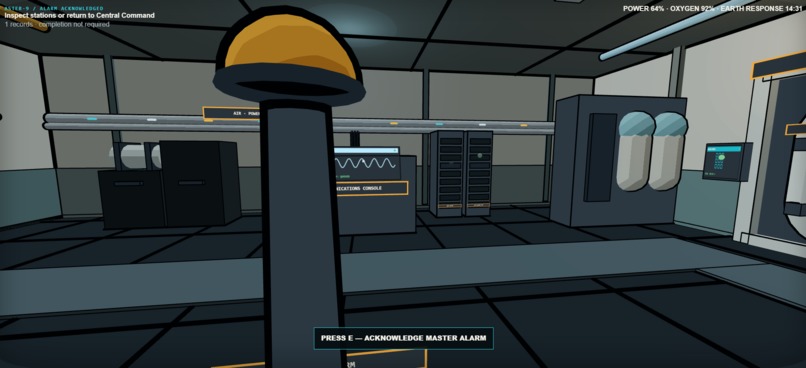
Alarm acknowledged — the Earth-response countdown is live. Inspect the stations and build your case.
-
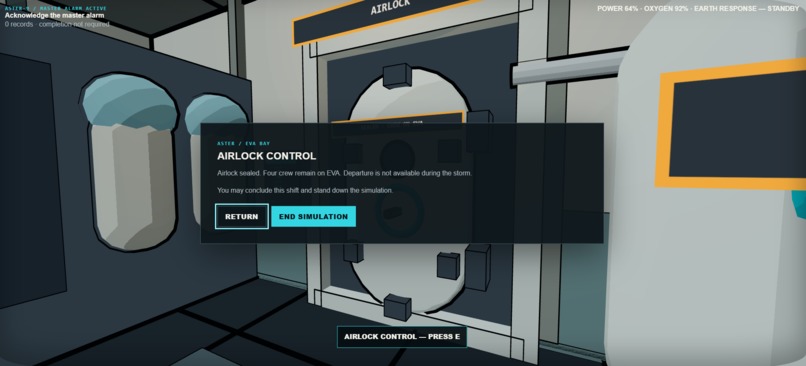
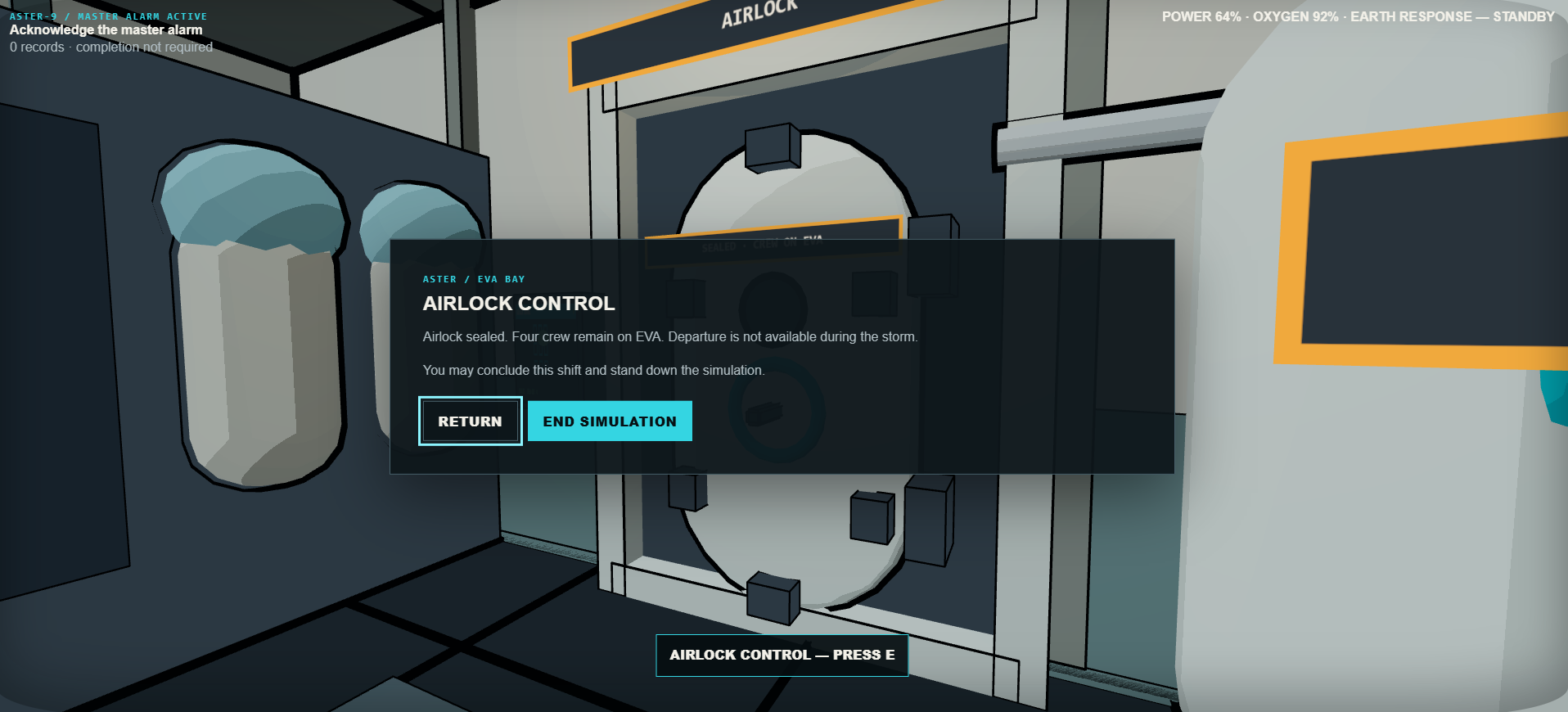
The airlock tells the truth: sealed, four crew outside. No fake exits — it offers to end your shift instead.
-
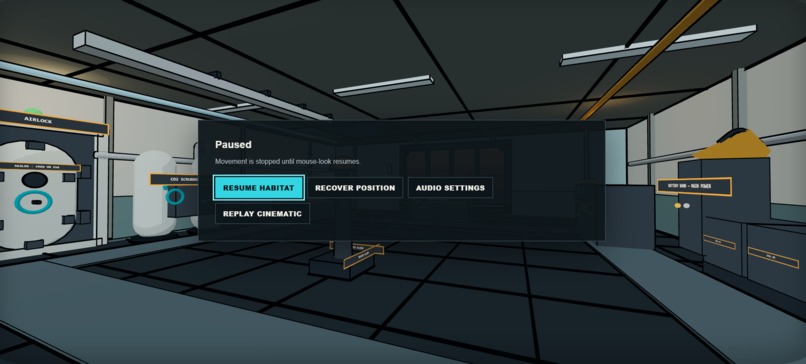
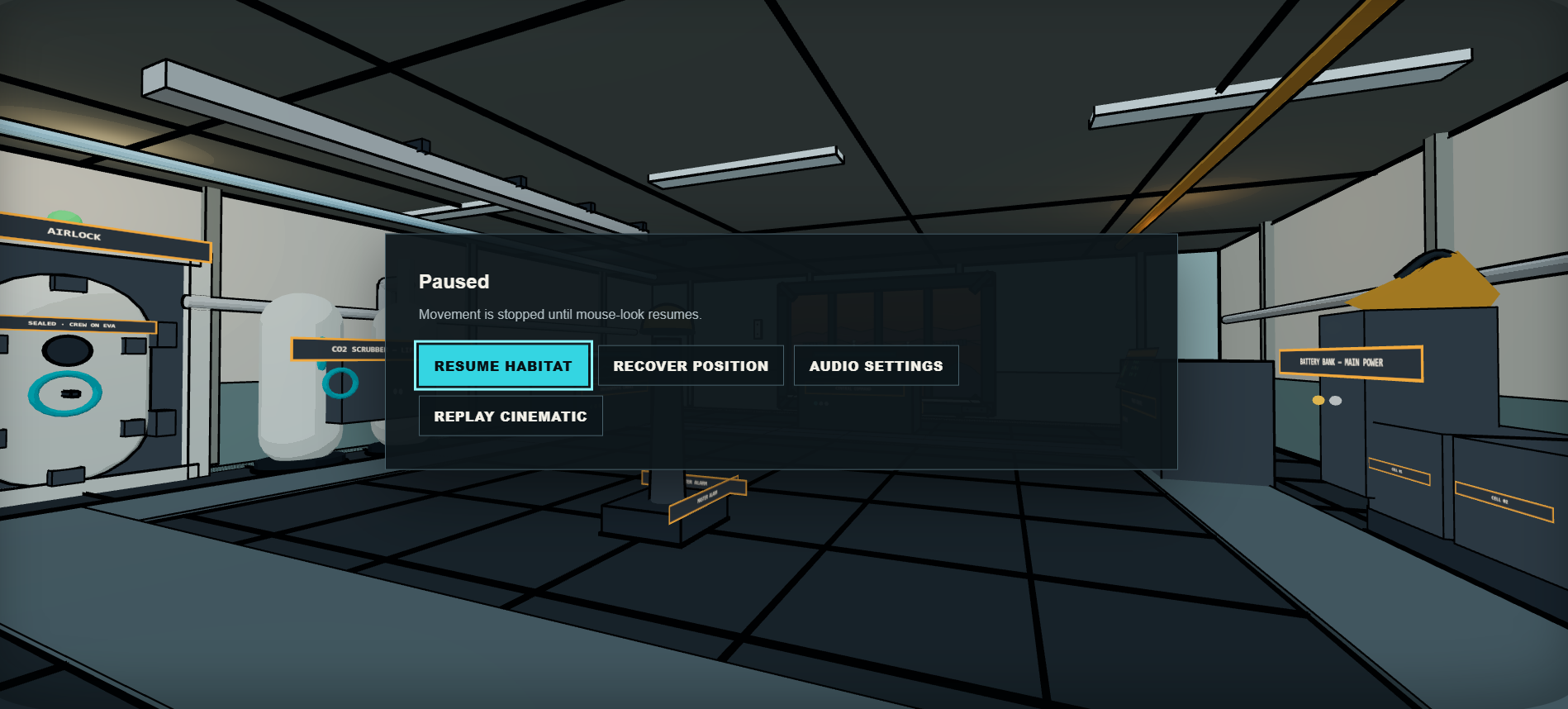
Pause surface with honest utilities — resume, recover position, audio settings, replay the opening.
Inspiration
On Mars, you cannot call for help — the answer takes about fifteen minutes each way.
During the January 2022 regional dust storm at Jezero Crater, the MEDA weather station aboard NASA's Perseverance rover recorded the pressure swings and dimming skies, and the raw files sit in the open NASA Planetary Data System archive.
Most people learn about space missions only through news reports. The datasets and technical information available in public databases are often too complex for general audiences to understand, making space exploration feel distant and disconnected from everyday life.
Television and films also tend to portray space missions with a great deal of fiction, focusing heavily on dramatic adventures. As a result, many people imagine space missions primarily as stories about astronauts exploring unknown worlds.
In reality, space missions involve highly complex systems and many different professional roles. I reviewed online resources to better understand who works on these missions and what their responsibilities are. I also asked ChatGPT 5.6 about the work performed by engineers in a future Mars habitat, which gave me several ideas for the project.
I decided to approach the experience from the perspective of a systems engineer. The player’s responsibilities include monitoring multiple streams of data, recording evidence, and developing actionable plans to maintain the stability and safety of the habitat.
The problem and the audience
As mentioned earlier, most people do not fully understand how space missions work, yet many remain deeply curious about them. Many NASA civil-service positions are limited to U.S. citizens, but even as an ordinary American citizen without a background in aerospace, my access to this world is still quite limited. I can only gain a surface-level understanding through science museums, NASA visitor centers, television programs, and online resources.
Many people probably share this experience. NASA tours can be fascinating, but a few days later, visitors may forget much of what they learned. That feels like a missed opportunity.
Many of us became fascinated with space as children. Many people once said that they wanted to become astronauts when they grew up. Yet the astronaut they imagine is usually someone wearing a spacesuit, secured by a tether, repairing a damaged space station after it has been struck by space debris. Or they imagine astronauts floating from one module to another inside a spacecraft, relying on specialized equipment for eating, drinking, sleeping, and using the bathroom.
But is that really all a space mission involves?
Through a conversation with ChatGPT 5.6, I learned about a regional dust storm observed in Jezero Crater. This led me to ask a hypothetical question: what would a systems engineer have done if a human habitat had existed on Mars at the time, with a several-minute communication delay between Mars and Earth?
To be clear, there is currently no human habitat on Mars.
The Mars habitat in this game is fictional, but the event and the data referenced in the experience are based on real observations. The project is designed for curious members of the general public, high school and college students, and science enthusiasts.
By operating simulated systems, collecting evidence, developing response plans, and discussing decisions with an AI assistant, players can gain an introductory understanding of a specific type of space mission through an immersive 3D game environment.
What it does
Signal Delay is a first-person decision game set in a cel-shaded Mars habitat, based on real MEDA observations from sols 305 and 313.
Players can watch the opening cinematic or skip it and jump straight into the game. The MVP centers on a single event: a dust storm is cutting the habitat's power, Earth's answer is fifteen minutes away, and the crew is outside — as the systems engineer, the player must come up with an executable plan.
Players inspect data monitored by four station systems, log their observations, then submit an emergency response plan. Every evidence panel links to the actual NASA source file in the PDS MEDA archive, with the storm's peak optical depth grounded in the peer-reviewed analysis by Lemmon et al., 2022 — so verifying the sources is easy. Players get three attempts to submit a plan.
ASTER, the habitat intelligence, evaluates the player's plan live against the evidence they actually logged: Claims with no logged records or irrelevant reasoning are rejected by ASTER. Evidence-backed reasoning is judged valid, earning a stable habitat.
If the API connection fails, the system says so honestly and falls back to contingency guidance clearly labeled as pre-scripted.
How we built it
One person, three collaborators. I am responsible for the design decisions and submission.
OpenAI Codex was the primary development tool: it implemented the entire codebase — Next.js + React Three Fiber + Rapier, the GPT-5.6 evaluation route with strict structured output, and the full test suite (170 automated tests: unit, integration, and production-build Playwright E2E). Gpt-5.6 generated WP-01 to WP-03 canonical prompts for Codex.
Claude Code drafted the canonical work-package prompts and reviewed every handoff before merge. Eleven Codex threads across ten documented build rounds; every prompt is committed to the repo before implementation and its SHA-256 is recorded in a session record, so every line of code traces to the instruction that produced it.
All visuals are 100% code-generated — cel-shaded procedural geometry, hand-drawn canvas decals, a physical pipe-and-cable network, zero external image or 3D assets.
ASTER's voice is OpenAI TTS, generated at build time and disclosed.
Raw MEDA CSVs are fetched and transformed by committed scripts, so the entire evidence pack is reproducible from the public archive down to each in-game panel.
Challenges we ran into
The browser is hostile to cinematics: autoplay policy silenced the opening, hidden tabs let a wall-clock timeline "complete" invisibly, and layout reflow made text ghost. We rebuilt the opening three times, ending with a title screen (user gesture unlocks audio), a visibility-aware clock, fixed-slot typography, and finally a voice-driven beat machine — each shot now holds until ASTER finishes its line, so audio, captions, and camera can never drift apart.
The UI level: keeping the live-AI vs contingency distinction unmissable without breaking immersion. A three-tier disclosure system was applied.
The art direction must be specified like engineering: silhouette tests, a closed greeble vocabulary, and ink-line weight classes, and a "pipes are physical geometry" rule are all written into the prompts.
Accomplishments that we're proud of
Every scientific claim in the game is one click from its NASA source file.
The AI assessment is genuinely live, security-hardened (server-side origin allowlist, forgery-safe client identity, rate-limited, zero-leak errors), and honest about its failures.
The whole build is auditable: Eleven Codex threads, every one documented with committed prompts, hash-verified session records, and green CI on the exact merged commit.
What we learned
Vague prompts produce vague scenes, and "draw it like a comic inker would" only works when you also write down the line weights.
Test environments lie: every real bug we shipped was invisible to an always-visible, always-focused test browser and was caught by a human playing naturally.
What's next for Signal Delay
More sols and more failure modes from the same open archive, a player character for third-person embodiment, and a scenario editor so educators can build their own evidence packs from any PDS dataset.
Built With
- claude-code
- gpt-5.6
- nasa-pds
- next.js
- node.js
- openai
- openai-codex
- openai-tts
- playwright
- rapier
- react
- react-three-fiber
- three.js
- typescript
- upstash-redis
- vercel
- vitest
- webgl

Log in or sign up for Devpost to join the conversation.