-
-
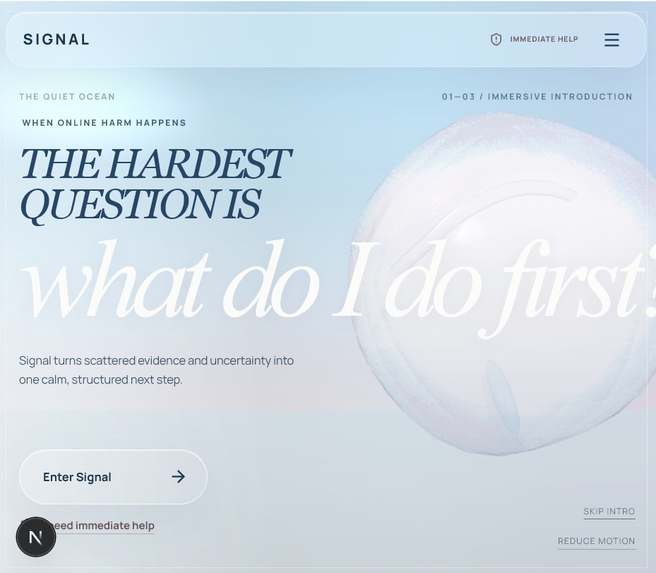
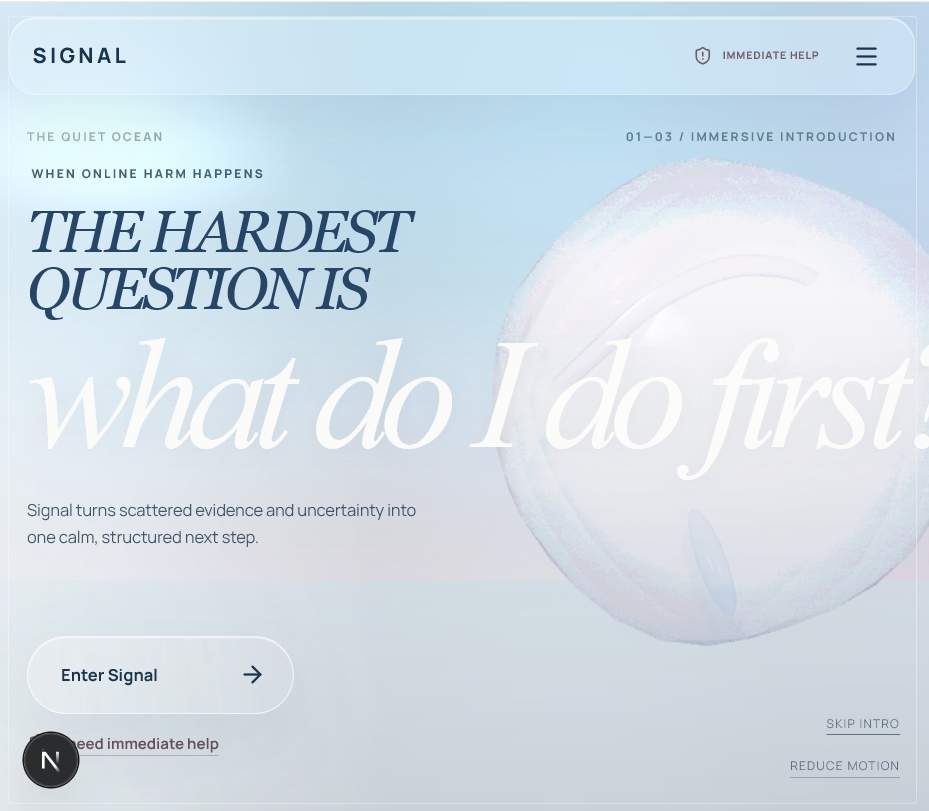
An immersive, trauma-aware entry experience designed to move users from uncertainty toward one clear next step.
-
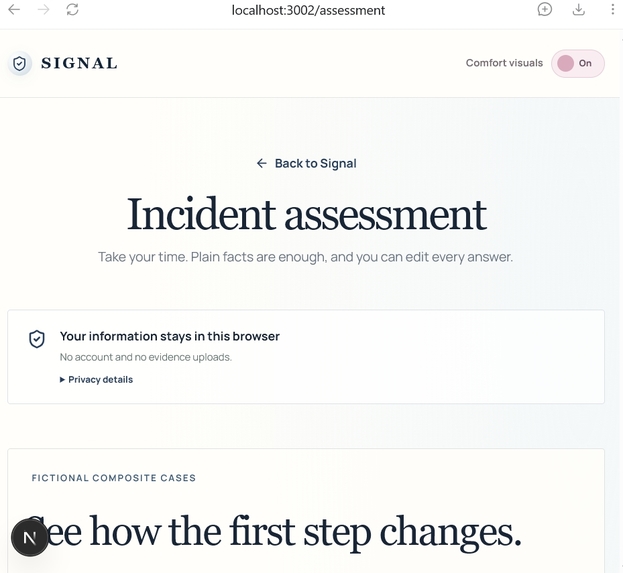
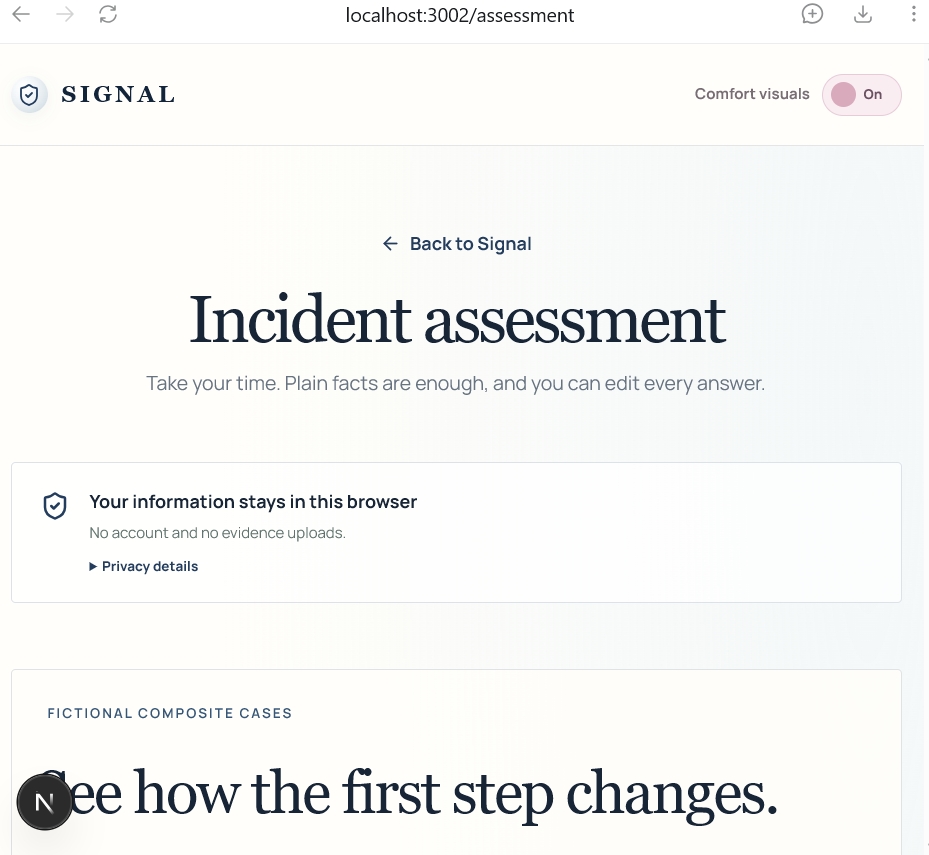
A calm, privacy-first assessment interface that reduces cognitive load and keeps sensitive information in the user’s browser.
-
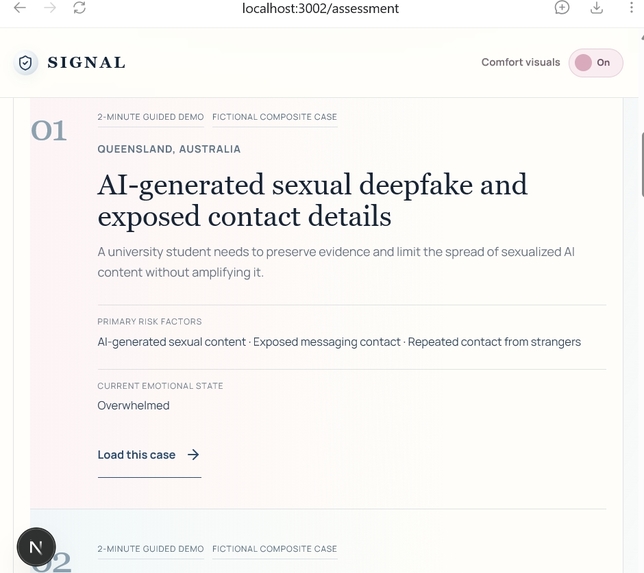
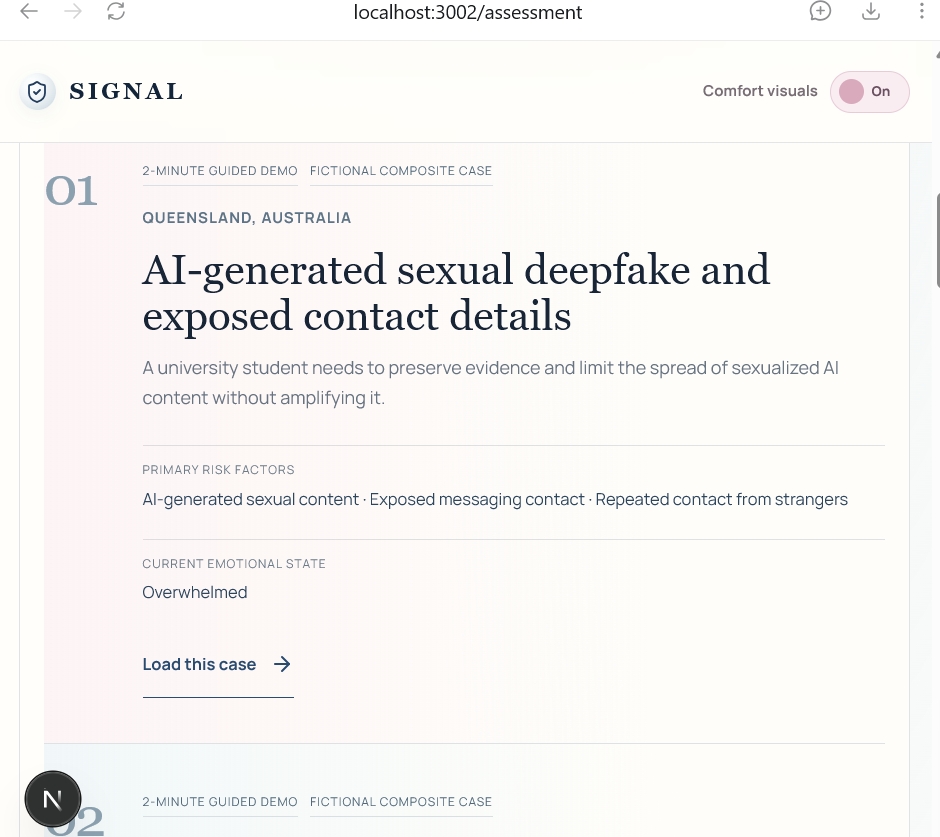
A fictional Queensland case demonstrating how Signal prioritizes evidence preservation and image-abuse reporting pathways.
-
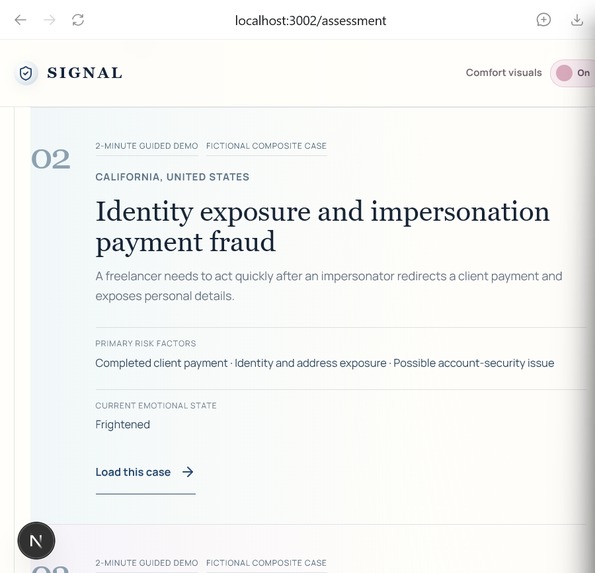
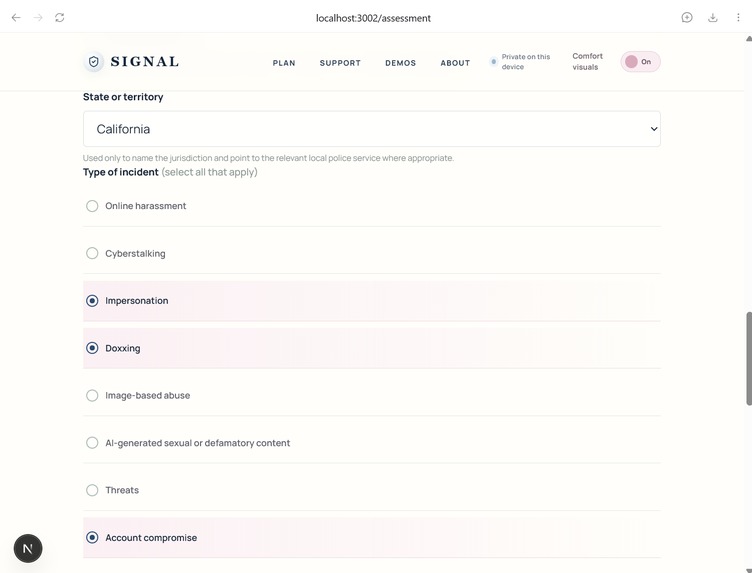
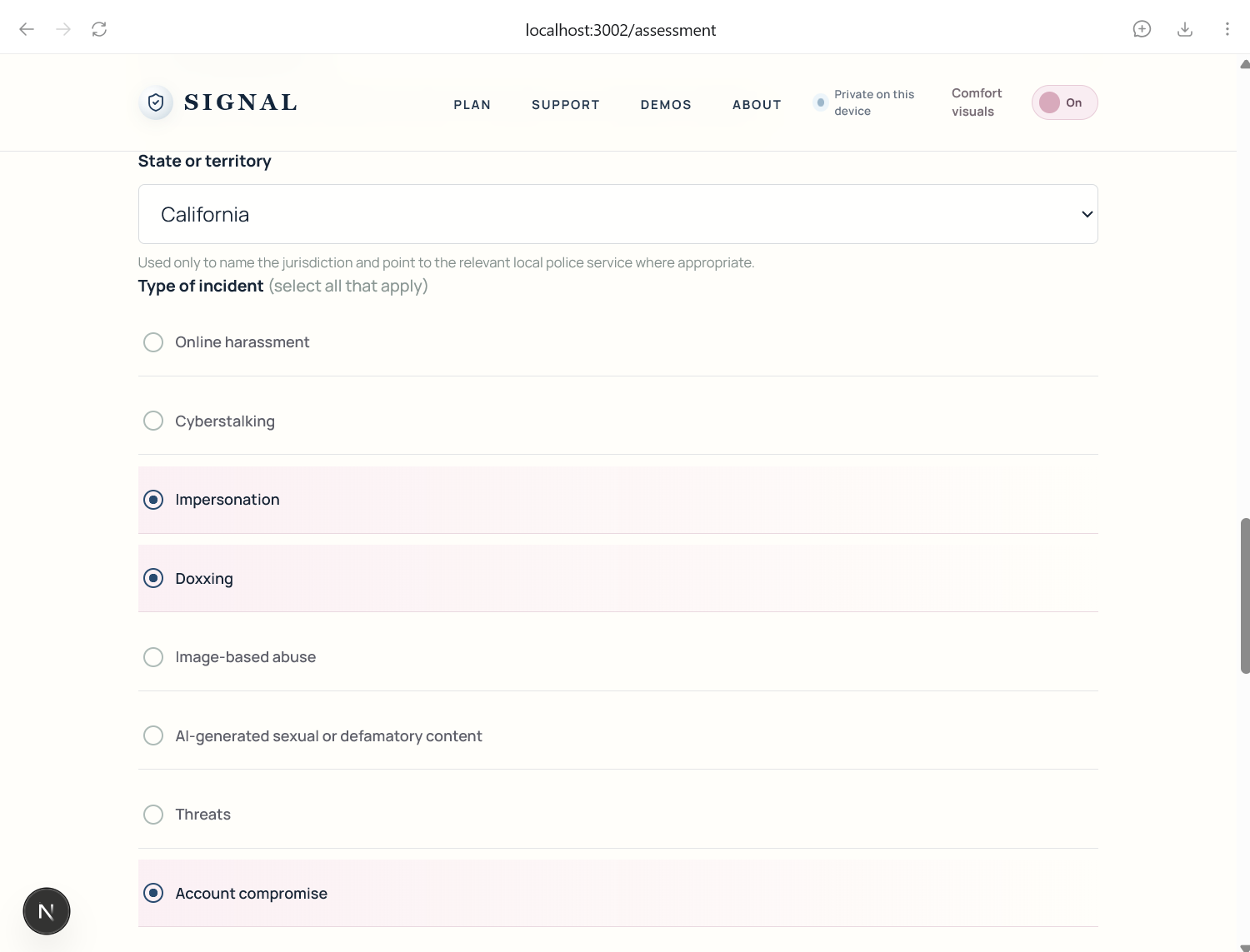
Structured, jurisdiction-aware inputs turn a complex incident into inspectable risk signals without relying on opaque free-form analysis.
-
Inspiration
Signal was inspired by a simple but painful problem: after online harm occurs, victims are often given a long list of resources but no clear answer to the most urgent question:
What should I do first?
Online harassment, cyberstalking, doxxing, impersonation, account compromise, payment fraud, threats, image-based abuse, and AI-generated harmful content can quickly create dozens of decisions. A person may need to preserve evidence, secure an account, contact a bank, report content, notify a workplace, speak to police, or seek emotional support—all while frightened, overwhelmed, and unsure which action is time-sensitive.
I wanted to build something that did more than provide information. Signal is designed to reduce that decision burden by turning a complicated incident into one prioritized first step, followed by a manageable plan.
The project was also shaped by a privacy concern: people experiencing online abuse should not have to surrender more sensitive information just to receive help. That led to Signal’s local-first and inspectable approach.
What it does
Signal Crisis Navigation App is a trauma-aware incident-response utility that helps users understand what to do first after online harm.
The current Build Week prototype includes three complete fictional composite cases covering:
- AI-generated sexual image abuse and exposed personal information
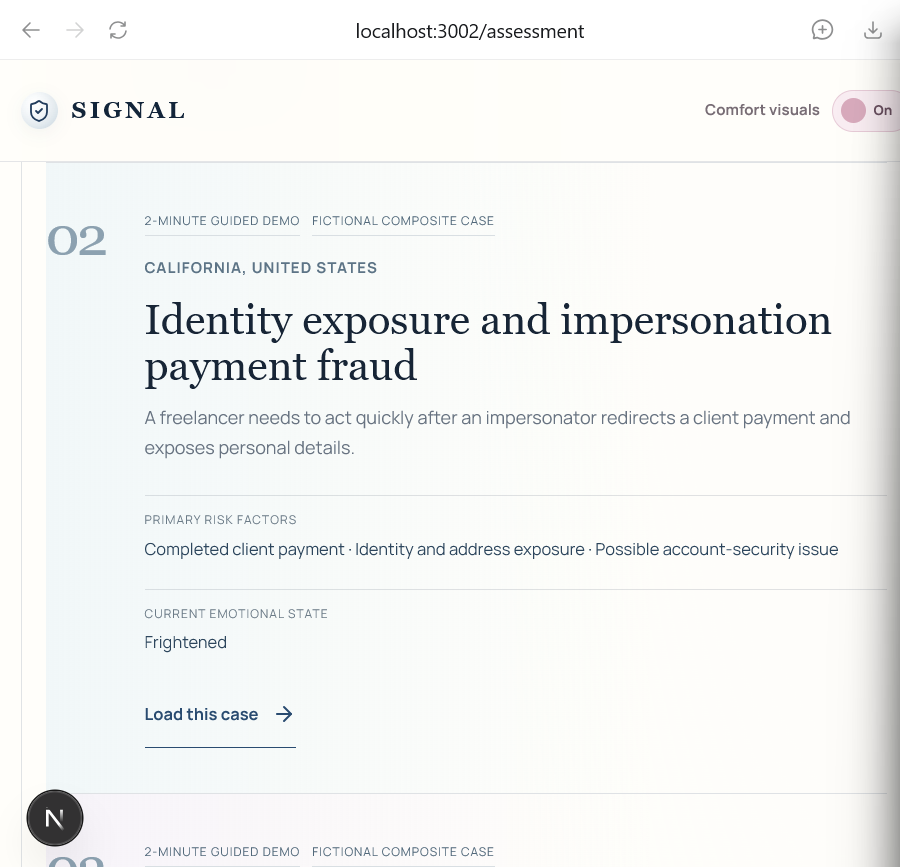
- Identity impersonation and payment fraud
- A direct threat involving a workplace and a specific time
Each case demonstrates a different prioritization pathway. Signal identifies the most urgent first contact, explains why that action comes first, and separates immediate steps from slower reporting or legal options.
The experience includes:
- A clear “Who to contact first” recommendation
- An explanation of “Why first” and “Not first”
- Actions for the first 15 minutes
- A plan for the next 24 hours
- A plan for the following 7 days
- Evidence-preservation guidance
- Escalation criteria
- Relevant official resources
- Emotional-support options
- A trusted-person message
- Report, timeline, and Case Pack workflows
- Browser-local screenshot OCR with user review and confirmation
I built Signal as a solo creator using GPT-5.6 through Codex throughout the development process.
Codex helped me translate the product concept into a working architecture, design the interaction flow, implement the interface, debug production issues, test different user pathways, improve accessibility, and refine the project’s privacy and safety boundaries.
The application was built with Next.js, React, TypeScript, Tailwind CSS, Three.js, React Three Fiber, and WebGL.
Signal uses structured incident signals and deterministic prioritization rules rather than relying on an opaque runtime model to make high-stakes decisions. These rules connect different risk factors—such as immediate danger, physical-location exposure, financial loss, account compromise, repeated contact, or a time-specific threat—to an ordered response plan.
Tesseract.js supports browser-local screenshot OCR. Extracted text is shown to the user for review rather than being treated as automatically reliable. Case progress and user-confirmed information can remain in the browser through local storage.
The immersive landing experience uses an ocean-inspired visual environment, while the assessment, reporting, and Case Pack interfaces use a more restrained and professional design. The intention was to create a product that feels human and distinctive without adding confusion during a stressful situation.
Challenges we ran into
The hardest challenge was balancing creativity, safety, privacy, and technical scope.
Signal deals with situations where inaccurate prioritization could have serious consequences. A conventional AI chatbot can produce flexible language, but it can also generate inconsistent or overly confident recommendations. I therefore chose deterministic, inspectable rules for the deployed runtime rather than sending sensitive case material to a live model.
Another challenge was deciding how much information to show. Crisis-resource websites often provide many useful links, but presenting everything at once can leave a distressed user with even more decisions. Signal had to explain enough to support informed choice without overwhelming the user.
Local OCR also required careful handling. Screenshot text can be incomplete or inaccurate, so the interface needed a human-confirmation step before extracted information influenced the workflow.
Deployment and browser performance presented additional challenges, particularly around WebGL fallbacks, responsive behavior, and maintaining a stable experience outside the local development environment.
The broader free-form custom intake also remains an early prototype. For the Build Week release, I narrowed the scope to three complete guided scenarios so that the core prioritization, evidence, reporting, support, and Case Pack workflows could be demonstrated honestly from beginning to end.
Accomplishments that we're proud of
I am proud that Signal became more than a concept or a chatbot mock-up.
The final prototype includes a publicly accessible application, three complete end-to-end incident pathways, local OCR, evidence workflows, emotional-support features, jurisdiction-aware resources, and a structured Case Pack experience.
I am especially proud of the product’s central interaction:
Signal does not simply give users more information. It tells them what deserves attention first—and explains why.
The three fictional cases demonstrate that the first recommendation changes according to the situation. A financial-loss case prioritizes the bank or payment provider, while a credible workplace threat prioritizes physical safety and workplace security.
I am also proud that the project treats privacy as part of the product experience rather than as a footnote. Sensitive case material does not need to be sent to a live model for the prototype to provide useful guidance.
Finally, building and deploying the project as a solo, non-traditional technical creator was an important accomplishment in itself. Codex allowed me to move from a personal problem and product idea to a functioning public prototype.
What we learned
I learned that the most useful response to a crisis is not always the most intelligent-sounding response. It is often the response that is easiest to understand, verify, and act on.
I also learned that agency and autonomy are not identical. A product can preserve user control while still actively helping them prioritize decisions. Signal does not make choices on behalf of the user, but it does reduce the burden of deciding where to begin.
Building the triage system showed me how important sequencing is. Police, platforms, banks, employers, legal services, and support organizations may all be relevant, but relevance does not mean equal urgency.
I learned that local-first processing can be a meaningful product feature, especially when users are handling intimate images, threats, financial details, identity documents, or evidence of abuse.
Most importantly, I learned that responsible AI product development also involves knowing where not to use generative AI. GPT-5.6 and Codex were extremely valuable in designing, implementing, testing, and refining Signal, while the deployed runtime deliberately uses transparent rules for sensitive prioritization.
What's next for Signal Crisis Navigation App
The next step is to connect a broader structured intake to the deterministic triage engine demonstrated in the three current case pathways.
Future development may include:
- More jurisdictions and regularly reviewed official resources
- Additional incident types and escalation pathways
- A complete user-configurable guided assessment
- Safer extraction of dates, threats, accounts, and evidence from screenshots
- Exportable evidence indexes and incident timelines
- Accessibility and multilingual support
- Partnerships with universities, workplaces, victim-support organizations, and legal clinics
- Expert review of the prioritization framework
- Stronger privacy, security, and data-retention controls
The long-term goal is not to replace professionals or automate legal judgment. It is to help a person move from panic and uncertainty toward a safer, more organized response.
One incident can create dozens of decisions. Signal begins with one clear step—and stays with the user through the steps that follow.


Log in or sign up for Devpost to join the conversation.