-
-

Signal Atals Logo
-
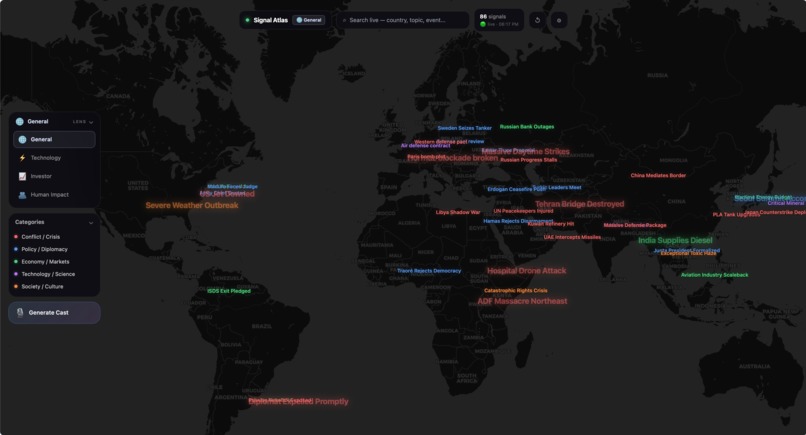
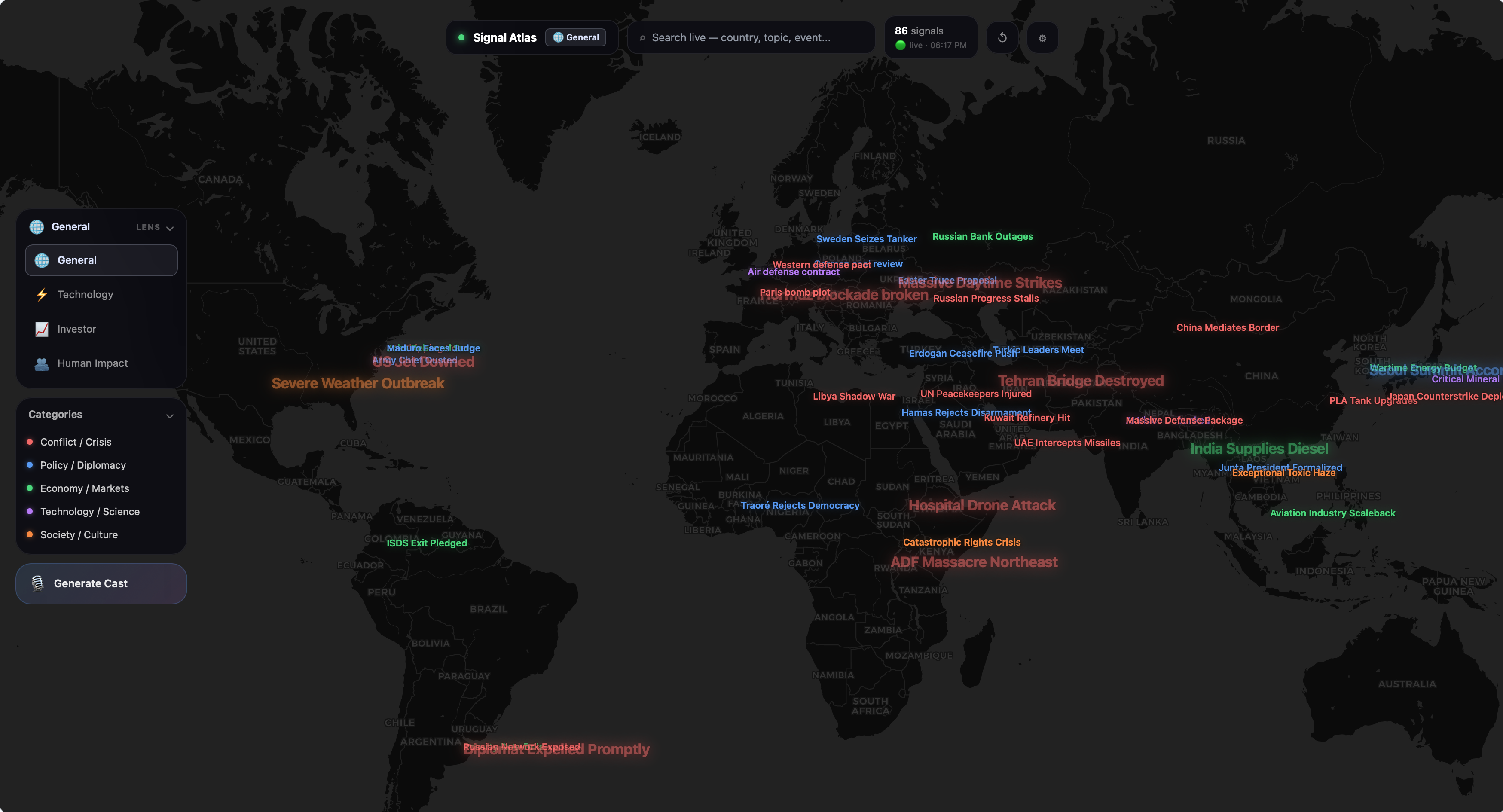
World View
-
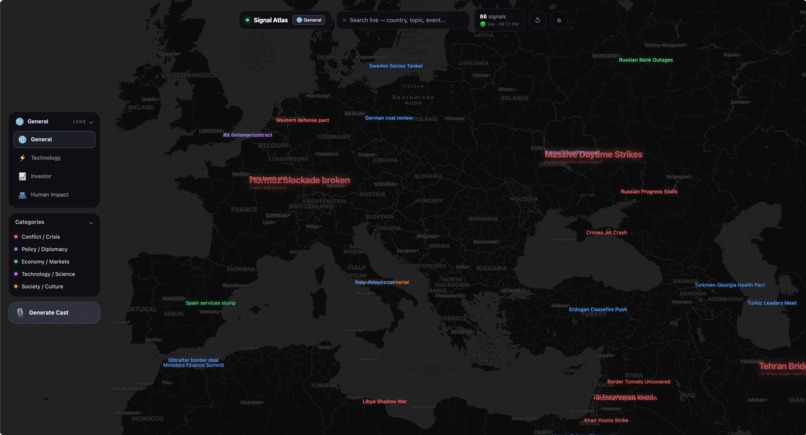
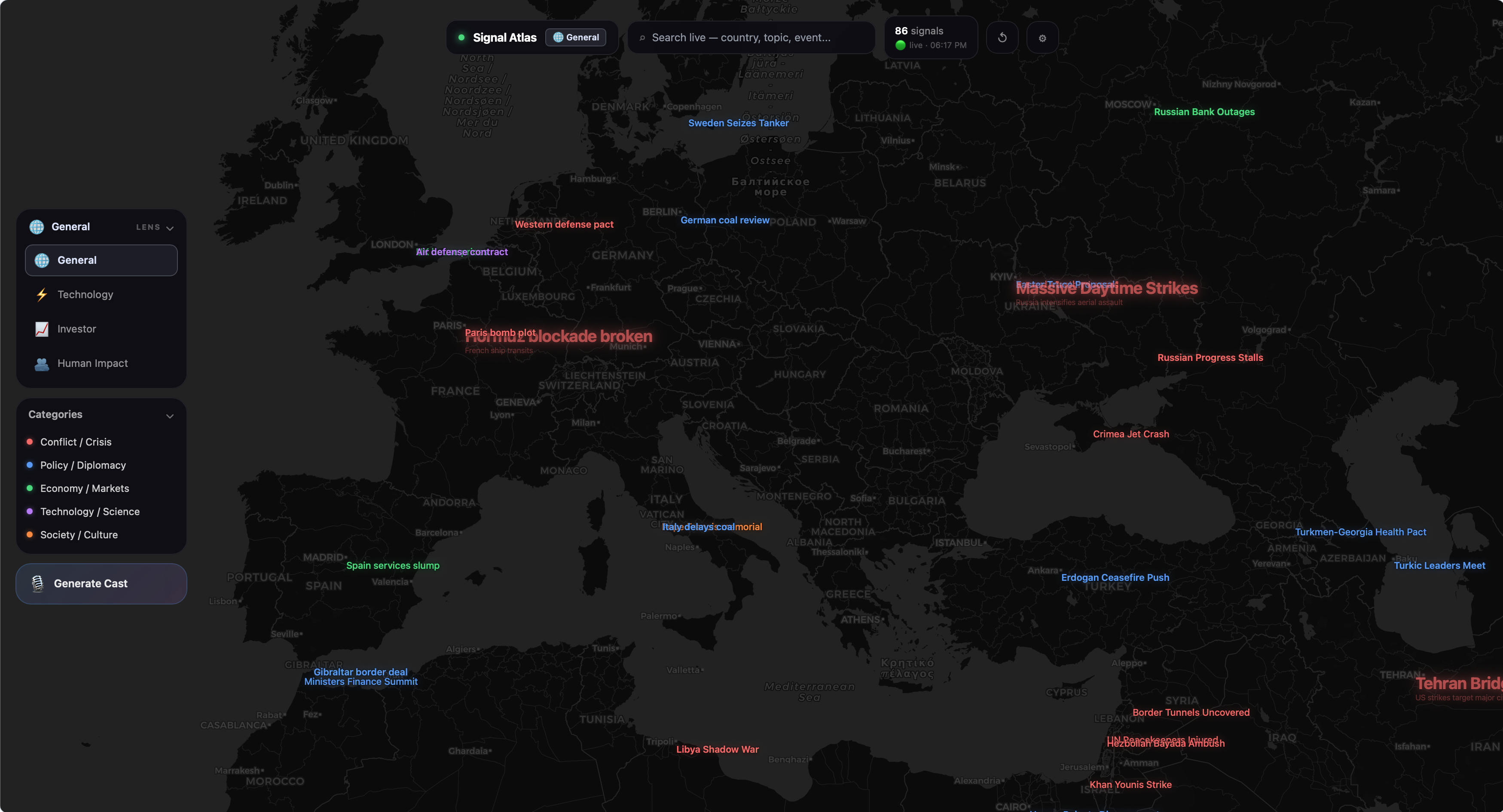
Region View-1
-
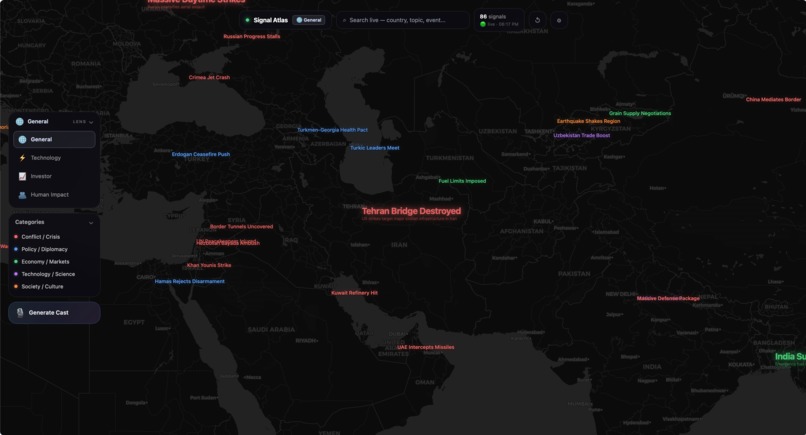
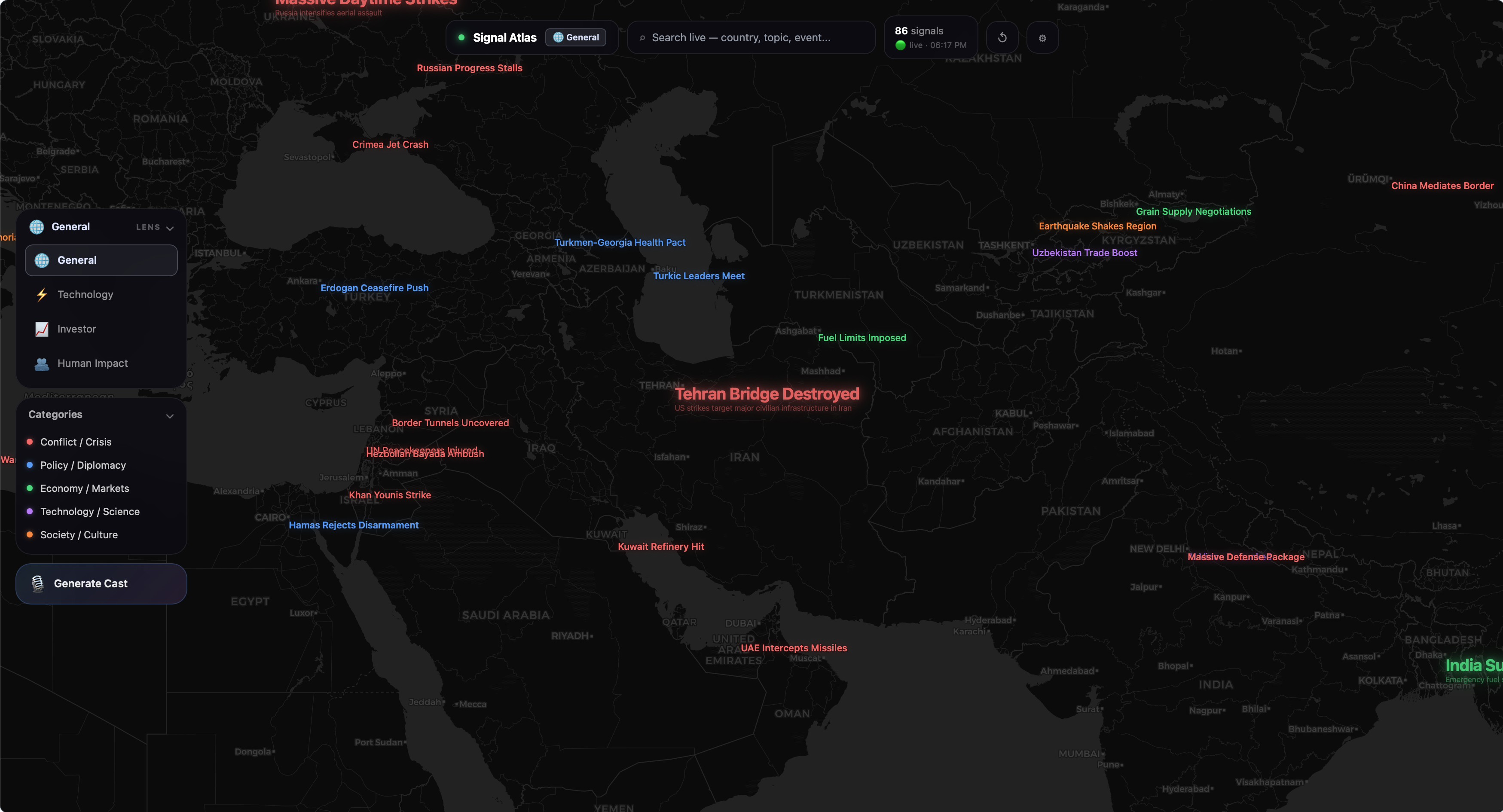
Region View-2
-
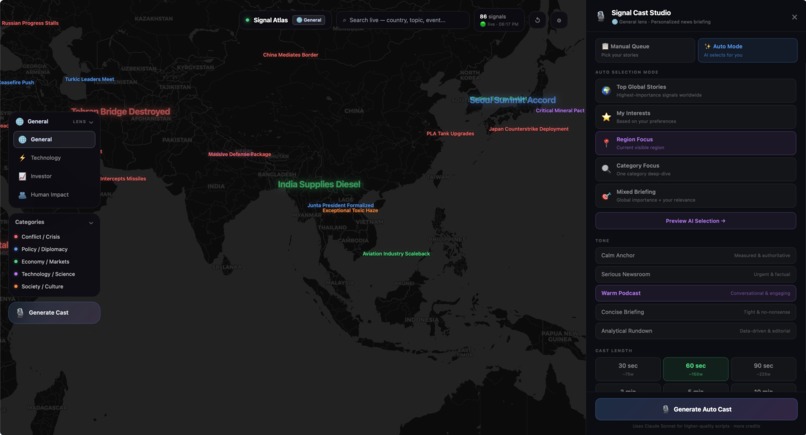
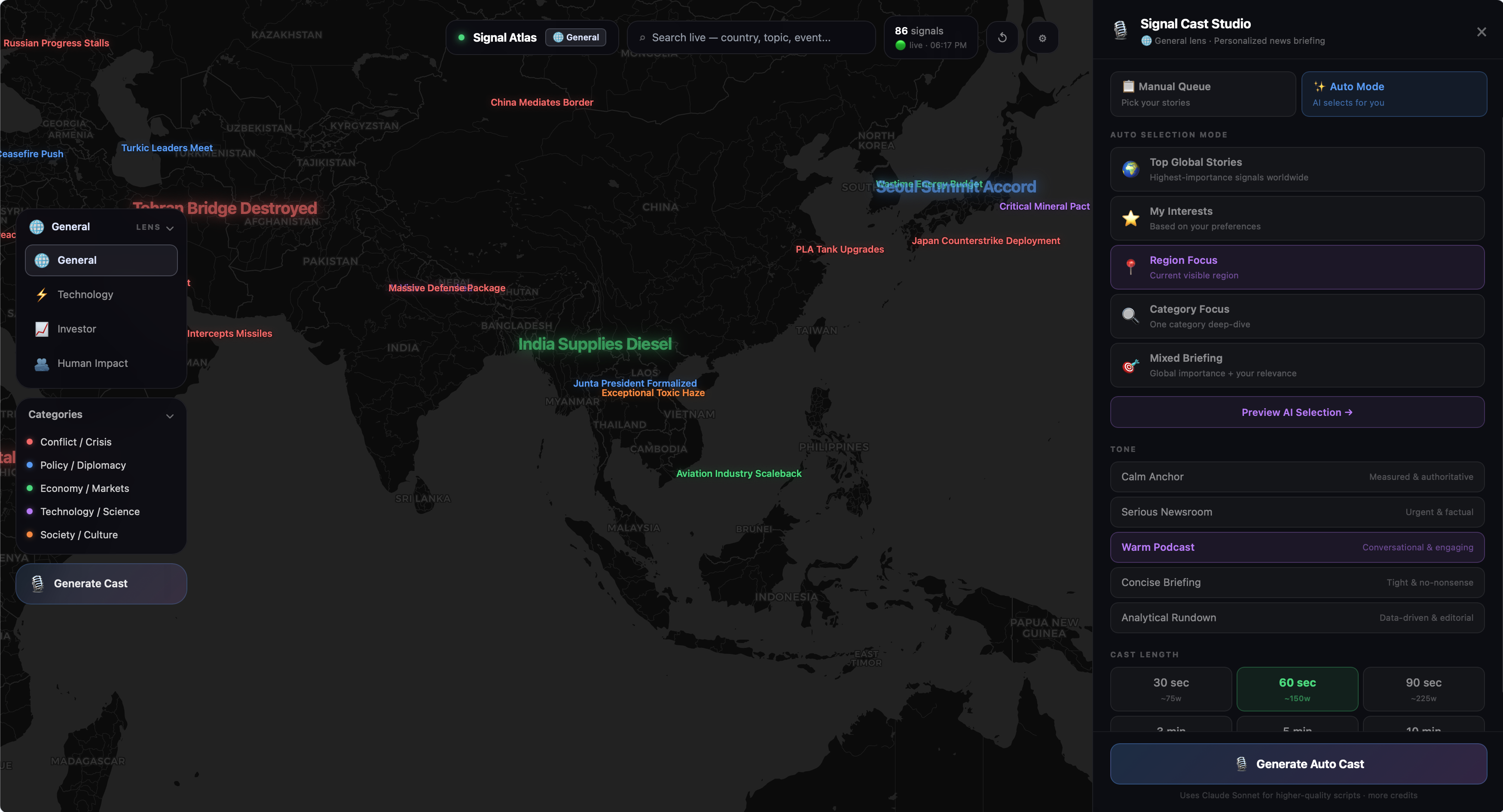
Cast Studio

🌍 Inspiration
People are often told to “stay informed” by reading the news.
In reality, most people avoid it.
Modern news platforms are overwhelming — endless lists of headlines, fragmented topics, and little sense of global context. At the same time, short-form content like TikTok or YouTube Shorts is far more engaging, even if it sacrifices depth and accuracy.
This led to a simple question:
What if global news could be explored as easily and intuitively as a map?
🧠 What We Built
Signal Atlas transforms global news into an interactive, spatial experience.
- News is collected and mapped onto a world interface
- Users can explore stories by region instead of scrolling through lists
- Articles can be added to a personal queue
- AI analyzes relationships between selected stories
- A personalized audio news cast is generated based on tone and length preferences
The result is a system that allows users not just to consume news, but to navigate and understand it.
⚙️ How It Works
- Real-time news aggregation and categorization
- Interactive map-based UI for exploration
- Queue-based selection system for user control
- AI-driven summarization and narrative generation
- Text-to-speech pipeline for audio delivery
- Optional download for offline listening
The focus was on creating a seamless pipeline from discovery → selection → synthesis → consumption.
🤖 AI Engine
AI is not a single feature in Signal Atlas — it is the core system that powers the entire experience.
1. Intelligent News Processing
AI continuously processes global news sources in real time, identifying:
- trending topics based on frequency and relevance
- important signals across regions
- relationships between seemingly separate events
High-signal stories are automatically prioritized and visually emphasized within the interface.
2. Context-Aware Map Rendering
The map is not static — it adapts dynamically using AI.
- At a global level, major international events are highlighted
- As users zoom in, AI refines the view to show more localized, relevant stories
- News visibility changes based on geographic relevance and importance
This allows users to move seamlessly from a world view to local context without losing meaning.
3. Narrative Synthesis
When users build a queue, AI does more than summarize.
- It analyzes relationships between selected articles
- Identifies shared themes, causes, and implications
- Reorganizes information into a coherent narrative
The result is not a list of summaries, but a connected story that is easier to understand and retain.
4. Personalized Audio Generation
AI transforms the narrative into a fully customized listening experience.
- Adjustable tone (e.g., formal, casual, briefing-style)
- Adjustable length (quick summary vs deep dive)
- Natural-sounding speech synthesis
This creates a personalized news podcast tailored to each user’s preferences.
Overall, AI enables Signal Atlas to move beyond traditional news consumption —
from fragmented information to structured, contextual, and personalized understanding.
⚠️ Challenges
One of the biggest challenges was balancing visual clarity with information density.
Mapping news to geography sounds intuitive, but in practice:
- Too many data points create clutter
- Too few reduces usefulness
- Relationships between stories are not always geographically obvious
Another challenge was designing the AI pipeline so that multiple unrelated articles could be transformed into a coherent, narrative-style audio briefing rather than a simple list of summaries.
💡 What Makes It Different
Most news platforms focus on either:
- content volume (more articles), or
- personalization (algorithmic feeds)
Signal Atlas instead focuses on structure —
helping users understand where things are happening and how they connect.
It shifts news consumption from passive scrolling to active exploration.
Built With
- base44-(ai-app-builder-platform)
- cloud-hosted
- elevenlabs-(text-to-speech)
- javascript
- map-based-ui-(interactive-visualization)
- openai-api
- react
- rest-apis

Log in or sign up for Devpost to join the conversation.