Inspiration
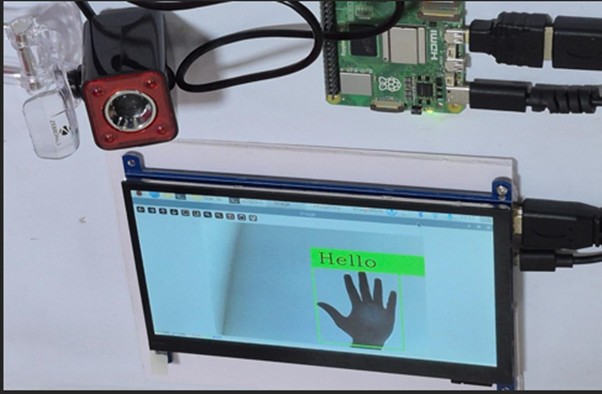
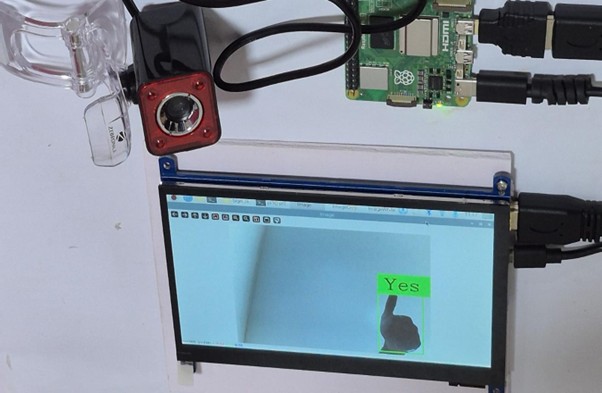
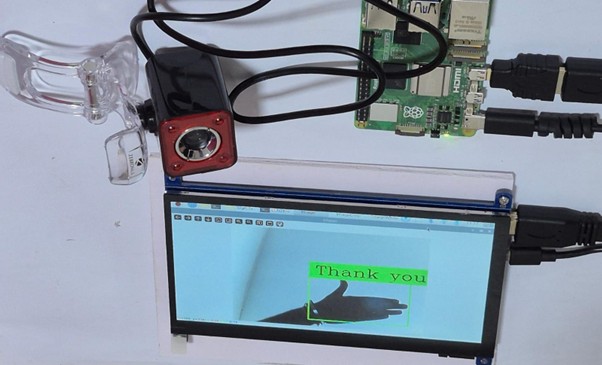
🎯 What We Built We built a real-time sign language translation system using computer vision and machine learning, all packed into a portable Raspberry Pi device. Here's how it works:
📸 A camera connected to the Raspberry Pi captures live video of hand gestures.
🧠 A trained deep learning model processes each frame, classifying hand signs using convolutional neural networks (CNNs).
📃 Once a sign is recognized, it is converted into text, and optionally into synthesized speech using text-to-speech (TTS) engines.
💬 The output is displayed or spoken in real-time — effectively turning signs into a voice.
🧰 Tech Stack Raspberry Pi 4 (Edge computing on a budget)
OpenCV (For real-time hand gesture tracking)
TensorFlow/Keras (For training and deploying the CNN model)
Python (To glue it all together)
Espeak / pyttsx3 (For converting text to voice)
Camera Module (To capture live gestures)
🧠 What We Learned This wasn’t just an AI project — it was a lesson in empathy, design thinking, and interdisciplinary engineering.
We learned how to process and label gesture datasets for training a model.
We discovered the beauty and complexity of sign language — it’s not just gestures, but expressions, speed, and rhythm.
We learned how to make resource-heavy AI models run efficiently on constrained devices like Raspberry Pi.
And most importantly, we realized how technology can be a voice for those unheard.
🚧 Challenges We Faced Low-latency gesture recognition on a Raspberry Pi was tough — we optimized the model to reduce lag without compromising accuracy.
Getting consistent input from varying lighting conditions and hand orientations took a lot of tweaking in the preprocessing phase.
Integrating TTS modules on Pi, especially with limited support for multilingual speech synthesis, was a technical puzzle.
And let’s not forget: collecting or generating a quality dataset for sign gestures is not as easy as importing from Kaggle!
🚀 What’s Next? Expand to sentence-level sign recognition using RNNs or transformers.
Add bi-directional translation (voice → text → signs via avatar or visuals).
Support regional variations of sign language (ASL, ISL, BSL, etc.).
Build a mobile-friendly version for on-the-go usage.
🌍 Final Thoughts With this project, we hope to open doors — not just to communication, but to understanding, connection, and inclusion. AI is more than automation. It’s empowerment.
Let’s build a future where no one is left unheard.
What it does
How I built it
Challenges I ran into
Accomplishments that I'm proud of
What I learned
What's next for Sign Language Detector
Built With
- ai
- iot
- ml

