Problem Statement/Ideation/Motivation
Cross-border remittances represent one of the largest and most inefficient financial flows in the global economy. According to the World Bank, over $700 billion is sent internationally each year, with migrant workers and their families bearing the brunt of an antiquated system. The average cost to send $200 internationally remains around 6.2%, with some corridors exceeding 10%. For a worker in Singapore sending $500 home to the Philippines each month, this translates to $300-600 lost annually in fees alone. Beyond cost, traditional remittance services suffer from slow settlement times, often taking 3-5 business days, leaving recipients in financial limbo during urgent situations.
The inefficiency stems from a fragmented correspondent banking system where multiple intermediaries each extract fees. Currency conversion happens at unfavorable rates, and compliance requirements create friction at every step. For the underbanked populations who rely most heavily on remittances, these barriers are compounded by limited access to traditional banking infrastructure, forcing reliance on expensive cash-based money transfer operators.
A parallel challenge exists in the realm of real-world asset (RWA) transfer. Physical assets such as property, commodities, and trade finance instruments remain trapped within national boundaries due to regulatory complexity, intermediary costs, and lack of standardized infrastructure. A property owner in Indonesia cannot easily sell fractional ownership to an investor in Europe. An exporter in Vietnam struggles to transfer invoice receivables to a financing partner in the United States. The friction in cross-border asset transfer limits capital mobility and economic opportunity for millions.
The XRP Ledger offers a compelling foundation to address these challenges. With 3-5 second transaction finality, fees measured in fractions of a cent, and native support for issued currencies, XRPL provides the technical infrastructure for efficient value transfer. The introduction of RLUSD, Ripple's regulated USD stablecoin, eliminates currency volatility concerns for remittance recipients. Native features like Checks, Escrows, and Decentralized Identifiers (DIDs) provide building blocks for compliant financial applications without requiring complex smart contract development.
However, a significant gap remains between XRPL's technical capabilities and user-accessible applications. Most existing XRPL interfaces cater to cryptocurrency traders rather than everyday users sending money home. The user experience assumes technical knowledge of blockchain concepts, wallet management, and transaction mechanics. There is no unified platform that leverages XRPL's native features to deliver a consumer-grade remittance experience with built-in compliance, trust mechanisms, and real-world asset capabilities.
Furthermore, the emerging RWA tokenization opportunity on XRPL remains largely untapped. While the ledger's trustline and IOU system provides native support for issued assets, no comprehensive marketplace exists for users to tokenize, transfer, and receive real-world assets across borders. The lack of identity verification integration means that RWA issuance lacks the trust layer necessary for serious adoption.
The current landscape forces users to navigate multiple applications, manually manage trustlines, and understand technical concepts like currency hex encoding and transaction memos. This fragmentation creates a poor user experience and limits XRPL adoption among the populations who would benefit most from its capabilities. There is a clear need for a unified, user-friendly platform that abstracts blockchain complexity while delivering the full value of XRPL's native features for cross-border payments and asset transfer.
Inspiration
The idea for SigmaPay came from watching friends and classmates send money back to their families abroad. One teammate's parents regularly send money to relatives in Southeast Asia, and the fees they pay through traditional services felt absurd in 2026. We kept asking ourselves: why does moving digital money across an imaginary line cost so much and take so long?
When we discovered the XRP Ledger and its native features, particularly RLUSD stablecoin and the DID system, we realized we could build something that actually solves this problem rather than just talking about it. The fact that XRPL settles in seconds for fractions of a cent made traditional remittance fees look like highway robbery.
The RWA angle came later when we started thinking bigger. If we can move money across borders instantly, why not assets? Why can't someone in Jakarta sell shares of their property to an investor in London without months of paperwork and thousands in legal fees? XRPL's trustline system already supports this technically. Someone just needed to build the interface.
Proposed Solution
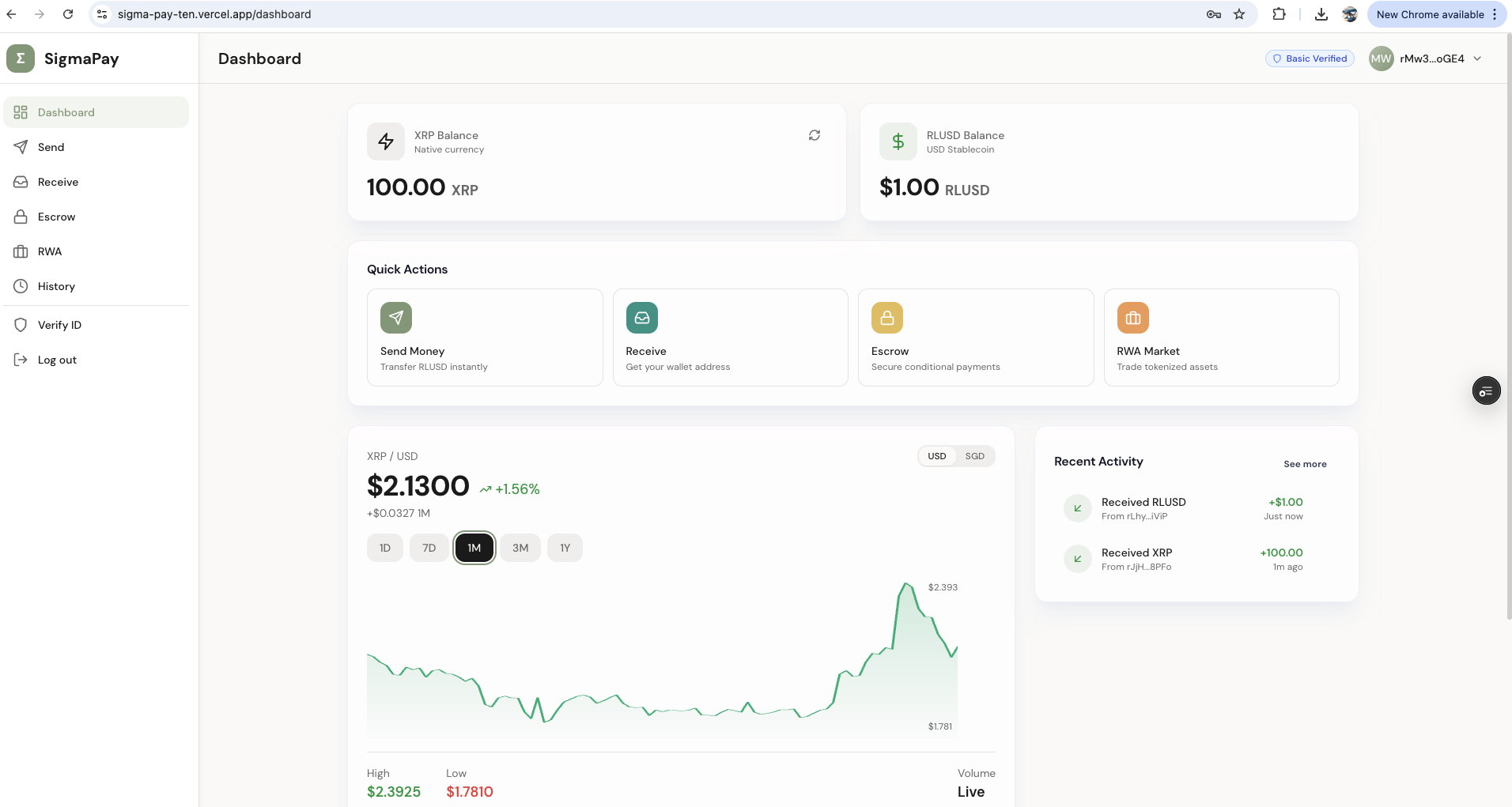
SigmaPay is a comprehensive cross-border financial platform that unifies remittance payments, identity verification, conditional escrow, and real-world asset tokenization into a single, mobile-first interface built on the XRP Ledger. Our platform transforms XRPL's powerful native features into accessible financial tools for everyday users, abstracting all blockchain complexity behind intuitive workflows.
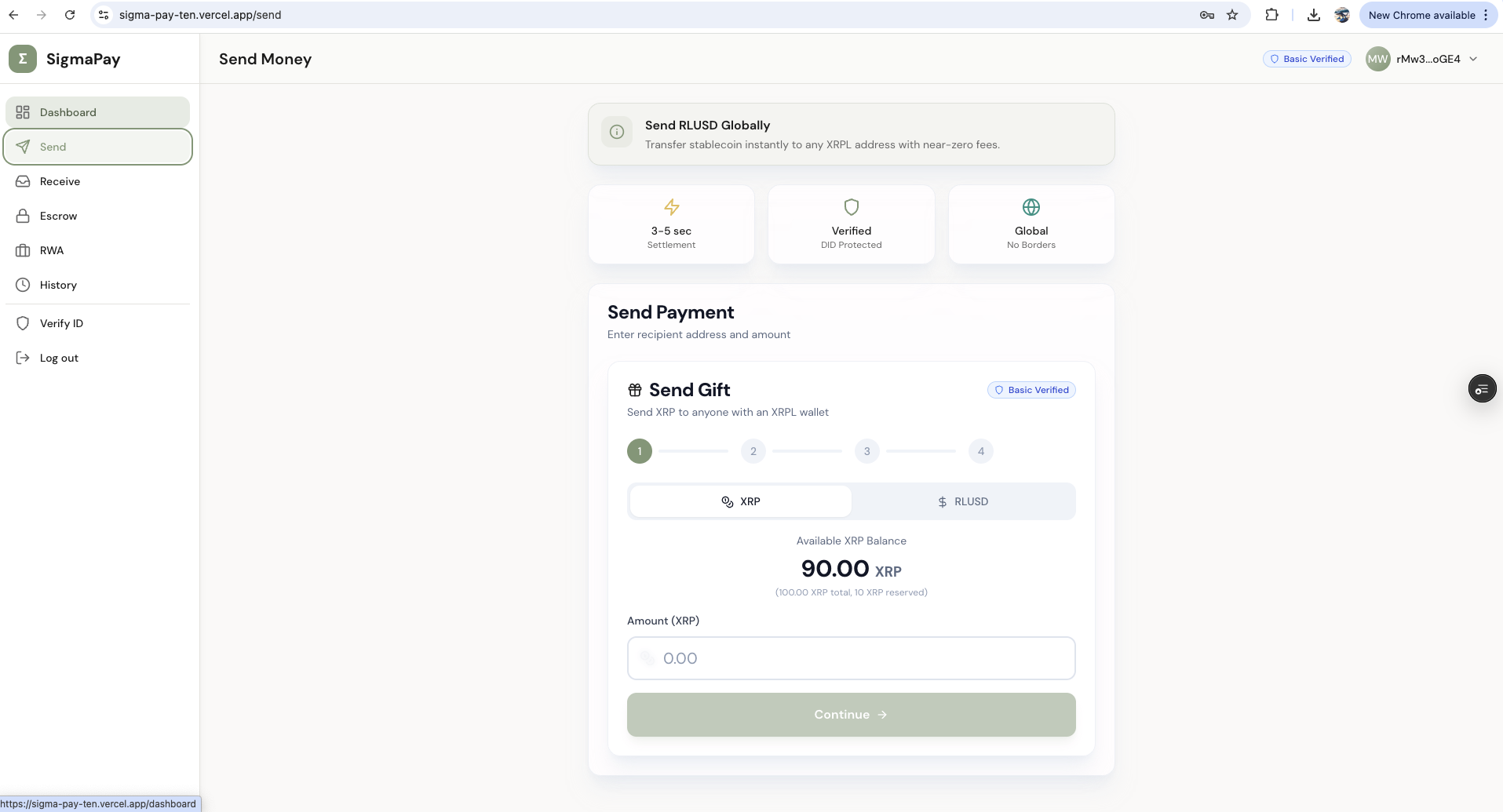
At the core of SigmaPay is a permissioned payment system powered by XRPL's Decentralized Identifier (DID) infrastructure. Users establish on-chain identity through our verification flow, which records verification status directly on the ledger using DIDSet transactions. This creates a transparent trust layer where recipients can verify sender legitimacy before accepting payments. Verification levels determine payment capabilities: unverified users can send up to $100 via claimable checks, basic verified users unlock direct payments up to $1,000, and fully verified users enjoy unlimited transfers. This tiered approach balances accessibility with compliance, allowing casual users immediate access while incentivizing verification for higher-value transfers.
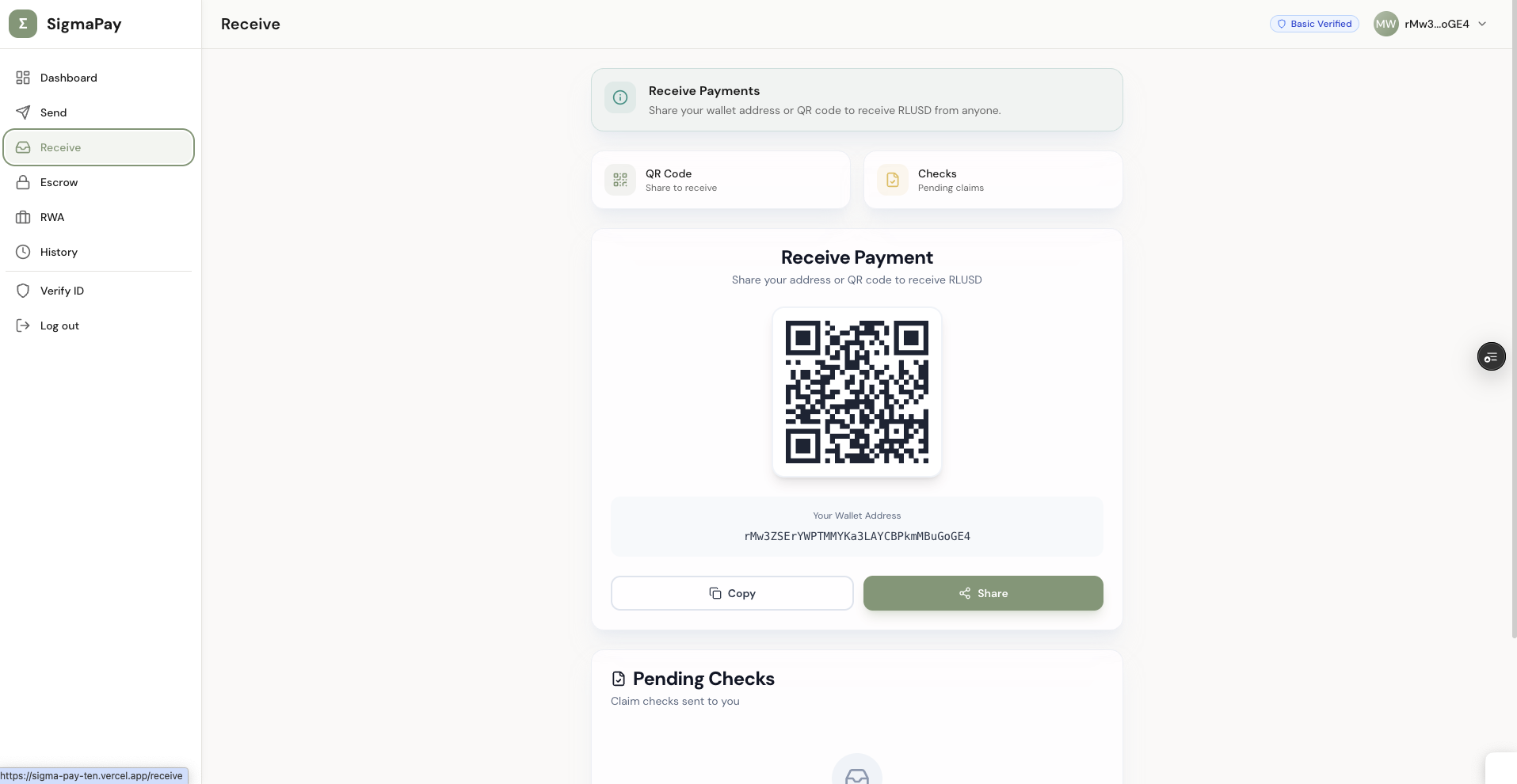
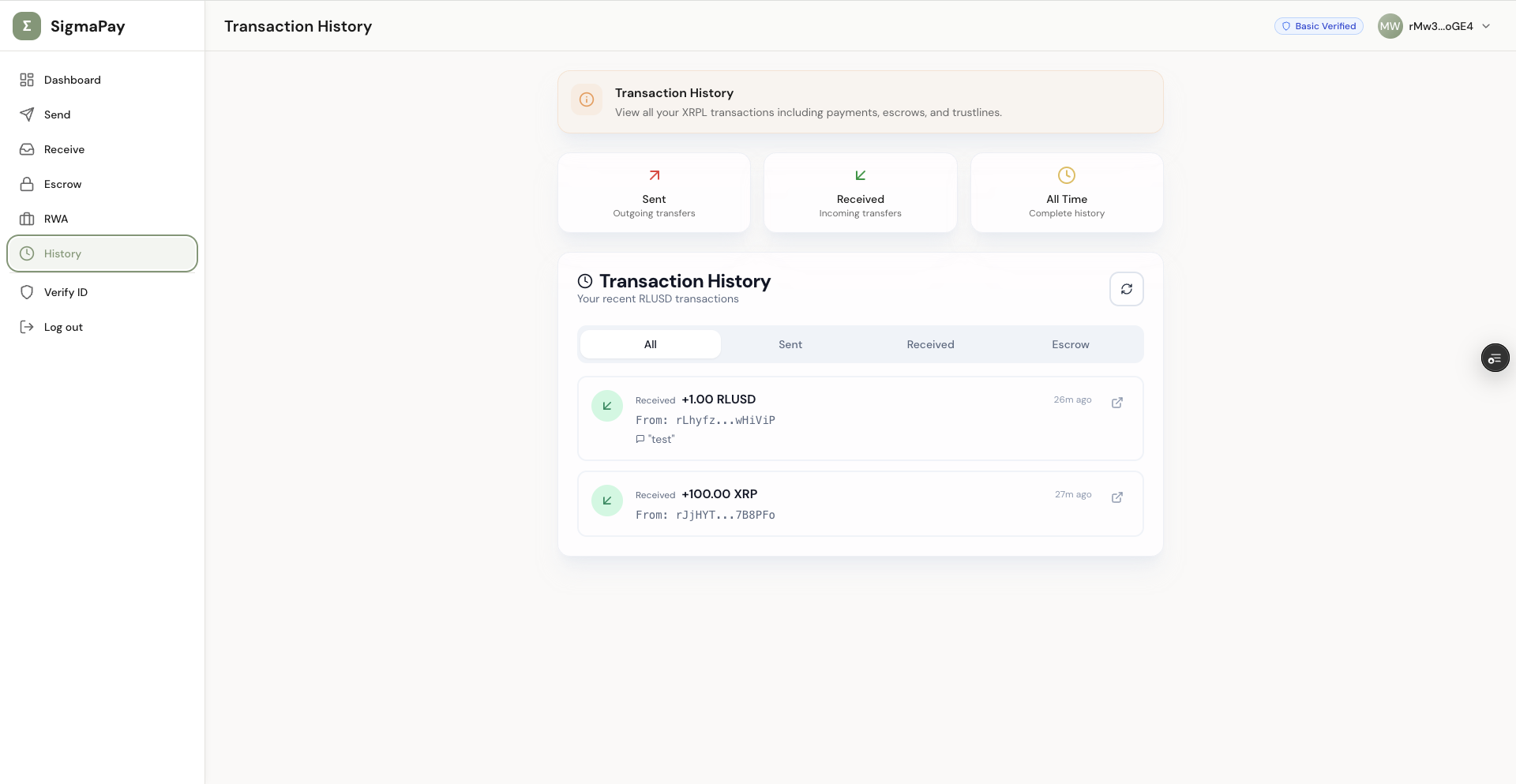
Our payment architecture leverages XRPL's native transaction types to optimize for different use cases. For verified users, we execute direct Payment transactions with RLUSD, settling in 3-5 seconds at negligible cost. For unverified users, we utilize XRPL's Check feature to create claimable payment instruments. The recipient can review sender verification status and choose whether to cash the check, providing protection against unwanted or suspicious transfers. All payments support memo attachments, enabling personal messages and payment references to travel with the transaction on-chain.
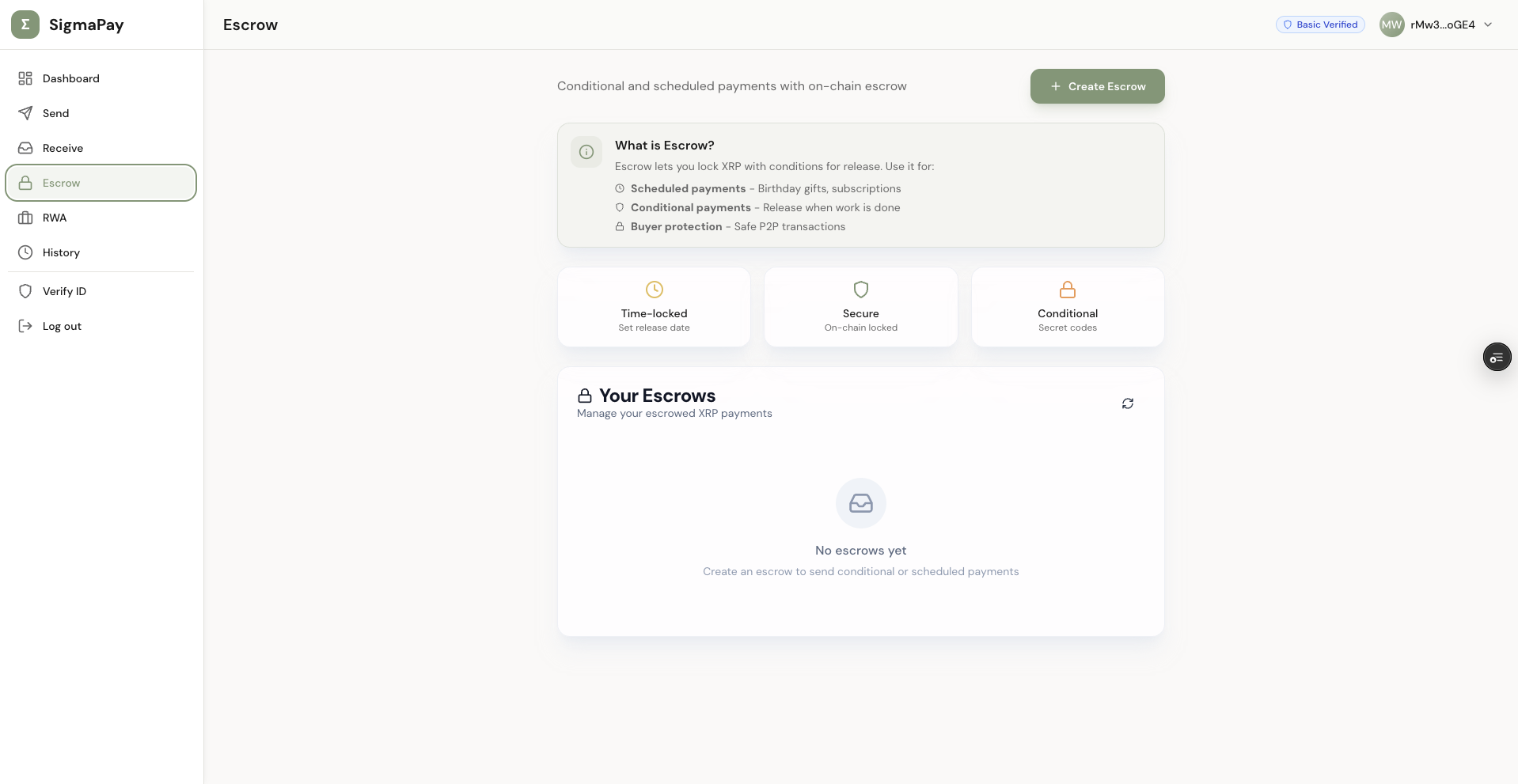
The escrow module extends our payment capabilities with time-locked conditional transfers. Using XRPL's native EscrowCreate and EscrowFinish transactions, users can create payments that release only when specific conditions are met. Our implementation supports time-based conditions for scheduled payments, as well as cryptographic conditions using SHA-256 hashlock for trustless conditional release. This enables use cases such as milestone-based freelance payments, rental deposits with automatic release, and cross-border trade settlement where payment releases upon delivery confirmation.
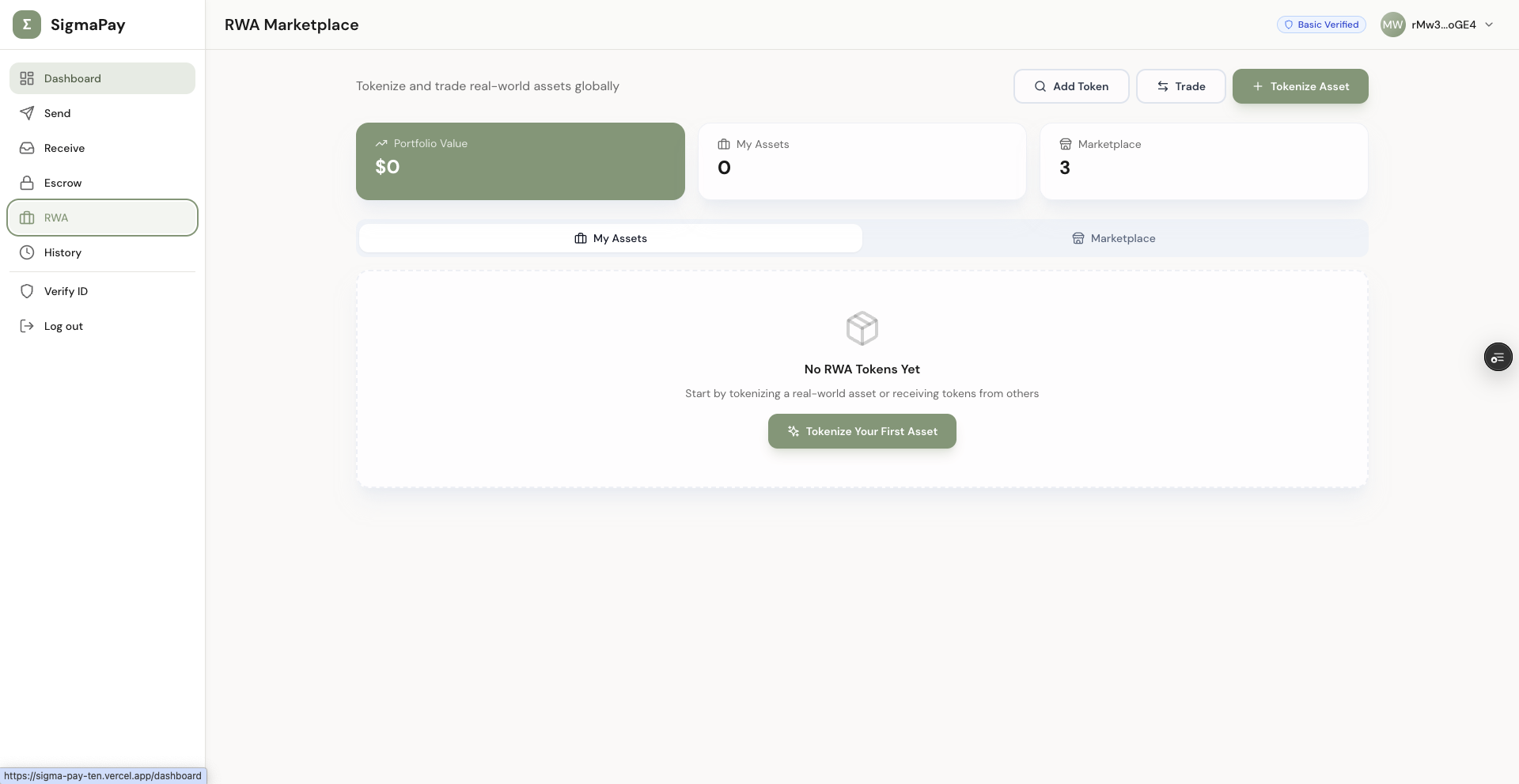
SigmaPay's RWA Marketplace represents our most ambitious feature, bringing real-world asset tokenization to everyday users. Verified users can tokenize physical assets including real estate, commodities, art, trade finance instruments, and credentials. The tokenization process creates issued currencies on XRPL with rich metadata stored in transaction memos, including asset descriptions, valuations, documentation links, and compliance information. These tokens can be transferred globally in seconds, with recipients automatically establishing trustlines to receive assets.
The marketplace interface allows users to browse available RWA tokens, view issuer verification status, and receive tokenized assets from anywhere in the world. We enforce verification requirements for token issuance, ensuring that only identified users can create new assets. This trust layer is critical for RWA adoption, as recipients need assurance about issuer legitimacy. All token metadata and transfer history remains verifiable on the public ledger, providing transparency without sacrificing user privacy.
Our technical architecture prioritizes security and user experience. Wallet management uses AES-256 encryption with user passwords, ensuring private keys never leave the client device. We integrate with Crossmark browser extension for users who prefer hardware-backed key management. The frontend is built with Next.js 14 and TypeScript, deployed on Vercel for global edge performance. Our backend API routes handle faucet interactions, price feeds, and chain state monitoring, insulating users from network reliability issues.
The platform connects to XRPL Testnet for the hackathon demonstration, with production deployment targeting XRPL Mainnet. We utilize RLUSD from Ripple's official testnet faucet, demonstrating real stablecoin integration rather than simulated tokens. All transactions are verifiable on the public XRPL testnet explorer, providing complete transparency into platform operations.
SigmaPay delivers a unified solution that eliminates the fragmentation currently experienced by users attempting cross-border transfers on XRPL. Rather than navigating multiple wallets, exchanges, and interfaces, users access remittances, escrow, and RWA capabilities through a single application. We abstract blockchain complexity entirely, presenting users with familiar fintech patterns while leveraging XRPL's unique capabilities under the hood.
Our platform directly addresses the remittance cost problem by reducing fees from 6-10% to effectively zero for the transfer itself, with only minimal XRP network fees measured in thousandths of a cent. Settlement time drops from days to seconds. The identity verification layer provides compliance infrastructure that traditional remittance services spend millions building, delivered natively through XRPL's DID system. The RWA marketplace opens entirely new possibilities for cross-border asset mobility that simply do not exist in traditional finance.
By combining XRPL's native Payments, Checks, Escrows, DIDs, and Trustlines into a cohesive user experience, SigmaPay demonstrates the full potential of the XRP Ledger as infrastructure for global financial inclusion. We are building the platform we wish existed for the hundreds of millions of people who send money across borders every month, and for the emerging economy of tokenized real-world assets that will define the next decade of finance.
How We Built It
We started with Next.js 14 using the App Router because we wanted a modern React framework with good performance out of the box. TypeScript was non-negotiable since we were dealing with financial transactions and needed the type safety. For the UI, we used Tailwind CSS with shadcn/ui components, which let us move fast without sacrificing polish.
The XRPL integration uses the official xrpl.js library (v3.1). We wrote wrapper functions for each transaction type we needed: Payments, Checks, Escrows, DIDSet, and TrustlineSet. The wallet system encrypts seed phrases with AES-256 using the crypto-js library, and we added Crossmark integration for users who already have XRPL wallets.
For the RWA marketplace, we leveraged XRPL's native trustline and IOU system. When a user tokenizes an asset, we create an issued currency with their address as the issuer and store metadata in transaction memos. The hex encoding for currency codes longer than three characters took some figuring out, but once we understood the format, it worked reliably.
The escrow system uses XRPL's native EscrowCreate with crypto conditions. We integrated the five-bells-condition library to generate and verify SHA-256 preimage conditions, enabling trustless conditional payments where funds release only when a secret is revealed.
We deployed on Vercel and created API routes to handle the testnet faucet and CoinGecko price feeds. This server-side approach solved CORS issues and let us add retry logic for when the faucet is busy.
Challenges We Faced
Time is one of our biggest constraints. We only built about 30% of the project before 8 Jan Wed 9pm due to unforseen circumstances.
The XRPL testnet faucet was another of our biggest headache. It would work fine for hours, then suddenly reject requests or time out. We ended up building a server-side API route that tries multiple faucet endpoints with exponential backoff and retries. Even then, sometimes you just have to wait.
Currency encoding on XRPL is not intuitive. Standard currencies like USD use three-character codes, but anything longer like RLUSD needs to be hex-encoded to exactly 40 characters. We spent hours debugging "invalid currency" errors before realizing that "RLUSD" needed to be "524C555344000000000000000000000000000000". The documentation exists, but it's easy to miss.
The DID system was tricky to implement correctly. XRPL's DIDSet transaction has specific requirements for the data format, and the documentation is sparse. We eventually got it working by studying existing DID transactions on the ledger and reverse-engineering the format.
State management between wallet creation and unlocking caused bugs early on. We had to carefully track whether a wallet was created, encrypted, and unlocked as separate states. A wallet could exist in storage but be locked, or be freshly created but not yet funded. Getting these states right took several iterations.
Finally, the RWA metadata storage required creativity. XRPL memos have size limits, so we couldn't store entire documents on-chain. We settled on storing essential metadata in memos and using IPFS-style content hashes for larger documents, though the full IPFS integration is planned for post-hackathon development.
What We Learned
XRPL is genuinely underrated as a platform for financial applications. The native transaction types like Checks, Escrows, and DIDs mean you can build sophisticated financial products without writing smart contracts. Everything just works at the protocol level, settles in seconds, and costs almost nothing.
Building for compliance from day one is easier than retrofitting it later. The verification level system forced us to think about trust and limits early, which made the entire architecture cleaner. We now have a natural path for adding KYC integration without rebuilding the payment flow.
User experience matters more than technical sophistication. We spent significant time making the interface feel like a normal fintech app rather than a crypto wallet. Most users should never need to know they're interacting with a blockchain.
Testing on testnet is essential but has limitations. The testnet faucet reliability issues taught us to build resilient systems, but we also learned that some bugs only appear under real mainnet conditions. Our architecture is designed to switch networks with minimal changes.
Contract Addresses:
XRPL Testnet:
- RLUSD Token Issuer: rQhWct2fv4Vc4KRjRgMrxa8xPN9Zx9iLKV (from tryrlusd.com)
- RWA Token Issuer: [if you created any tokenized assets]
Note: SigmaPay uses native XRPL transactions (Payments, Checks, Escrows, DIDSet) rather than smart contracts. All transactions are verifiable on https://testnet.xrpl.org

Log in or sign up for Devpost to join the conversation.