-
-
-
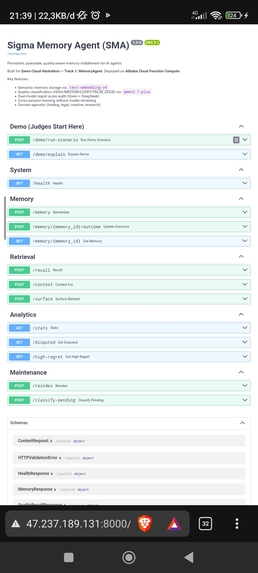
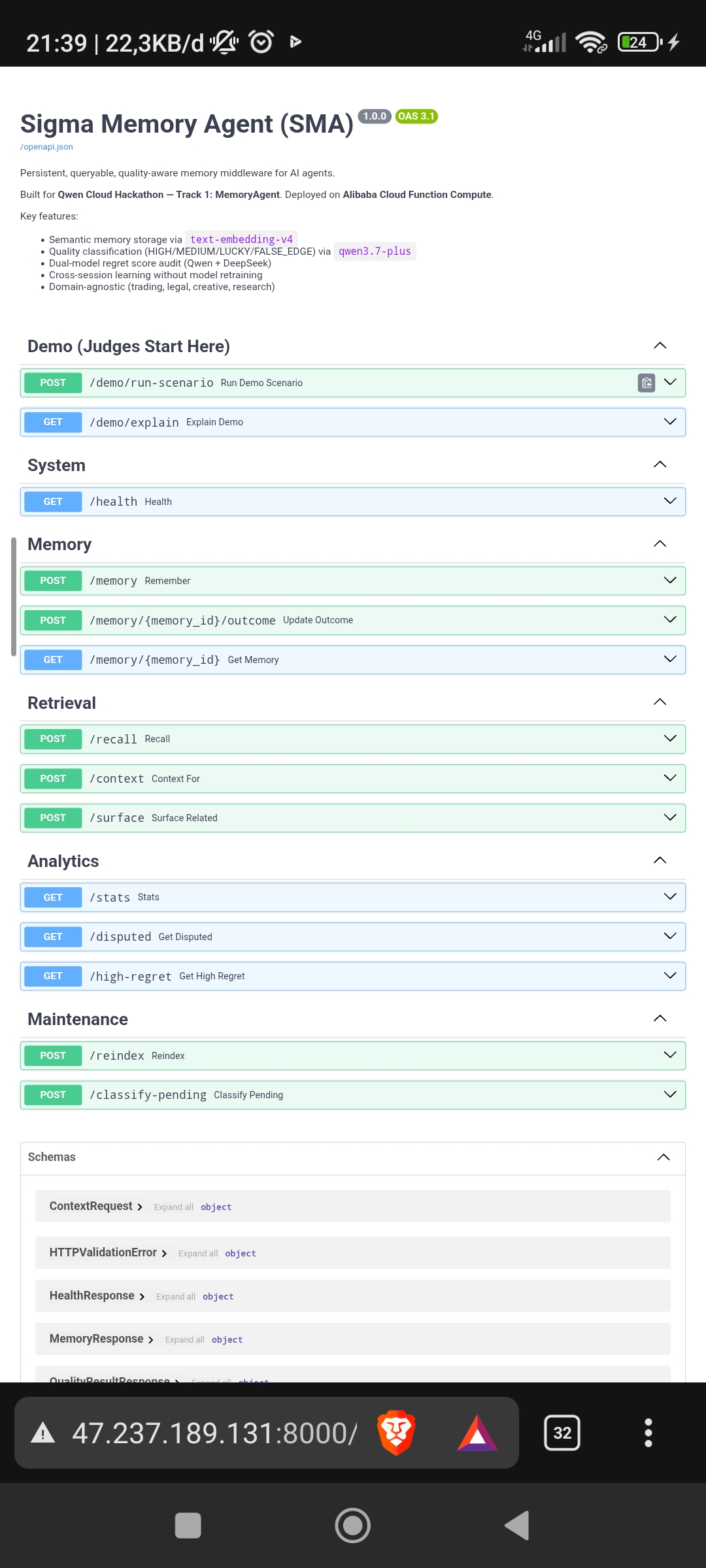
Interactive API for judment with Demo endpoint.
-
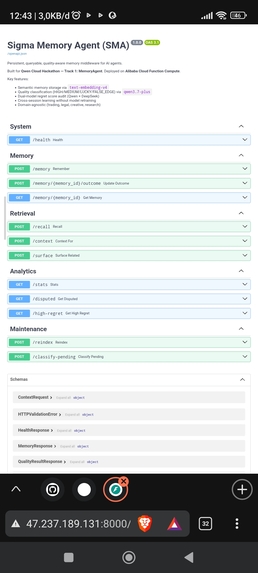
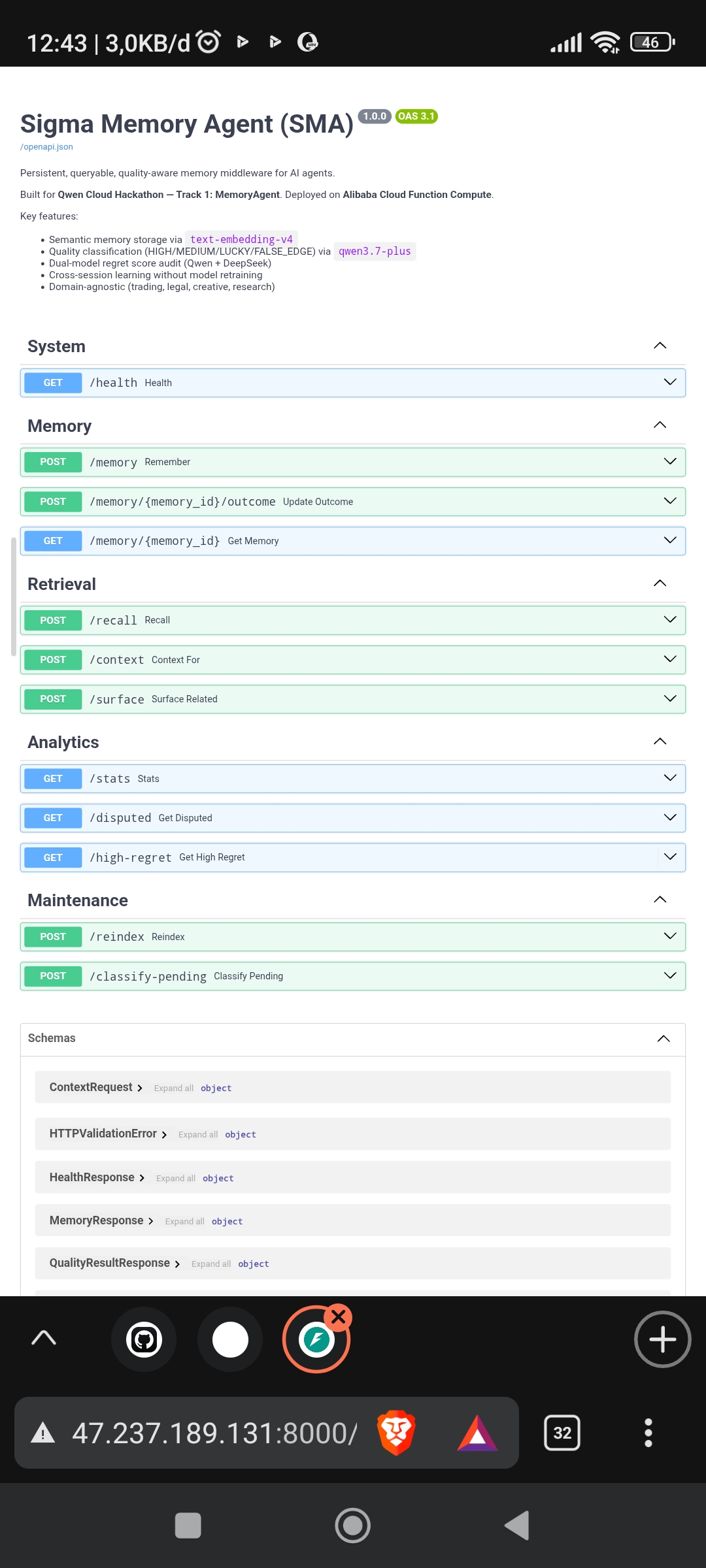
Interactive API documentation demonstrating how developers can integrate SMA into existing AI workflows.
Inspiration
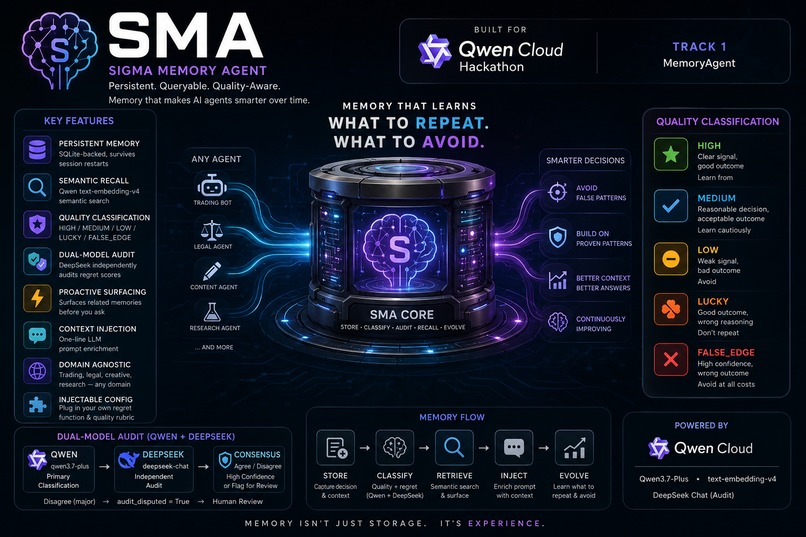
Large Language Models have become incredibly capable, yet they all share the same limitation—they forget. Most AI agents restart every conversation without remembering previous outcomes, cannot distinguish successful experiences from failed ones, and have no reliable long-term memory layer. We built Sigma Memory Agent (SMA) to solve this problem. Instead of treating memory as simple storage, SMA treats memory as experience—capturing what should be remembered, what should be avoided, and continuously improving future decisions.
What it does
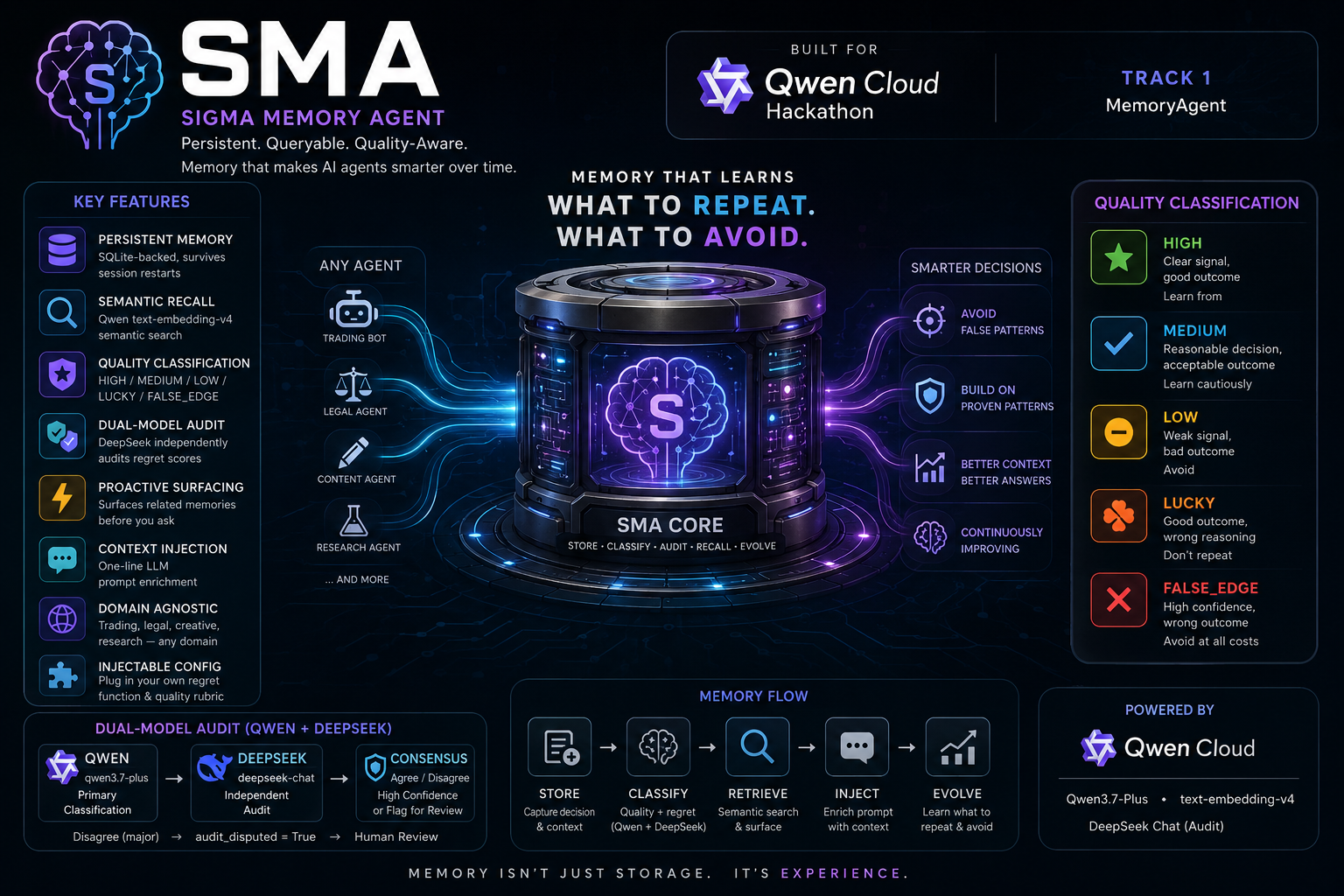
Sigma Memory Agent is a portable, quality-aware memory infrastructure for AI agents. It enables any AI agent to: Store persistent memories across sessions Perform semantic memory retrieval Classify memories by outcome quality Learn what to repeat and what to avoid Audit important decisions using dual-model verification Inject relevant context back into LLM prompts Work across different AI domains without changing the architecture Unlike traditional vector databases, SMA doesn't simply retrieve similar memories—it evaluates whether those memories actually led to good outcomes.
How we built it
SMA is implemented as a production-ready REST API. The system combines: Qwen text-embedding-v4 for semantic retrieval Qwen3.7-Plus for memory quality classification DeepSeek Chat as an independent auditing model SQLite for lightweight persistent storage FastAPI for high-performance APIs The architecture is intentionally framework-independent, allowing any AI agent to integrate persistent memory through simple API calls.
Challenges we ran into
One of the biggest challenges wasn't storing memories—it was deciding which memories deserved to be remembered. Good outcomes can come from poor reasoning, while correct reasoning can sometimes produce poor outcomes due to external factors. To address this, SMA introduces quality-aware memory classification and optional dual-model auditing, helping AI agents distinguish between reliable knowledge and misleading experiences.
Accomplishments that we're proud of
Built a portable memory architecture instead of a single-purpose application. Implemented persistent memory with semantic retrieval. Added quality-aware memory classification. Added independent dual-model auditing. Designed a framework-independent REST API that can be integrated into virtually any AI agent.
What we learned
Building better AI isn't only about larger language models. Long-term usefulness depends on giving AI agents reliable memory, meaningful context, and mechanisms for learning from experience. Memory should not only answer: "What happened?" It should also answer: "Should this experience influence future decisions?"
What's next for Sigma Memory Agent (SMA)
Multi-agent shared memory Distributed memory synchronization Plugin ecosystem Enterprise governance and compliance Support for additional embedding models Cloud-native deployment Human feedback reinforcement Production integrations with autonomous AI systems SDKs and developer libraries for Python, JavaScript, and other ecosystems Framework adapters for LangChain, CrewAI, AutoGen, OpenAI Agents SDK, and future agent frameworks Our long-term vision is to make Sigma Memory Agent more than a standalone service. We envision SMA as the memory infrastructure and developer library that AI engineers can plug into any intelligent agent—without rebuilding long-term memory from scratch. Just as databases became essential building blocks for modern software, we believe persistent, quality-aware memory will become a fundamental building block for the next generation of autonomous AI systems. Our goal is simple: To become the persistent memory layer every AI agent—and every AI developer—can rely on.


Log in or sign up for Devpost to join the conversation.