-
-
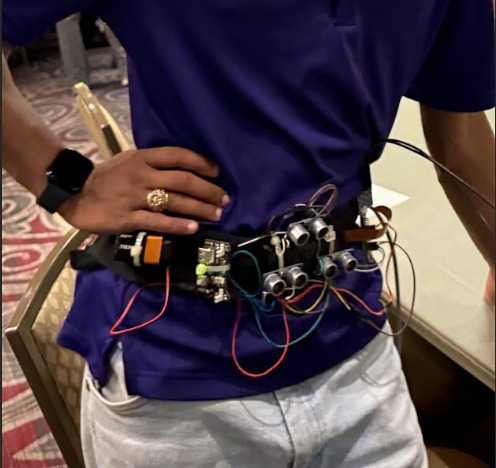
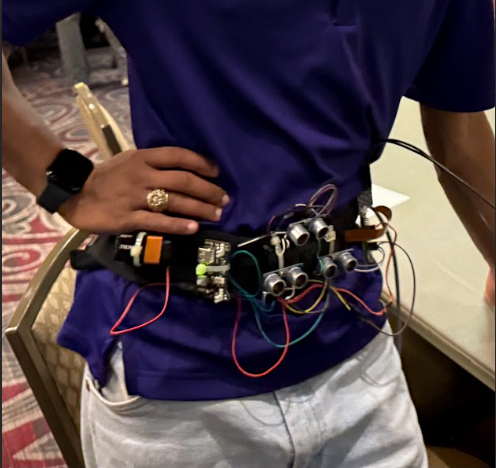
hackathon prototype: camera with 3 ultrasonic sensors to sense objects on the left, right and center of the user
Hardware Challenge
Inspiration
Our motivation for Seer AI was to help visually impaired individuals navigate their surroundings safely and independently. Traditional mobility aids such as canes and guide dogs have limitations, so we wanted to create a modern solution leveraging Artificial Intelligence, computer vision, and sensor technology. We decided to build a wearable device that enables navigation by sensing and giving the user real-time situational data through audio.
What it does
How we built it
The device was built using a Raspberry Pi as the processing unit, equipped with the Picamera2 for capturing high-resolution images. Object detection was implemented using OpenCV and the YOLO framework, which provided robust and accurate recognition of objects in real-time. Ultrasonic sensors were integrated to measure the distance of each object to the user. Real-time audio feedback was generated using the pyttsx3 library to announce detected objects and their distances.
Project Outcomes
Throughout the project, we deepened our understanding of computer vision techniques, particularly object detection using YOLO, and how to integrate it with hardware like cameras and ultrasonic sensors. We learned to work with the Picamera2 library for efficient image processing and gained hands-on experience configuring and optimizing sensor hardware. Additionally, we developed skills in real-time audio feedback systems and systems integration.


Log in or sign up for Devpost to join the conversation.