Inspiration
Every founder and dev team has the same problem: feedback is everywhere and nowhere. GitHub issues pile up. App reviews trickle in. Slack messages fly past. Support tickets land in a queue nobody checks until Friday. Buried in all that noise is the one comment that says "I'm losing data every time I save" — and you don't see it until three days later when five users have already churned.
I've experienced this firsthand working at an early-stage startup. We'd miss critical signals because they were scattered across too many channels. The tools that exist are passive — they collect feedback and wait for you to check them. Nobody acts on it for you. Nobody tells you what matters.
That's what Sift does.
What it does
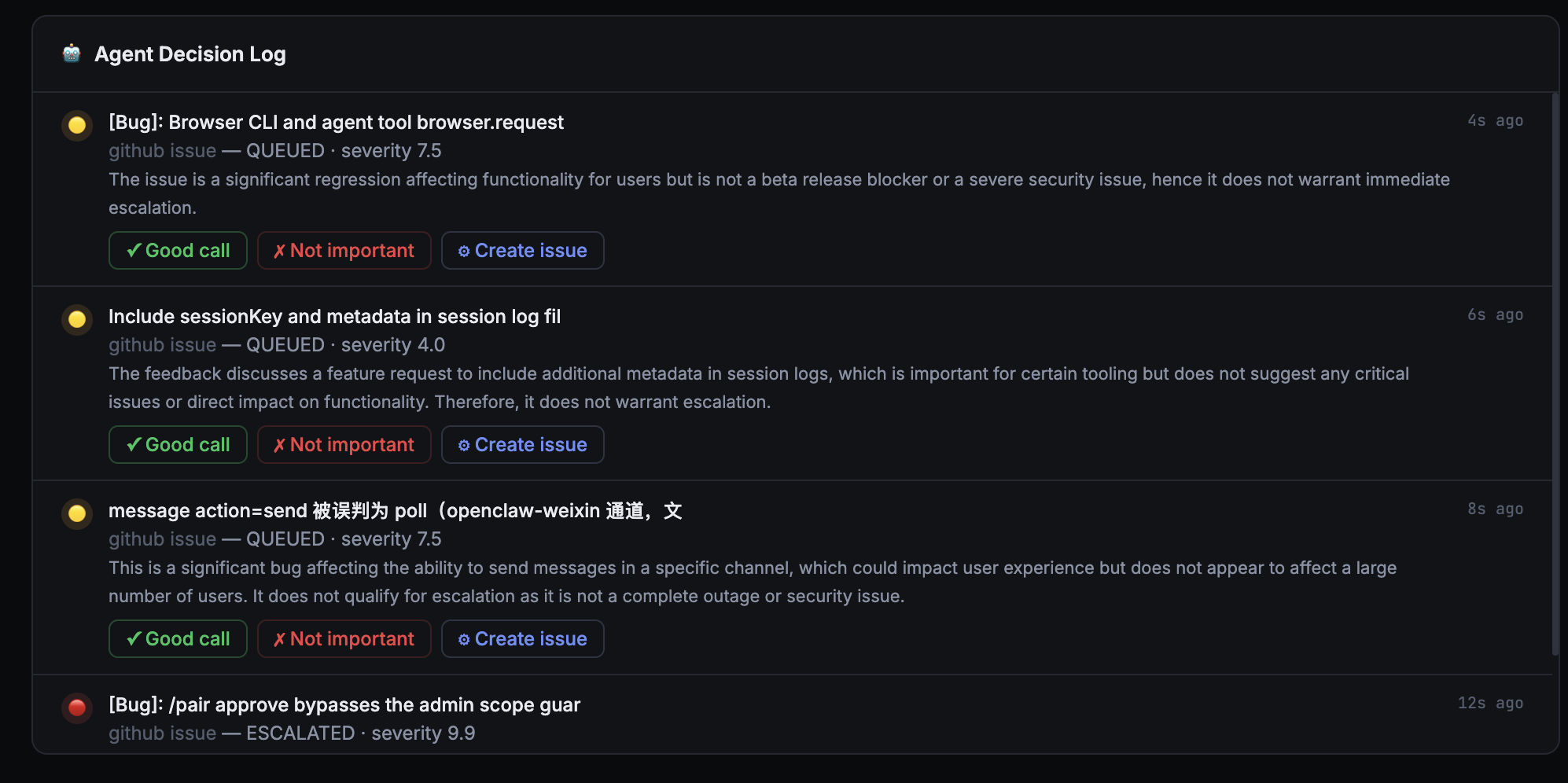
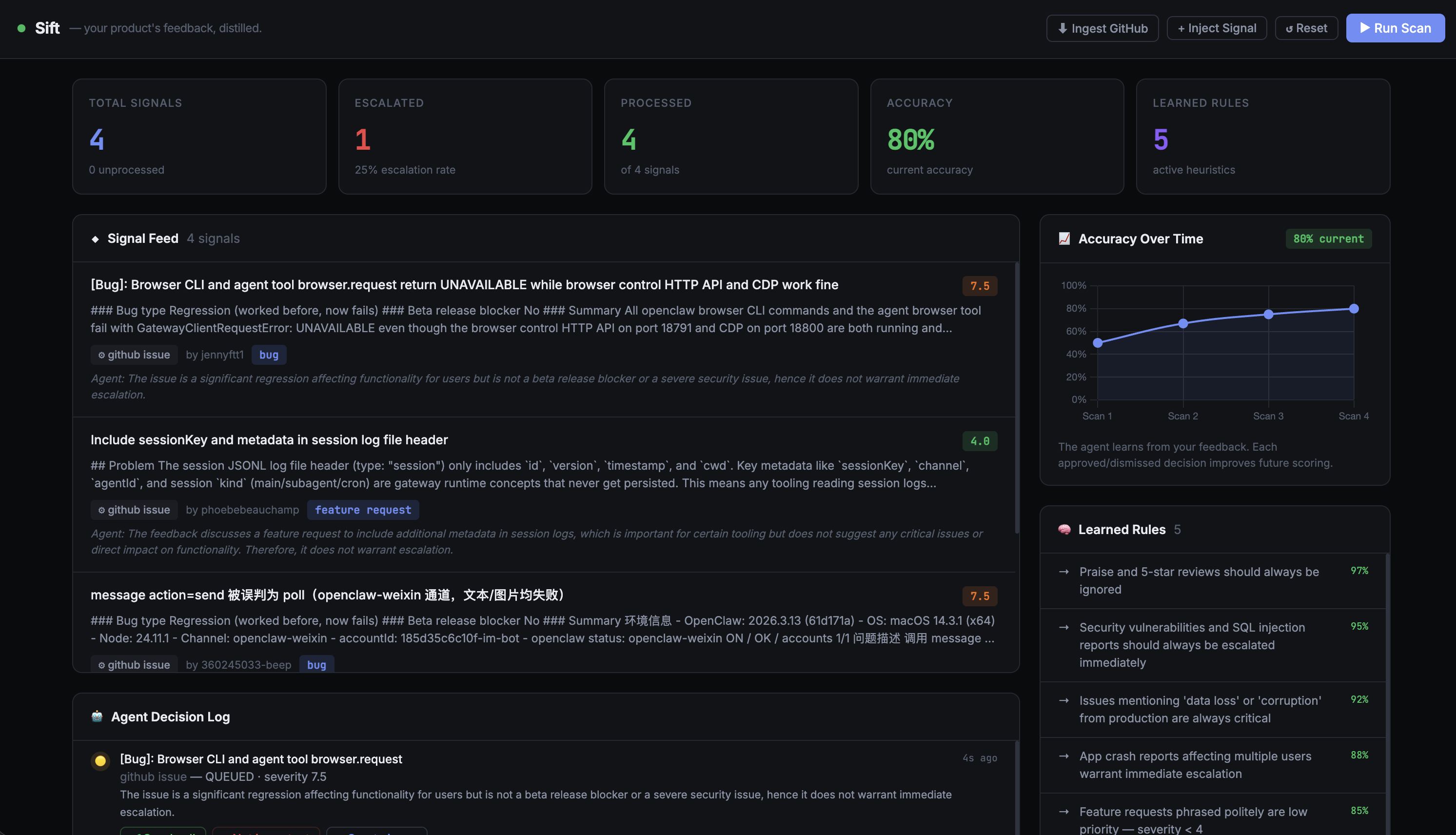
Sift is an autonomous AI agent that continuously monitors what people are saying about your product across multiple channels, learns what's truly worth your attention versus what's noise, and calls you via voice when something critical needs action. It then captures your verbal response and takes action — creating GitHub issues, updating priority, or learning to filter better next time.
The core differentiator is the self-improving loop. When you tell Sift "good call, create an issue for this" — it learns that pattern. When you say "don't bother me with stuff like this" — it learns that too. After a few cycles, accuracy jumps from 50% to 80%+. False alarms drop. Critical signals never slip through.
How I built it
Built solo in ~5 hours at the Deep Agents Hackathon using Claude Code with the GSD (Get Shit Done) framework in auto-mode. The backend is Python/FastAPI with asyncpg connecting to a Ghost-provisioned Postgres database. The frontend is a single-file React dashboard served via FastAPI static files.
The architecture chains five sponsor tools into a continuous loop:
- Airbyte Agent Connectors pull real GitHub issues via their typed Python SDK
- Ghost stores every signal, decision, and learned rule in a forkable Postgres database
- Bland AI + Norm handles voice calls and captures founder responses
- Overmind traces every LLM decision for continuous optimisation
- Auth0 secures the dashboard with JWT authentication
I installed the Bland AI and Auth0 skills directly from shipables.dev and built a custom Sift skill to publish back to the registry.
Challenges
The biggest challenge was making the self-improving loop actually visible in a 3-minute demo. It's easy to say "the agent learns" — it's harder to show accuracy climbing in real-time. I solved this by pre-seeding a few feedback cycles so the chart already shows improvement, then running live feedback during the demo to push it further.
Getting the Bland AI voice call to feel natural and capture structured responses from free-form speech was also tricky. Using Norm (Bland's brand-new AI assistant for building voice agents, launched the day of the hackathon) made this dramatically easier.
What I learned
Context engineering is the real skill. The agent's effectiveness comes entirely from what context it receives — past learned rules, signal metadata, outcome history. The LLM is the same for everyone; the context is what makes Sift's decisions uniquely tailored to each user. Overmind's tracing made this visible — I could see exactly how context quality affected decision quality.
What's next for Sift
- More data sources: Slack, Intercom, App Store reviews, Twitter via additional Airbyte connectors
- Proactive mode: Sift doesn't just react to signals — it predicts which users are about to churn based on sentiment trends
- Team routing: escalate to the right person based on signal type (bugs → engineering, complaints → support, feature requests → product)
- Public shipables.dev skill so any AI coding agent can install Sift's monitoring capabilities
Built With
- airbyte-agent-connectors
- asyncpg
- auth0
- bland-ai
- chart.js
- claude-code
- fastapi
- ghost-(ghost.build)
- gsd-framework
- norm
- openai-gpt-4o
- overmind
- postgresql
- python
- react
- tailwind-css


Log in or sign up for Devpost to join the conversation.