💡 Inspiration
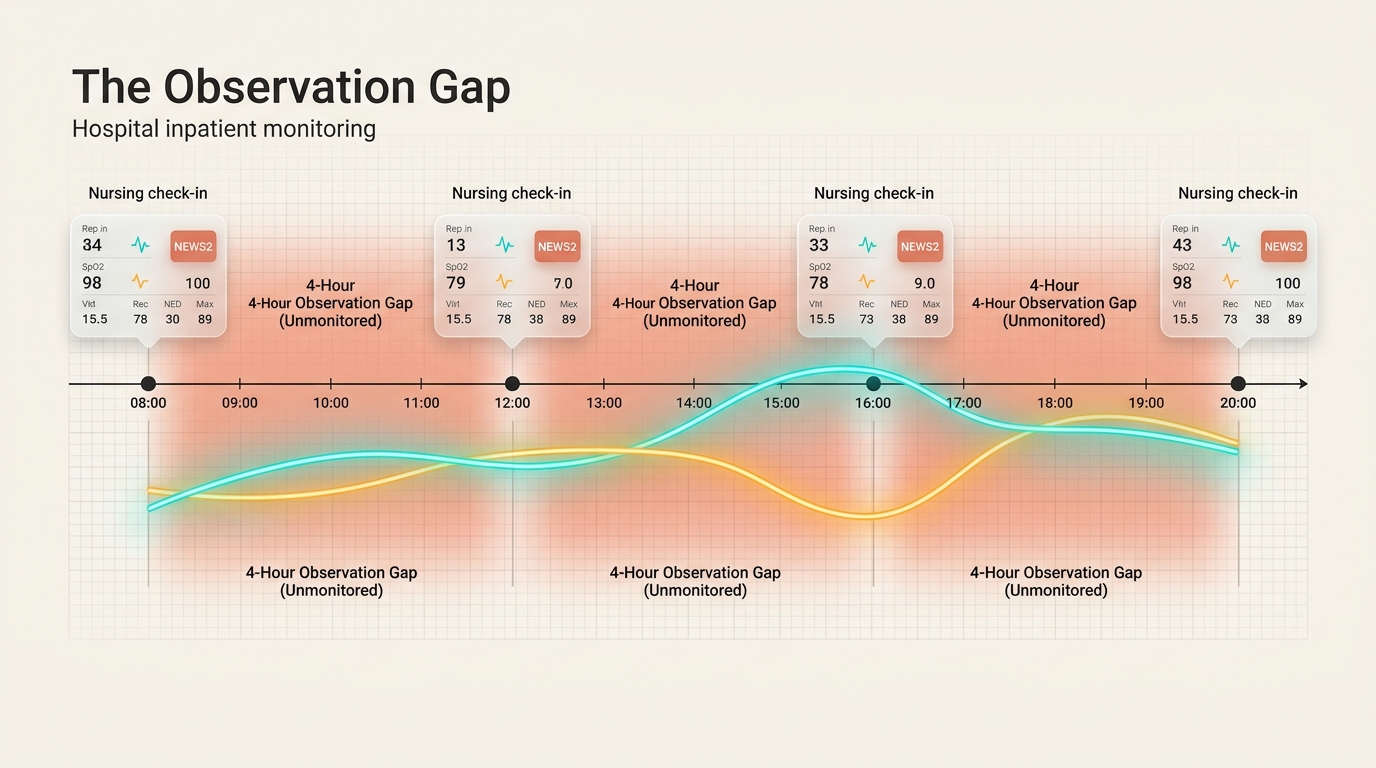
On general medical-surgical hospital wards, vital signs and NEWS2 scores are charted intermittently—typically every 4 to 6 hours. Between rounds, acute respiratory deterioration often develops silently. However, hospital wards cannot simply deploy continuous monitors indiscriminately: unchecked telemetry leads to motion artifacts, false alarms, and severe nursing alarm fatigue.
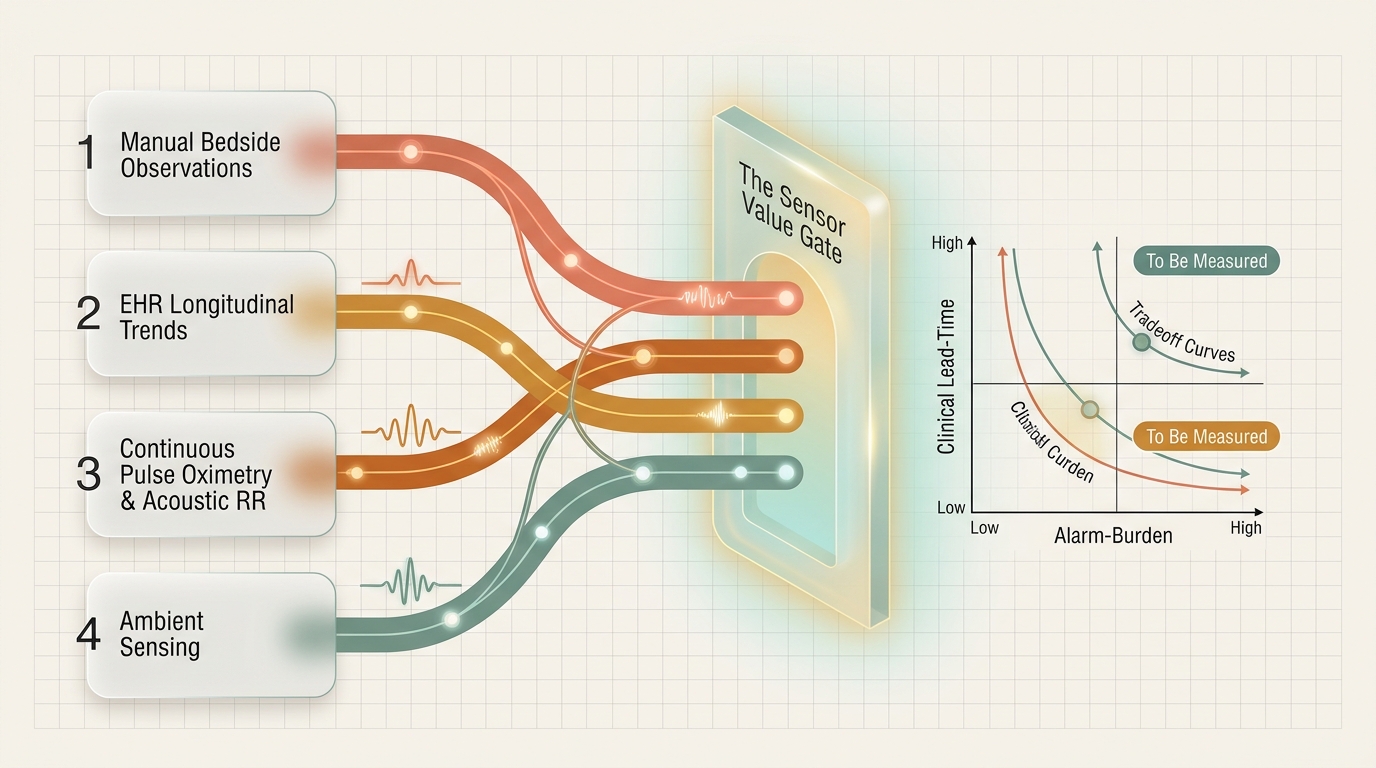
We built SIFT-Ward around a core question: "Every sensor must earn its alert." We wanted to create an early-warning pathway where supplemental continuous and EHR data are evaluated against strict signal quality and clinical utility thresholds before triggering bedside alerts.
🩺 What it does
SIFT-Ward is a data-quality-aware early-warning system prototype designed for adult medical-surgical ward patients with new or escalating oxygen requirements:
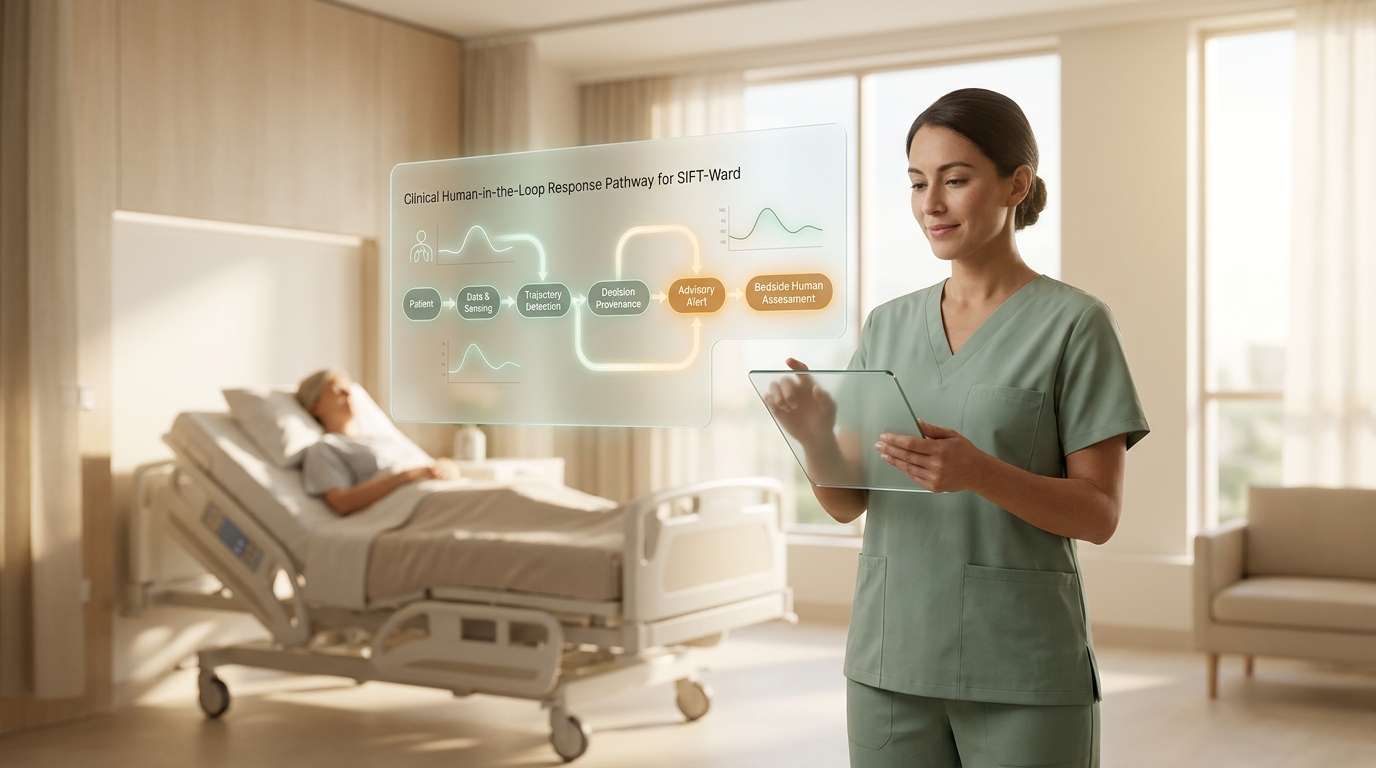
The Sensor Value Gate: Directly compares routine bedside observations (NEWS2), longitudinal EHR trends, and quality-checked continuous physiological telemetry to evaluate whether added data provides statistically meaningful early warning at an acceptable alarm burden. Signal Quality Gating (SQI): Rejects motion artifacts and sensor disconnects. Codifies the safety principle: "Missing or poor-quality data means uncertain—not low risk." Observation Gap Scrubber: An interactive 12-hour shift timeline contrasting routine episodic charting with silent sub-acute respiratory drift. Human-in-the-Loop Clinical Workflow: Directs advisory review requests to a named bedside nurse under existing hospital protocols, with a backup escalation route if unacknowledged. Clinical judgment unconditionally leads; no automated prescriptions or therapy changes. Real-Time Scenario Replay: Demonstrates baseline stabilization, emerging respiratory rate drift, and advisory alert dispatch. 🛠️ How we built it Frontend Architecture: React 18, TypeScript, and Vite. Cinematic & Vascular Motion: Built with Framer Motion (useScroll, useSpring, useTransform) and custom SVG motion paths. Includes a VascularFrame overlay with flowing bioluminescent blood particles along capillary pathways. Visual Design System: Custom "Bioluminescent Organic Clinical" light-mode identity featuring warm alabaster (#F6F3EE), terracotta coral (#D98A6C), and eucalyptus sage (#4B8C81) with JetBrains Mono tabular telemetry readouts. Safety Architecture: Strict clinical guardrails, non-clinical demo disclosures, and an accessible Standard Operating Procedure modal. ⚠️ Challenges we ran into Avoiding False Reassurance: A critical clinical safety requirement was ensuring missing or noisy telemetry is never misinterpreted by algorithms as a "normal" score. We designed the interface to surface explicit "Uncertain — Verify at Bedside" states whenever signal quality drops below 70%. Simulating Authentic Waveforms Without Clinical Noise: Generating realistic photoplethysmogram (PPG) pulses and rolling dual-axis SpO₂/RR trajectories locally while keeping the interface completely responsive. Complex Vascular SVG Math: Implementing smooth, continuous Framer Motion particle trajectories along branching coronary arterial and venous networks. 🏆 Accomplishments that we're proud of Crafted a visual identity that feels human, warm, and clinical rather than a cold admin dashboard or sci-fi control room. Built a working scenario replay engine that takes clinicians step-by-step through baseline vitals, respiratory drift, and advisory alert generation. Codified the "Sensor Value Gate" framework to solve real-world alarm fatigue. 📚 What we learned The hardest challenge in hospital early-warning AI is not model complexity, but alarm fatigue and clinical trust. An AI that triggers too many false alerts will be muted or ignored by ward staff. Continuous sensing must earn its place by proving actionable incremental lead time over simpler EHR and bedside baselines. 🔮 What's next for SIFT-Ward Benchmark the Sensor Value Gate algorithm against open clinical datasets (PhysioNet MIMIC-IV and eICU Collaborative Research Database). Develop SMART on FHIR integration to ingest real-time flowsheet data from hospital EHRs (Epic / Oracle Health). Conduct prospective silent shadow testing on a partner ward to quantify true false-alarm rates before any interventional pilot.
Built With
- clinical-ux
- digital-health
- early-warning-system
- framer-motion
- lucide-react
- news2
- react
- svg-animation
- typescript
- vite
