-
-
SIFT Guardian: The AI Analyst That Verifies Its Own Findings
Inspiration
Modern incident response teams are overwhelmed by the volume of security alerts, forensic artifacts, and investigation data they must analyze. While AI can accelerate investigations, it often produces hallucinated findings or conclusions that cannot be traced back to actual evidence. We wanted to build an autonomous incident response agent that behaves like a senior analyst—one that validates its own conclusions, cross-references multiple sources of evidence, and corrects itself when inconsistencies are detected.
What it does
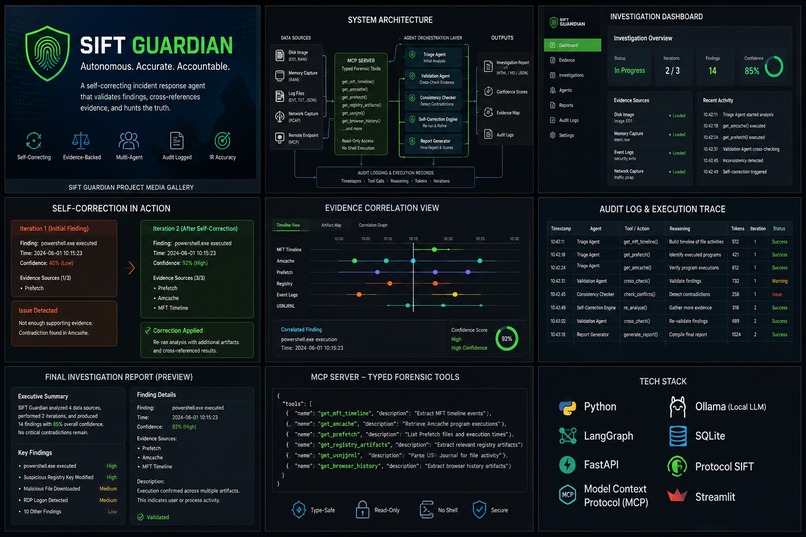
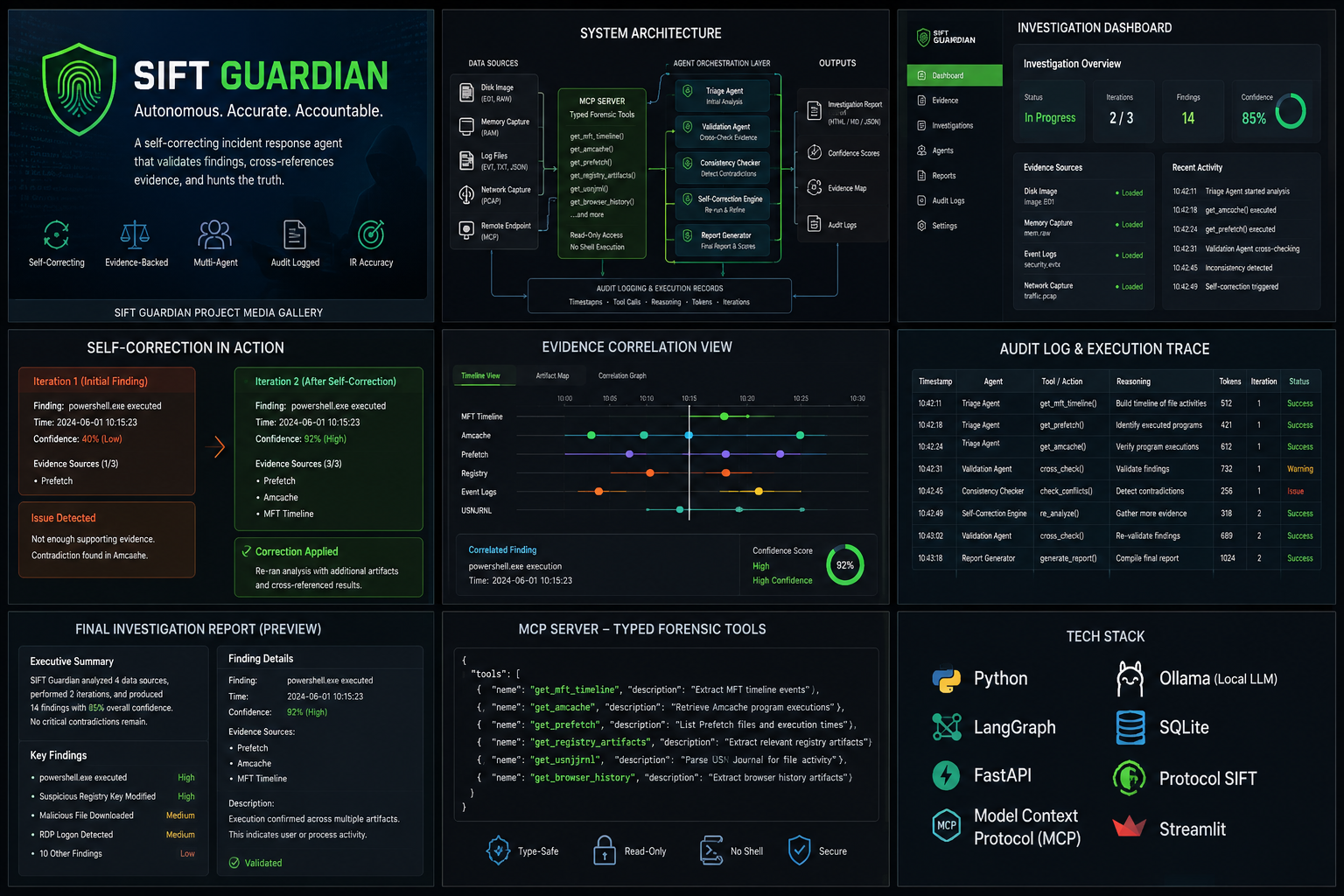
SIFT Guardian is a self-correcting autonomous incident response agent built on Protocol SIFT. It analyzes forensic evidence through a secure MCP-based tool layer, correlates findings across multiple sources, validates conclusions using independent evidence, and automatically re-runs analysis when confidence is low or contradictions are found.
The system generates confidence-scored findings, maintains complete audit trails, and produces evidence-backed investigation reports. Every conclusion can be traced to the forensic artifacts that support it, reducing hallucinations and increasing trust in AI-assisted investigations.
How we built it
We designed SIFT Guardian using a hybrid architecture that combines a typed MCP tool layer with a multi-agent workflow.
The MCP layer exposes structured forensic functions instead of unrestricted shell access, improving safety and evidence integrity. Multiple specialized agents collaborate during the investigation process:
- Triage agent identifies relevant artifacts and initial findings.
- The validation agent cross-checks findings against independent evidence sources.
- The consistency checker detects contradictions and missing evidence.
- The self-correction engine automatically triggers additional analysis when confidence thresholds are not met.
- Report Generator produces a final investigation report with confidence scores and supporting evidence.
The system also records structured execution logs containing tool usage, timestamps, reasoning steps, and validation outcomes.
Challenges we ran into
One of the biggest challenges was balancing autonomy with accuracy. Allowing an AI agent to operate independently increases efficiency, but it also increases the risk of incorrect conclusions.
Another challenge was designing a self-correction workflow that could detect inconsistencies without creating endless execution loops. We implemented confidence thresholds, validation checkpoints, and iteration limits to ensure the system remained reliable and predictable.
Maintaining evidence traceability while keeping the workflow autonomous was also a significant design challenge.
Accomplishments that we're proud of
- Built a self-correcting incident response workflow instead of a simple AI chatbot.
- Implemented evidence-backed validation to reduce hallucinated findings.
- Created confidence-scored findings that explain why a conclusion was reached.
- Designed a structured audit trail that records every agent decision and tool execution.
- Demonstrated how AI agents can improve investigation speed while preserving analyst trust and accountability.
What we learned
This project reinforced the importance of evidence validation in AI-driven security workflows. We learned that autonomous systems become significantly more trustworthy when they can explain their reasoning, verify their own conclusions, and transparently document every step they take.
We also gained experience designing agentic systems that balance automation with forensic rigor, showing that self-correction is often more valuable than simply increasing model intelligence.
What's next for SIFT Guardian
Future development will focus on expanding support for additional forensic data sources such as memory captures, network packet captures, cloud logs, and remote endpoint telemetry.
We also plan to:
- Add advanced multi-source correlation across disk, memory, and network evidence.
- Integrate with live SIEM and EDR platforms through MCP.
- Develop a benchmarking framework for measuring investigation accuracy and hallucination rates.
- Introduce analyst feedback loops that allow the system to continuously improve over time.
- Enhance explainability features to support analyst training and knowledge transfer.
Our long-term vision is to create an autonomous incident response platform that security teams can trust to investigate, validate, and explain findings with the same rigor expected from experienced human analysts.
Built With
- agent
- and
- audit
- checker
- confidence
- consistency
- context
- deepseek
- engine
- execution
- fastapi
- forensic
- generator
- git
- github
- implementation
- iq-engines
- json-based
- langgraph
- layer
- llm
- logging
- logs
- mcp
- model
- models
- natural-language-processing
- ollama
- protocol
- python
- qwen
- records
- report
- scoring
- self-correction
- server
- sift
- sqlite
- structured
- system
- tool
- toolkit
- triage
- validation


Log in or sign up for Devpost to join the conversation.