Inspiration
Ask a chatbot which of twelve contractor bids to take and you'll have an answer in ten seconds. Confident. Plausible. Useless.
Useless because you're the one signing the award, and "the AI said so" isn't a reason you can give anyone. Because when you ask why the third bid lost, it makes something up. Because when you say "actually, the deposit schedule matters more to me," it starts over and hands you a different answer with the same confidence. And because it never once said "these bids aren't comparable yet." It just ranked them.
That's the gap. Not the first answer — models are good at first answers. The answer you can come back to tomorrow, challenge, change one input on, and put your name to. That takes a record of what was checked, what wasn't, and who decided. A model won't build that on its own. So I built the thing around the model that does.
Sift works the other way round from a chatbot. You say what matters. It works out what has to be established before an answer is even allowed, goes and establishes it, tells you plainly what it couldn't, and keeps the decision where it belongs. With you.
What it does
You name the factors, including ones nobody anticipated. Will a dog crate fit in the boot? Does
the deposit schedule leave you exposed? Type it in and the case grows a new typed attribute on the
spot, under a custom. namespace enforced in packages/core/src/extensions.ts, carrying who asked
for it and why. From then on it is a real column on every option. A model working through the
WebMCP tools can fill it in across the options and has to say unknown where it can't; a person
can confirm it; and an unknown is never scored as a zero. Missing data lowers coverage, not the
score. You are not picking from a menu somebody else wrote.
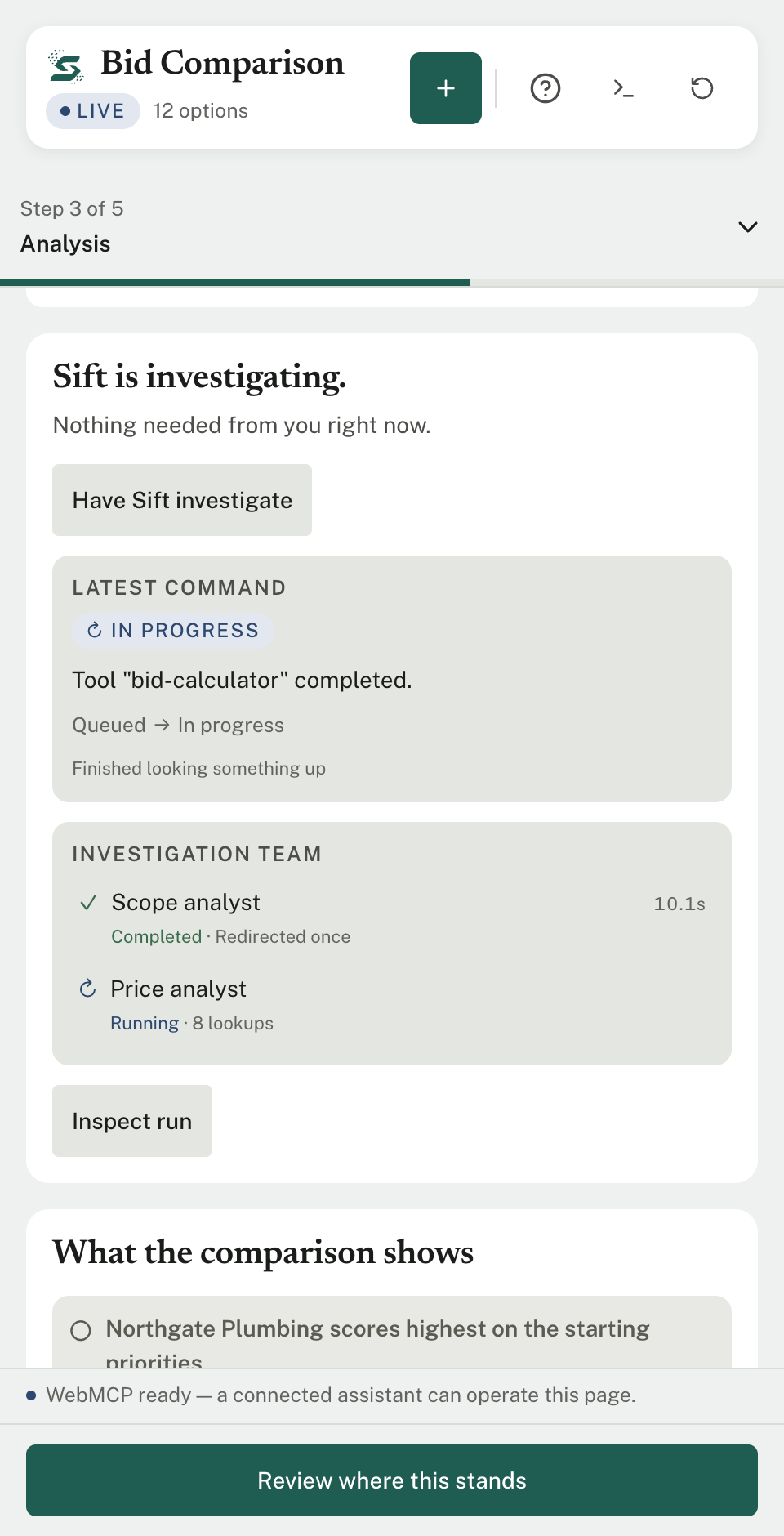
It works out what to do next from the evidence, not from a script. A decision pack declares the obligations that must be satisfied before an answer is allowed. The engine picks the next one from the current state of the evidence and loads only the AgentSkill that obligation needs. As findings land, what it does next changes.
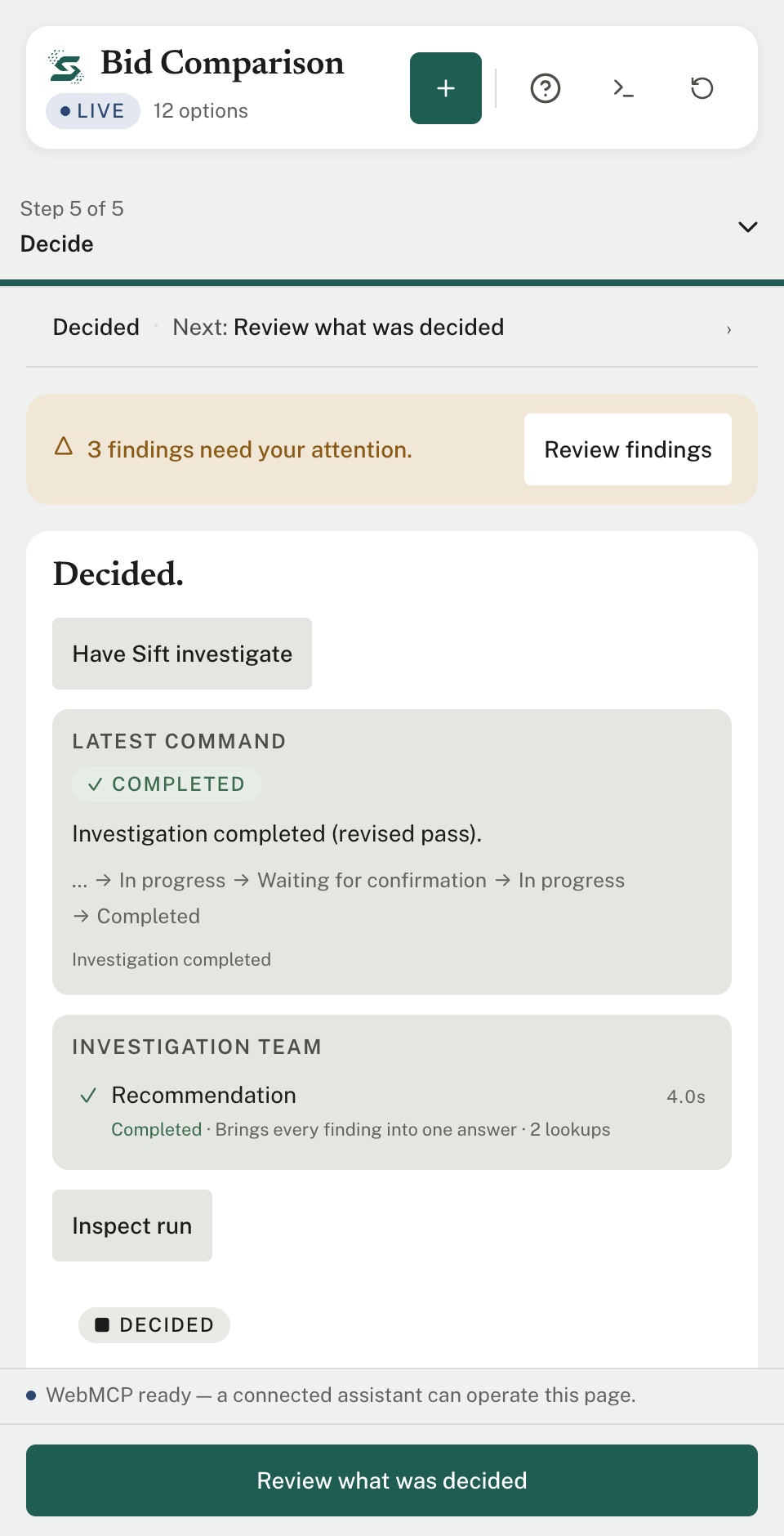
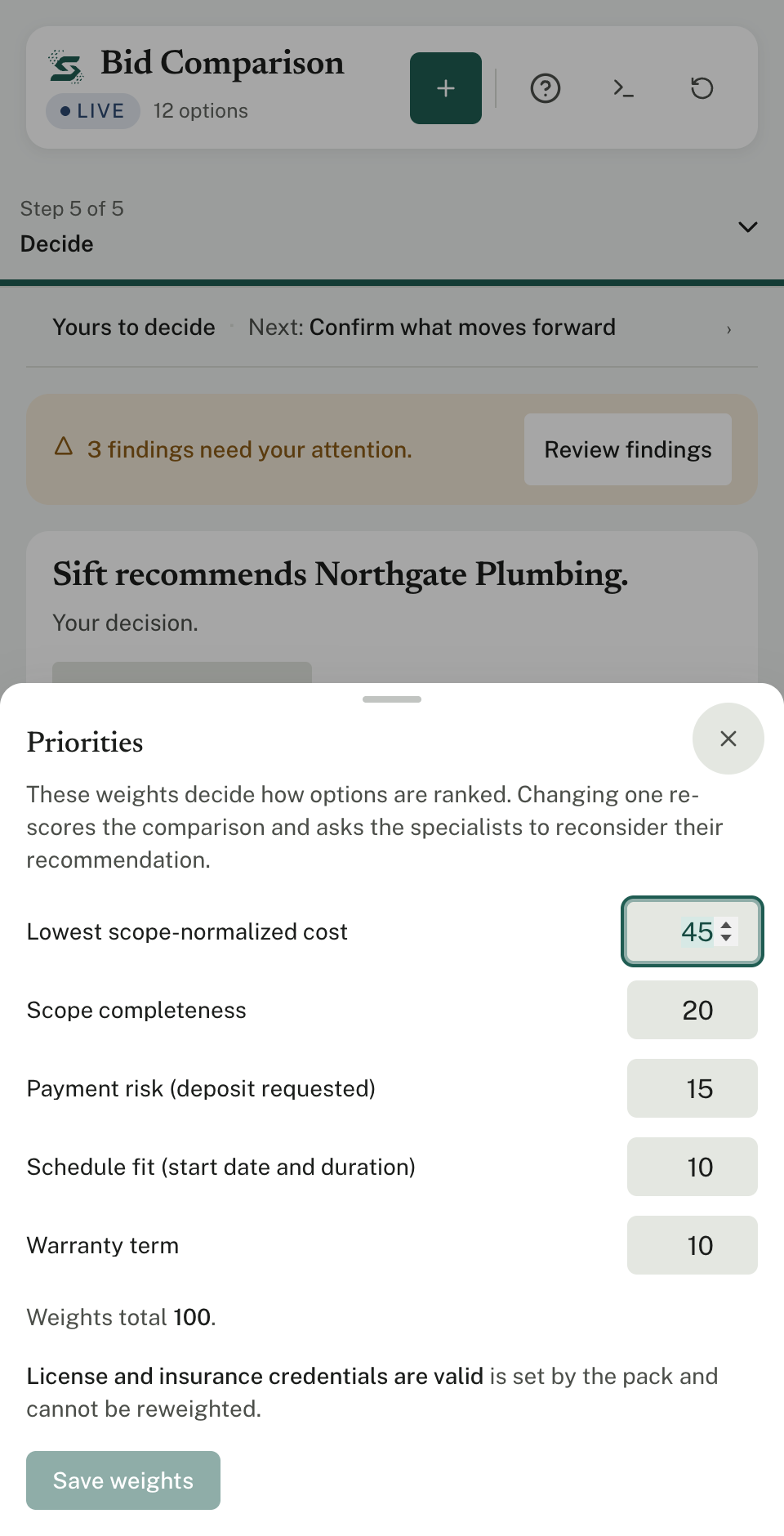
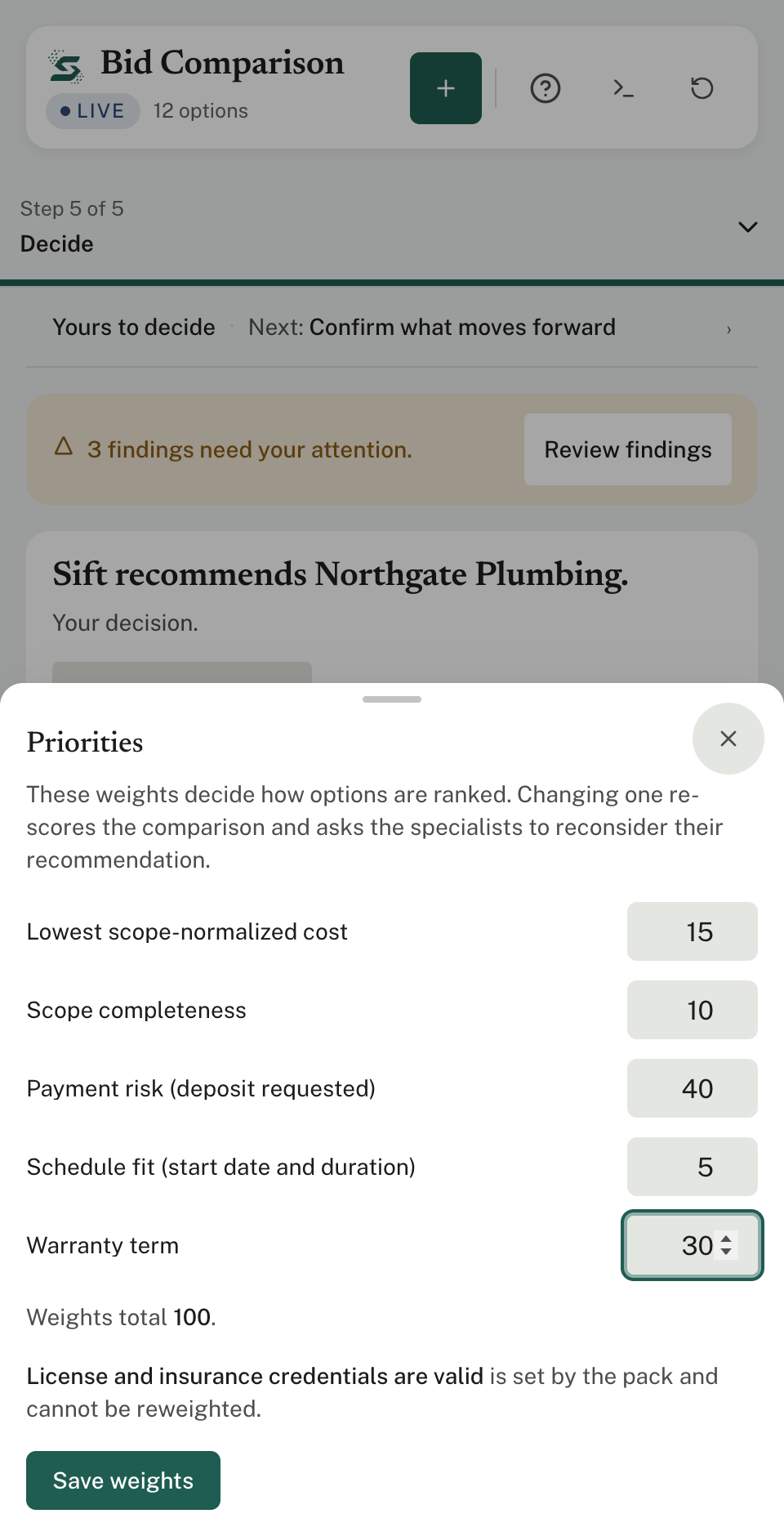
Change one thing and it doesn't start over. Reweight your priorities and Sift works out which obligation that touched, reopens only that one, and recomputes from there. One specialist, one revised pass. It does not ask the model to "answer again."
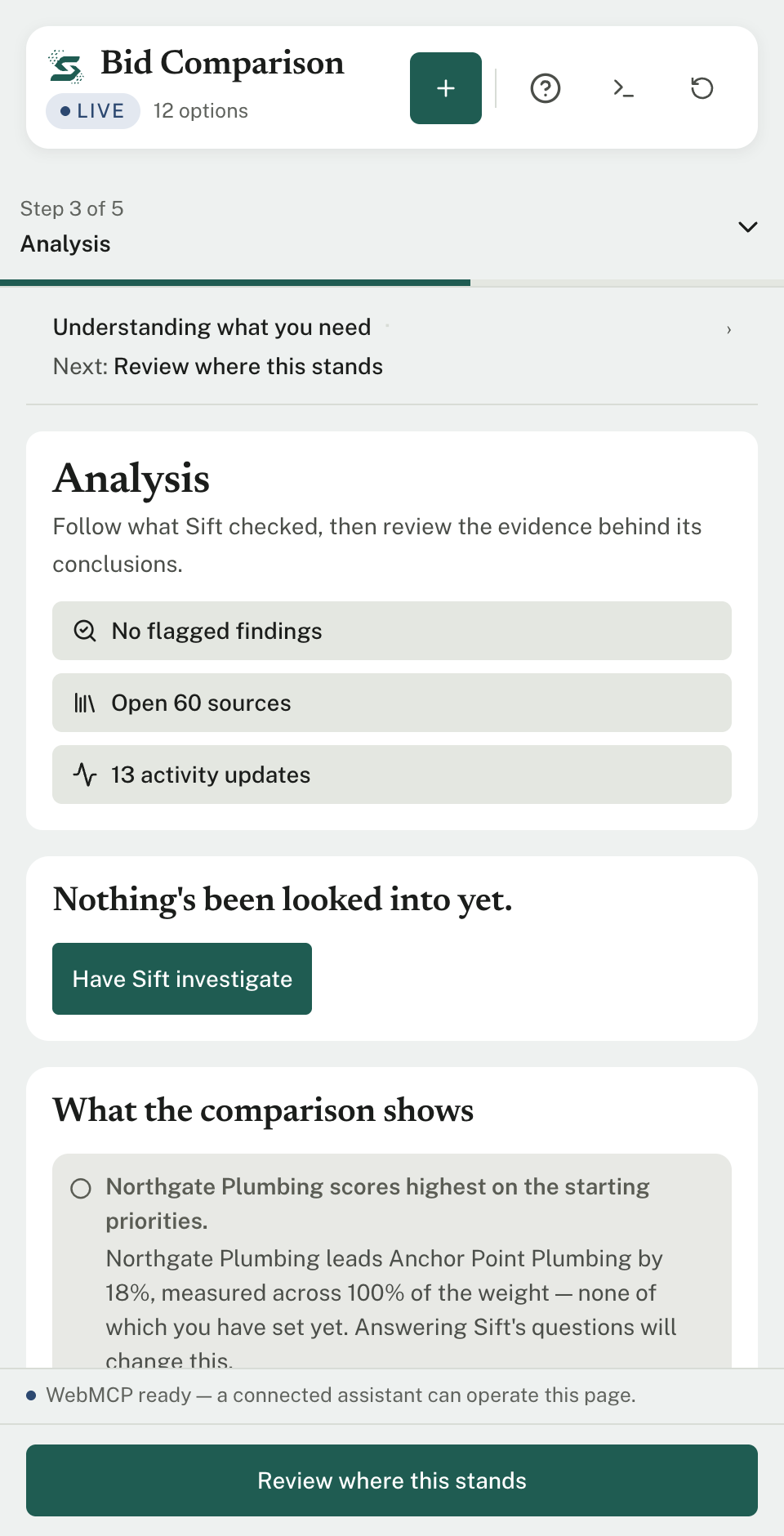
It refuses to answer before it's earned the right to. If the options aren't on a common basis yet, the draft is withheld and the missing questions are listed. Unknown never becomes zero. Disputed never becomes settled.
It shows its working and marks its own limits. Every value carries where it came from. Anything
a model produced is agent_proposed, never verified — only a person can attest. Where it couldn't
establish something, it says so instead of guessing.
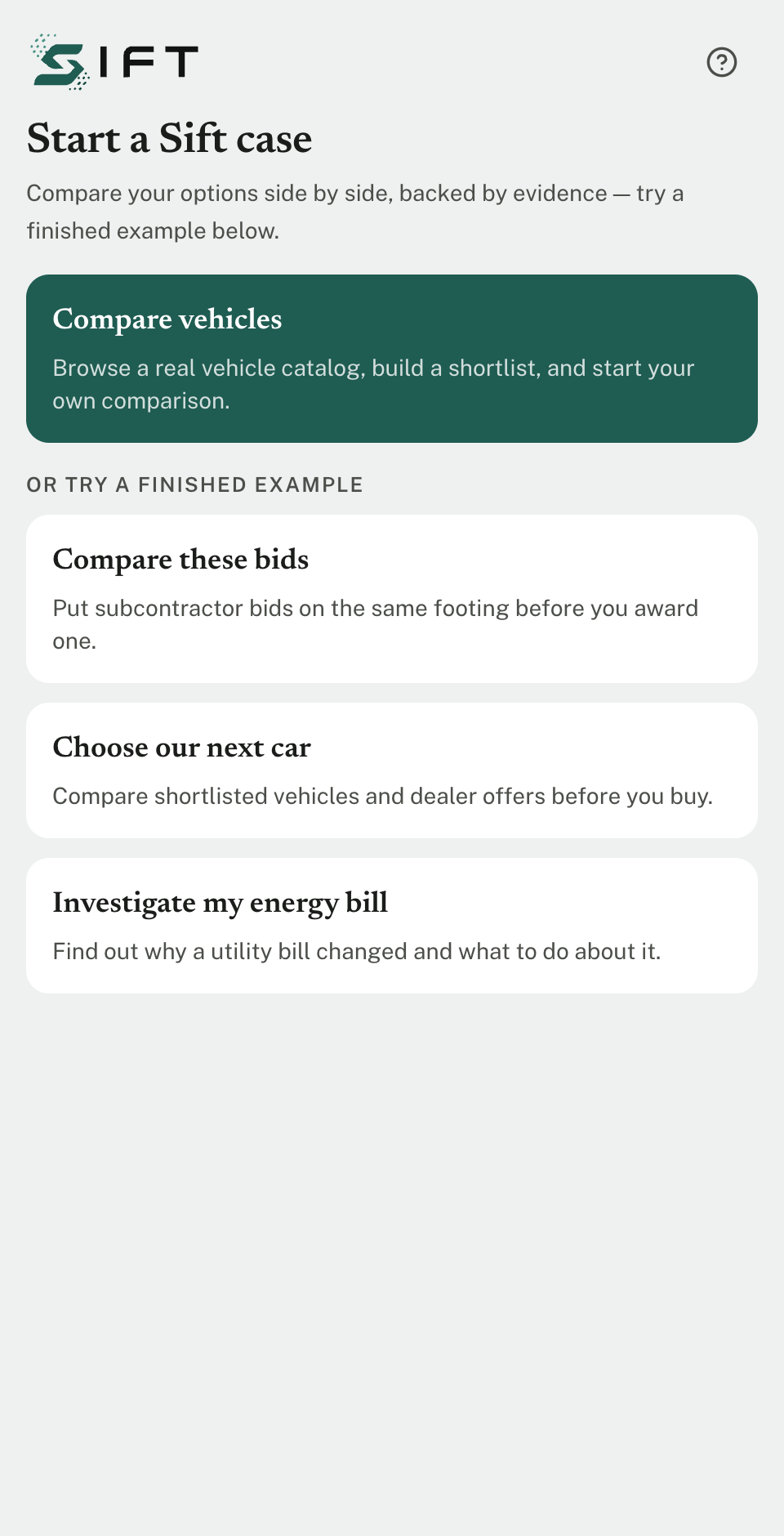
The same engine runs three packs — subcontractor bids, a car purchase, a household energy bill. The pack is data. Neither the deterministic core nor the Strands adapter knows anything about plumbing.
The worked example: twelve bids
Twelve plumbing bids for a school renovation. A Strands Swarm reads them, normalizes scope, checks
the price arithmetic, verifies licences and insurance, and tests the schedule. Then the part I care
about. The synthesis drafts the obvious answer — rank by quoted total — and GoalLoop throws it out,
because the bids aren't on a common basis yet, so that ranking would be false. The run emits
goal.validation_failed, then goal.validated, in the same pass.
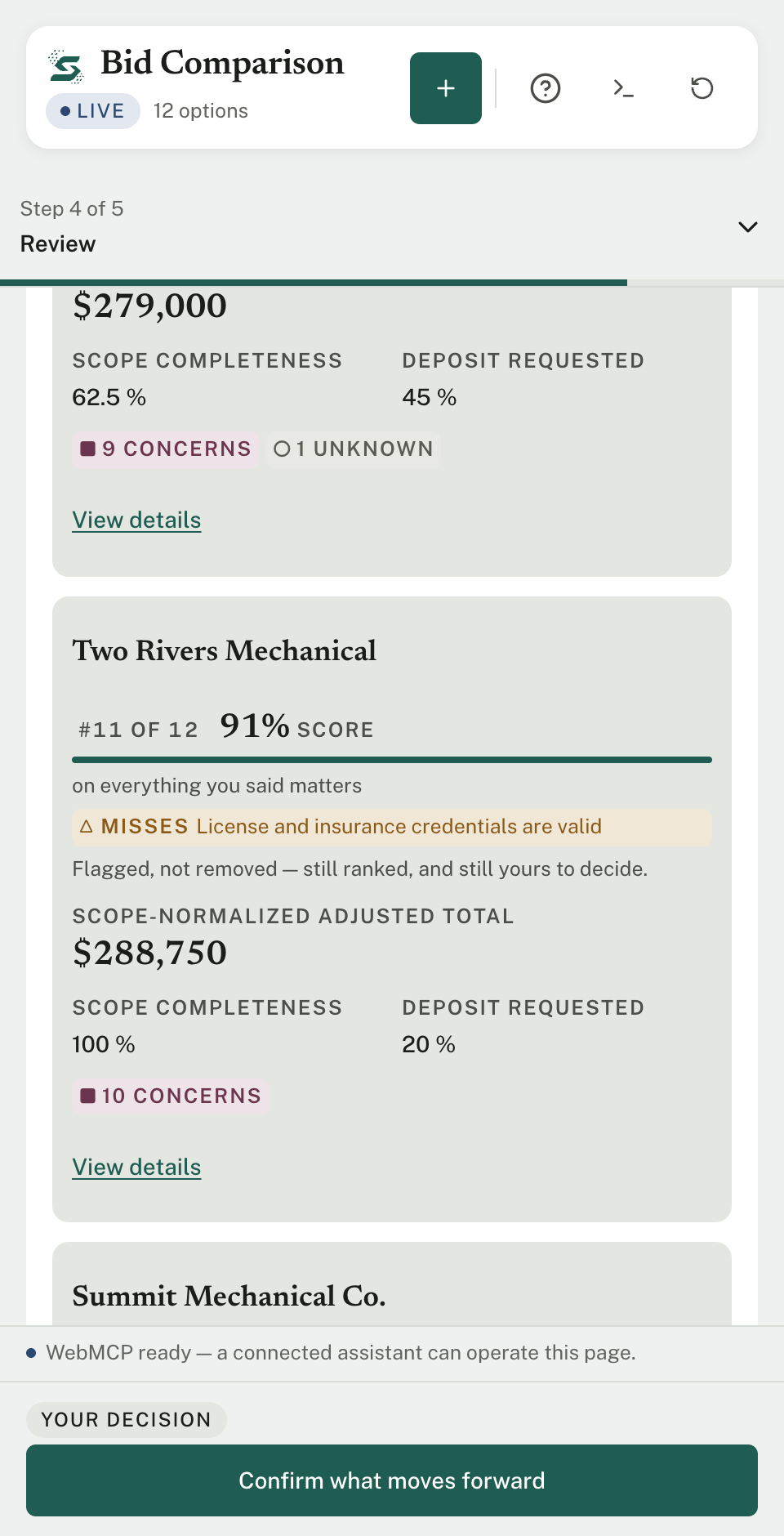
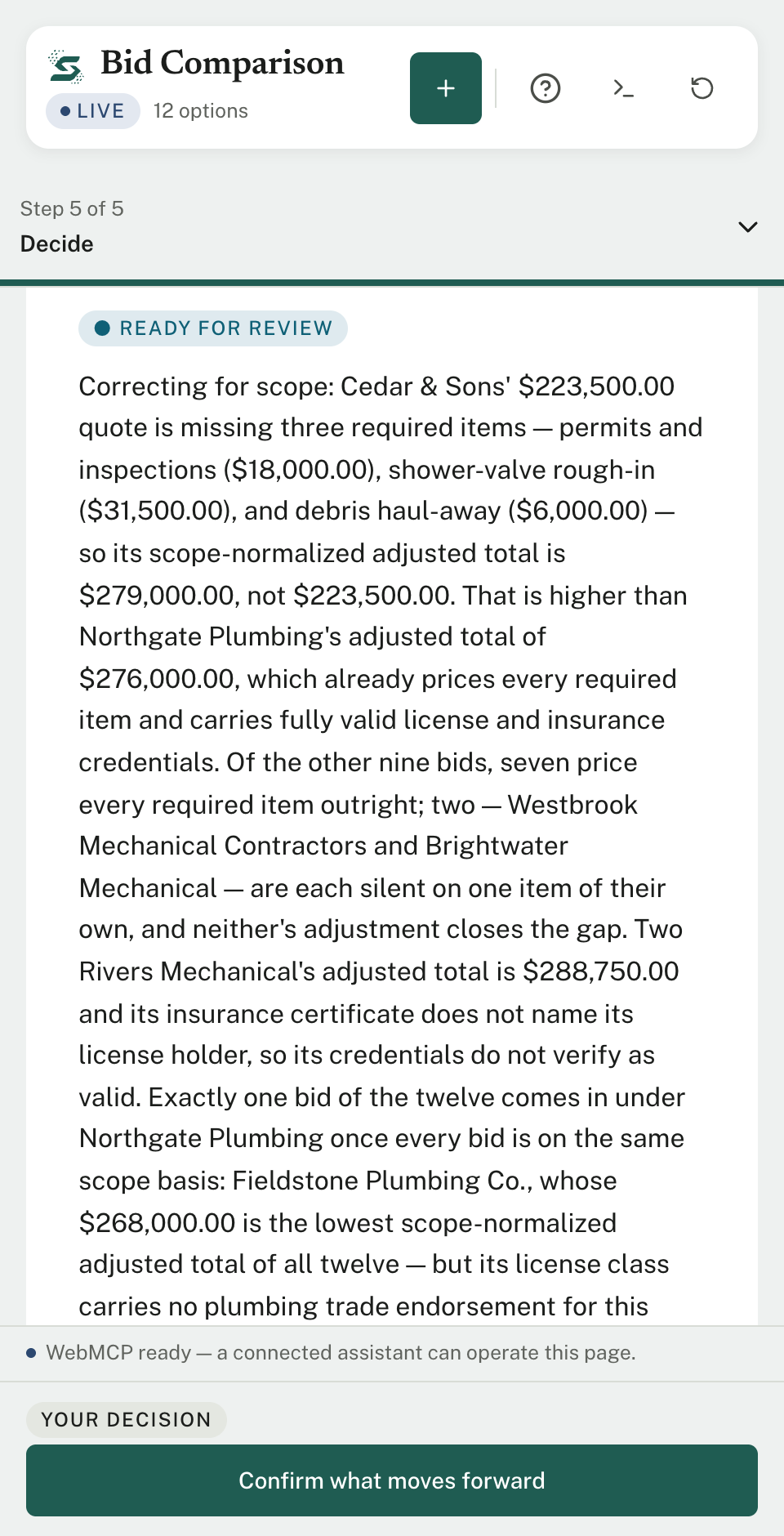
Once the gaps are priced in you can check the maths by hand. The $223,500 bid says nothing about permits ($18,000), the shower-valve rough-in ($31,500), or haul-away ($6,000). Add them and it's $279,000. That's more than the $276,000 bid it appeared to beat.
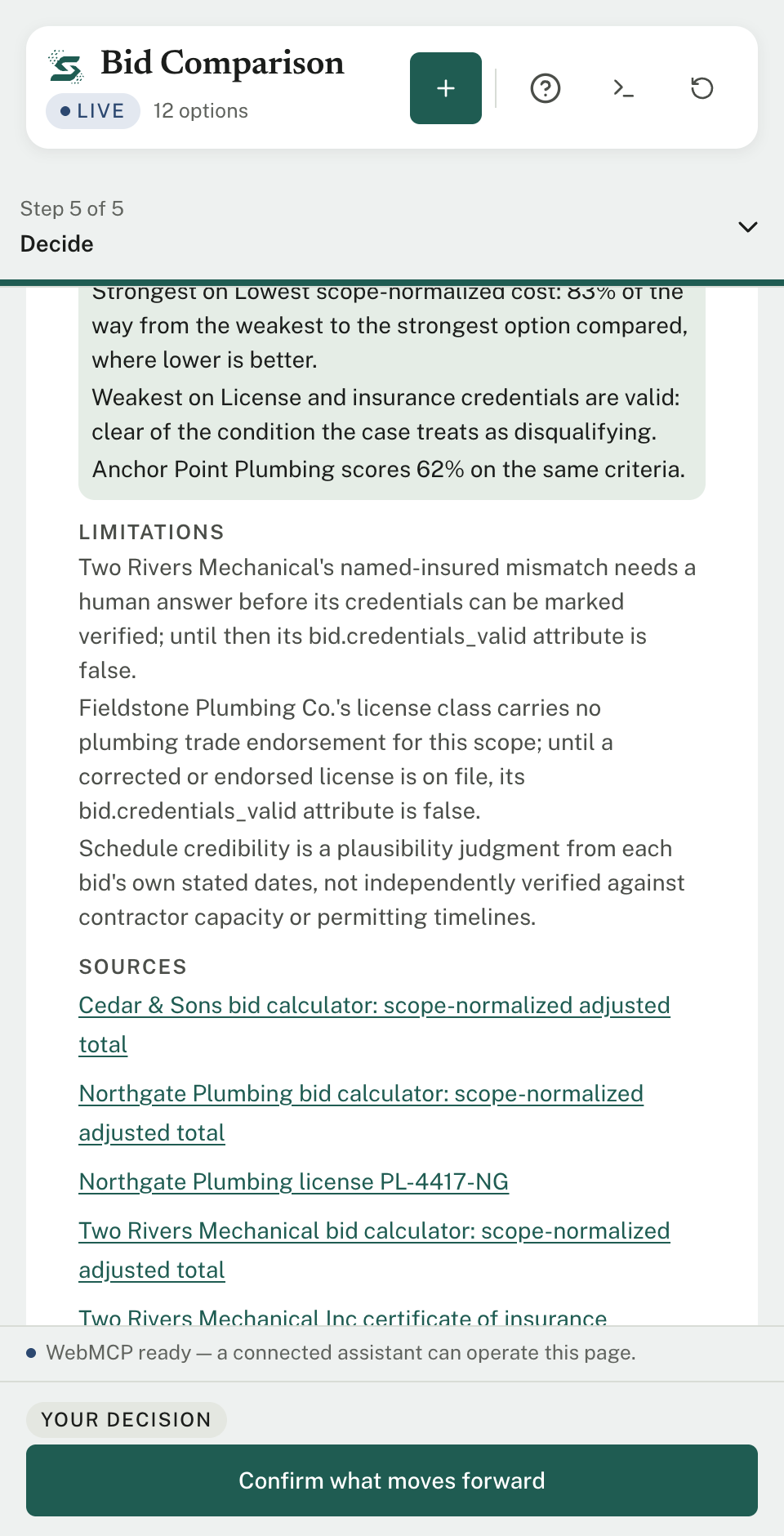
Credentials are a hard constraint, not a weighting. Reweight toward warranty and deposit and Two Rivers scores highest of all twelve: 91%, against the winner's 72%. It still doesn't win. Its insurance names "TRM Holdings LLC", not its licence holder. Sift flags it instead of dropping it — "#11 of 12", the 91% still showing, "Flagged, not removed — still ranked, and still yours to decide."
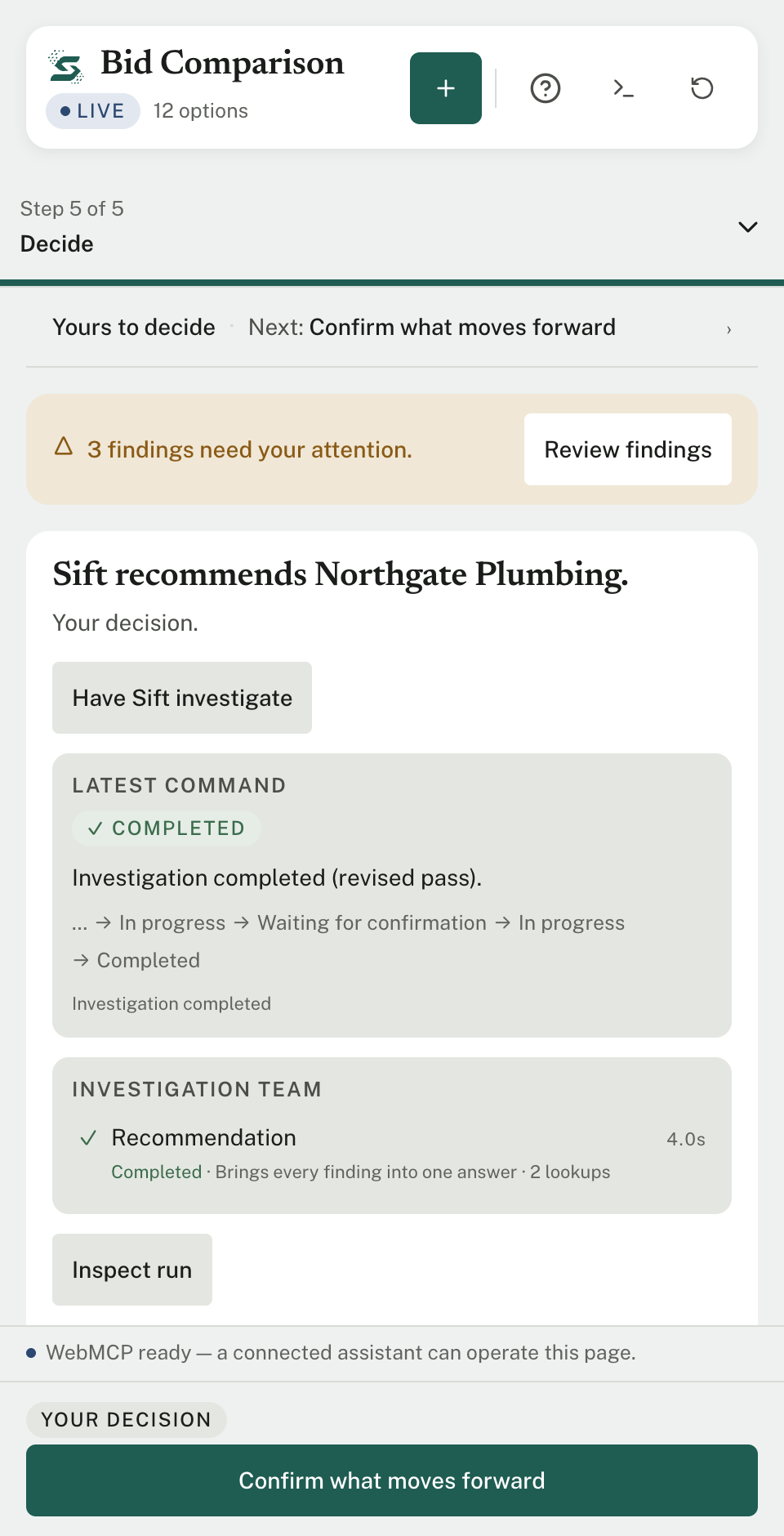
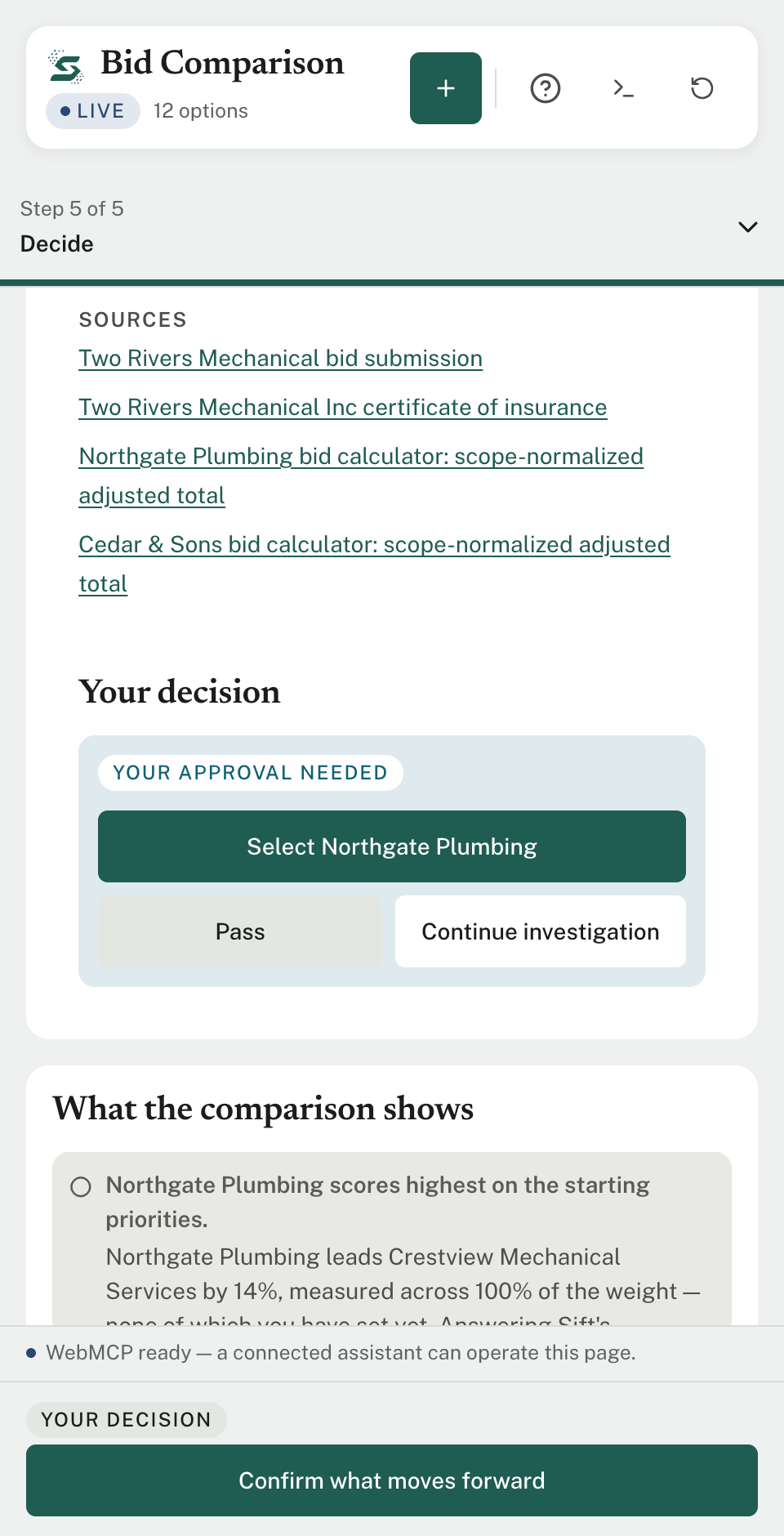
The agent recommends. The person awards. propose_award is gated by a Confirm intervention.
The proposal sits pending, with no approving actor, until someone acts.
How we built it
The part that has to be trustworthy is the part you can check.
packages/core is pure TypeScript. Scoring, readiness, policy and the state reducer live there. One
dependency. No model call, no network, no filesystem, no environment read. That's what makes "the
ranking is arithmetic the model never touches" something you can verify instead of something you
have to believe.
Everything non-deterministic sits behind a Strands adapter:
- Two multi-agent topologies from
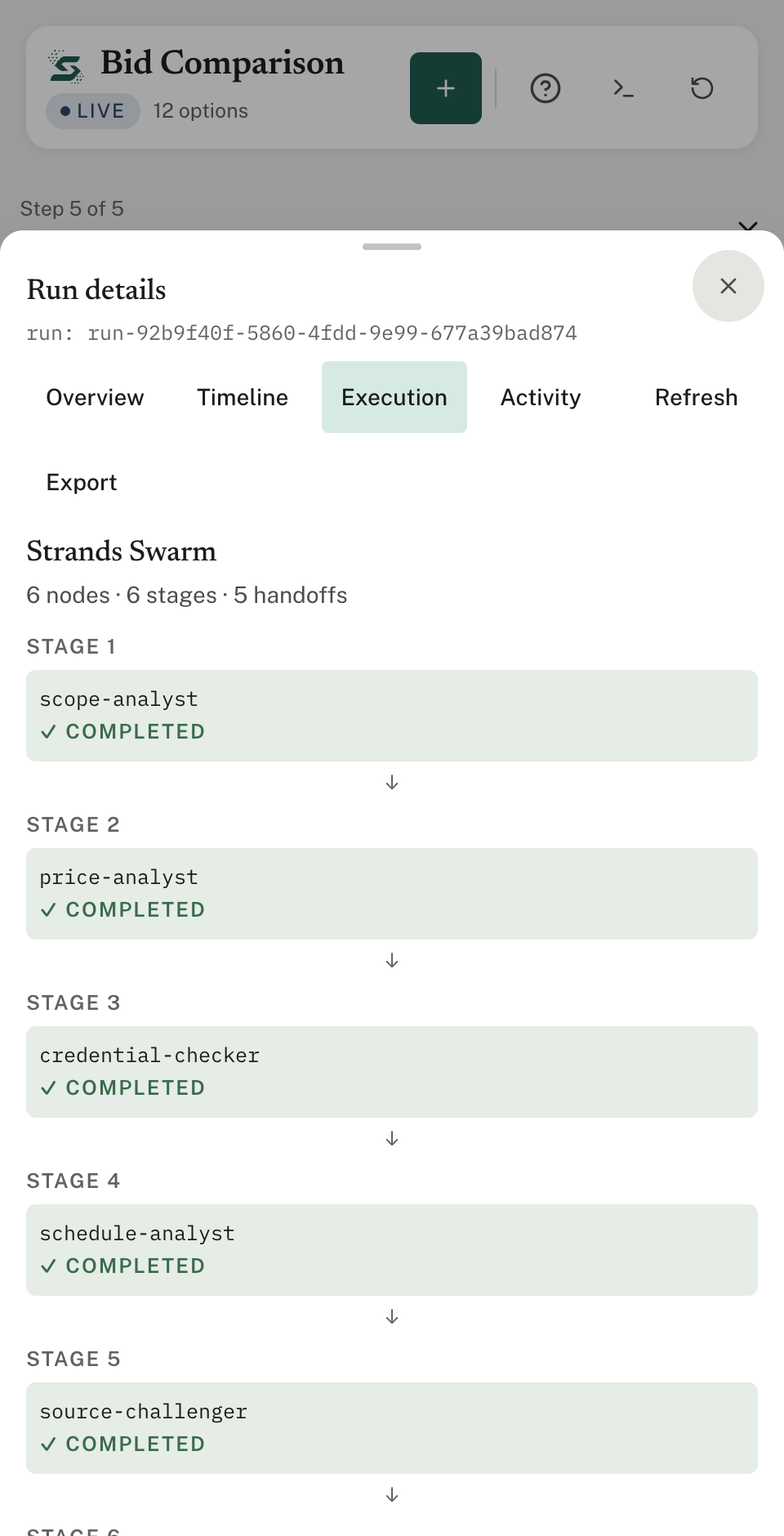
@strands-agents/sdk/multiagent. A boundedSwarmwhere ordering is a routing problem — six specialists, 6 nodes, 5 handoffs — for bids and home energy. AGraphwhere the order is fixed, for car purchase. AgentSkills,ContextInjectorandGoalLoop, all from the SDK's own vended plugins. An import line settles whether they're really Strands or my own thing wearing the name.- Interventions that do real work.
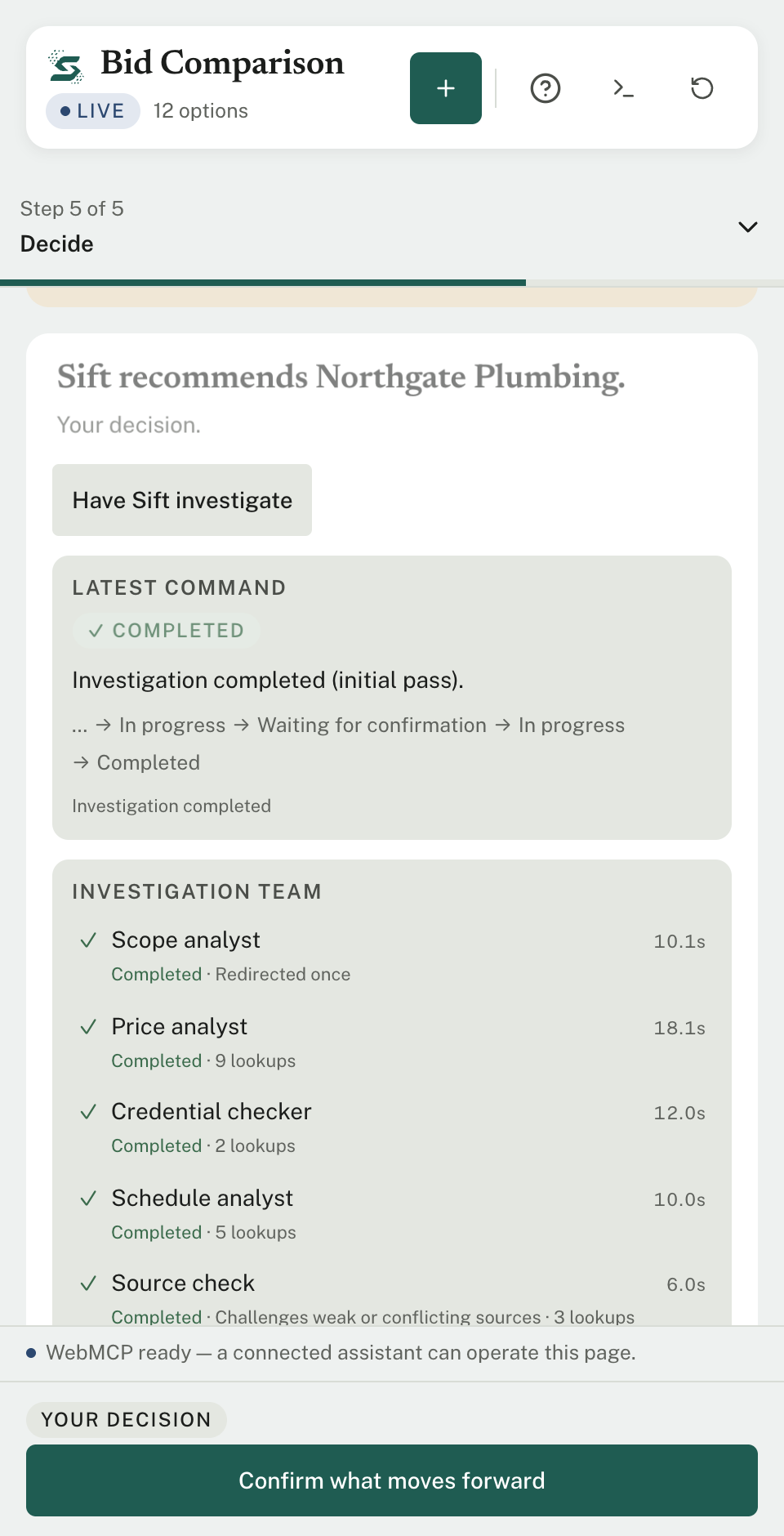
Guideredirects the scope analyst when it circles the same two bids.Denyrefuses the price analyst's reach for the licence registry, a tool this pack grants only to the credential checker.Confirmgates the award. - Lifecycle hooks feeding the activity stream and a Runtime Inspector, without exposing chain-of-thought.
What the model does, and what it doesn't. The orchestration is real and runs for real. The hero demo's model responses are scripted, so that trajectory is deterministic: the same 433 events every run, offline, with no credentials, which is what the release gates need. So the handoffs you watch are real SDK handoff events along a fixed path, not routing the model chose at inference time.
Real inference does run, on one path. The bid-document reader builds a real BedrockModel and reads
an unstructured PDF. I used Amazon Nova Lite, because Anthropic models are blocked on this account
pending AWS's use-case form, and Nova is cheaper anyway. You can watch it in the demo: it read six
values off the document, said plainly that it couldn't read two, and marked every one
agent_proposed at 40% confidence, not verified. packages/core/src/attributes.ts rejects a
verified claim from anything but a user. The model proposes. Only a person attests.
It runs on Amazon Bedrock AgentCore. The same service is deployed as an AgentCore Runtime, built for arm64 from the repo's own Dockerfile. Through AgentCore's own invoke API it opened the twelve-bid case, ran the full Strands investigation, and handed back a ready recommendation for Northgate, with the Cedar scope correction in its rationale. Getting there caught a real bug: AgentCore forwards no custom headers, so every mutating call had been failing on a missing idempotency key. The key can now travel in the request body.
All of it is checkable. claim-evidence-matrix.md maps each capability to its implementing
file, the test that fails if the claim stops being true, and the event count in an exported run. On
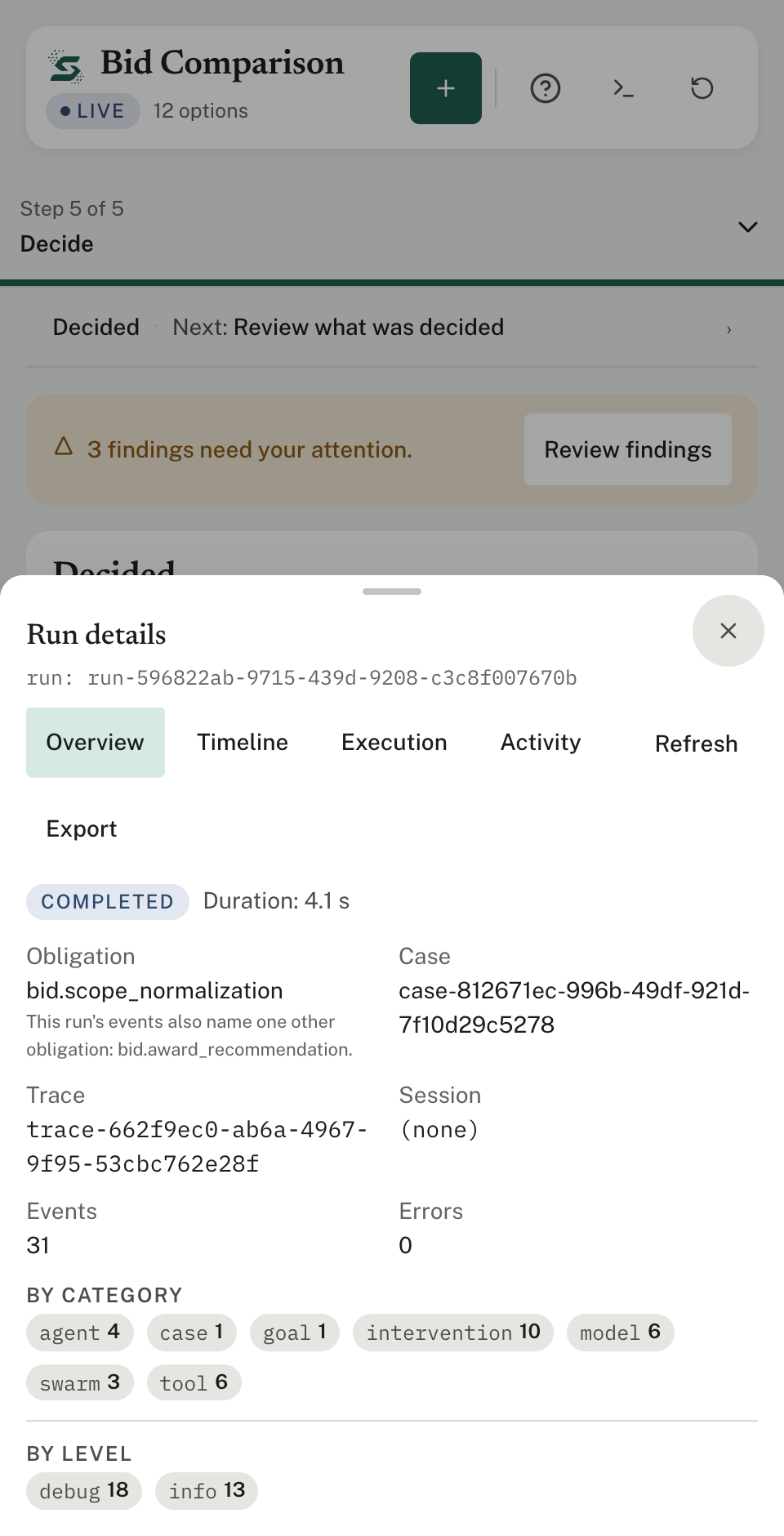
the run that appears in the video: 433 runtime events, 28 context injections, 4 skill activations,
105 spans — every span carrying "otel.scope": "strands-agents", with no other value anywhere in
the export. A class named after Strands can't produce that.
Challenges we ran into
The obvious fix was the wrong one. Internal source IDs were leaking into the rationale people read. Stripping them would have broken two other things: the goal validator needs a citation to accept a synthesis, and the citation chips are built by scanning that same string. One string was doing validation, extraction and display at once. The fix went at the display boundary, with validation left running on the raw text.
I built a gate nobody could pass. The blind-spot review was offered whenever the required topics were answered, without checking whether the pack declared any check to review. The bid pack declares none, so the app's primary action opened a panel with nothing in it. That file's own comment reads "The pane must never be a dead end." I'd reached one through the front door.
A test was protecting the bug. An end-to-end spec asserted the help panel read "Ask Sift to look into this", under a comment claiming the labels matched the real controls. They never had. The button says "Have Sift investigate." The test was faithfully locking in the defect.
Accomplishments that we're proud of
The refusal is real and reproducible — a failed goal validation followed by a passing one, in the same run, on a ranking every comparable product would have shipped as an answer.
The deterministic core held. Under repeated pressure to let one useful effectful thing in, it still declares one dependency and touches nothing outside itself.
Flagging instead of eliminating. A bid that scores highest and still can't win, shown with its winning score intact and the reason stated, is the honest form of a hard constraint. It's also harder to build than dropping it quietly.
What we learned
Green tests aren't a working product. The last round of defects all came from using the running product, never from reading code. 5,300 unit tests and 222 end-to-end tests proved the machinery worked. None of them proved the experience did. Visual baselines catch change, not badness, so a screen that has always been wrong passes forever.
Documentation drifts toward flattery. The architecture diagram put budget enforcement inside the subgraph labelled "pure functions: no model, no I/O", contradicting the project's central technical claim. Re-deriving it against the code found three more false statements.
"Not yet" has to be designed for. Most of the hard interface decisions were about making a refusal read as rigor rather than failure.
What's next for Sift
- Route the public deployment's execution through the AgentCore runtime, and correlate AgentCore traces with the Runtime Inspector.
- Contextual checks for the bid pack: bid bonds, prevailing wage, retainage. The mechanism exists; this pack declares none yet.
- More jurisdictions in the pack-declared regulatory layer, with the same citation-and-responsibility discipline.
- More packs on the same spine. Neither the core nor the adapter knows anything about plumbing. A pack is data.
Built With
- better-sqlite3
- docker
- drizzle-orm
- express.js
- node.js
- opentelemetry
- playwright
- radix-ui
- railway
- react
- sqlite
- strands-agents-sdk
- tailwindcss
- typescript
- vite
- vitest
- webmcp
- zod

Log in or sign up for Devpost to join the conversation.