-
-
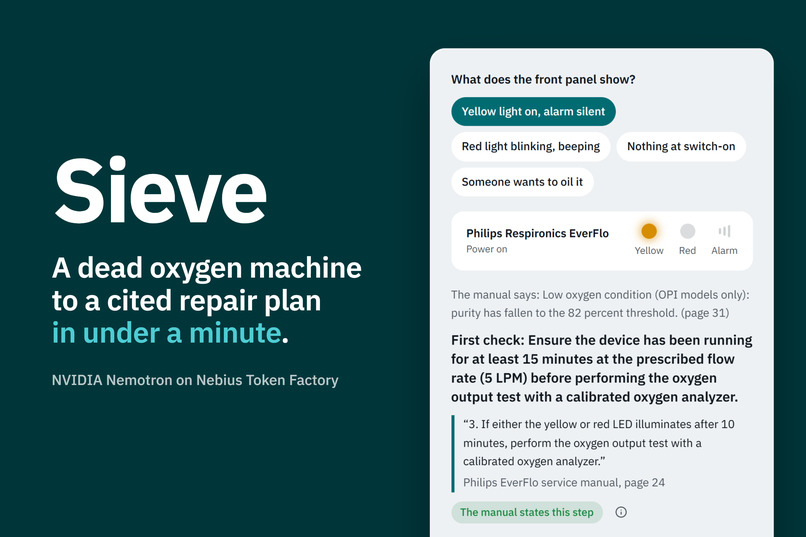
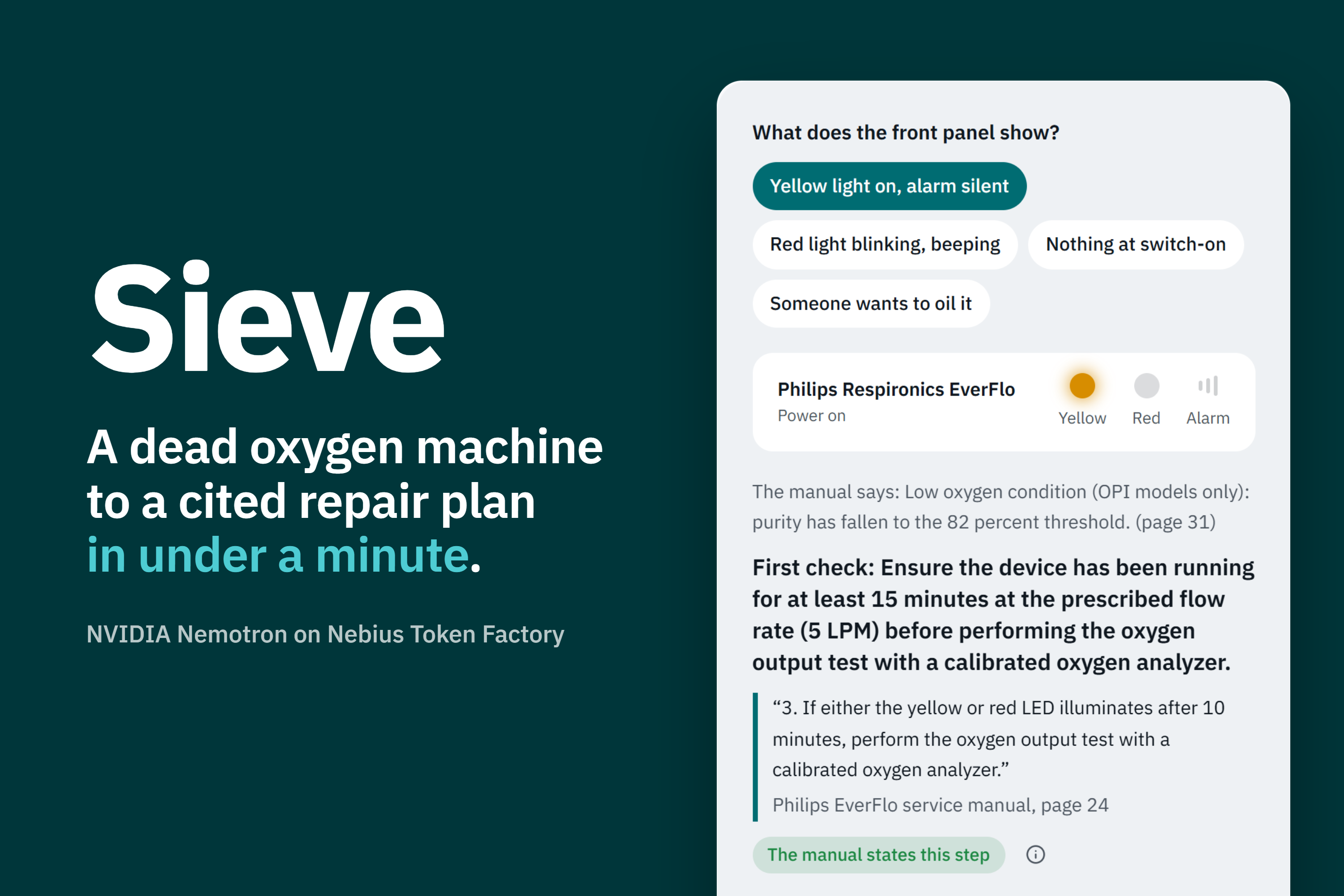
Snap a photo of a broken oxygen machine, get a repair plan from its own service manual in under a minute.
-
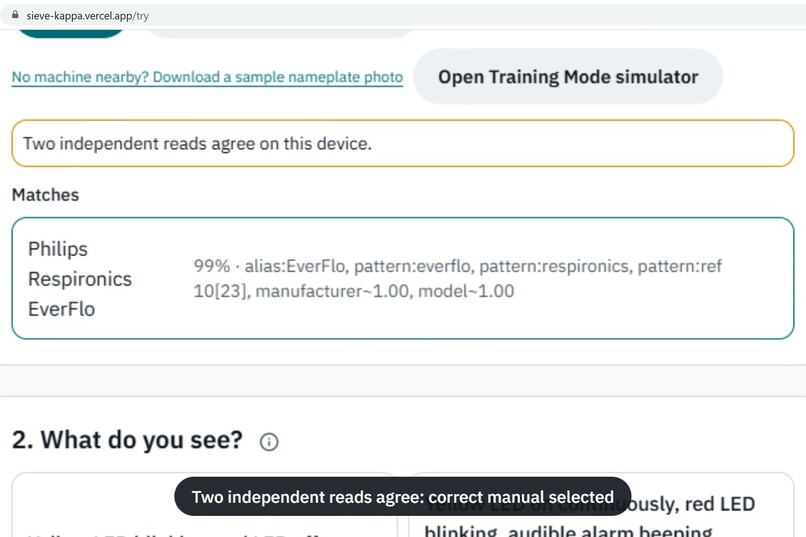
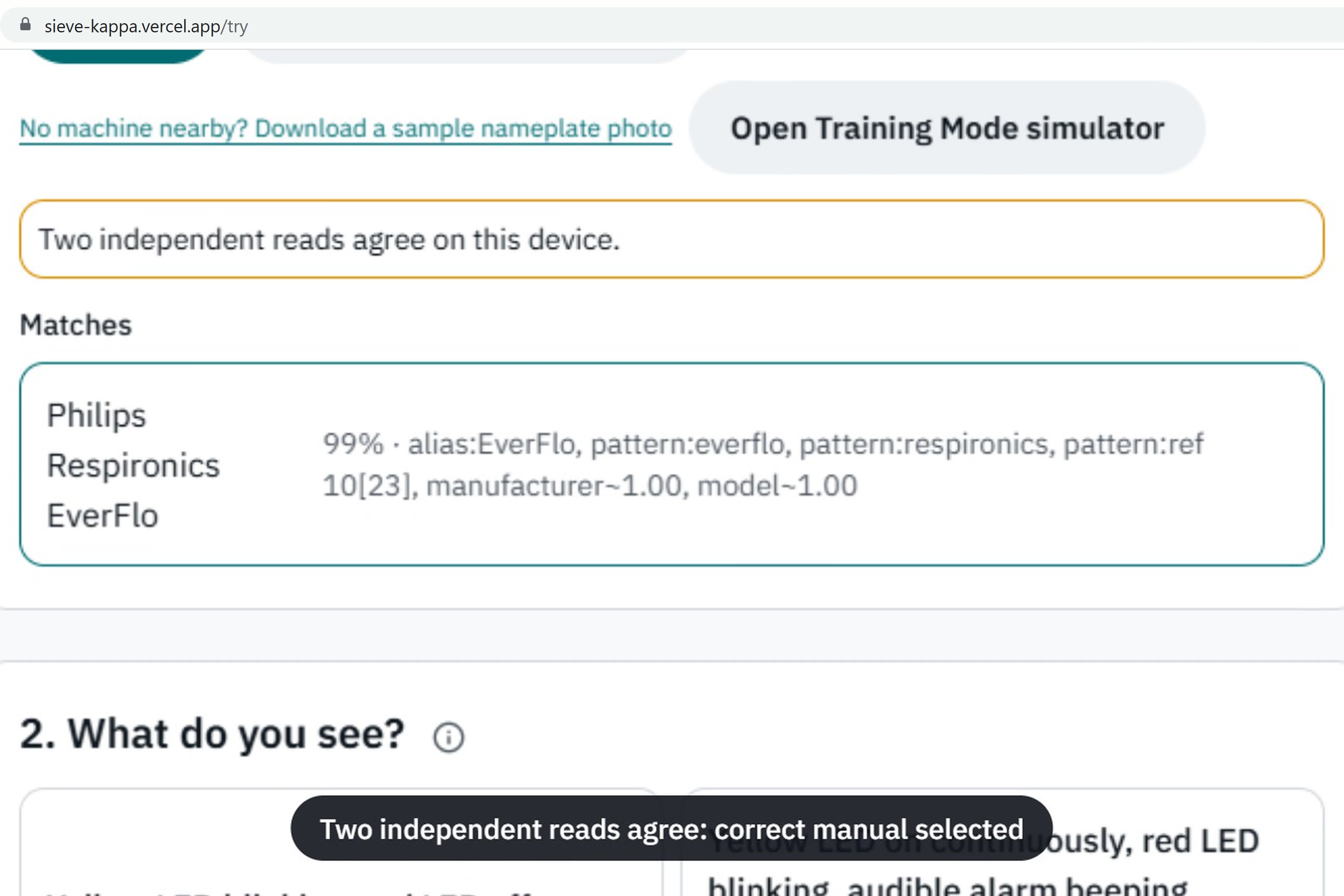
Two different vision models read the nameplate. Sieve only opens a manual when both agree on the machine.
-
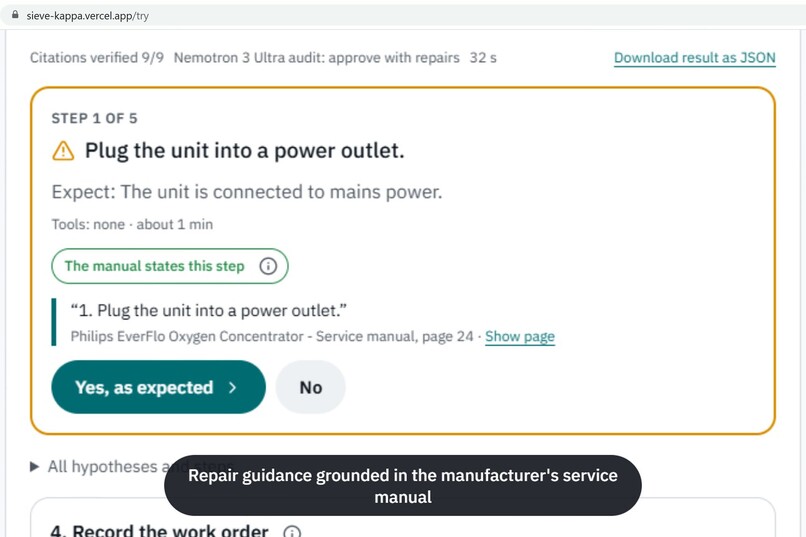
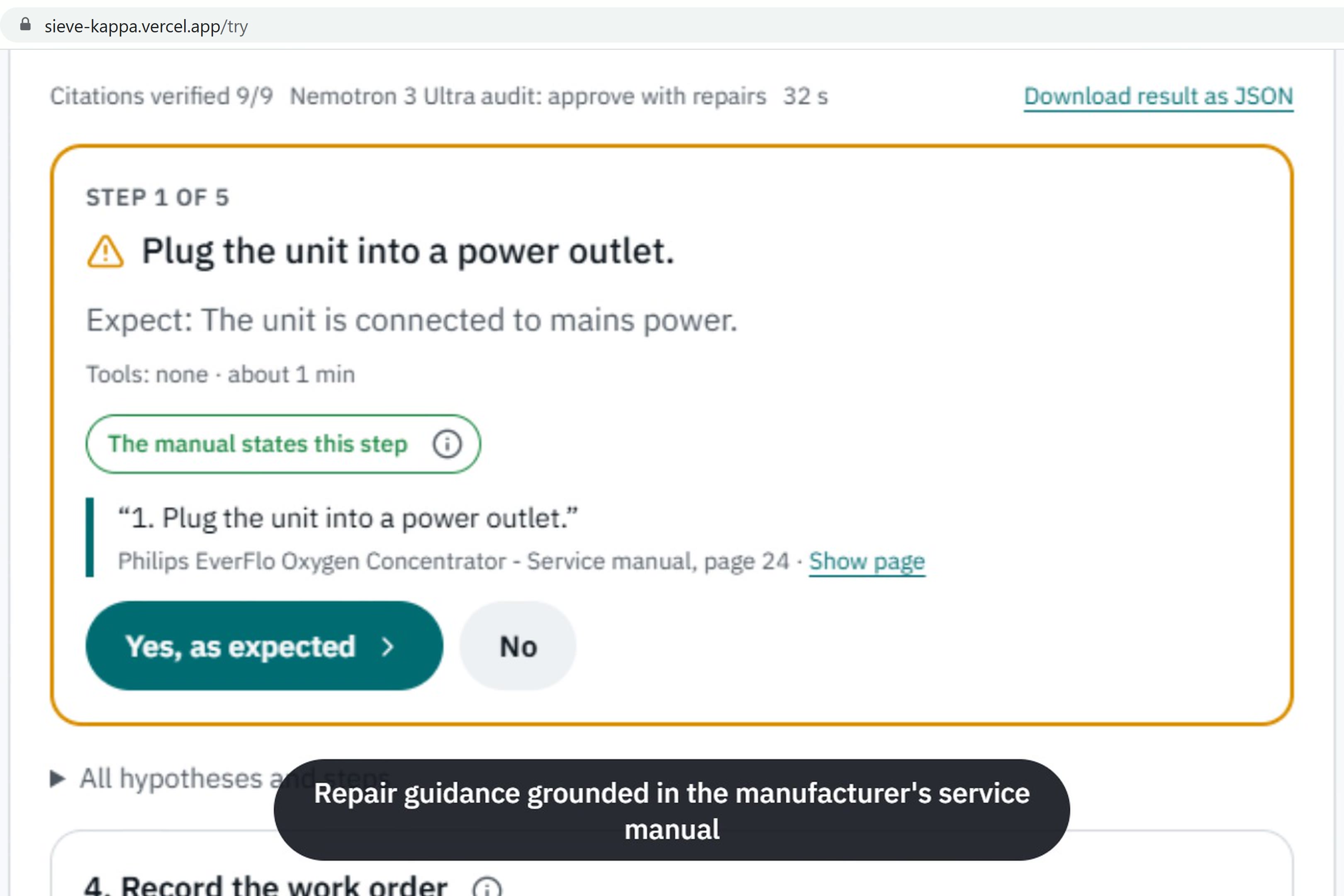
Every repair step quotes the manual page it came from, so the technician can check it for themselves.
-
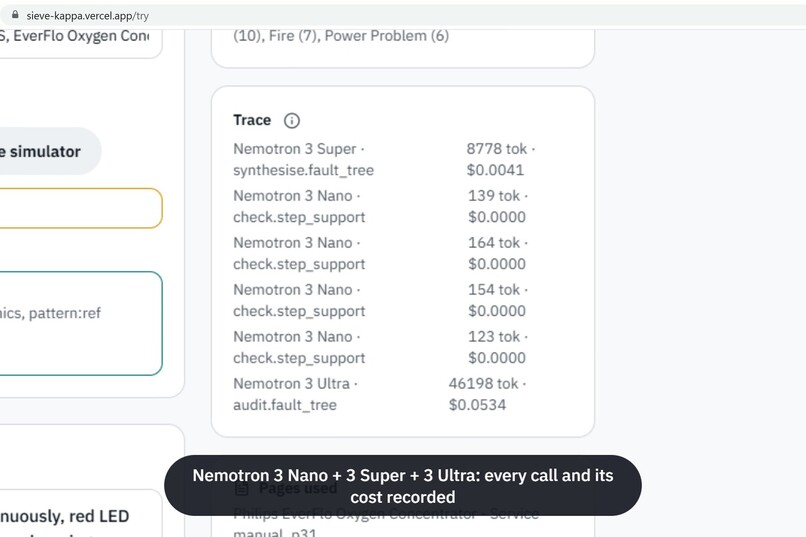
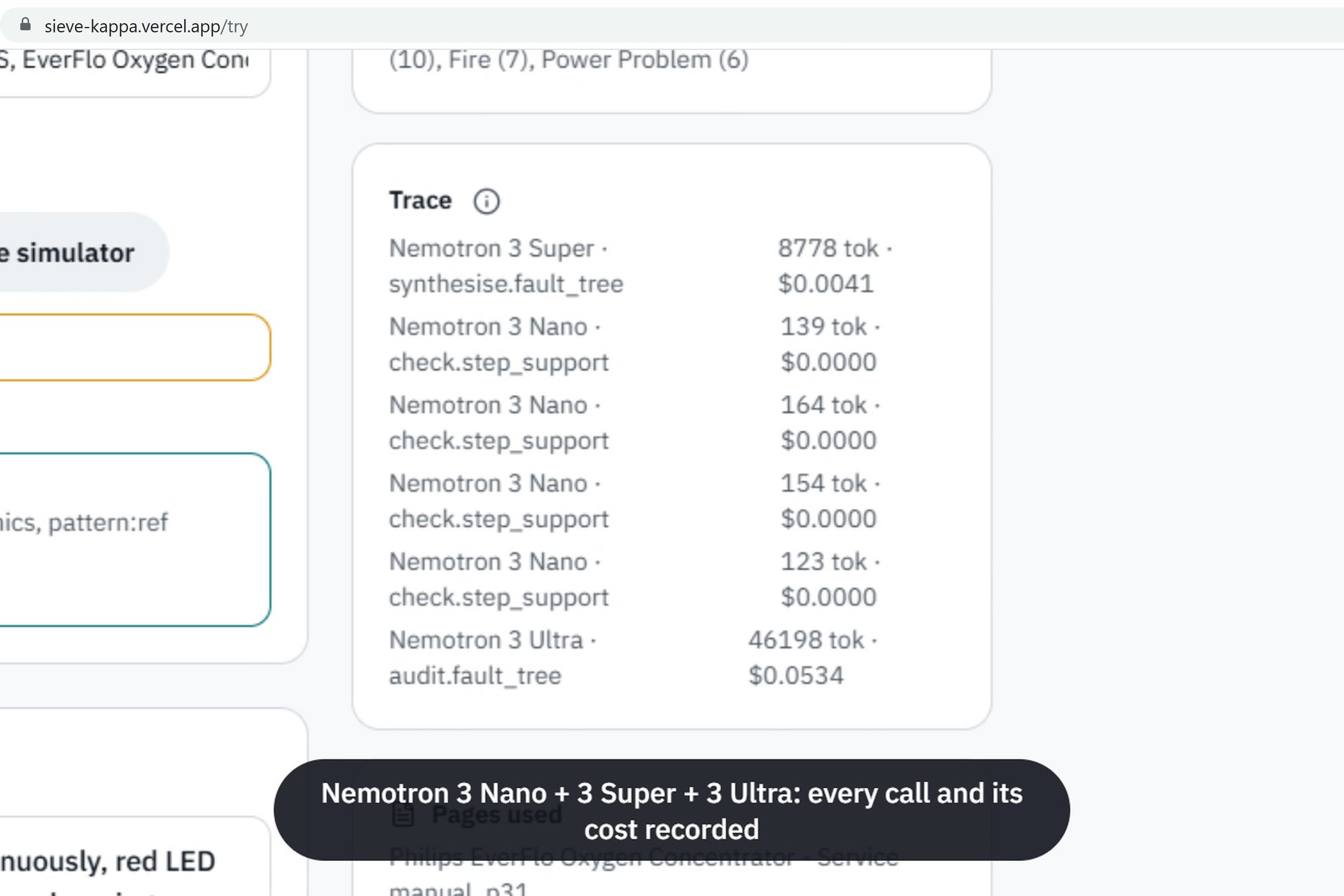
Nothing hidden: every model call is listed with its tokens and cost. A whole repair plan costs a few cents.
-
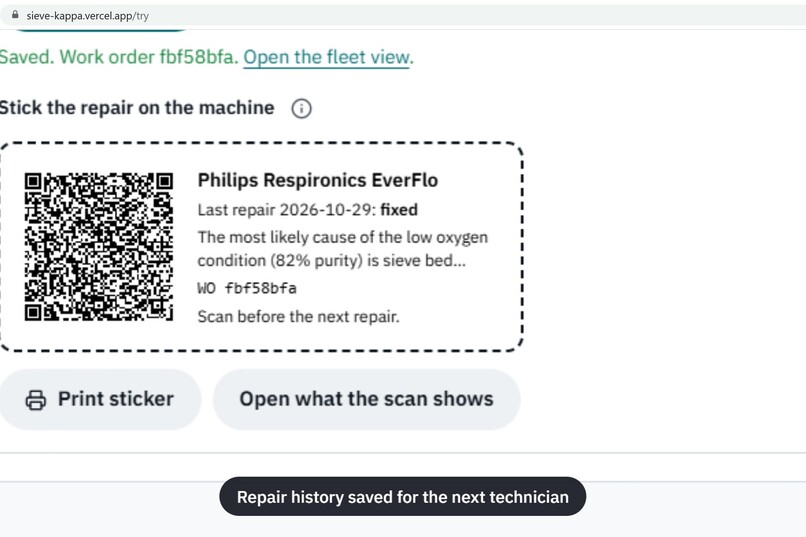
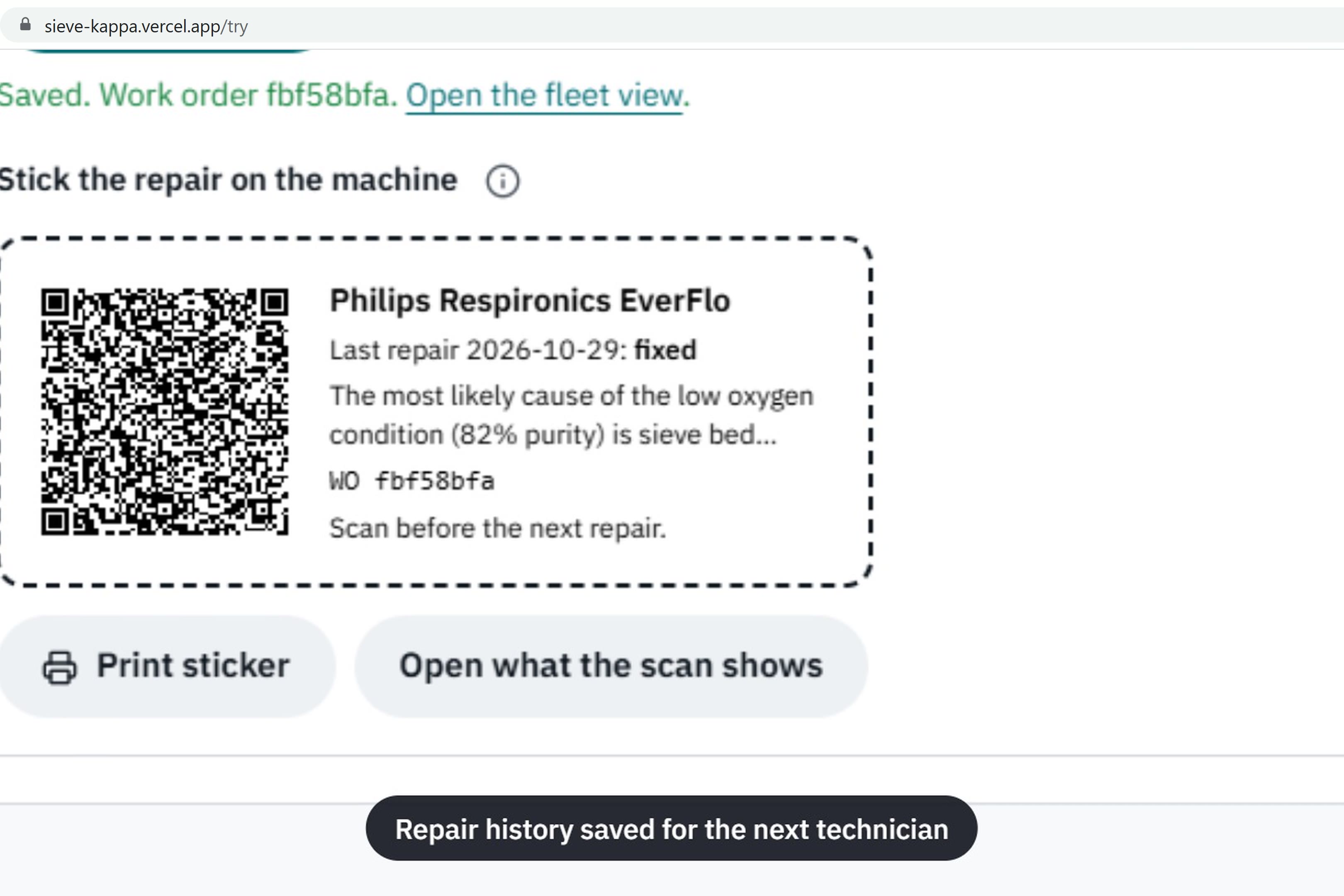
The fix becomes a work order and a QR sticker on the machine. The next technician scans it and picks up from here.
-
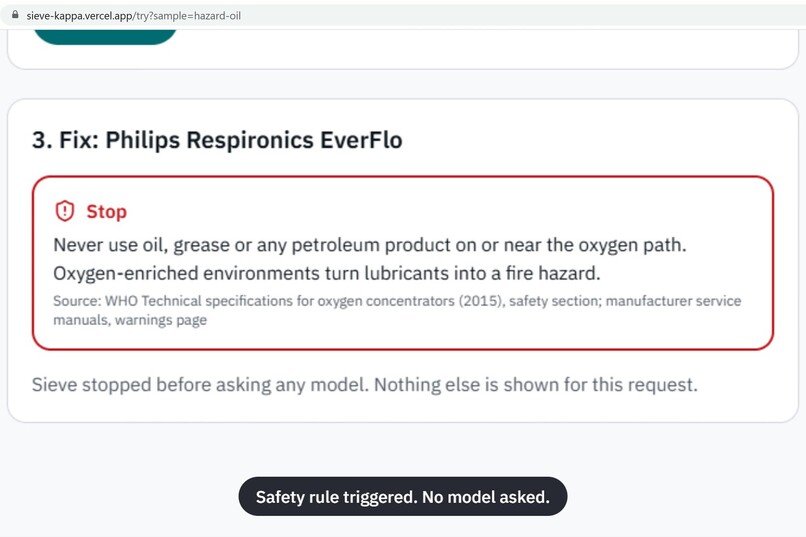
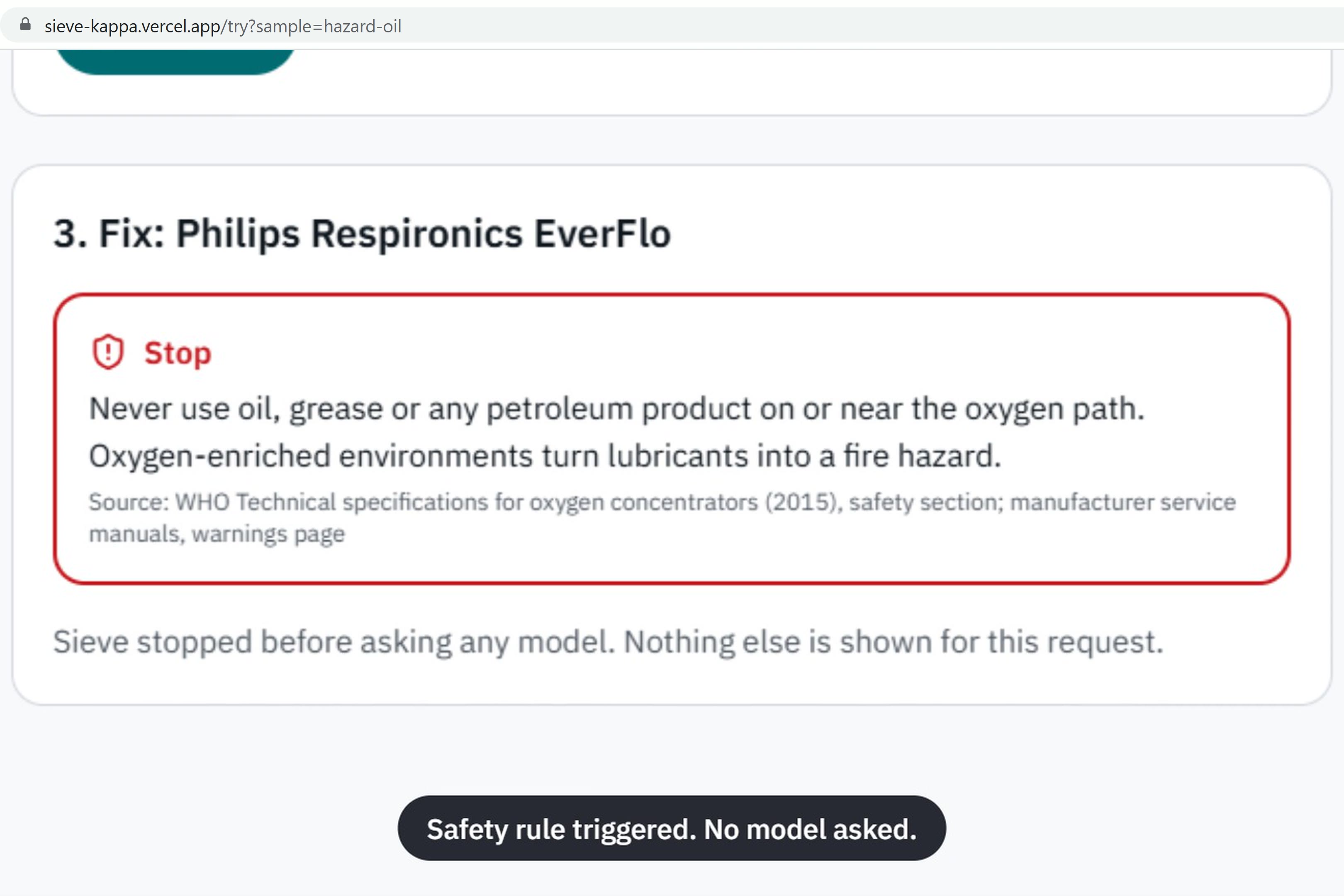
Ask to oil the compressor and Sieve says no before any AI is asked. Oil near oxygen starts fires.
-
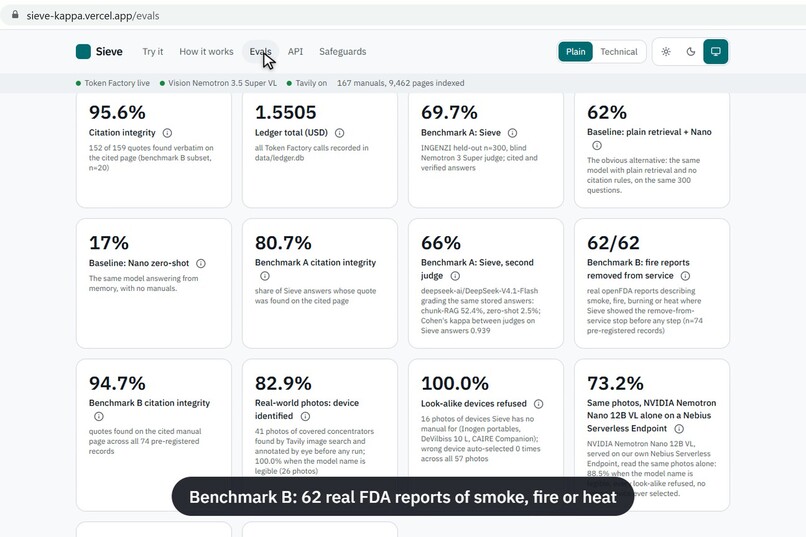
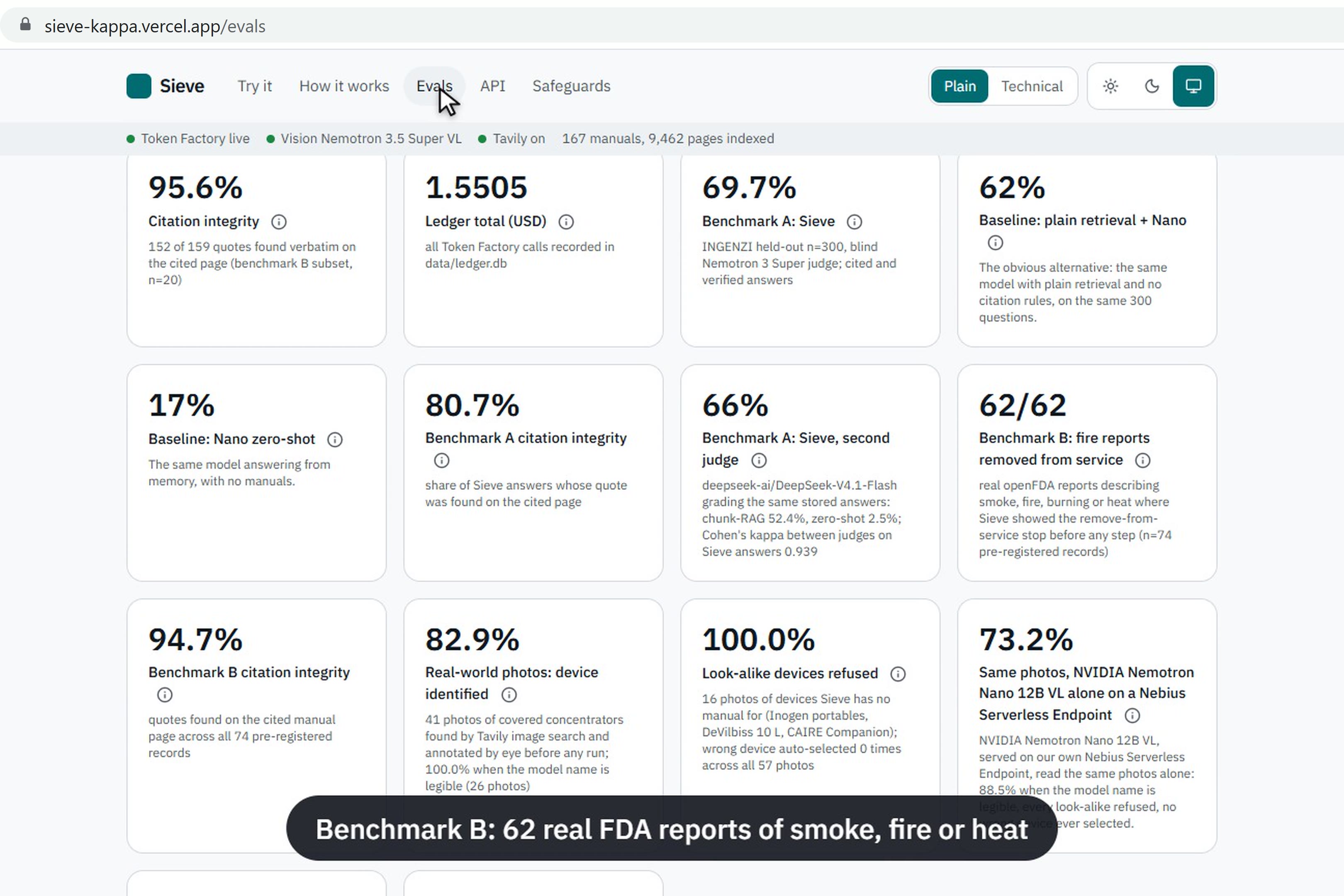
Measured on outside data: 69.7% on the prior work's own questions, and 62 of 62 fire reports taken out of service.
-
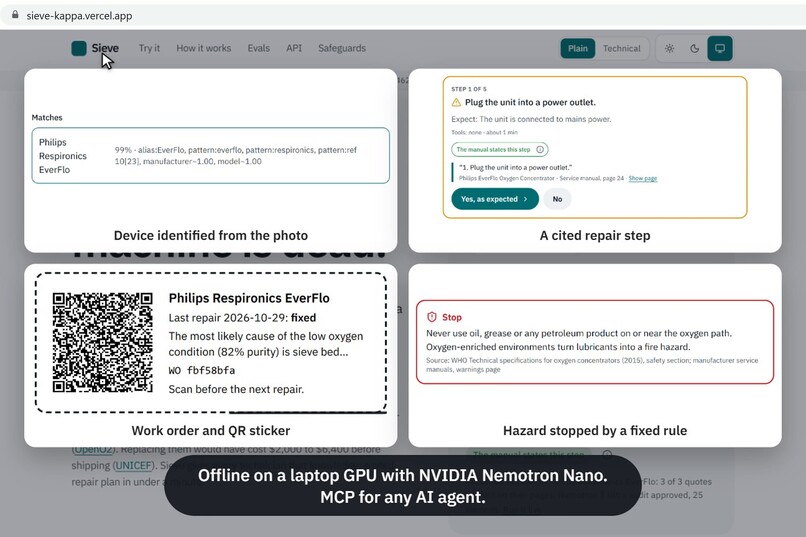
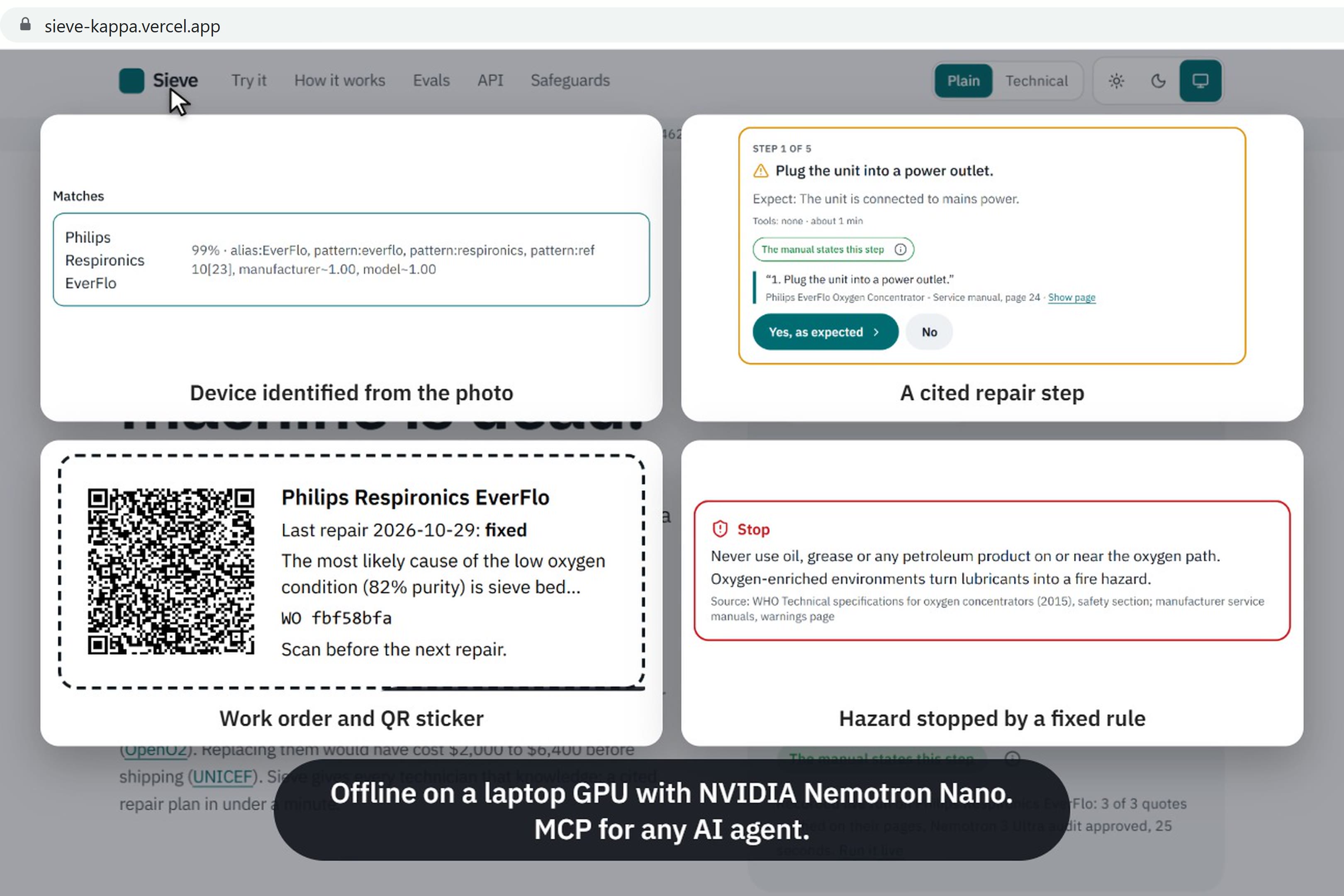
One run, start to finish: photo, cited step, work order, safety stop. Also works offline on a laptop GPU.
Four years broken. A few hours to fix. At Chintheche Health Center in Malawi, four oxygen concentrators sat broken for four years. A repair team with the right knowledge had all four running again in a few hours (OpenO2). Sieve puts that knowledge in every technician's hand: photograph the machine, and get a repair plan from the manufacturer's own service manual, every step cited to its page, in under a minute, for about 5 to 7 US cents.
Try it in two minutes (no sign-up, no key)
- See it work: run a real case live at sieve-kappa.vercel.app/try?sample=everflo-yellow. Click Identify, then Build the fix.
- See it refuse: ask to oil the compressor at /try?sample=hazard-oil. A fixed safety rule stops it before any AI is asked.
- See the numbers: sieve-kappa.vercel.app/evals
- Use your own manual: upload any service manual on /data and ask it a question.
- Use it from your own AI agent: add
https://sieve-api.vercel.app/mcpas a remote MCP server in Claude, Cursor or any MCP client.
Why Physical AI
Sieve is an edge agent for physical machines.
- It senses the real world: the phone camera reads the nameplate and the alarm lights, with NVIDIA Nemotron 3.5 Super VL and a second model that must agree.
- It acts in the real world, through the technician's hands: it picks the next physical check, waits for what the technician sees, and branches on the answer. Smoke, oil near oxygen and live mains stop it before any model replies.
- It runs on the device: with no internet, NVIDIA Nemotron Nano runs on a laptop GPU.
- It is coordinated through an agent runtime: Hermes Agent runs Sieve as tools and a scheduled FDA recall watch over the fleet.
- It uses Nebius the way the track describes: a Serverless Endpoint served Nemotron Nano 12B v2 VL for real-time photo reading, and a Serverless Job evaluated the system from a clean machine.
Inspiration
Hospital equipment in poorer countries rarely fails for lack of parts. It fails for lack of knowledge.
- 38.3 percent of hospital devices across 16 low- and middle-income countries are out of service (Perry and Malkin, 2011).
- 72 percent of 2,849 repair requests in 60 hospitals were fixed without any imported parts (Malkin and Keane, 2010).
- Two-thirds of sub-Saharan countries have at most one biomedical engineer per million people (WHO data, 2017).
- In Ethiopian public hospitals, equipment without a service manual was 55 percent less likely to work (Sewagegn et al., 2025).
- In Nigeria, 2 of 57 hospital oxygen concentrators tested were fit for use, and staff named lack of maintenance knowledge as a cause (Bakare, Graham et al., 2020).
And oxygen matters: when hospitals in Papua New Guinea gained working oxygen, deaths of children with pneumonia fell by 35 percent (Duke et al., Lancet 2008). Replacing the four Malawi machines would have cost $2,000 to $6,400 (UNICEF). The manual already had the answer. Sieve brings it to the person holding the screwdriver.
What it does
- Photograph the machine. Two different vision models read the nameplate. Sieve opens a manual only when both agree.
- Answer three safety questions. Smoke, sparks or a patient still connected stop everything first.
- Get the fix. Sieve finds the right pages in the real service manual and writes a step-by-step plan. Every step quotes the manual page it came from.
- Walk it one check at a time. The technician says what they see, and Sieve picks the next check.
- Stay safe. Dangerous steps (oil near oxygen, live mains, smoke) are blocked by fixed rules, not by the AI.
- Get a second opinion. NVIDIA Nemotron 3 Ultra reads the entire manual in one call and audits the plan.
- Check recalls. FDA recalls and known failure patterns for that model are checked.
- Find the part. Tavily searches suppliers for the failed part. If Sieve has no manual for a known device, Tavily finds one and Sieve indexes it in the same request.
- Close the job. The repair is saved as a work order with a QR sticker for the machine. The next technician scans it and starts from this history, even if the hospital's server is down.
Also included: a fleet view with a weekly brief, a Training Mode on a simulated front panel, and an offline mode that runs on a laptop GPU with no internet.
How we built it
- Nebius Token Factory serves every model call through one API:
- NVIDIA Nemotron 3.5 Super VL reads the nameplate photo.
- Nemotron 3 Nano and 3.5 Lightning handle intake, extraction and the 140,000-token weekly fleet brief (about one cent).
- Nemotron 3 Super writes the repair plan.
- Nemotron 3 Ultra audits it, with the whole manual in its one-million-token context.
- Qwen3-Embedding-8B embeds the manual pages for search.
- Search: 167 manuals and 9,462 pages, searched by keyword and by meaning together.
- Safety: a fixed rules engine and a citation checker decide what reaches the technician. AI reads and drafts; rules decide.
- Offline: NVIDIA Nemotron Nano 9B v2 and Nemotron Nano 12B v2 VL on a laptop RTX 4070 through llama.cpp.
- Agents: Sieve is a hosted MCP server and runs inside Hermes Agent, which also runs a scheduled FDA recall watch. It also ran inside NVIDIA OpenShell and NemoClaw sandboxes.
- Nebius AI Cloud: a Serverless Endpoint served Nemotron Nano 12B v2 VL for photo reading, and a Serverless Job checked the project end to end from a clean machine.
- Stack: FastAPI, Next.js, SQLite. Every call is logged with its tokens, cost and seconds, and shown in the Trace panel.
Challenges we ran into
- Worn nameplates are hard to read. We caught a vision model reading a real 1025DS label as a 525DS. So Sieve reads every photo with two different models and opens a manual only when they agree.
- Manual PDFs are messy. Exact quote matching broke on PDF text glitches. We switched to citing numbered manual sentences, and now 100 percent of citations resolve to their page.
- Keeping the AI away from dangerous advice. We moved every safety decision out of the model and into fixed rules that run before any model is asked.
- Service manuals are copyrighted, so they are indexed for search and never redistributed.
Accomplishments that we're proud of
- 69.7 percent on the closest prior work's own 300 repair questions (INGENZI, arXiv 2601.16967), against 62.0 percent for plain retrieval and 17.0 percent for the model alone. A second independent judge agreed (kappa 0.94).
- 62 of 62 real FDA reports of concentrators that smoked or caught fire: Sieve took the machine out of service before showing a single step.
- Never picked a wrong device from 57 real-world photos, and identified 100 percent of concentrators whose model name was legible.
- Every step is cited to its manual page, and every model call and its cost is public.
- A full product, not a chat box: photo to plan to work order to QR sticker, online and offline.
What we learned
Models should read and draft; tables, rules and checkers should decide. That one rule let us measure Sieve's refusals and safety stops instead of just describing them.
What's next for Sieve
- A pilot with a district hospital biomedical department.
- Text recognition for the 2,121 scanned manual pages.
- WhatsApp delivery through Hermes Agent, for technicians without a laptop.
- NVIDIA's page-image embedder on a Nebius Serverless Job, so diagrams and wiring pages are searchable too.
Sources
Every number above links to its source. Also behind Sieve's design:
- The technician is the difference: rural Nepali hospitals without a biomedical technician had twice the share of broken devices, 14 versus 7 percent (Thapa et al., 2022).
- One check at a time works: a 19-item checklist cut surgical deaths from 1.5 to 0.8 percent across eight hospitals (Haynes et al., NEJM 2009).
- The oil stop is industry standard: oil and grease near oxygen "can ignite extremely easily and burn with explosive violence" (European Industrial Gases Association).
- The oxygen gap: only 30 percent of the 299 million people in low- and middle-income countries who need oxygen receive it (Lancet Global Health Commission, 2025).
The full list is on the live site at sieve-kappa.vercel.app/references.
Built With
- fastapi
- hermes-agent
- llama.cpp
- mcp
- nebius-ai-cloud
- nebius-serverless
- nebius-token-factory
- nextjs
- nvidia-nemoclaw
- nvidia-nemotron-3-nano
- nvidia-nemotron-3-super
- nvidia-nemotron-3-ultra
- nvidia-nemotron-3.5-lightning
- nvidia-nemotron-3.5-super-vl
- nvidia-nemotron-nano-9b-v2
- nvidia-nemotron-nano-vl
- nvidia-openshell
- openfda
- python
- qwen3-embedding
- sqlite
- tavily
- typescript
- vercel
