-
-
Traceability for farmers
-
Forecast
-
Dashboard
Inspiration
Agriculture feeds the world, but many agricultural businesses still run critical operations across spreadsheets, messaging apps, disconnected ERPs, paper records, and fragmented databases.
This fragmentation becomes even more challenging when working with small-scale farmers.
At SiembraCo, we experience this complexity every day: customer demand must be translated into procurement decisions, farmers and crops must be coordinated, inventory changes constantly, quality and traceability matter, payments must be managed, and every delivery connects a corporate buyer with agricultural production happening somewhere in the field.
We realized that the opportunity was not to build another traditional ERP.
It was to build an AI-native operating system for agricultural businesses.
That is why we created SiembraCo+.
SiembraCo+ was started during the Build with Gemini XPRIZE submission period as a new software product, building on the agricultural knowledge, operational experience, and selected infrastructure accumulated by SiembraCo.
Our goal is simple:
Give agricultural businesses an intelligent operating layer that understands customers, farmers, crops, inventory, finance, traceability, logistics, and impact — and can help people make better operational decisions.
What it does
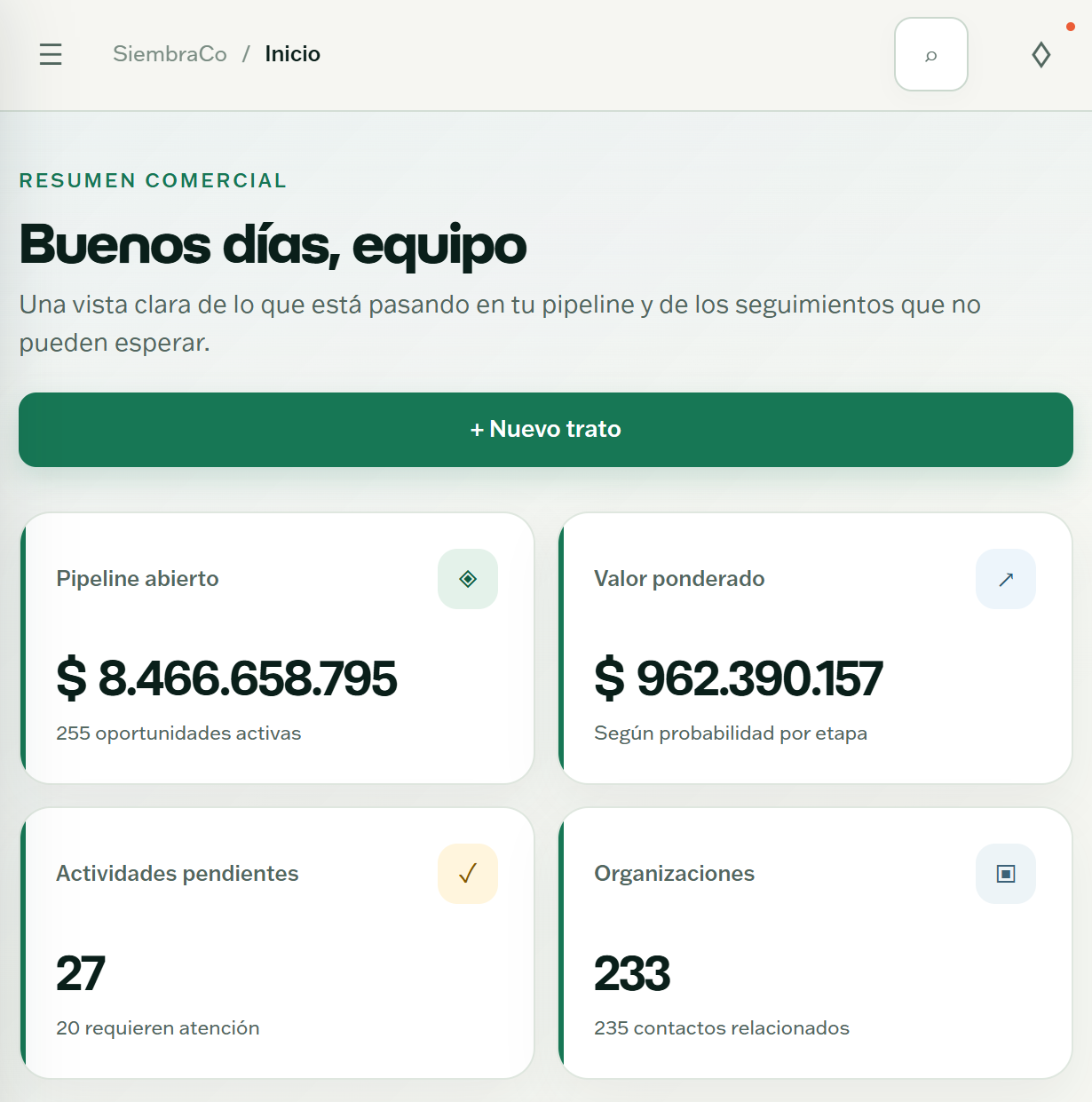
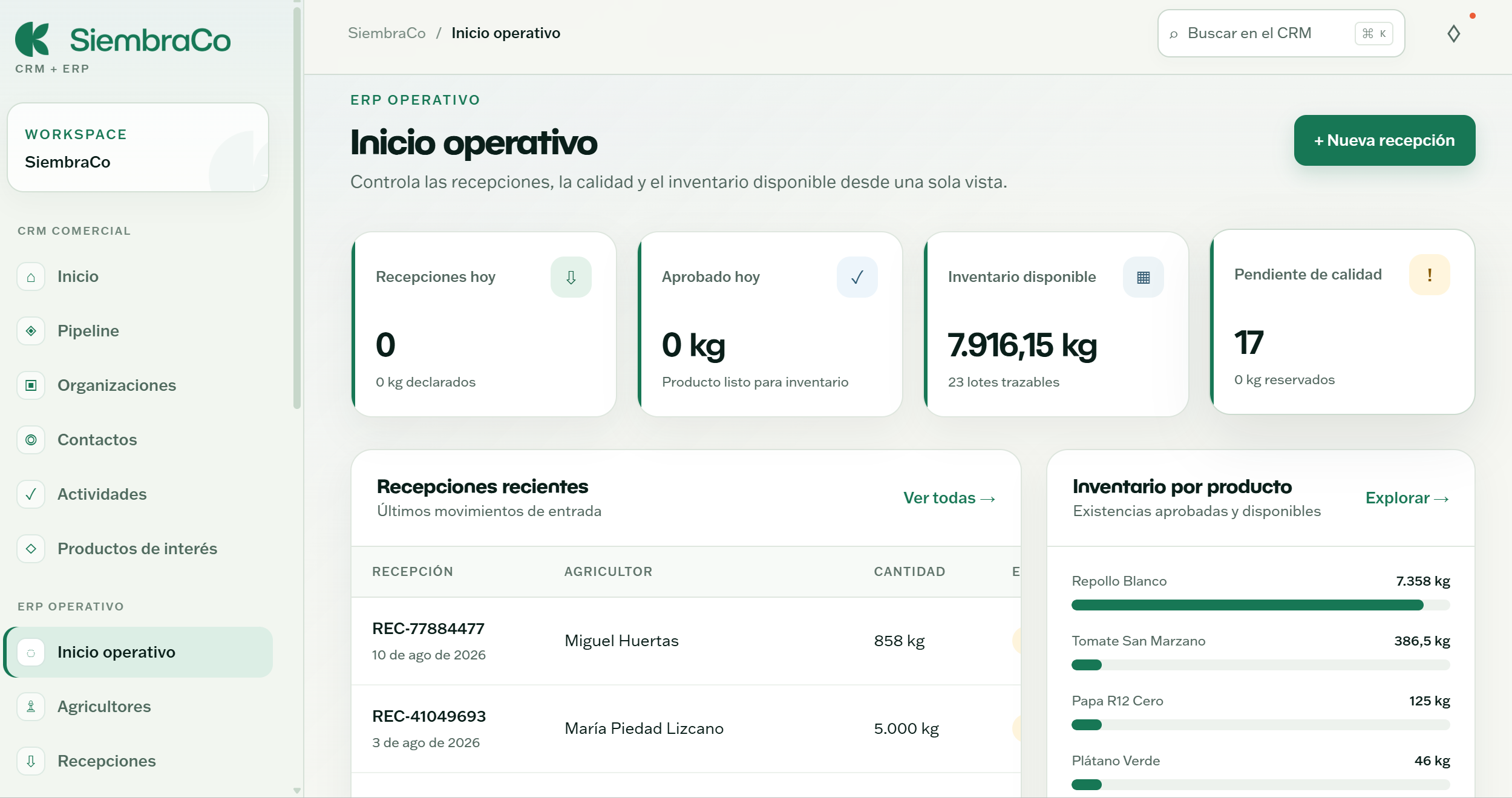
SiembraCo+ brings the core workflows of an agricultural business into one connected platform.
Today, the system includes capabilities across:
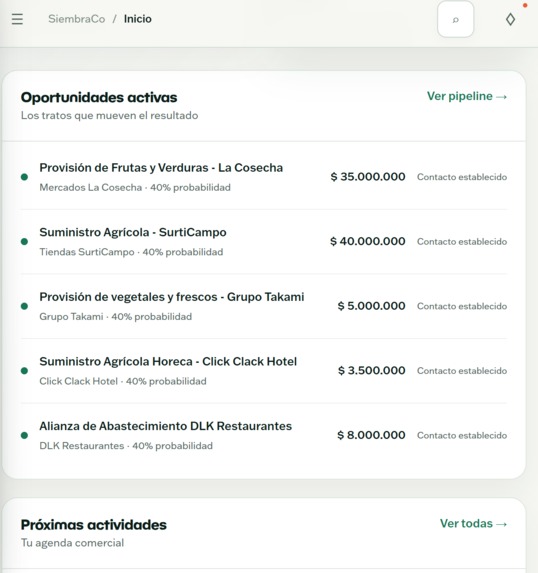
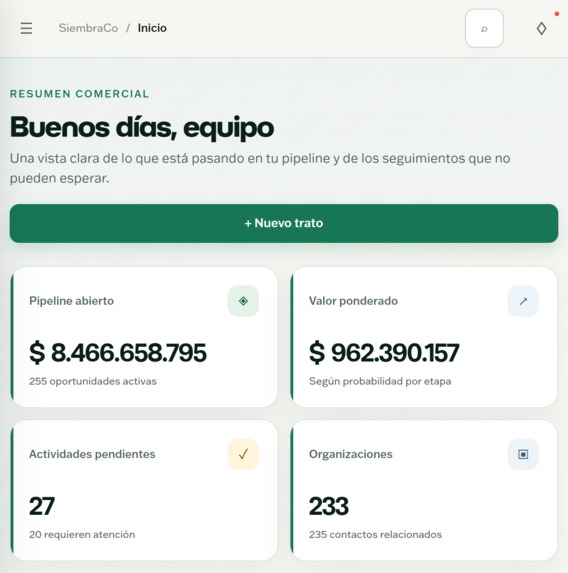
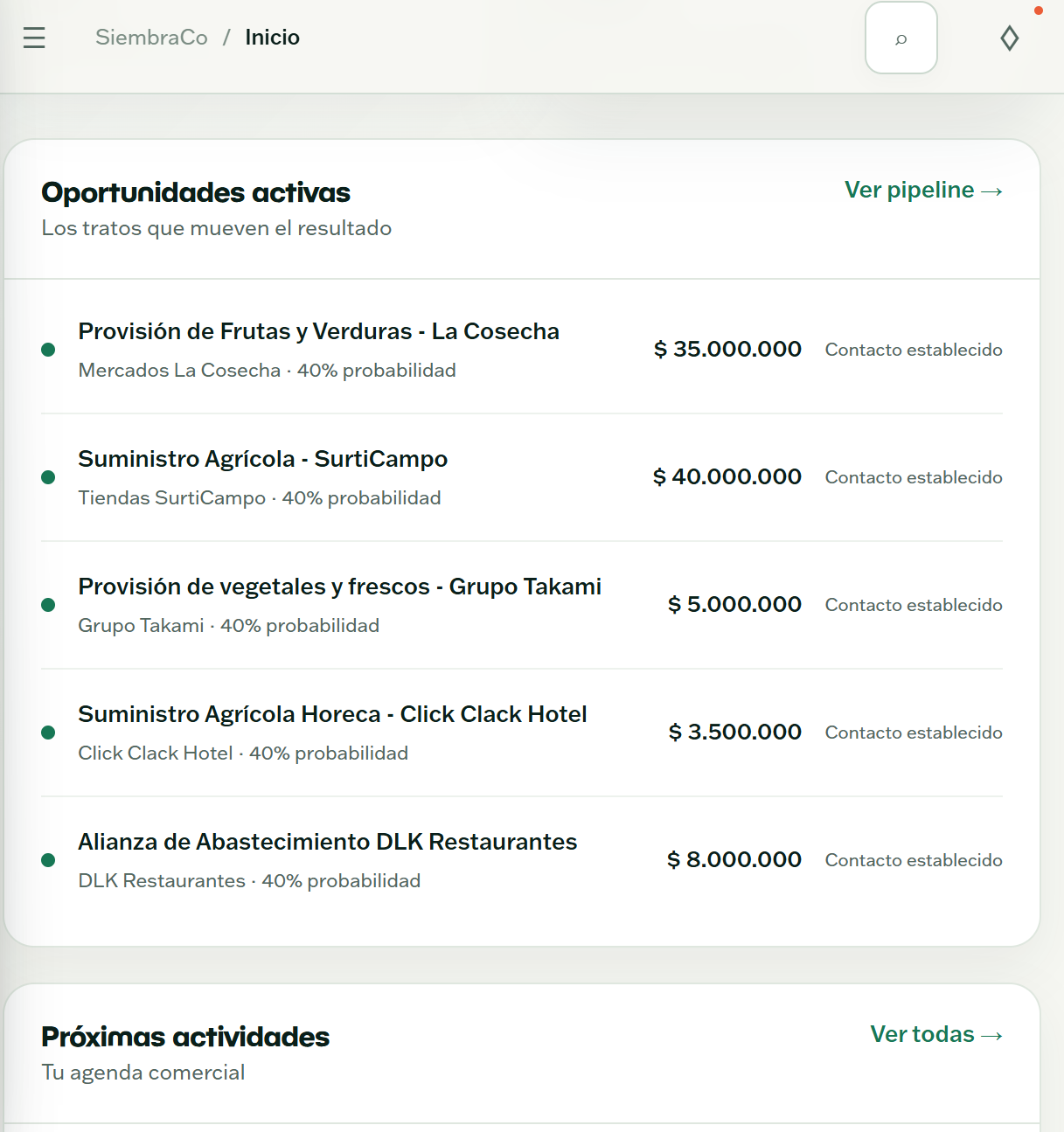
CRM & Sales
Manage:
organizations and customers contacts opportunities and deals commercial pipelines activities and follow-ups products customer demand Agricultural ERP
Manage the physical flow of food from the farm into the supply chain:
Farmer → Reception → Quality → Lot → Inventory → Dispatch → Customer
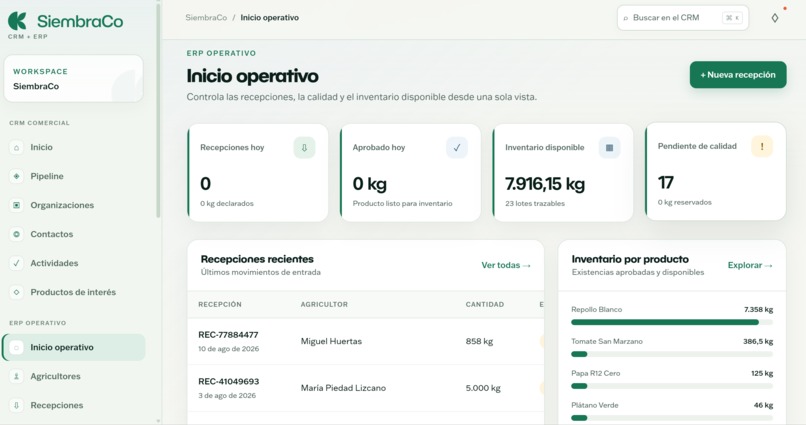
The platform manages farmers and suppliers, agricultural products, crop receptions, quality approval, lots, inventory movements, dispatches, and traceability.
Finance
Connect operations with financial information, including:
accounts payable farmer settlements sales invoices accounts receivable overdue balances cash-flow information factoring workflows accounting integrations Impact+
Agricultural procurement creates more than transactions.
SiembraCo+ includes an impact layer designed to measure the social, economic, and environmental outcomes connected to agricultural sourcing.
This includes indicators related to:
small-scale farmers women farmers rural income food volumes territories sustainable agriculture water and energy waste logistics greenhouse gas emissions customer-attributed impact
Corporate customers can access their own impact dashboard and explore how their sourcing connects to farmers, territories, products, traceability, and sustainability indicators over different periods.
The AI-native layer
The next generation of agricultural software should not require users to navigate dozens of screens just to understand what is happening.
SiembraCo+ is being designed so users and AI agents can interact with the same operational system.
Instead of only asking:
"Where is the inventory screen?"
we want an operator to ask:
"Which orders next week are at risk?"
"Which farmers could supply this order?"
"What products should we procure this week?"
"Which customers have overdue receivables?"
"What is our current availability by crop and farmer?"
"Analyze our operation and identify the most important supply risks."
To enable this, we built an agent-access layer using APIs and the Model Context Protocol (MCP).
Authorized agents can interact with real operational capabilities such as inventory, receptions, dispatches, opportunities, activities, farmers, accounts payable, financial information, and operational reports.
These actions run through controlled backend services with authentication, permissions, workspace isolation, transactions, idempotency, and auditability.
Our objective is not to add a chatbot on top of an ERP.
Our objective is for AI to become an operational intelligence layer for agricultural businesses.
How we built it
SiembraCo+ is a responsive web application designed to work across desktop, laptop, tablet, and mobile devices.
The current architecture uses technologies including:
Next.js React TypeScript Firebase Authentication Cloud Firestore Firebase Storage Firebase / Google Cloud Functions Firebase Hosting Model Context Protocol (MCP) APIs and external integrations
Google Cloud and Firebase provide the infrastructure for identity, operational data, backend services, storage, security, and deployment.
The architecture separates the user interface, operational services, data layer, and agent-access layer so that AI agents do not require unrestricted direct access to the database.
What makes SiembraCo+ different
Most business software starts with accounting, inventory, or sales and later tries to adapt those concepts to agriculture.
We started from the agricultural supply chain itself.
A customer order is connected to a product.
A product is connected to inventory and future availability.
Inventory is connected to lots.
Lots are connected to receptions.
Receptions are connected to farmers and agricultural production.
Dispatches connect that production back to customers.
Payments connect commercial activity to rural income.
And traceability allows those transactions to become measurable impact.
This creates a connected operational graph that AI can reason over.
The long-term opportunity is to help agricultural businesses move from:
recording what happened
to:
understanding what is happening → predicting what could happen → recommending what to do → executing authorized actions.
Small-scale farmers at the center
SiembraCo+ was born from SiembraCo's experience working directly with farmers.
Small-scale farmers frequently face limited market access, fragmented information, unpredictable demand, technical-assistance gaps, and inefficient supply chains.
Technology should not make that relationship more distant.
It should make it more transparent and coordinated.
By connecting demand, agricultural production, traceability, payments, and impact, SiembraCo+ is designed to help agricultural businesses build stronger and more sustainable relationships with their farmer networks.
This is also where SiembrAI, SiembraCo's farmer-facing AI initiative, can complement SiembraCo+ by helping bring intelligence and technical support closer to the field.
Together, the vision is an intelligent connection between both sides of the agricultural supply chain:
SiembrAI → intelligence for farmers and production
SiembraCo+ → intelligence for agricultural business operations
Challenges we faced
One of our biggest challenges was modeling agriculture without oversimplifying it.
Agricultural supply chains are not conventional retail supply chains.
Availability changes. Quality changes. Harvest dates move. Products are perishable. A farmer may supply several crops. Lots can be divided between customers. Inventory must preserve traceability. Payments and commercial conditions vary. Sustainability metrics need evidence and methodology.
Another challenge was designing AI access safely.
If an AI agent can interact with real business operations, authorization and auditability become fundamental. We therefore designed the agent layer so actions pass through controlled business services rather than giving agents unrestricted database access.
A third challenge has been transforming operational experience into reusable software.
SiembraCo existed before this competition. SiembraCo+ did not.
SiembraCo+ was created as a new product during the XPRIZE submission period. It uses the agricultural knowledge and selected reusable technical foundations developed through years of operating SiembraCo, while the SiembraCo+ product, its integrated CRM/ERP/Impact architecture, workflows, interfaces, agent layer, and associated development were created during this new build period.
What we learned
The biggest lesson has been that AI becomes much more valuable when it has structured operational context.
An LLM can answer questions.
But an AI system connected safely to customers, orders, farmers, inventory, traceability, finance, and impact can potentially understand the state of a business and help operate it.
We also learned that AI-native does not mean removing humans.
Agricultural operations involve financial, commercial, food-safety, and farmer-related decisions where accountability matters.
Our approach is therefore based on AI + controlled execution + human authorization where appropriate.
What's next
We are working toward a SiembraCo+ where an agricultural business can ask:
"What needs my attention today?"
and receive an answer based on its actual operation.
The system should be able to identify supply risks, inventory gaps, overdue customers, farmer availability, upcoming demand, operational anomalies, and sustainability information — and then propose or execute the appropriate authorized workflows.
Our ambition is bigger than digitizing agricultural businesses.
We want to give them an intelligent operating system capable of helping them compete, grow, and build more sustainable supply chains while creating better opportunities for the farmers behind our food.
Built With
- cloud
- firebase
- firestore
- gcp
- gemini
- nextjs
- node.js
- react
- typescript


Log in or sign up for Devpost to join the conversation.