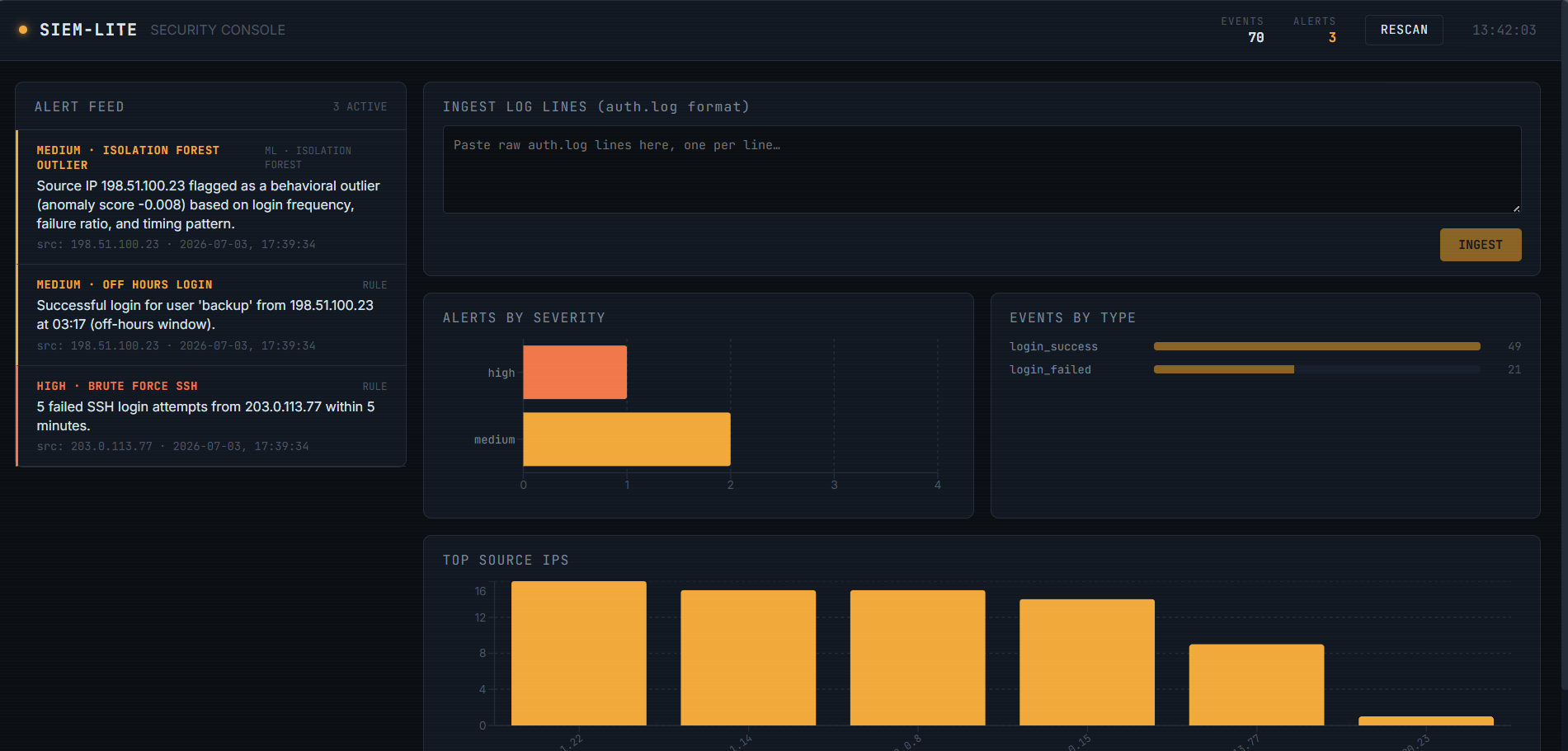
SIEM-lite
Repo: https://github.com/takshp2024-sys/siem-lite
A lightweight Security Information and Event Management (SIEM) platform that ingests raw security logs, normalizes them into a common schema, and detects threats using both rule-based signatures and a statistical anomaly model (Isolation Forest) — the same modeling approach used in my Robot Sensor Anomaly Detector (F1=0.82, ROC-AUC=0.89), adapted here to login behavior instead of sensor telemetry.
Built to demonstrate practical SOC-style detection engineering: log normalization, rule authoring, ML-based behavioral outlier detection, and a real-time analyst dashboard.
Why both rule-based and ML detection?
A real SOC runs both, and understanding why is the point of this project:
| Rule-based | Isolation Forest (ML) | |
|---|---|---|
| Catches | Known attack signatures (brute force, off-hours logins) | Behavioral outliers with no predefined signature |
| Speed | Instant, deterministic | Requires enough baseline data to model "normal" |
| Weakness | Blind to anything not explicitly written | Can flag legitimate-but-unusual behavior (false positives) |
Running both layers means known attacks are caught immediately, while novel or slow-and-low activity that doesn't match any rule still has a chance of surfacing.
Architecture
flowchart LR
    subgraph Sources
        A1[auth.log]
        A2[JSON log feed]
    end

    subgraph Backend[FastAPI Backend]
        P[Log Parser<br/>normalizes to common Event schema]
        DB[(SQLite / Postgres)]
        R[Rule Engine<br/>brute force · off-hours login]
        ML[Isolation Forest<br/>behavioral outlier scoring]
        API[REST API<br/>/events /alerts /stats]
    end

    subgraph Frontend[React Dashboard]
        UI1[Alert Feed]
        UI2[Severity / Event / Top-IP panels]
        UI3[Manual log ingest]
    end

    A1 --> P
    A2 --> P
    P --> DB
    DB --> R
    DB --> ML
    R --> DB
    ML --> DB
    DB --> API
    API --> UI1
    API --> UI2
    UI3 --> API
(Rendered directly by GitHub — no external image needed. See docs/architecture-notes.md for a deeper breakdown of each stage, and drop a static export here if you want a non-Mermaid version for a slide deck.)
Stack
- Backend: FastAPI, SQLAlchemy, SQLite (swappable for Postgres via
DATABASE_URL), scikit-learn - Frontend: React + Vite, Recharts
- Detection: custom rule engine (sliding-window brute-force detection, off-hours login flagging) + Isolation Forest anomaly scoring on per-IP login behavior
- Deployment: Docker Compose (backend + frontend as separate containers)
Quickstart
Option A — Docker Compose (recommended)
git clone <this-repo>
cd siem-lite
docker compose up --build
- Dashboard: http://localhost:5173
- API docs (Swagger): http://localhost:8000/docs
Option B — Run locally without Docker
Backend:
cd backend
pip install -r requirements.txt
uvicorn app.main:app --reload
Frontend:
cd frontend
npm install
npm run dev
Load demo data
The dashboard starts empty. Generate and ingest a synthetic auth.log that includes a real embedded brute-force burst and an off-hours login:
cd backend/sample_logs
python generate_sample_log.py > sample_auth.log

curl -X POST http://localhost:8000/ingest/file \
  -F "fmt=auth_log" \
  -F "file=@sample_auth.log"
Refresh the dashboard — you should see three alerts fire: a brute_force_ssh rule alert, an off_hours_login rule alert, and an isolation_forest_outlier ML alert, all correctly attributing the same attacker IP.
API Reference
| Endpoint | Method | Description |
|---|---|---|
/ingest/text |
POST | Ingest raw log lines from a JSON body |
/ingest/file |
POST | Ingest an uploaded log file |
/ingest/rescan |
POST | Re-run detection over existing data without new ingestion |
/events |
GET | List normalized events (filterable by type, source IP) |
/alerts |
GET | List generated alerts (filterable by severity, detector) |
/stats/summary |
GET | Aggregate stats for dashboard charts |
Full interactive docs at /docs (Swagger UI, auto-generated by FastAPI).
Detection logic
Rule-based (app/detection/rules.py)
brute_force_ssh— flags a source IP with 5+ failed logins within a 5-minute sliding windowoff_hours_login— flags successful logins between 00:00–05:00
ML-based (app/detection/anomaly.py)
- Builds a feature vector per source IP: total event count, failed-login ratio, distinct users attempted, mean time between events, and standard deviation of login hour
- Fits an Isolation Forest (
contamination=0.1) and flags IPs scored as outliers - Requires a minimum of 20 events before running, since Isolation Forest needs enough data to establish a baseline of "normal"
Both thresholds are tunable constants at the top of each file — documented there rather than buried in logic, since threshold tuning is itself a real SOC operating decision.
Project structure
siem-lite/
├── backend/
│   ├── app/
│   │   ├── detection/       # rules.py, anomaly.py
│   │   ├── models/          # SQLAlchemy Event, Alert models
│   │   ├── routers/         # ingest, events, stats
│   │   ├── log_parser.py    # auth.log + JSON normalization
│   │   ├── database.py
│   │   ├── schemas.py
│   │   └── main.py
│   ├── sample_logs/
│   │   └── generate_sample_log.py
│   └── requirements.txt
├── frontend/
│   ├── src/
│   │   ├── components/      # StatusBar, AlertFeed, StatsPanels, IngestPanel
│   │   ├── lib/api.js
│   │   └── App.jsx
│   └── package.json
├── docs/
│   └── architecture-notes.md
└── docker-compose.yml
Limitations & what I'd add next
Being upfront about this matters more than pretending it's production-ready:
- Single-node only. No log shipping agent (Filebeat/Fluentd) — logs are ingested via direct upload for demo purposes. A real deployment would need an agent-based collection pipeline.
- Isolation Forest retrains on every detection pass rather than being persisted and incrementally updated — fine for a demo dataset, not for production log volume.
- No authentication on the API — every endpoint is open. Given more time, this is exactly where the RBAC-secured Vulnerability API (planned) project's JWT pattern would get reused.
- Rule thresholds are static constants, not configurable per-environment through the UI.
Author
Taksh — Computer Science Honours, York University · GitHub Built alongside a Robot Sensor Anomaly Detector (PyTorch LSTM Autoencoder + Isolation Forest) — this project reuses the same anomaly-detection instincts applied to security log data.
Built With
- anomaly-detection
- css
- cybersecurity
- docker
- dockerfile
- fastapi
- html
- javascript
- log
- python
- react
- scikit-learn
- siem
- sqlite
- threat-detection

Log in or sign up for Devpost to join the conversation.