-
-
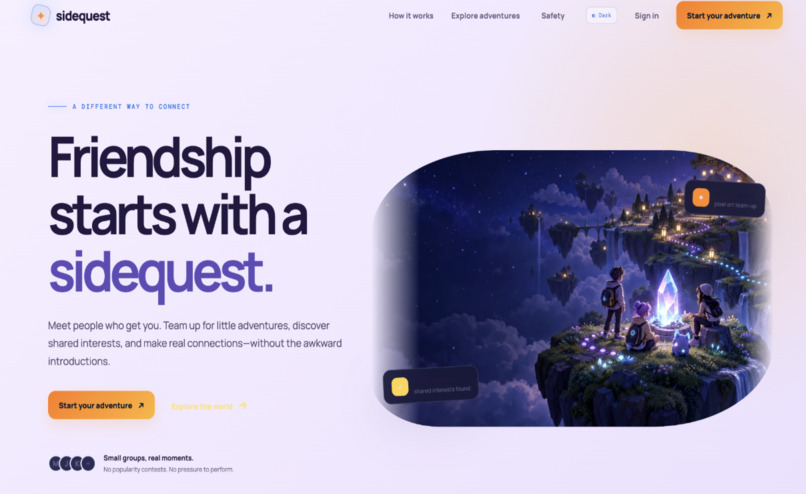
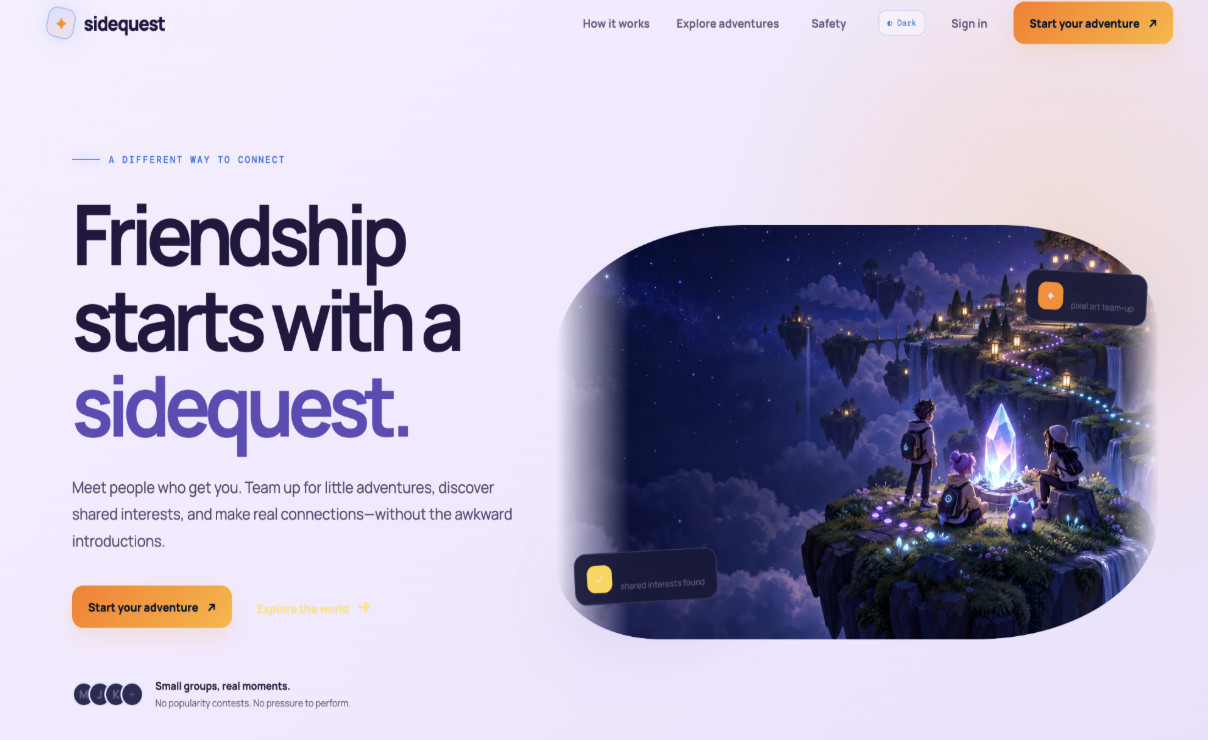
Home Page
-
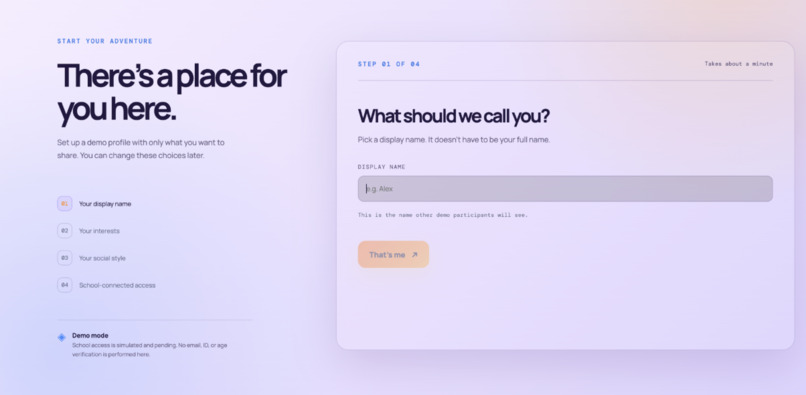
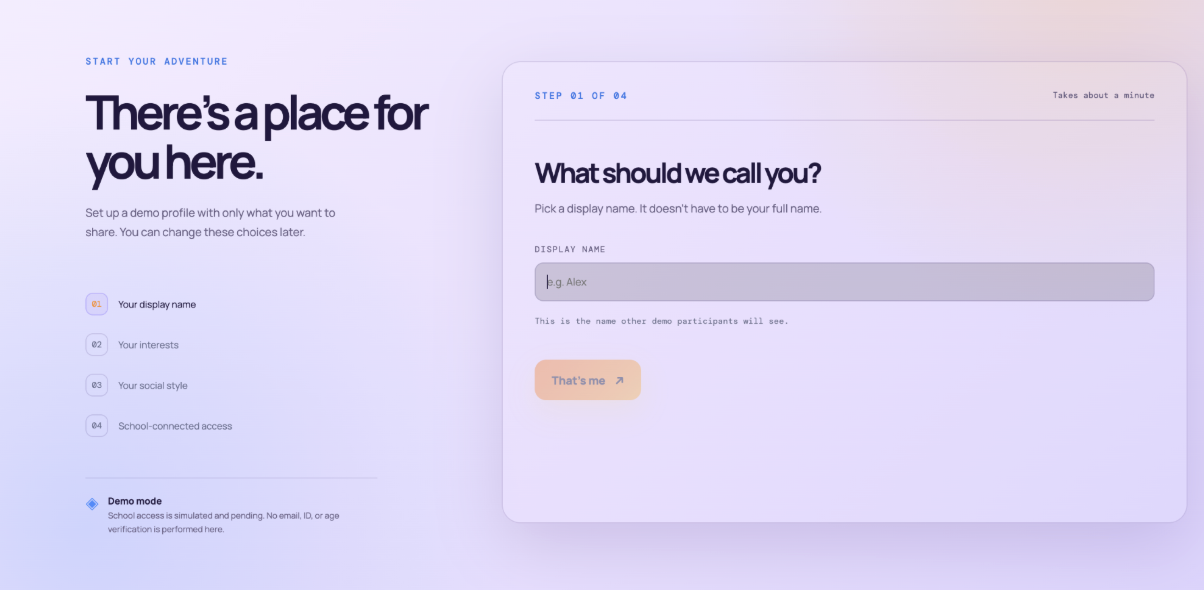
Sign-Up Page
-
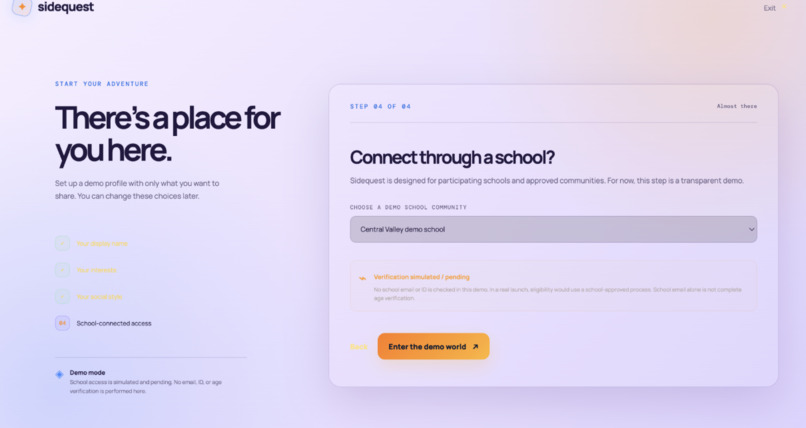
Safety and Verification
-
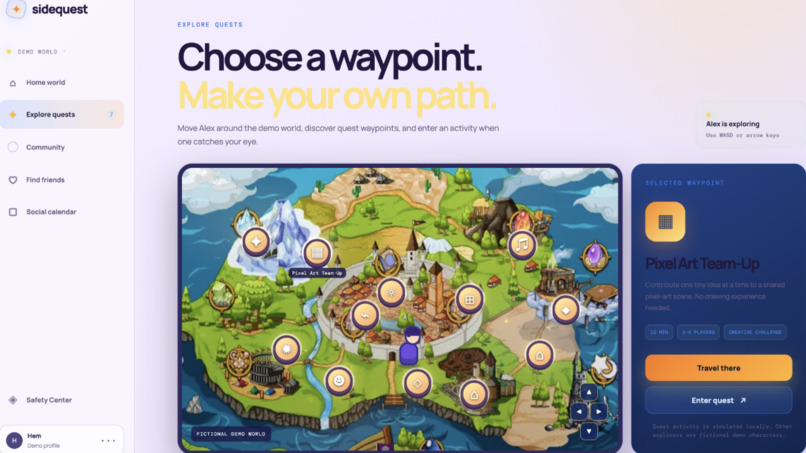
Quests and Interactive Games
-
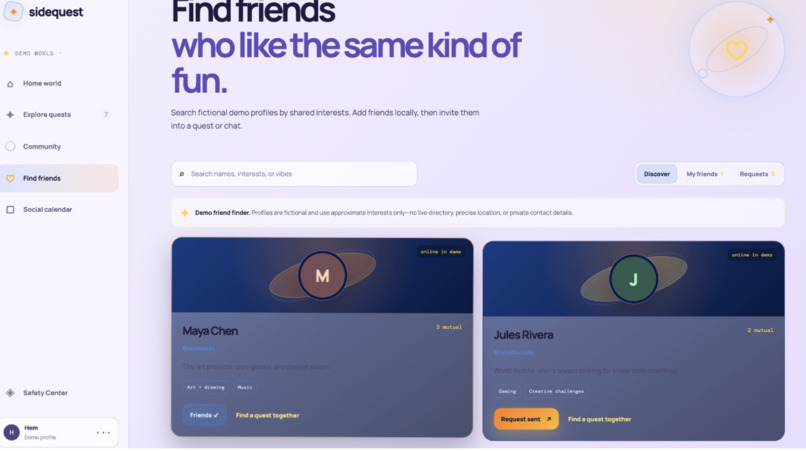
Connecting with Others
-
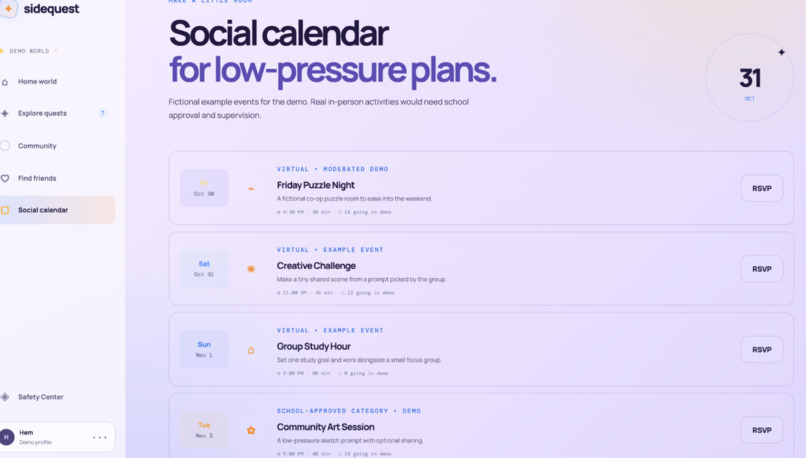
Social Calendars
Inspiration
Growing up as a student can be challenging, especially when someone feels lonely, struggles to make friends, or has difficulty finding people who understand them. In the Central Valley, geographic isolation and barriers to accessing support can make it even harder for some teens to find meaningful social connections.
We wanted to explore a simple question: What if making friends didn't have to start with awkward small talk?
That question inspired SideQuest, a school-connected multiplayer world where Central Valley teens can meet through games, creative activities, and shared adventures. Instead of expecting students to introduce themselves or start conversations with strangers, SideQuest gives them something to do together. We believe that small, enjoyable interactions can be a starting point for building friendships and a stronger sense of belonging.
What it does
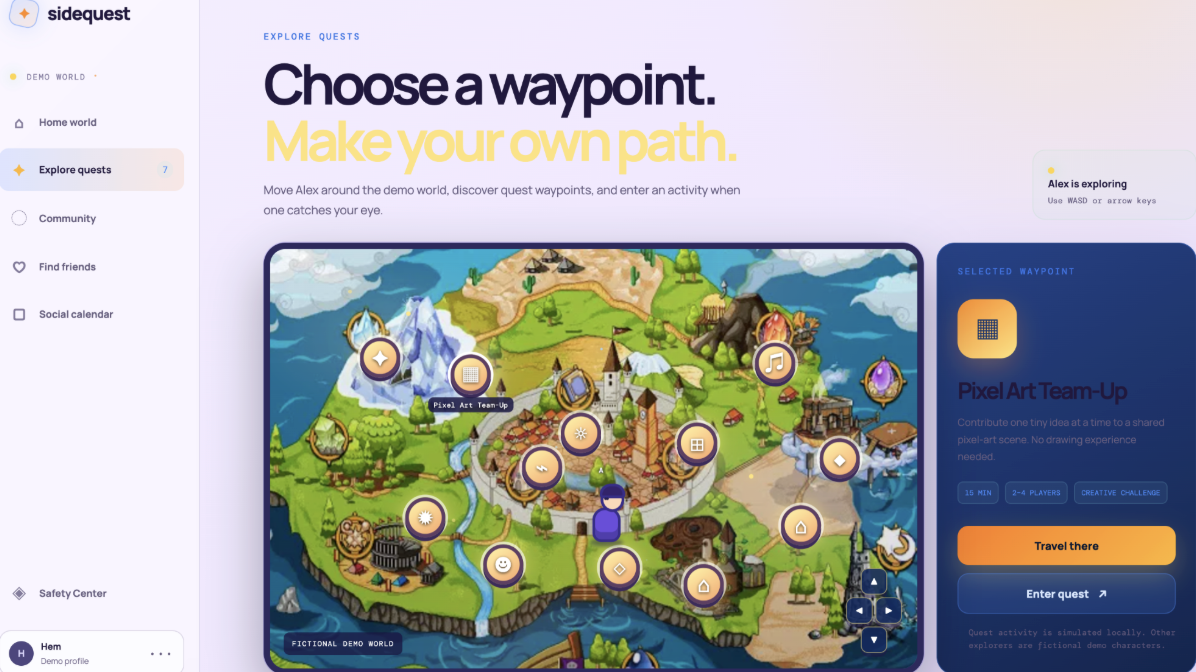
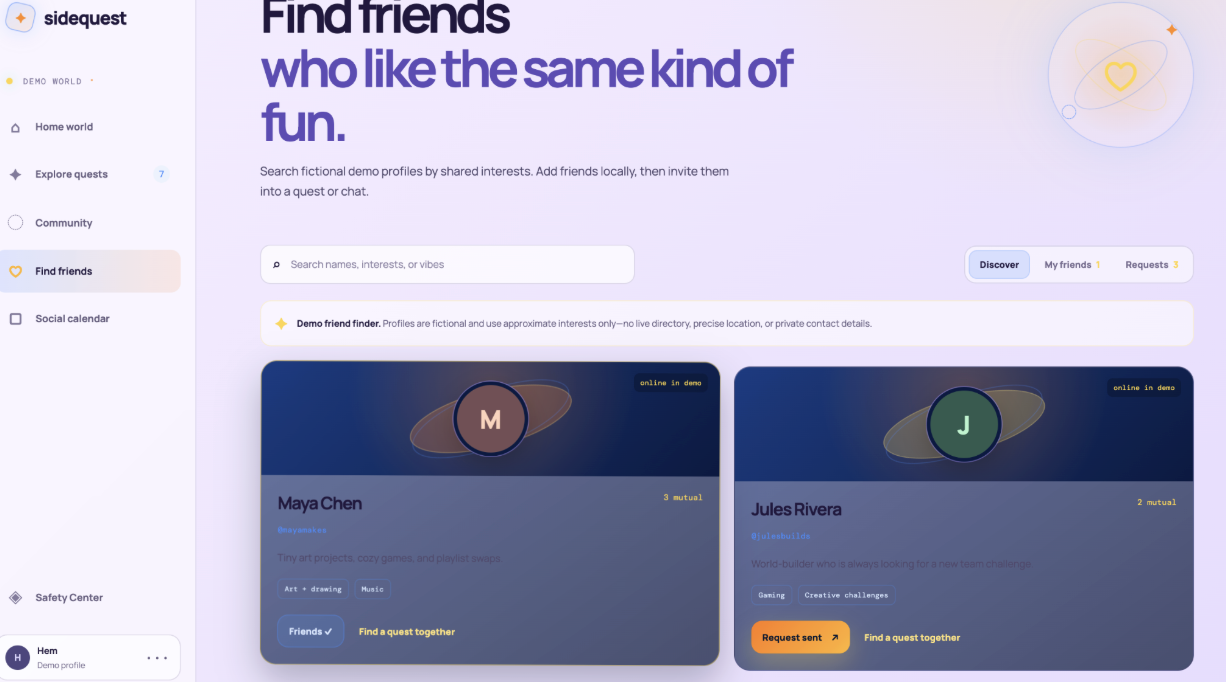
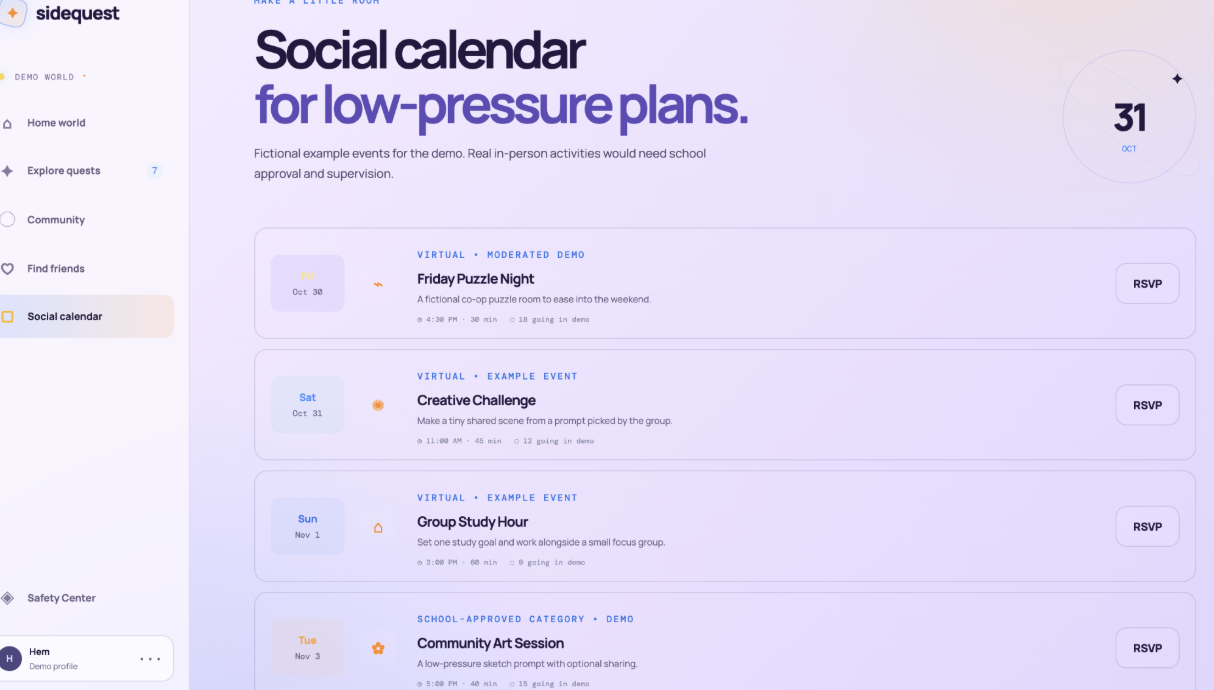
SideQuest is a social platform designed to help Central Valley teens connect through interactive adventures, shared interests, and low-pressure activities. Its central feature is an interactive world map containing themed islands, each offering a different way to connect SideQuest also aims to support interest-based communities, group messaging, personalized profiles, and social activities. Students can discover people with similar interests and interact through shared experiences rather than relying entirely on direct messages. Safety and privacy are important parts of our vision. We want access to be limited to eligible students at participating Central Valley schools through school-connected verification. We also plan to prioritize private profiles, reporting and blocking tools, minimal personal-data collection, and clear community guidelines. SideQuest is designed to encourage social connection and belonging. It is not a substitute for mental health treatment or professional support.
How we built it
We approached SideQuest by starting with the user experience: how could we make an online social space feel welcoming, intuitive, and fun for someone who might find traditional social platforms intimidating?
We developed the concept around an interactive world map, with each island representing a different activity or opportunity to connect. We chose purple as a central part of the SideQuest identity and envisioned distinct colors, themes, and landmarks for each world so students could explore according to their interests.
We also focused on making the experience activity-centered rather than popularity-centered. The goal is to encourage collaboration and shared accomplishments, not follower counts or social rankings.
Our prototype is available at SideQuest. We designed the project with the needs of Central Valley students in mind, considering accessibility, privacy, and the importance of creating a welcoming digital environment.
Challenges we ran into
One of our biggest challenges was figuring out how to address loneliness without creating just another social media platform. Traditional social platforms often depend on posting, messaging strangers, and maintaining an online presence. We wanted SideQuest to offer a different experience, where friendships could develop naturally through shared activities.
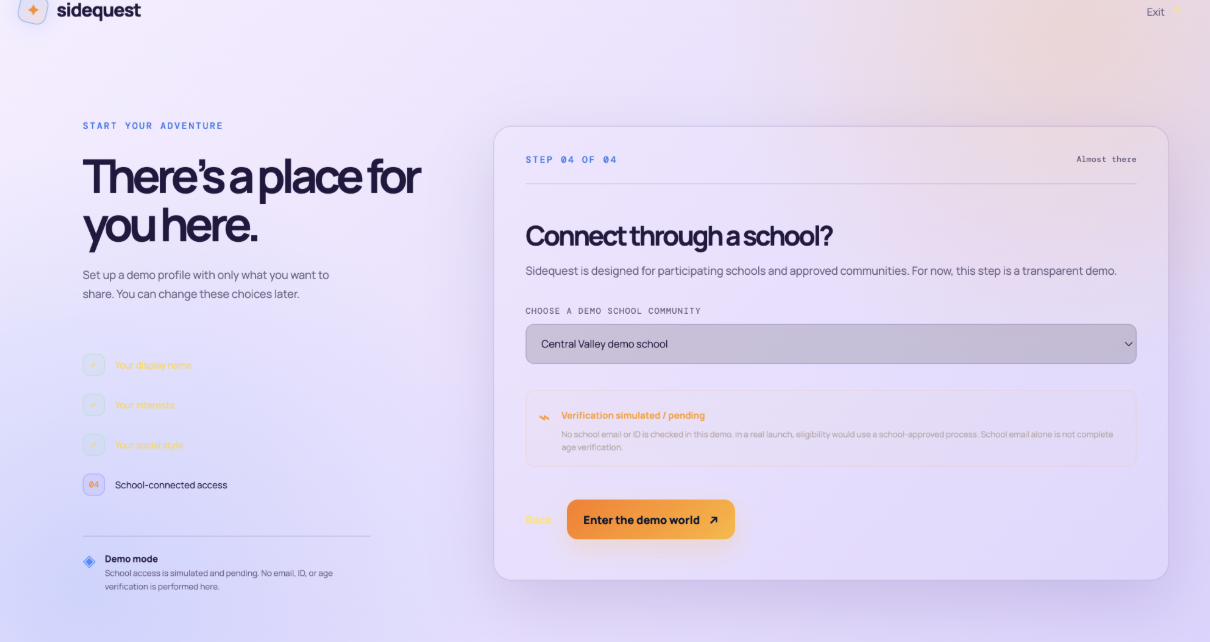
Another challenge was balancing social interaction with safety. A platform intended for teenagers needs thoughtful privacy protections, age-appropriate community guidelines, and ways to report or block inappropriate behavior. School-connected access introduces additional considerations, including verification, student privacy, and the need for school participation.
We also had to think about how to make the experience engaging beyond its visual design. An interactive map is only useful if the activities behind it are enjoyable and meaningful. This pushed us to prioritize genuine gameplay, clear navigation, and features that encourage students to participate together.
Accomplishments that we're proud of
We are proud of turning a community-focused idea into a concrete project with a clear purpose: helping students find connection through shared experiences.
We developed the SideQuest concept around an interactive multiplayer world, with themed destinations that encourage creativity, problem-solving, storytelling, and collaboration. We also considered how the platform could serve students with different interests and different levels of comfort with social interaction.
Most importantly, we are proud that SideQuest approaches social connection from a different angle. Rather than asking students to be more outgoing, it gives them opportunities to participate at their own pace and connect through something they already enjoy.
We hope to build something that makes students feel that there is a place for them, even when finding that place in everyday life feels difficult.
What we learned
We learned that solving a social problem with technology requires more than adding messaging features or creating an attractive interface. The experience itself needs to make people feel comfortable participating.
We also learned that safety and privacy must be considered from the beginning, especially when building for teenagers. School-connected verification, private-by-default profiles, and accessible reporting tools are important design considerations, but they must be implemented and tested carefully rather than treated as guarantees.
Finally, we learned to think about impact in practical terms. SideQuest should not simply measure engagement by time spent online. A more meaningful goal is to create opportunities for students to collaborate, discover shared interests, and develop a stronger sense of belonging.
What's next for SideQuest
Our next step is to make SideQuest more interactive by connecting each island to a playable experience. We want to prioritize a few polished activities, such as collaborative pixel art, cooperative puzzles, and branching group stories, before expanding the world.
We also want to explore secure friend requests, private game rooms, interest-based communities, and school-approved participation. These features would require appropriate technical safeguards and partnerships with participating schools.
In the longer term, we hope to work with Central Valley students, educators, and school communities to understand what makes an online space genuinely welcoming and useful. Their feedback would help us improve accessibility, strengthen privacy protections, and make the activities more engaging.
Our vision is for SideQuest to become more than a website. We want it to be a place where students can show up as themselves, embark on small adventures, and discover that meaningful connections can begin with something as simple as playing a game together.

Log in or sign up for Devpost to join the conversation.