-
-
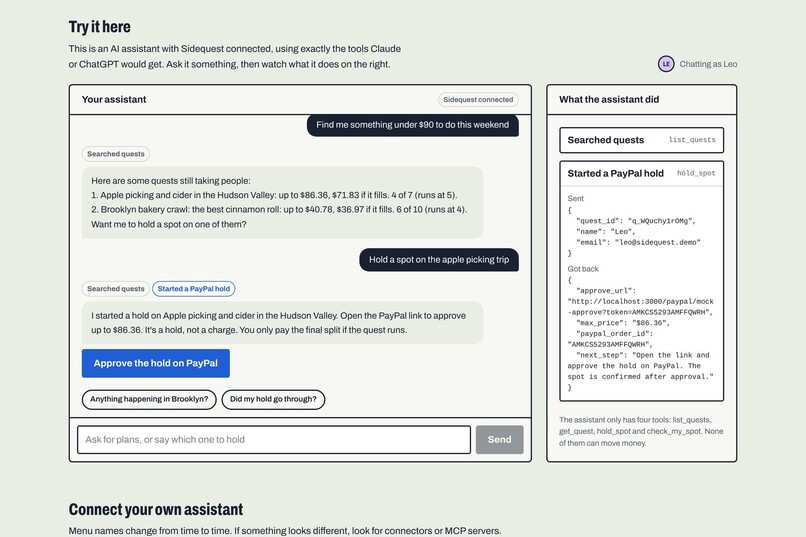
MCP agentic commerce
-
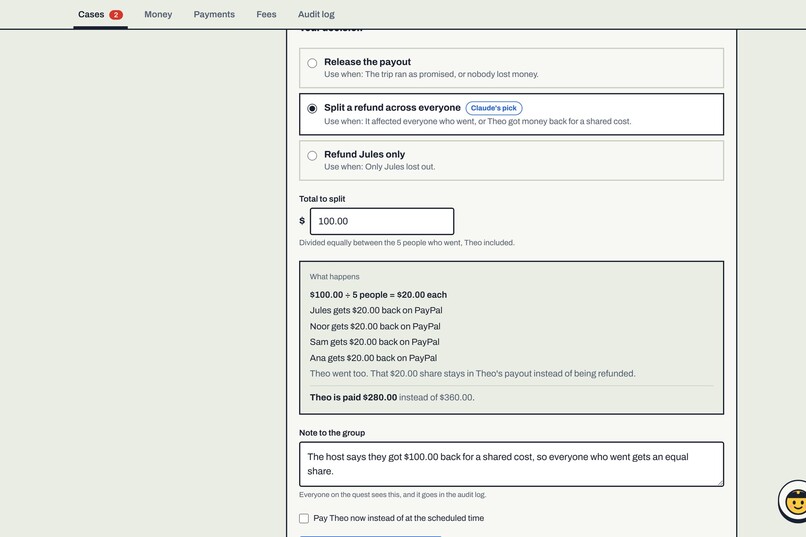
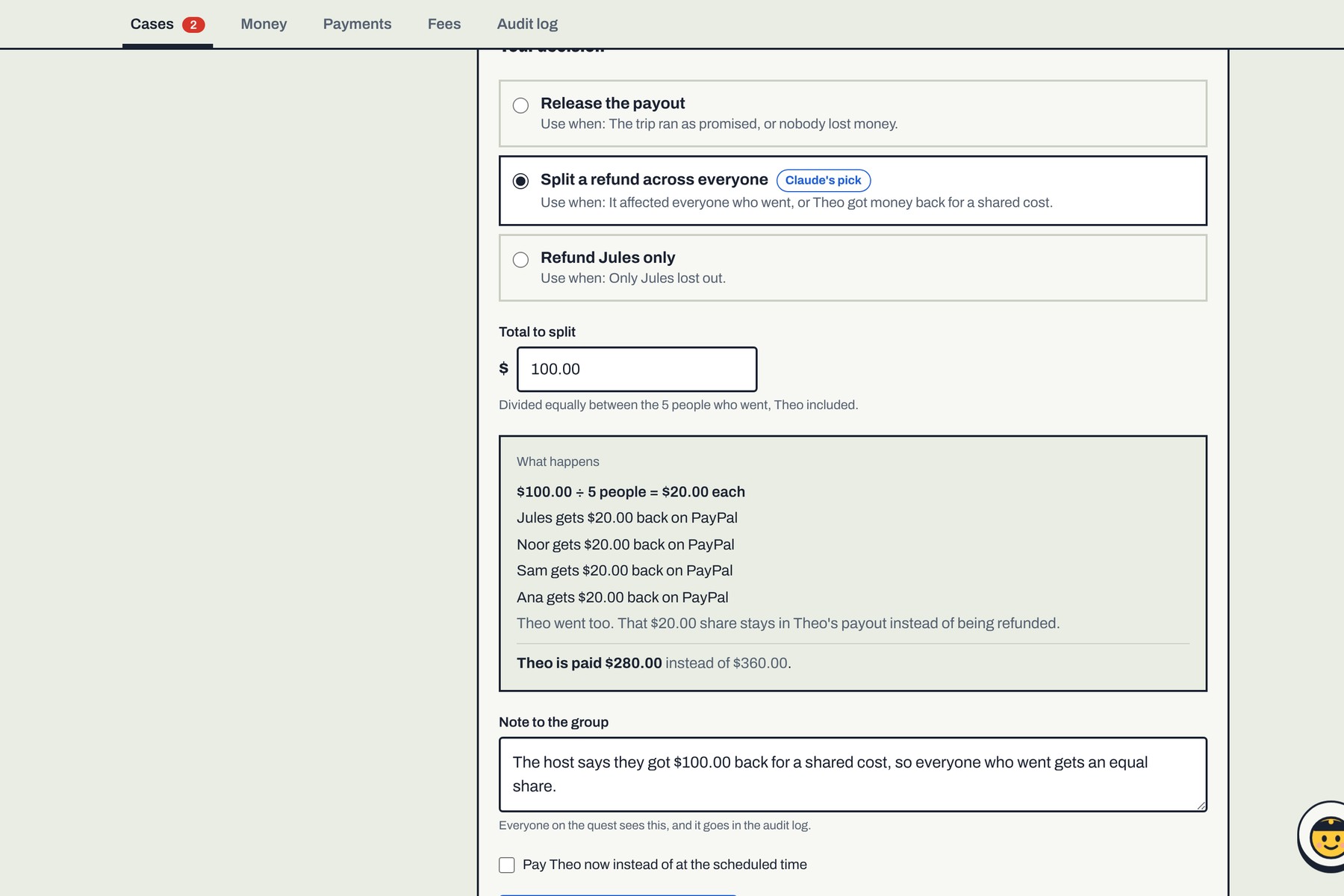
Admin dispute decision
-
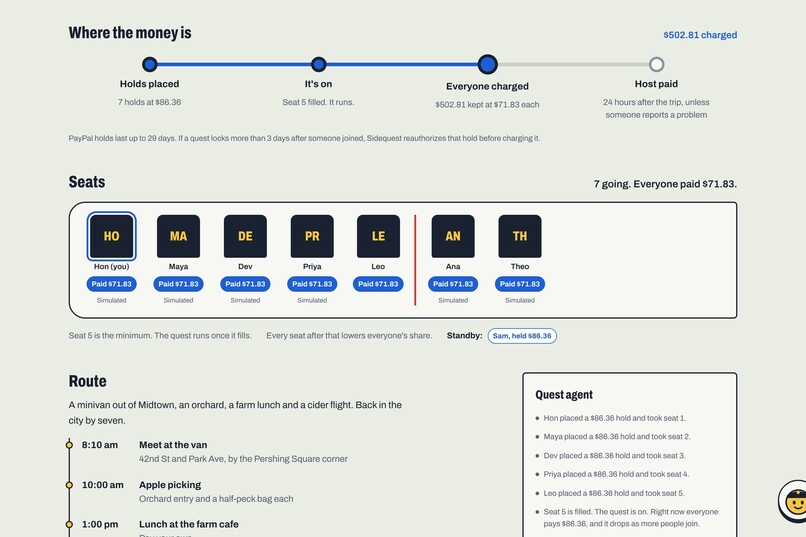
Lock and charge
-
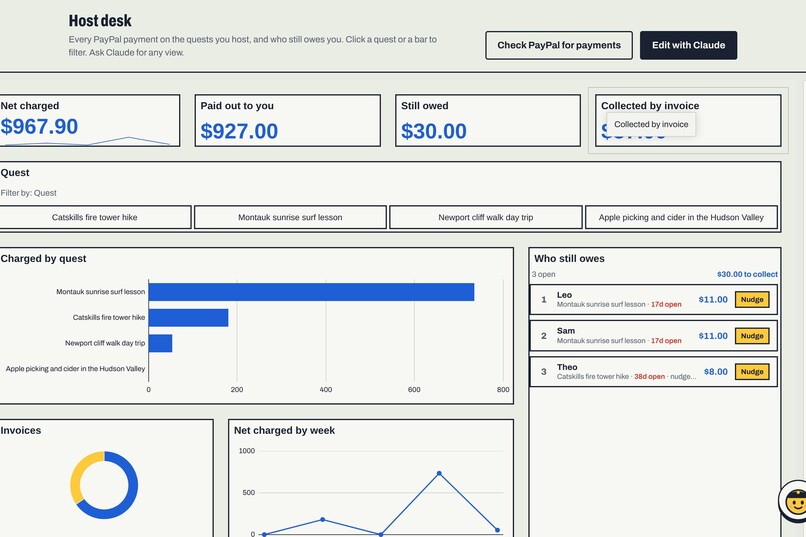
AG Studio host desk
-
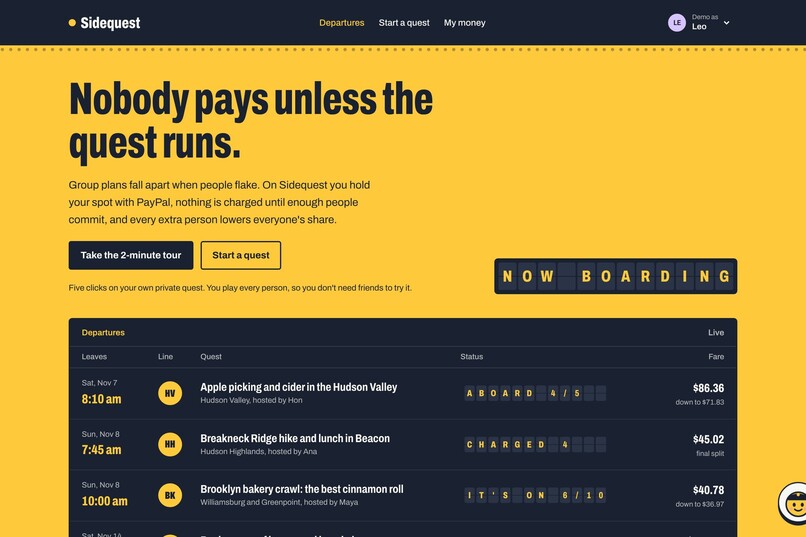
Home page
-
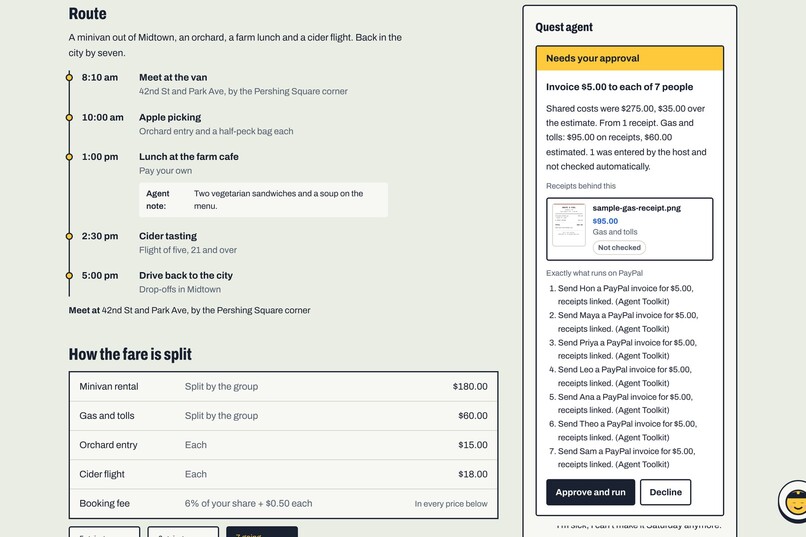
Receipt to invoices
-
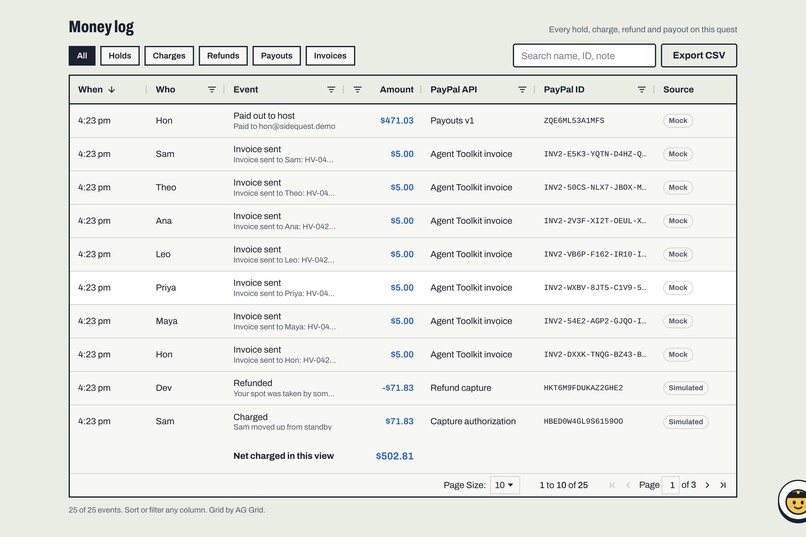
Money log with PayPal IDs
-
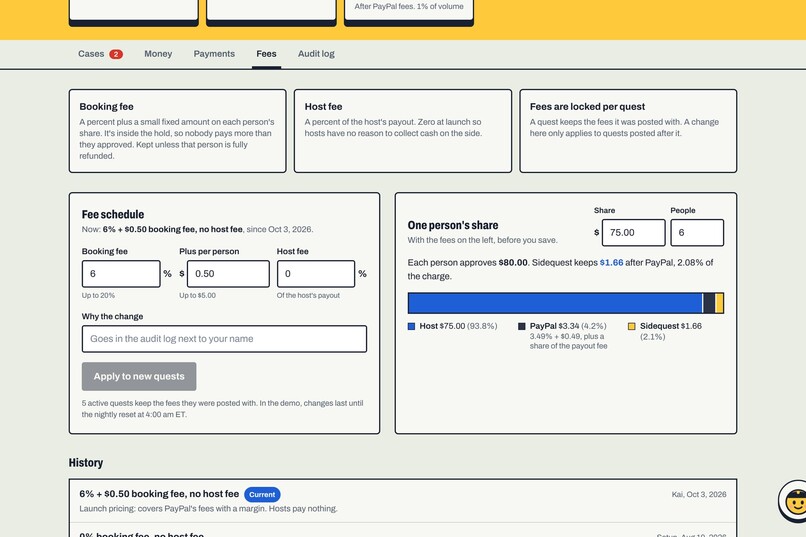
Fees net of PayPal
-
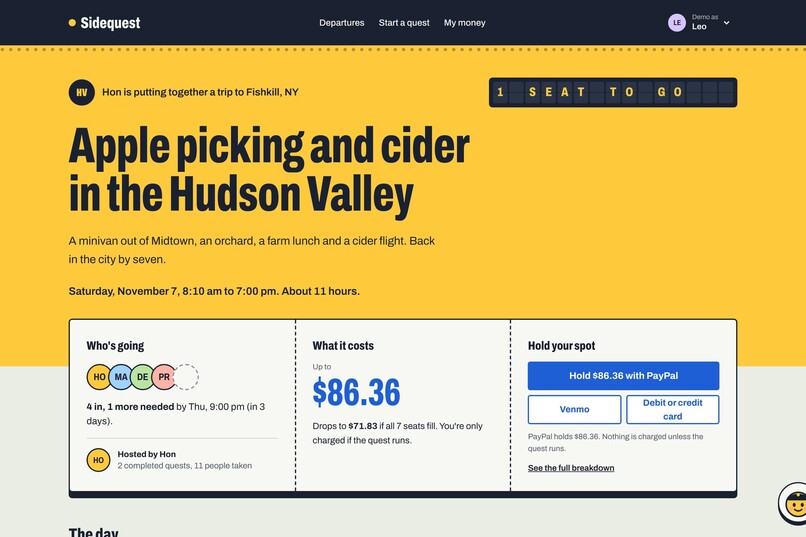
Holding a spot with PayPal
-
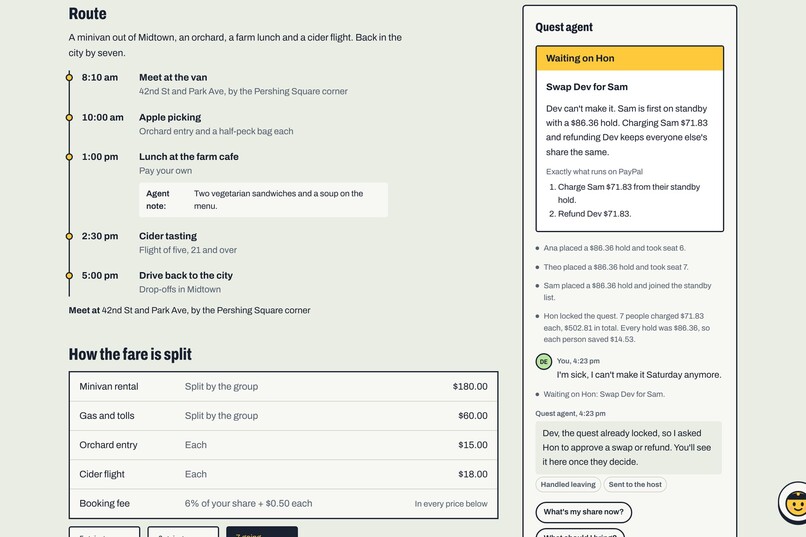
Claude handles a dropout
Inspiration
Group plans die in the group chat. Someone suggests a day trip, four people say maybe, and whoever books the van ends up fronting the cost and chasing payments.
PayPal already has the right building block: authorize now, capture later. Sidequest is built around it.
What it does
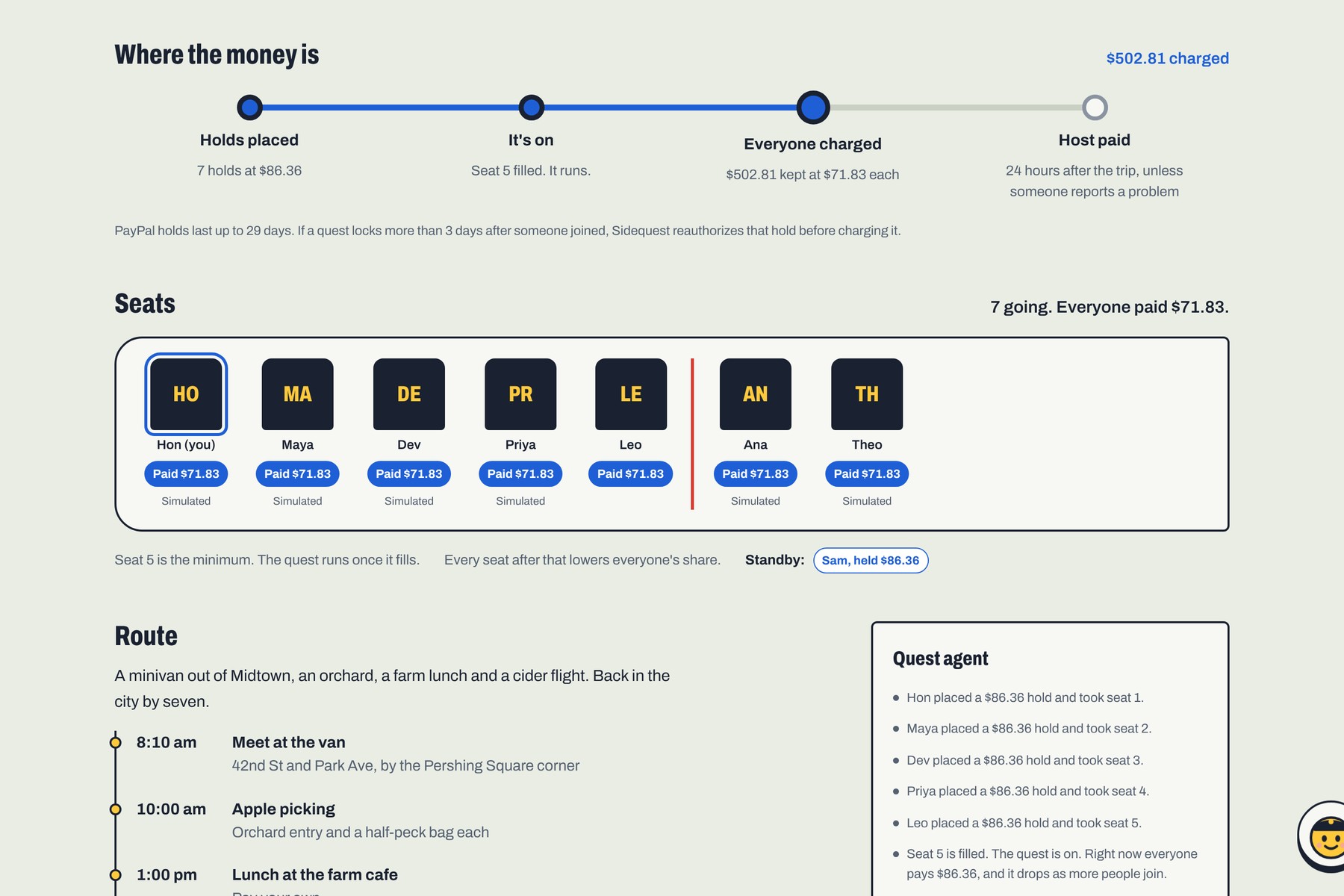
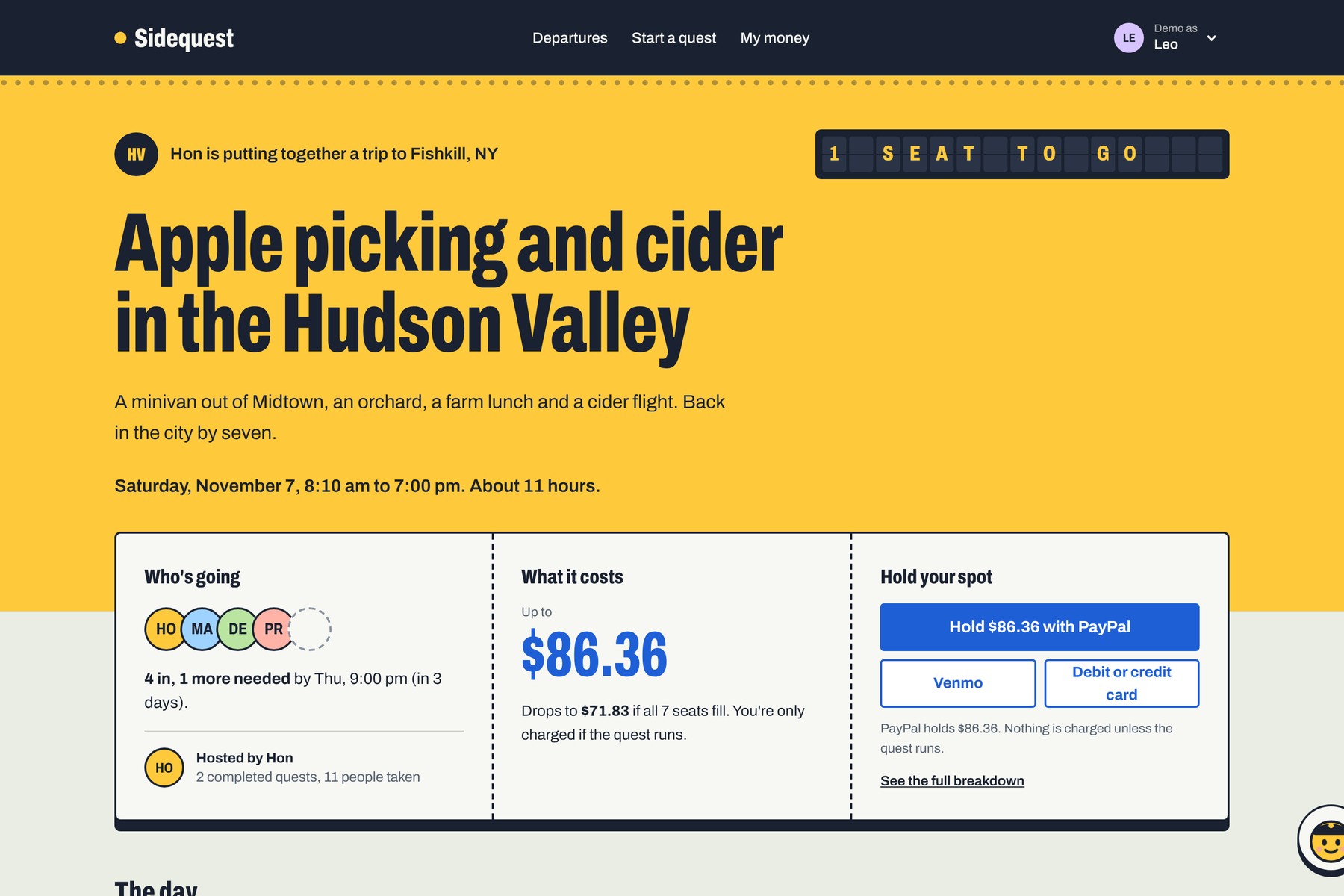
- Hold, don't pay. Joining places a PayPal hold for the most you could pay. Nothing is charged.
- It runs or it doesn't. When enough people commit, the host locks and everyone pays the real split, which drops with every extra person. If not enough people commit, every hold is released.
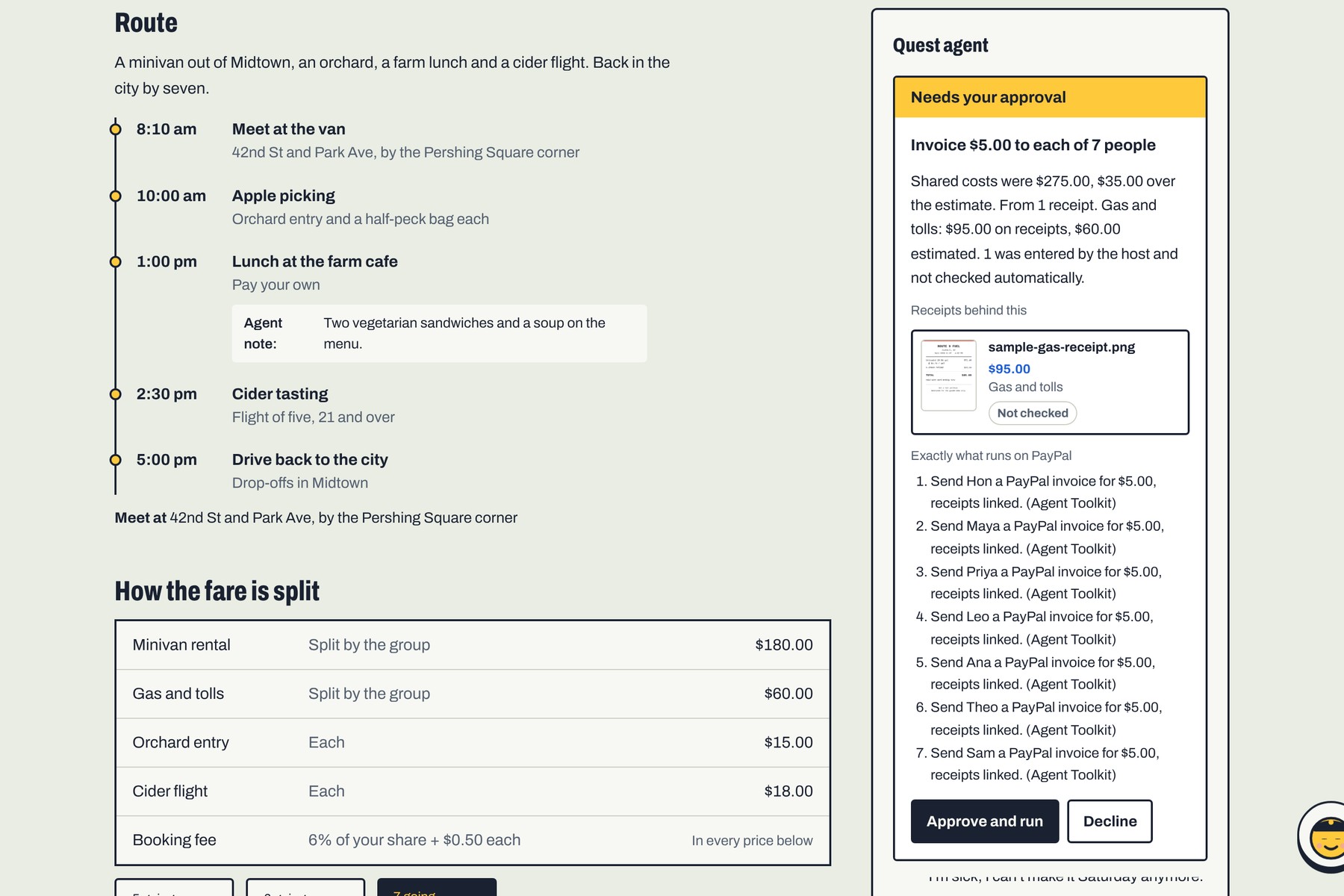
- Claude does the admin, the host approves the money. Claude plans the quest from one sentence, runs the group chat, swaps dropouts with people on standby, and reads receipts to settle up with refunds or PayPal invoices. It can only propose money moves. The host sees the exact PayPal operations and approves them.
Around that core:
- Escrowed payout. The host is paid through PayPal Payouts 24 hours after the trip, unless a member reports a problem or opens a PayPal dispute.
- Admin console. Sidequest staff decide reports, never the host. Claude reads the chat, receipts and payments and suggests a remedy; the admin approves it. The same console audits every payment against PayPal, shows revenue net of PayPal's fees, and edits the fee schedule.
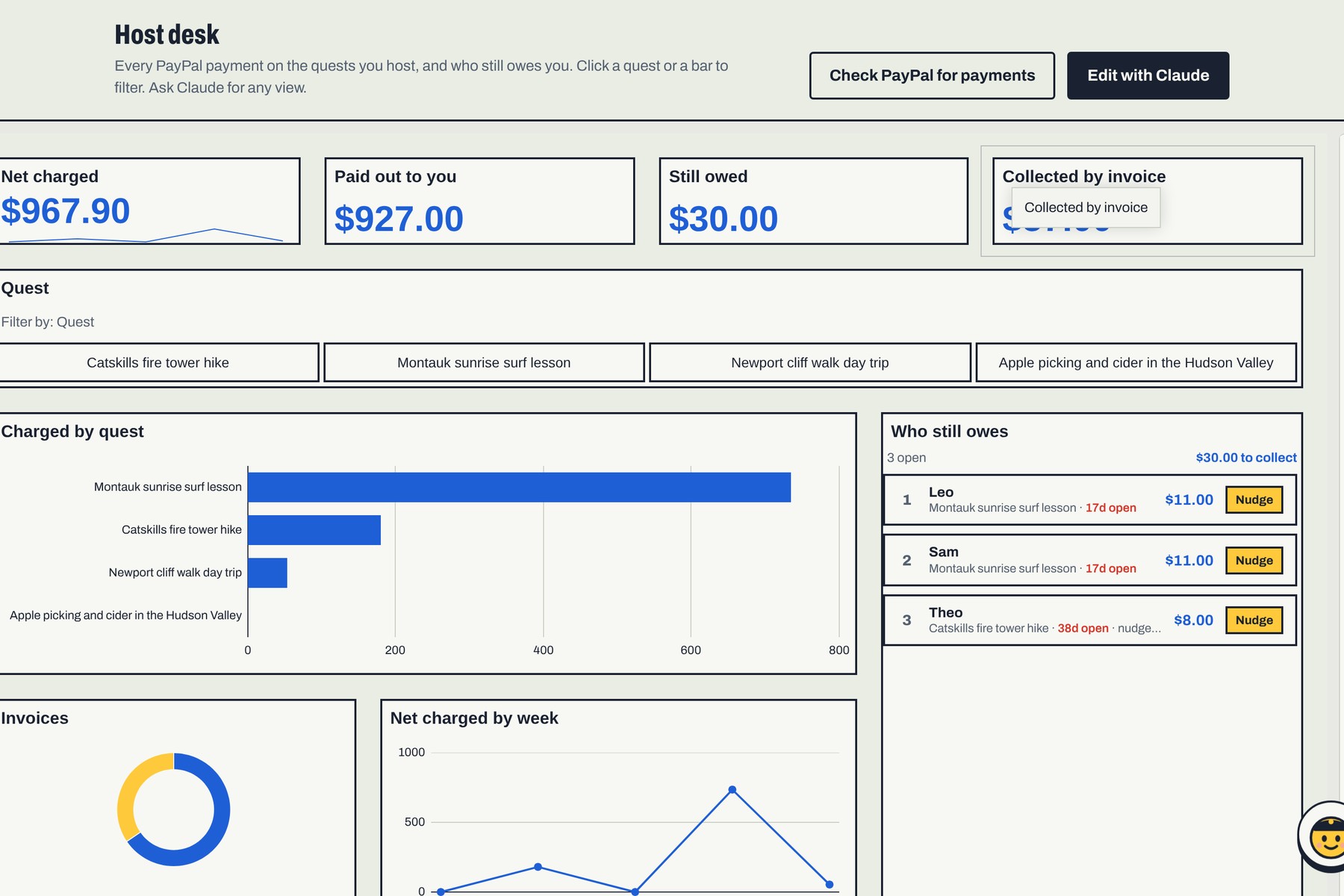
- Host desk. An AG Studio dashboard of every payment and who still owes, with nudges sent through PayPal's invoice reminders and Claude to build any view.
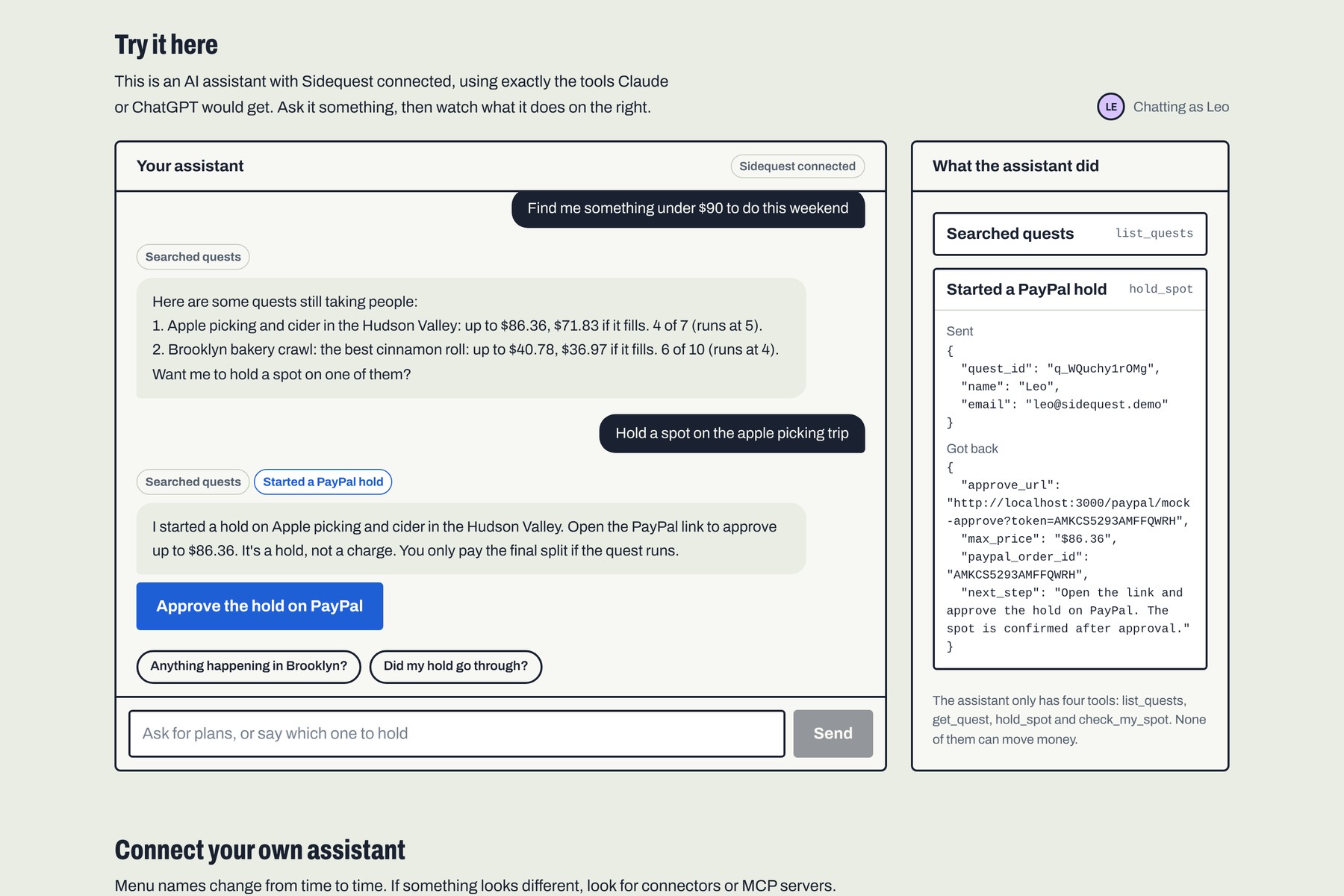
- Agentic commerce. Sidequest is an MCP server. Claude, ChatGPT or any MCP client can find a quest and start a hold. You still approve it on PayPal. Scout, a small assistant in the corner of every page, uses the same four tools, so judges can try it without installing anything.
Business model
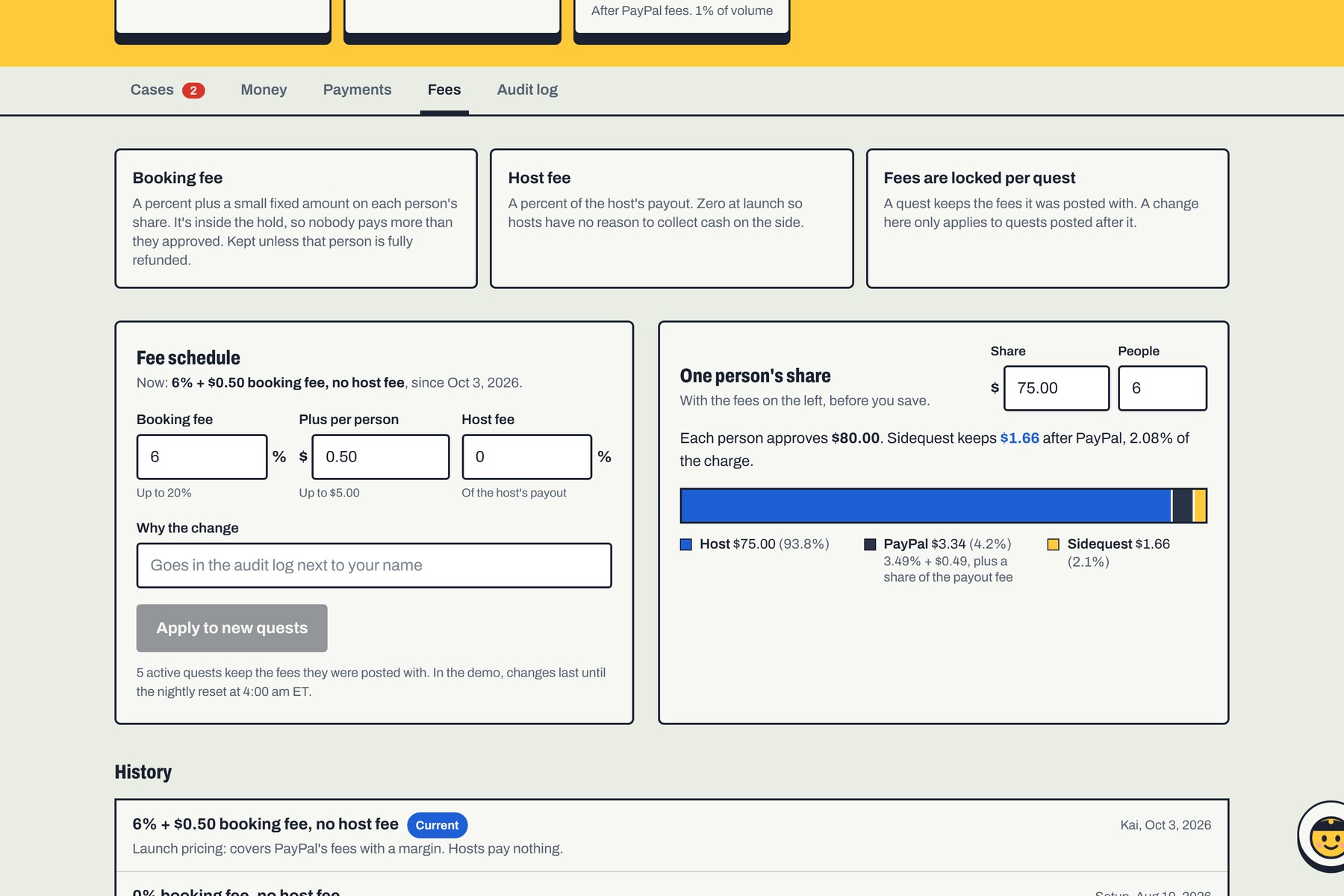
A booking fee of 6% + $0.50 per person, inside the hold, so "most you'll pay" still holds. It's only collected when a quest runs, and it's refunded with a full refund. A host fee exists but is 0% at launch. On a $75 share the member approves $80.00, PayPal takes about $3.34, the host gets $75.00 and Sidequest keeps $1.66.
Fees are set by admins from the dashboard. Each quest keeps the terms it was posted with, so changing fees never changes what anyone agreed to. The admin money view reads PayPal's real fee from every capture and refund, so revenue is always net of PayPal.
How we built it
- Backend: FastAPI, SQLAlchemy and Render Postgres. A single quest engine owns every money move and enforces the rules the agent can't bend: captures never exceed the authorization, refunds never exceed the capture.
- PayPal: Orders v2 with
intent: AUTHORIZE, authorization capture (partial,final_capture), void, reauthorize after the honor period, capture refunds, Payouts v1, webhooks with signature verification, and JS SDK Smart Buttons with PayPal, Venmo and cards. For operations: the Disputes API (dispute webhooks open cases, admins accept claims), Transaction Search (PayPal's statement matched against our books), fee breakdowns from captures and refunds, and lookups of every authorization, capture, refund, payout batch and invoice for reconciliation. - PayPal Agent Toolkit: It ships adapters for OpenAI Agents, LangChain and CrewAI. We wrote a Claude adapter over its shared layer, so the agent uses the toolkit's own tool definitions, parameter models and handlers for orders and invoicing.
- AI: Claude with a forced tool call for quest drafts, and a tool-use loop with guarded tools for the quest agent.
- MCP: Streamable HTTP server mounted on the API, with
list_quests,get_quest,hold_spotandcheck_my_spot. - Render: One Blueprint deploys the API, the web app, Postgres, a Cron Job and a Workflow. The Cron Job is the money clock: it starts or cancels quests at their deadline, locks fares and releases escrowed payouts even when nobody has the site open. The Workflow runs settle up: one
send_invoicetask per person, each on its own instance with retries, and deterministic PayPal invoice numbers so a retry can never bill anyone twice. - AG Studio + AG Grid: The host desk is an AG Studio dashboard over three related tables (quests, PayPal events, invoices). A custom widget, Who still owes, ranks open PayPal invoices with a Nudge button. AG Studio's Agent Framework runs all five built-in agents on Claude through our own endpoint, plus one tool we added,
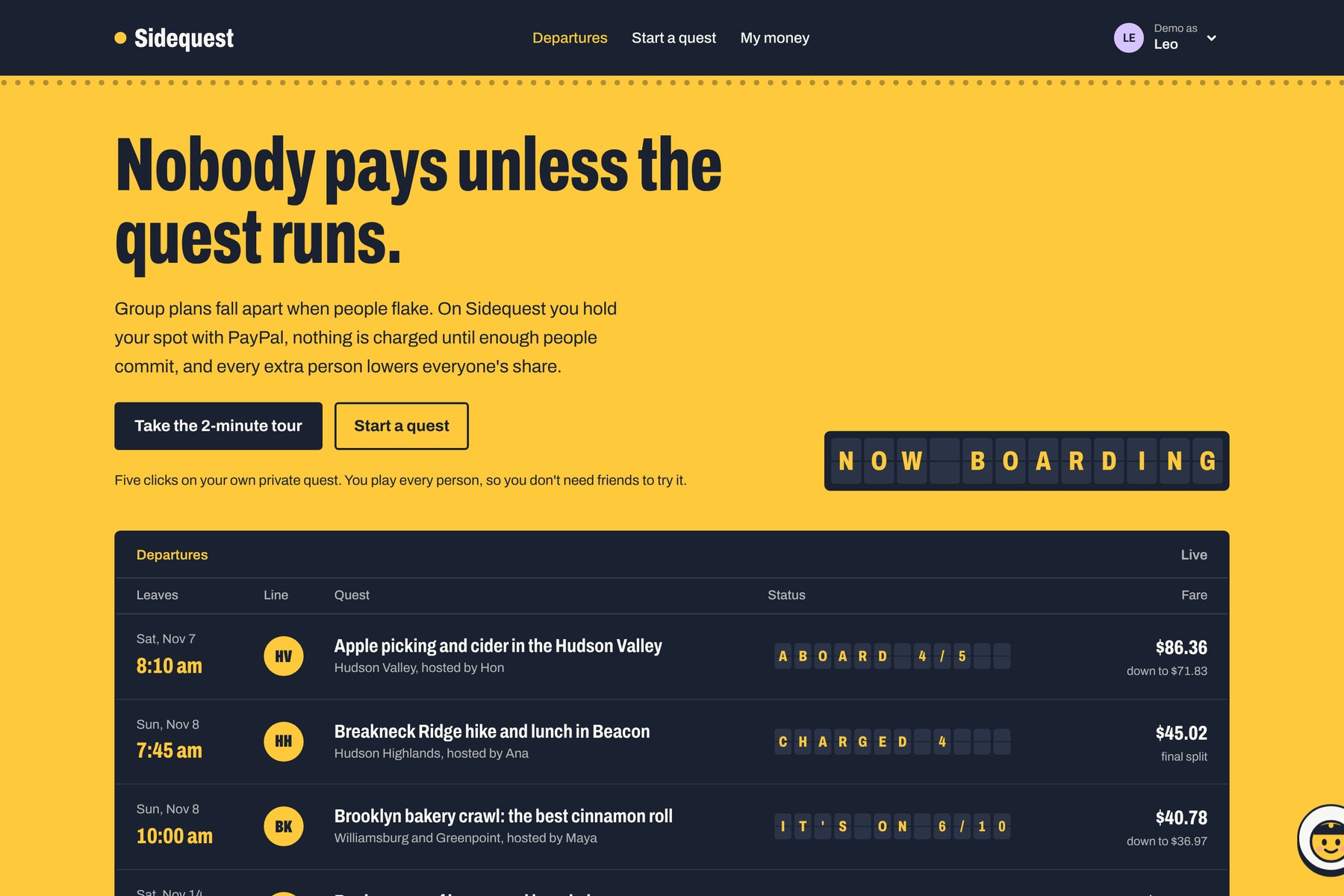
draft_payment_reminder: Claude writes the nudge, the host sends it through PayPal's Invoicing reminder API. Quest pages keep an AG Grid money log with CSV export. - Frontend: Next.js and Tailwind. The design is a rail platform: a ticket for every quest, a split-flap departure board, a seat map, and a "money route" that shows each PayPal step as a station. Blue is used only for money, so you can always see what is held, charged or refunded.
Challenges
- The split has to be safe. The hold is placed before anyone knows the group size. Holding at the minimum-group price and capturing at the final split means the capture is always at or below the authorization.
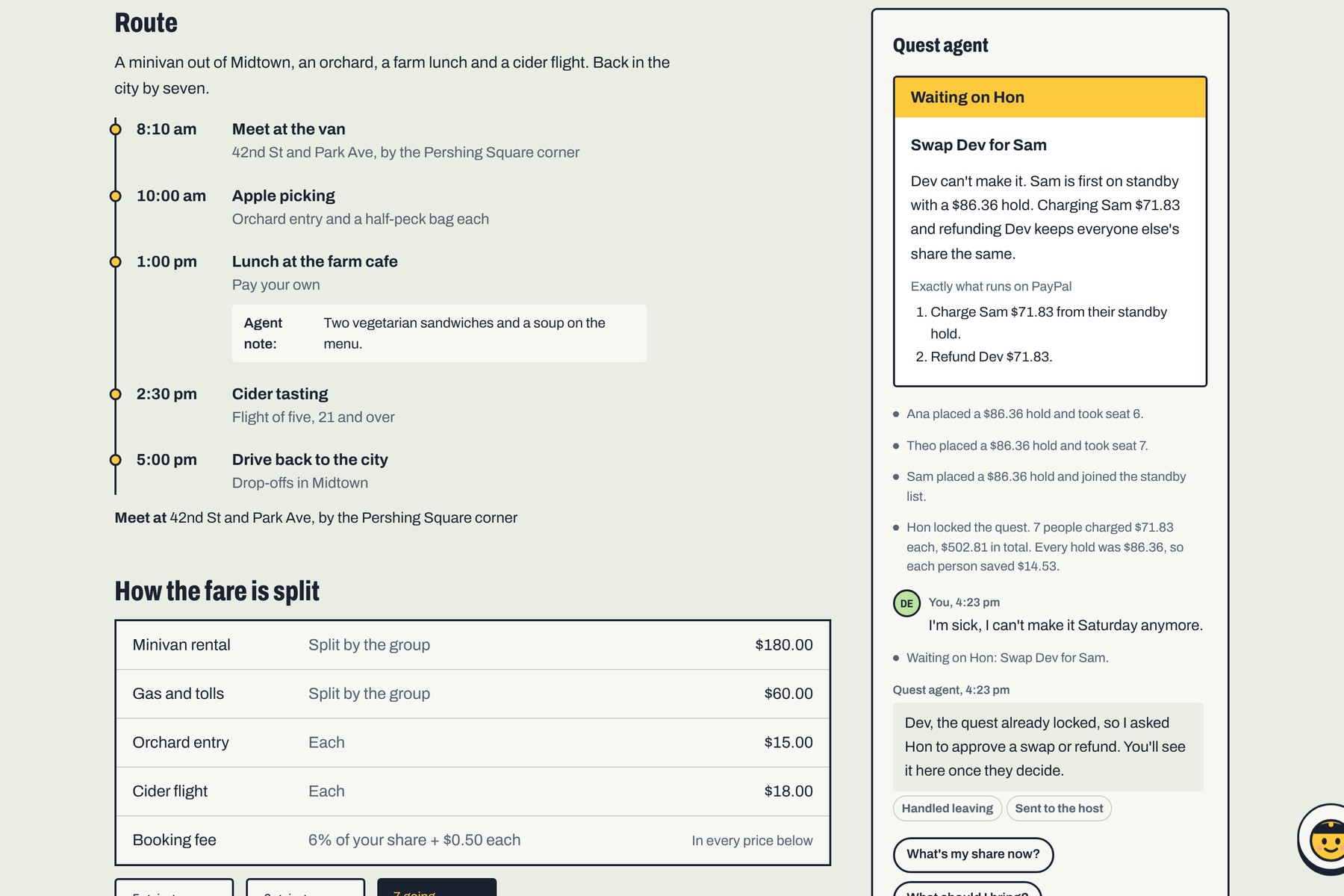
- Dropouts after charging. After lock, a refund alone would raise everyone else's share. Standby members keep their holds after lock, so a swap is a capture plus a refund and nobody else's price changes.
- Agents and money. We wanted the agent to be useful without being trusted with money. Every money move it suggests becomes a proposal that is re-validated against the live state at approval time.
- Who judges a dispute. The first version let the host close reports about their own trip. Now a report or PayPal dispute goes to a Sidequest admin, the host can only reply, and every decision lands in an audit log.
- Trust in both directions. Holds protect members from paying for a trip that never happens. A payout window and receipt checks protect them from a host who overcharges or doesn't show.
Accomplishments
- The full PayPal lifecycle in one product: authorize, capture, void, reauthorize, refund, invoice, payout, disputes and webhooks.
- Books that reconcile against PayPal, with revenue net of PayPal's real fees.
- A Claude adapter for the PayPal Agent Toolkit.
- An MCP server that lets any AI assistant commit you to a plan without ever spending on its own.
- A mock mode and demo personas, so judges can play every side of a quest alone in two minutes.
What we learned
Authorization holds are an underused tool for coordination. A hold is a commitment you can see, and that changes how people answer "are you in?"
What's next
- Recurring quests with PayPal subscriptions for clubs.
- Host verification and ratings.
- Location-based discovery of nearby quests this weekend.
- PayPal Multiparty, so hosts are paid directly at capture.
Testing instructions for judges
- Open https://sidequest-web-q5pq.onrender.com and click Take the 2-minute tour. The first load can take up to a minute if the server was asleep.
- In step 1, approve the hold in PayPal's sandbox popup with the buyer login shown in the bar. Pay with the card or balance, not Pay in 4.
- Follow the five steps in the bar. Each one switches to the right person and runs the next PayPal action.
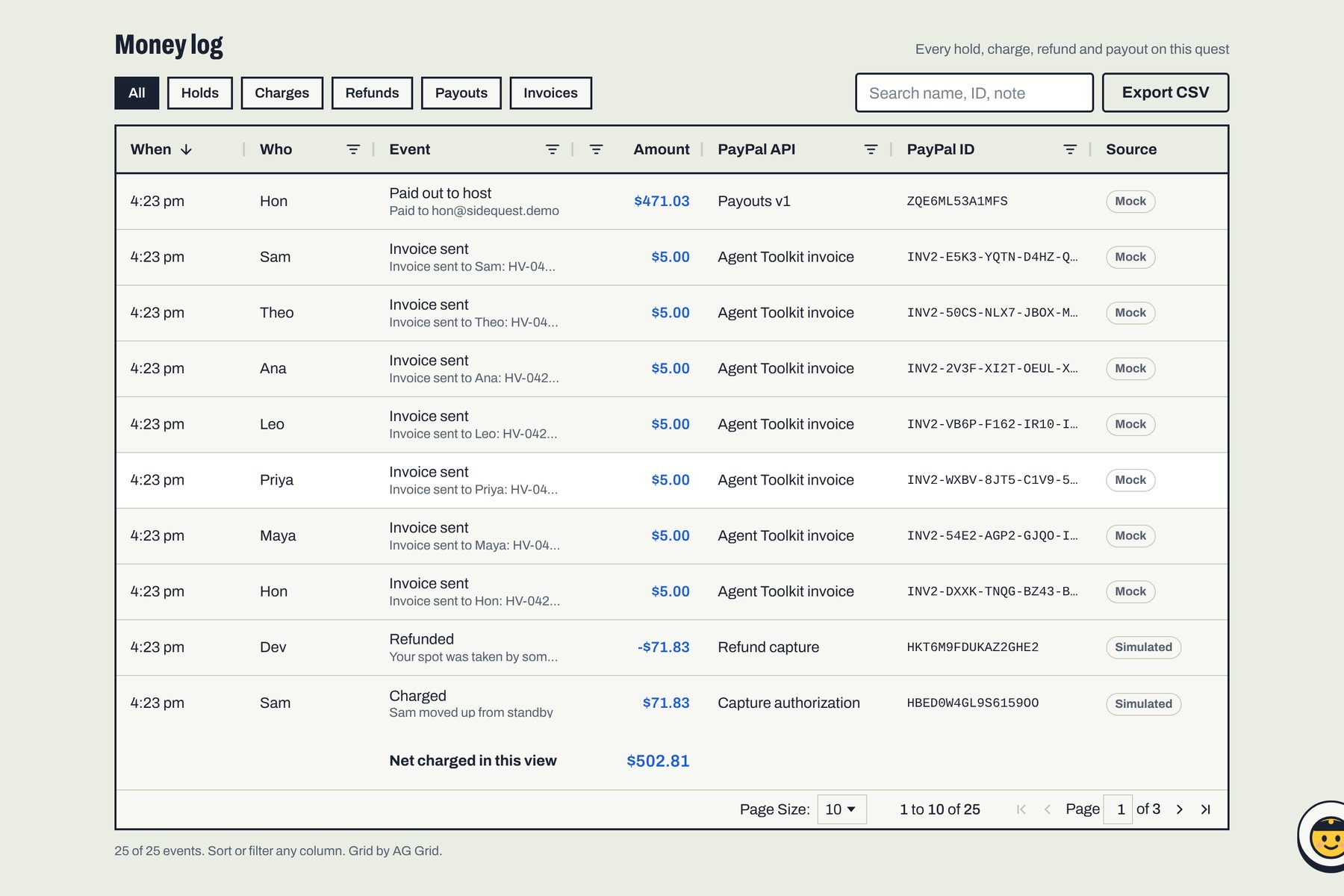
- Scroll to Money log to see every hold, charge, refund and payout. Switch to Kai (admin) to see the PayPal API and ID behind each one. Members and hosts never see PayPal IDs.
- Pick Hon from the person menu (top right) and open My money for the host desk. Press Nudge on Leo, then Edit with Claude and try Nudge the oldest invoice.
- Admin: at the end of the tour click See how disputes are handled, or pick Kai from the person menu. Ask Claude about the kayak report (it suggests splitting the outfitter's $100 refund, $20 each), decide it, then check the Money, Payments, Fees and Audit log tabs. Try anything: the demo data resets every night at 4 am ET.
- For AI agents (footer): ask the assistant to find a quest and hold a spot. It uses the same MCP tools any AI assistant would, and you approve the hold on PayPal.
Built during the submission period
All code was written from scratch after the submission period opened on October 1, 2026. Side Quest started as a concept in a university venture course. There was no prior code.
Built With
- ag-grid
- ag-studio
- anthropic
- claude
- fastapi
- model-context-protocol
- next.js
- paypal
- paypal-agent-toolkit
- paypal-disputes
- paypal-js-sdk
- paypal-orders-v2
- paypal-payments
- paypal-payouts
- paypal-transaction-search
- paypal-webhooks
- postgresql
- python
- react
- render
- render-cron-jobs
- render-workflows
- sqlalchemy
- tailwindcss
- typescript

Log in or sign up for Devpost to join the conversation.