Inspiration
As someone juggling freelance work and a rental property, I grew frustrated with spreadsheets and disjointed tools for tracking side income. Tax season felt overwhelming—missing deductions, guessing at quarterly payments, and never knowing which hustle was actually profitable. I wanted a tool that spoke to everyday side hustlers like me: simple, visual, and focused on actionable insights, not just data entry.
What it does
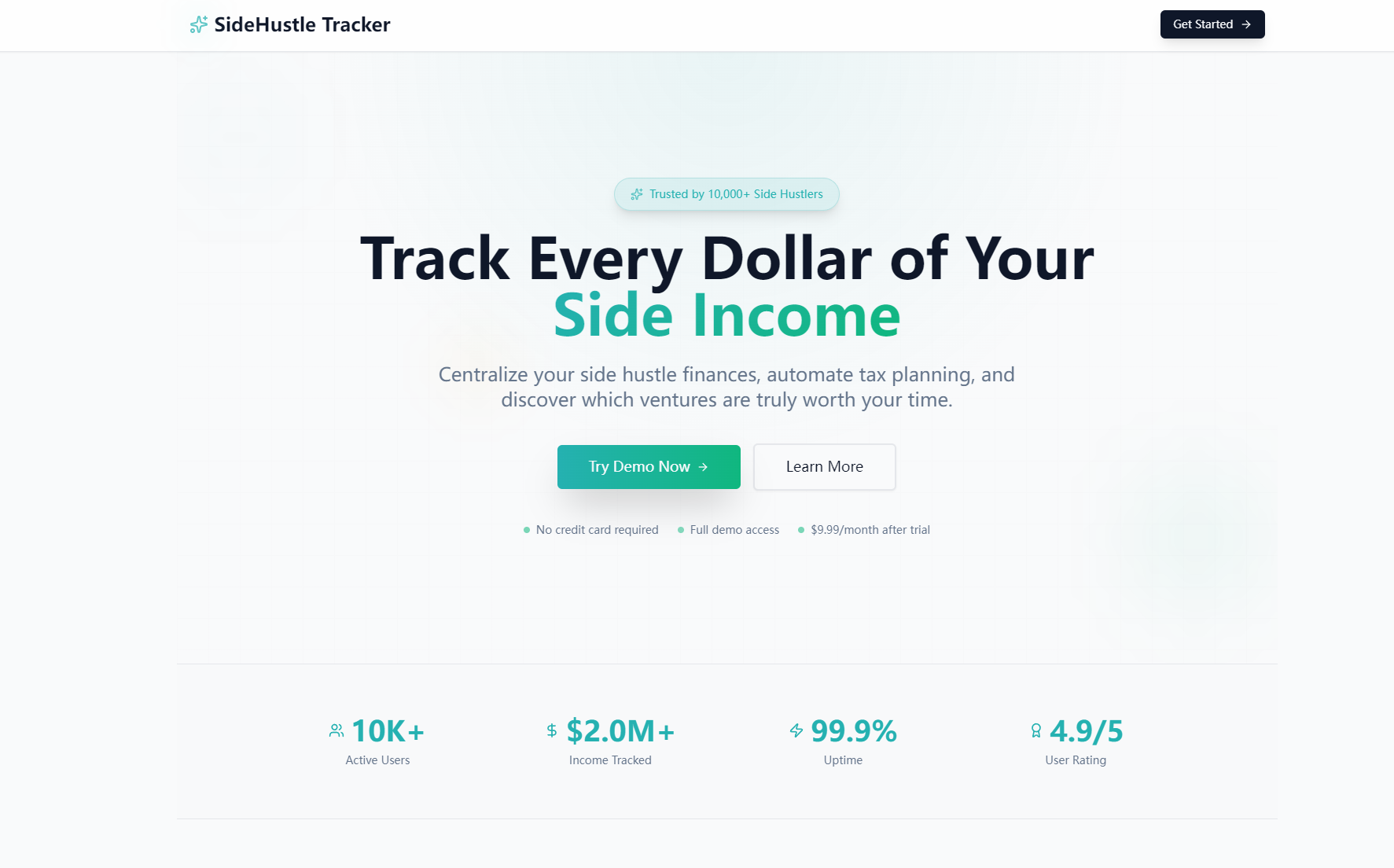
SideHustle Tracker centralizes income from freelance, ride-sharing, reselling, and rentals; tracks tax-deductible expenses (supplies, travel, mileage); calculates quarterly tax reserves; and analyzes ROI/profitability across hustles. It generates visual reports, highlights top-performing streams, and updates calculations in real time—all with a smooth, intuitive UI.
How we built it
I started with wireframing core pages (Dashboard, Income Log, Tax Center) in Figma, prioritizing responsive design and animated data transitions. For development, I used React for the frontend (with TailwindCSS for styling) and Node.js/Express for the backend, storing data in MongoDB. Chart.js powered the interactive graphs, and I built custom logic for tax reserve calculations ($\text{Tax Reserve} = (\text{Gross Income} - \text{Deductible Expenses}) \times \text{Tax Rate}$) and profit margin analysis ($\text{Profit Margin} = (\text{Net Profit} / \text{Gross Income}) \times 100$).
Challenges we ran into
The biggest hurdle was making tax calculations flexible—adjusting for income fluctuations and ensuring real-time updates across all modules without lag. Designing intuitive filters for income/expense logs also took iteration; early versions were too clunky, so I simplified to focus on date range and category (the filters users actually need). Animating chart transitions without breaking data accuracy was another tricky spot—balancing visual polish with performance.
Accomplishments that we're proud of
The real-time financial dashboard is my proudest win: it pulls together total income, tax reserve progress, and top hustles in one glance, with smooth hover effects and dynamic gradients that make data feel approachable. I also nailed the expense-to-tax deduction flow—users can link expenses to specific hustles, and the tool automatically adjusts taxable income, taking the guesswork out of tax prep.
What we learned
I deepened my understanding of financial logic for side income (and how tax rules apply to gig work in the US/EU), and learned to prioritize user experience over "cool" features—simple, fast navigation mattered more than complex bells and whistles. I also honed my skills in integrating data visualization libraries with live backend data, and how to build error handling for edge cases (like negative income entries or missing data).
What's next for This project
First, I want to add more granular tax customization (adjusting for regional tax rates in the US/EU). Next, I’ll build a mobile-responsive layout optimized for on-the-go entry (critical for ride-share drivers or resellers). Finally, I plan to add a "hustle optimizer"—suggesting which streams to scale based on time investment vs. profit margin—turning data into concrete next steps for users.

Log in or sign up for Devpost to join the conversation.