-
-
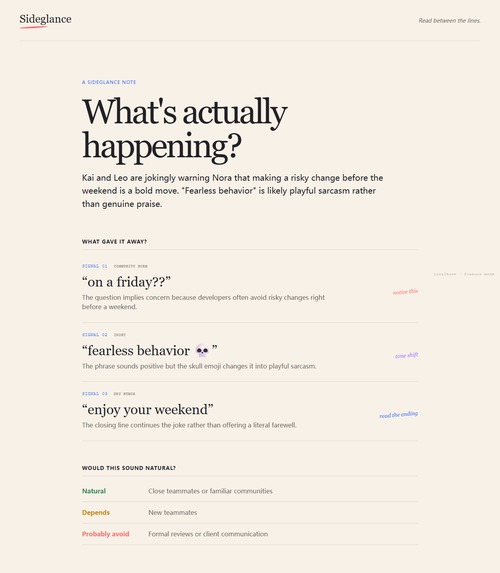
Every interpretation is grounded in exact evidence, with confidence and usage boundaries made explicit.
-
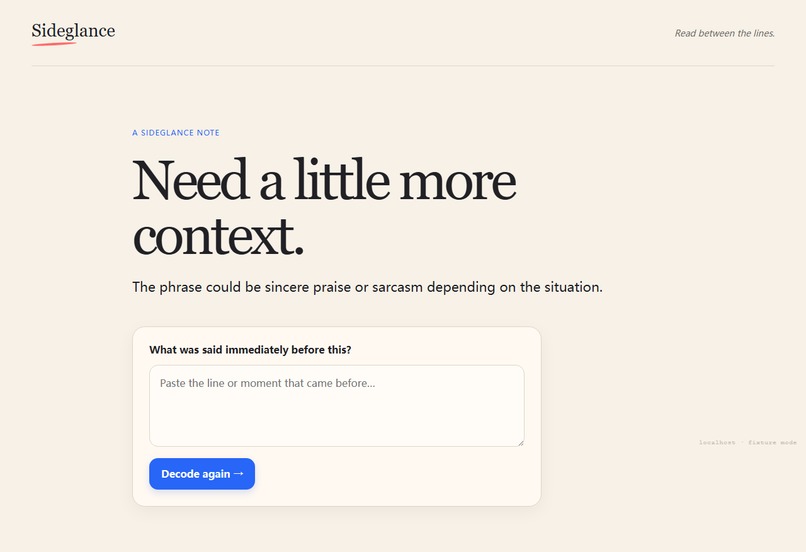
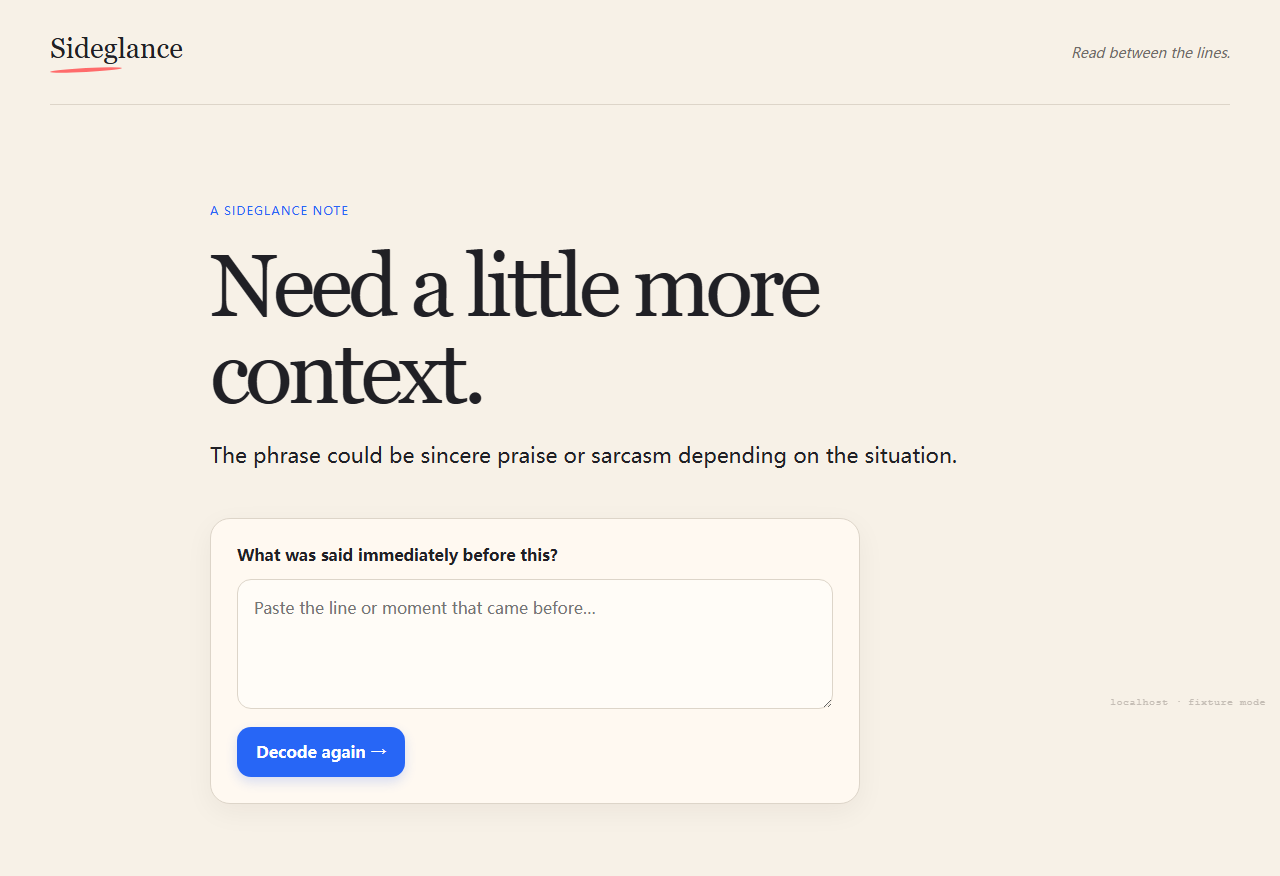
When context is missing, Sideglance asks one minimum clarification question instead of guessing.
-
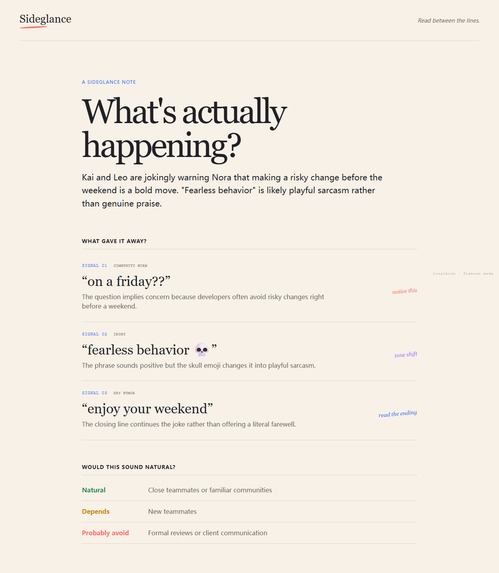
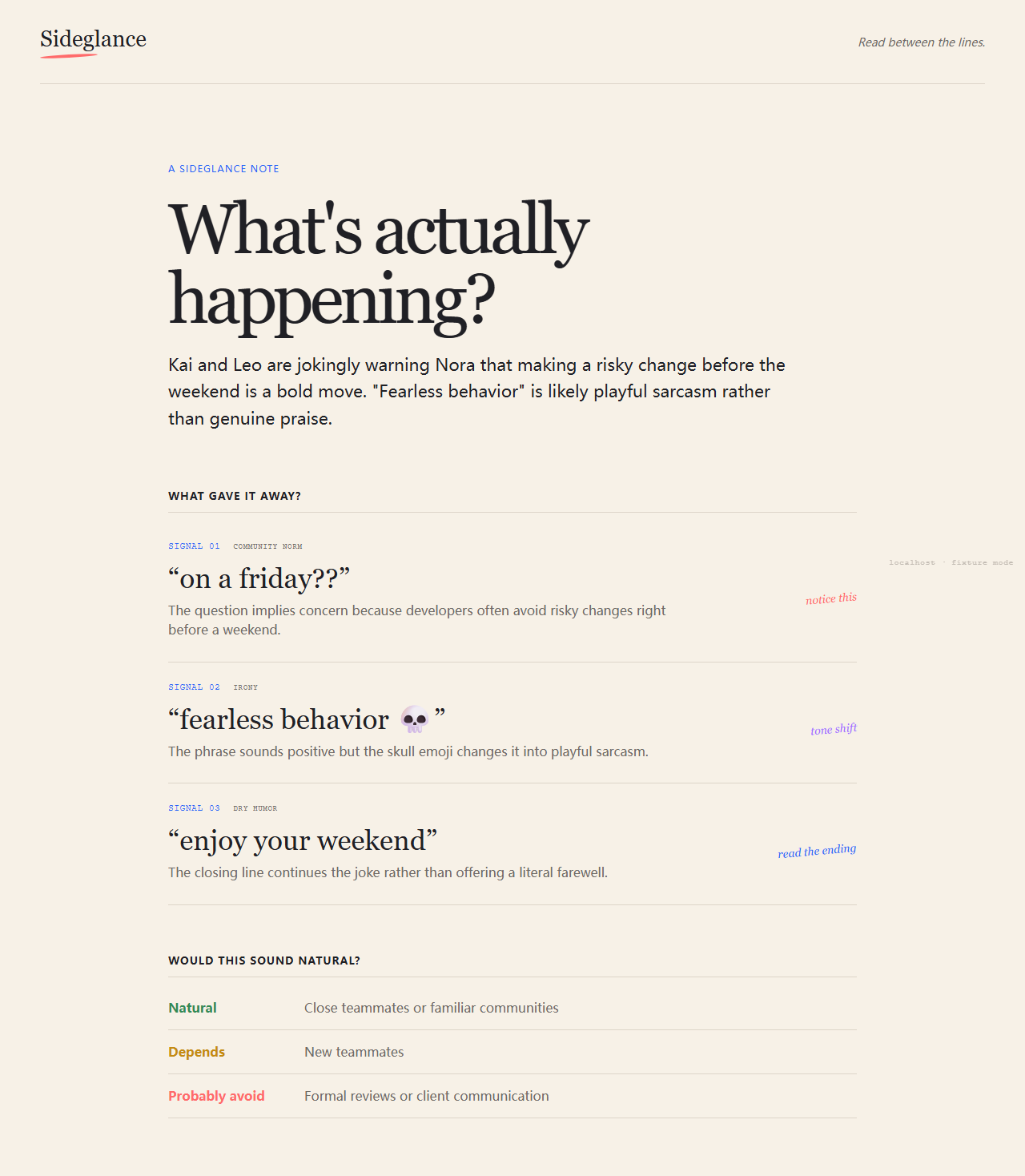
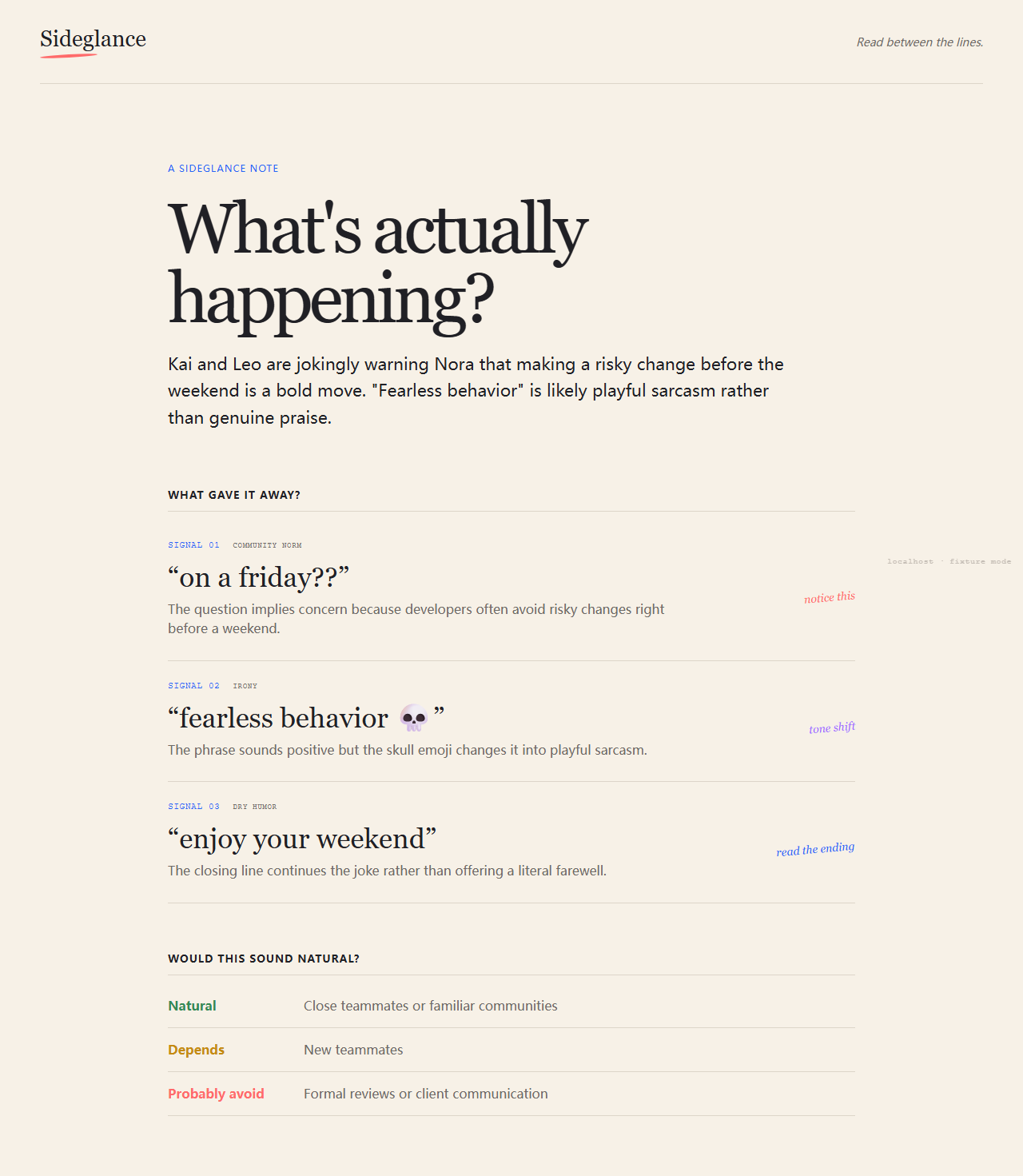
Sideglance reveals the hidden meaning: playful sarcasm shaped by developer culture and timing.
-
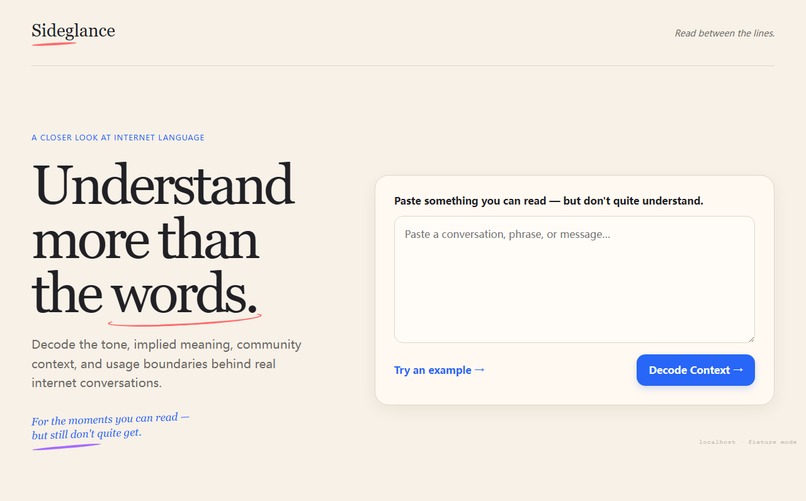
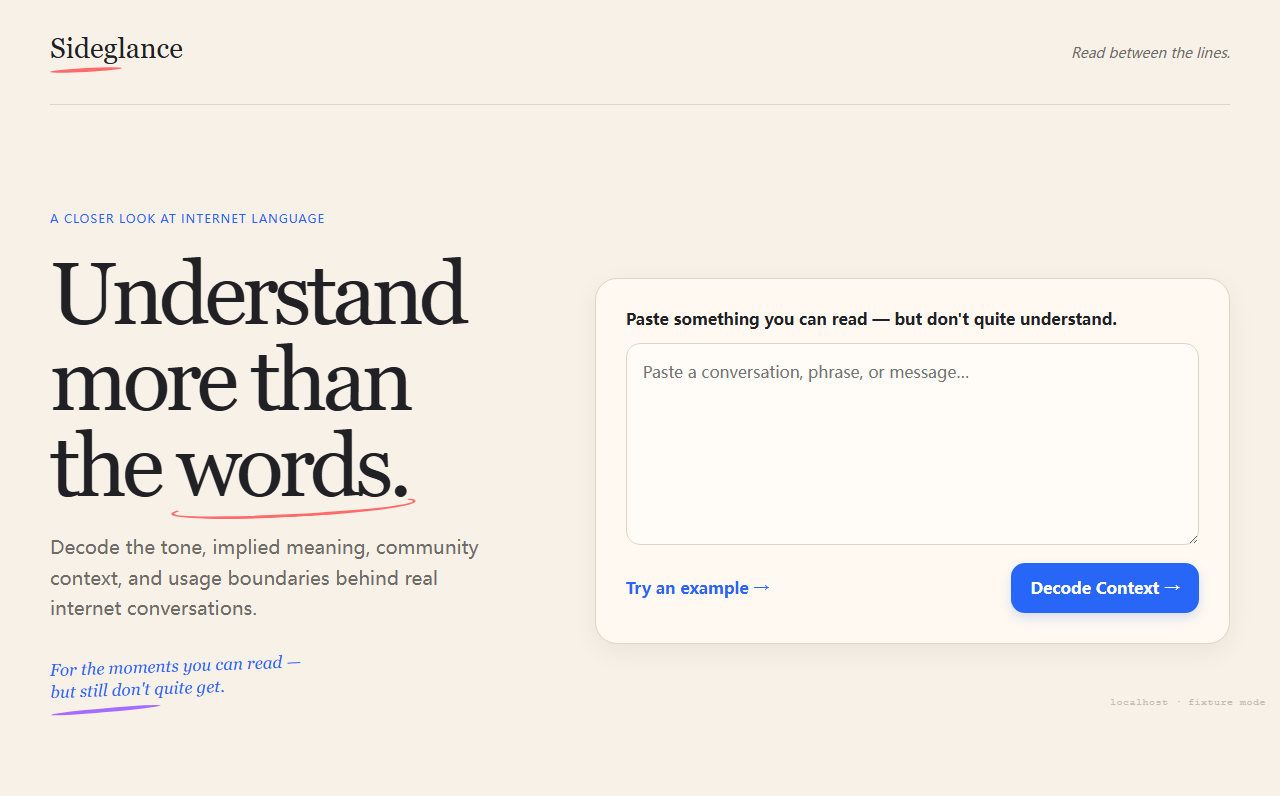
Start with an Internet Moment: paste the conversation you understand, but may not fully read.
Inspiration
I built Sideglance around a problem that translation tools do not really solve: sometimes you understand every word in an online conversation, but still misunderstand what is happening.
Sarcasm, dry humor, community norms, cultural references, timing, and relationship context can completely change how a message should be read.
Translation tells you what the words say. Sideglance focuses on what people mean.
What it does
Sideglance is a context intelligence tool for “Internet Moments.”
A user pastes a conversation, post, or short exchange into Decode. Before interpreting it, Sideglance runs a Context Gate to decide whether there is enough information to make a responsible reading.
If context is missing, Sideglance asks one minimum clarification question instead of guessing.
If context is sufficient, it explains what is actually happening through:
- tone and social signals
- contextual meaning
- confidence
- evidence
- usage boundaries
For example, “fearless behavior 💀” can look like praise in isolation. After someone merges a major authentication rewrite on a Friday, the same phrase becomes playful sarcasm shaped by developer culture and timing.
How I built it
Sideglance combines Google Gemini with deterministic product logic.
Gemini handles context sufficiency reasoning and structured social/pragmatic interpretation.
Around that probabilistic layer, I built deterministic safeguards in TypeScript:
- structured contracts and schema validation
- EvidenceRef-based grounding
- exact source-text resolution
- confidence and presentation guards
- safe failure behavior
Instead of allowing the model to invent supporting quotations, the model references evidence IDs. Deterministic code resolves those IDs back to the exact original text before the explanation reaches the user.
The core principle is:
We constrain probabilistic AI with deterministic product logic.
The frontend is built with TypeScript, Vite, HTML, and CSS. A Cloudflare Worker acts as the server-side boundary for model credentials and provider calls.
The project currently passes 106 unit and integration checks and 4 end-to-end flows.
Challenges
The hardest part was not generating an interpretation. It was deciding when the system should not interpret.
A fluent but unsupported social explanation can be worse than no answer, so uncertainty became a first-class product state.
Another challenge was external model transport reliability. To keep judging reproducible, the public hosted demo uses Sideglance’s deterministic fixture path while the repository contains the Gemini-backed runtime architecture.
What I learned
Building Sideglance made me think less about “how good is the model response?” and more about “what should the product allow the model to claim?”
Useful AI products need explicit uncertainty behavior, evidence boundaries, and deterministic validation around probabilistic reasoning.
What's next
The current hackathon scope is Decode: understand one Internet Moment now.
The longer-term direction is Sideglance Radar — helping users build context instinct over time across different communities and online spaces.
Sideglance is not trying to define an objective cultural truth. Its goal is to surface the context you did not know you were missing before you act on the wrong interpretation.
Built With
- cloudflare
- css
- gemini
- html
- playwright
- typescript
- vite
- vitest

Log in or sign up for Devpost to join the conversation.