-
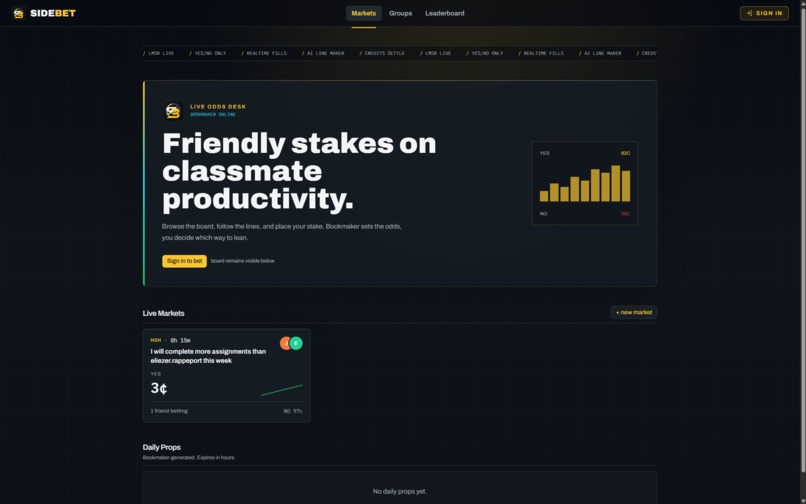
landing
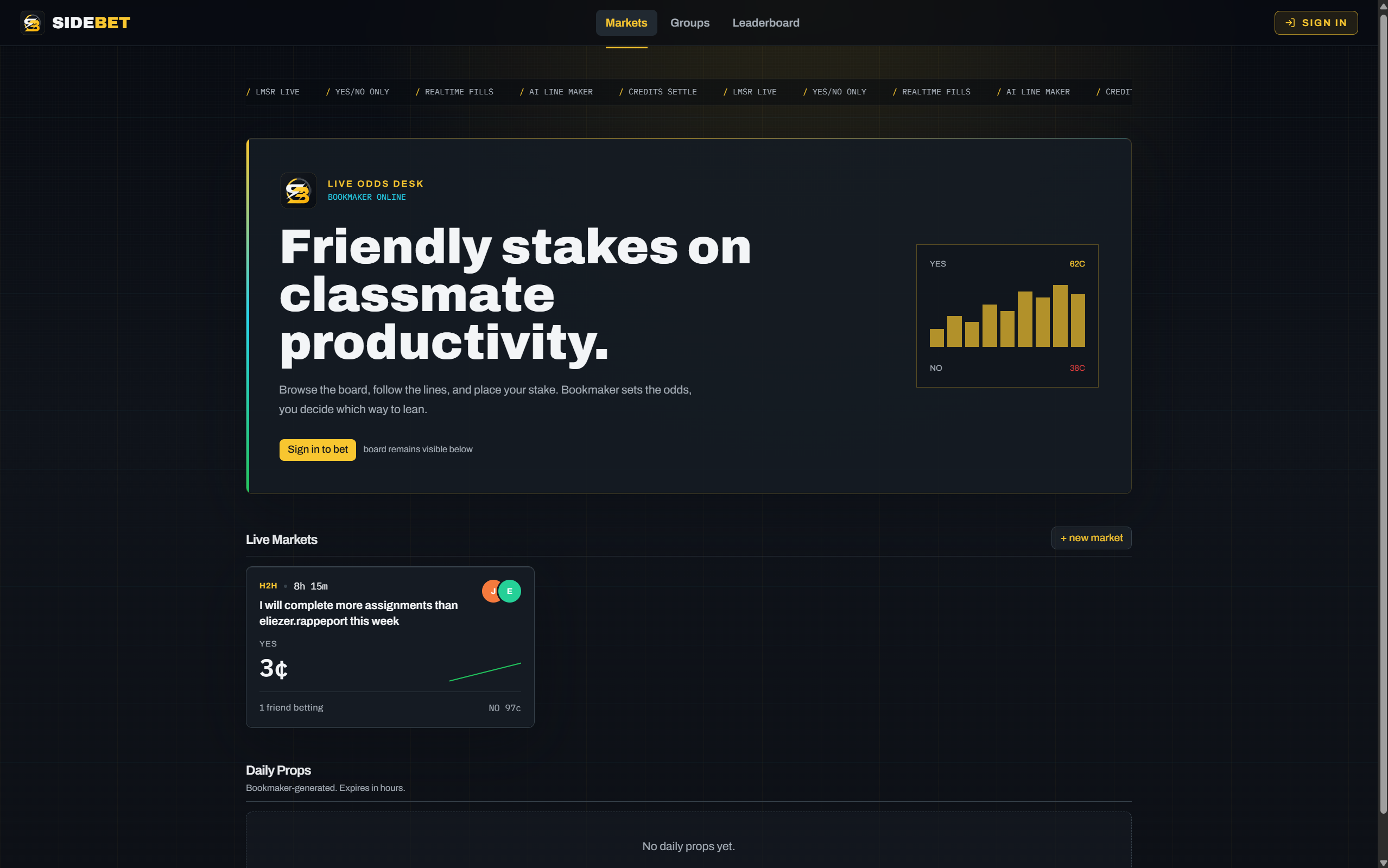
Side Bet — A social sportsbook for homework
Inspiration
One in three U.S. college students drops out, and the largest single driver isn't tuition — it's disengagement. Study after study points to the same thing: the students who quit aren't the ones who can't do the work, they're the ones who stopped showing up to it. Meanwhile, the same demographic spends hours a day on apps engineered around the mechanic that does keep humans coming back: a live, social, peer-visible scoreboard.
We kept asking: what if the loop that DraftKings uses to make people care about an NFL game on a Tuesday night could be pointed at the thing that actually decides whether you graduate — finishing your problem sets?
So we built Side Bet: a private, group-scoped prediction market where friends bet small (cosmetic) dollars on each other's coursework. "Will Justin submit Lab 4 by Friday?" "Most assignments completed this week — Ezzy or George?" An AI bookmaker prices every market against real submission history; an early-warning agent watches the betting record itself for the signature of a student who's slipping.
The pitch is dropout prevention via commitment contracts. The product is a sportsbook.
What we learned
A hackathon team of three with a sharp design doc can ship more than a hackathon team of five without one. We spent the first two hours not coding — we spent them writing a merge contract (docs/00-architecture.md) that nailed every table name, server-action signature, API route shape, and realtime channel before anyone touched a keyboard. That contract was the single most valuable artifact of the build. With it, three lanes (Platform / Agent / UI) ran in parallel for sixteen hours and the integration at hour 18 actually merged.
Some specific things we learned in the trenches:
- LMSR is beautiful but numerically unforgiving. The naive cost function $C(q_y, q_n) = b\,\ln(e^{q_y/b} + e^{q_n/b})$ overflows as soon as a market has any meaningful volume. The log-sum-exp trick — factoring out $\max(q_y/b,\, q_n/b)$ — is non-optional, not nice-to-have.
- Tool calling reliability is per-model, not per-vendor. Llama 3.3 70B on NVIDIA NIM is excellent at picking the right formula but occasionally returns mixed prose-plus-JSON, so we shipped a
extractJsonthat scans for the last balanced{…}block instead of trustingJSON.parse(content). - Atomicity in Postgres is surprisingly easy if you give in to plpgsql. A single
SELECT … FOR UPDATEon the markets row was the difference between a working market and a market whose share counts diverged from its own price under concurrent trades. - "USD" doesn't need Stripe. A column rename —
credits int → balance_cents int— plus oneformatUsdhelper plus a single rounding rule at the LMSR boundary turns play credits into a believable wallet.
How we built it
Stack at a glance
| Layer | Choice |
|---|---|
| Frontend | Next.js 16 (App Router), shadcn/ui, Tailwind v4, Recharts |
| Backend | Next.js server actions + API routes, deployed to Vercel |
| DB / Auth / Realtime | Supabase (Postgres + RLS + realtime channels) |
| AI | NVIDIA NIM via the OpenAI-compatible client — meta/llama-3.3-70b-instruct, falling back to nvidia/llama-3.1-nemotron-70b-instruct |
| Real Canvas integration | Browserbase + Playwright-CDP (cookie-capture SSO, no credentials stored) |
| Resend (group invites + magic links) | |
| Tests | Vitest |
| Package manager | Bun |
The market mechanism: LMSR
Every Side Bet market is a binary YES/NO Logarithmic Market Scoring Rule market — the same primitive used for head-to-head bets, daily props, and vote-resolved open-ended bets. Only resolution_criteria differs.
The cost function:
$$C(q_y, q_n) = b \cdot \ln!\left(e^{q_y/b} + e^{q_n/b}\right)$$
The instantaneous YES price (which is also the market's implied probability):
$$p_\text{yes} = \frac{e^{q_y/b}}{e^{q_y/b} + e^{q_n/b}}$$
The cost to buy $\Delta$ YES shares:
$$\text{cost}(\Delta) = C(q_y + \Delta,\, q_n) - C(q_y,\, q_n)$$
When the AI bookmaker decides a market should open at probability $p_0$, we seed share counts so the price starts there:
$$q_y - q_n = b \cdot \ln!\frac{p_0}{1 - p_0}$$
The liquidity parameter $b$ controls market depth — we use $b = 50$ for daily props, $100$ for weekly head-to-heads, $200$ for season-long markets. All the math lives in lib/lmsr/index.ts as a single source of truth that both the trade engine (Person A) and the agent toolkit (Person B) import.
The AI bookmaker — formulas as tools
We wanted an agent that visibly thinks — not a black-box LLM that emits a number. So we built a deterministic formula toolkit (lib/odds/) and exposed each formula as an OpenAI-compatible tool spec. The model picks formulas; TypeScript does the math.
The toolkit includes, among others:
estimate_prob_more_completions— given two students' weekly rates and variances, returns $P(A > B) = \Phi!\left(\dfrac{\mu_A - \mu_B}{\sqrt{\sigma_A^2 + \sigma_B^2}}\right)$estimate_prob_submits_by_deadline— base rate × time-pressure factorseed_lmsr_shares— the inversion aboveapply_house_edge— pulls a fair probability toward $0.5$ by a small fractioncompute_at_risk_score— deterministic severity classifier (none/yellow/red)recommend_spread_handicap— extra completions credited to the weaker subject
The agent loop in lib/ai/agent-loop.ts runs a standard tool-call cycle, but with three demo-grade safeguards: a 4-second wall-clock timeout (Promise.race), an automatic retry on the fallback model, and — if all else fails — a deterministic fallback that returns the same Zod-validated shape in <50 ms, computed entirely from the toolkit. The demo can never hang on an AI call.
Atomic trade execution
The non-negotiable in any prediction market is that two simultaneous trades can't corrupt the share counts. Our execute_lmsr_trade Postgres function does, in one transaction:
SELECT … FOR UPDATEon the markets row (row-level lock)- Reject if the market is closed, locked, or past
closes_at - Reject if the user is not in the market's group
- Reject if the market is vote-resolved and the caller is the creator (defense in depth — the server action checks this too)
- Compute LMSR cost, round up to the nearest cent, deduct from
balance_cents - Update market shares +
current_price_yes, upsert position, insert trade, insert price-history row - Return the new state
Closing a position rounds down to the nearest cent, so the LMSR pool can never be drained by sub-cent rounding leakage from repeated buy/close cycles.
Real Canvas integration via Browserbase
We started with mock Canvas data, then went further: a working SSO flow that drops the user into a remote Chromium running on Browserbase, lets them sign into UCSC's CAS (CruzID + Gold password + Duo) inside that Chromium, then captures cookies over the Chrome DevTools Protocol once login completes. We never see, store, or proxy the password — only the post-auth cookies. The lifecycle (one long-lived CDP connection cached per session, garbage-collected after 10 minutes) is a real piece of infrastructure that survives Browserbase's free-tier session timeouts.
The pivot: from public credits to private USD groups
Mid-hack we cut the public friendships graph entirely and rebuilt around groups: a user joins a group via 6-character invite code or emailed token (Resend), an "active group" cookie scopes the home page, and every market lives inside exactly one group. Vote-resolved markets — for stuff Canvas can't grade, like "Will Justin pull an all-nighter in the library tonight?" — resolve via a 24-hour group vote after resolves_at, with strict majority winning, ties or zero votes voiding the market and refunding everyone their cost basis.
That pivot, in retrospect, was the move that made the product feel real. A private group of friends betting on each other is a plausible product. A public marketplace of strangers betting on each other's grades is a privacy disaster.
Realtime
Six Supabase channels feed the live UI: markets:open, market:{id}, trades:market:{id}, nudges:user:{id}, market:{id}:votes, group:{id}:markets. Price changes trigger a 400 ms gold flash on the price label; new price_history rows extend the Recharts line with animationDuration: 300 so the chart breathes instead of jumping.
Challenges we faced
- Concurrent trades, divergent prices. Our first trade implementation read the market state, computed cost, and wrote back — three separate statements. Two simultaneous YES buys both saw the pre-trade state and both wrote back; the pool ended up with too many shares for too little cost. Wrapping everything in a single plpgsql function with
FOR UPDATEsolved it for good. - LMSR overflow. Once a market had $\sim 200$ YES shares with $b=100$, $e^{q/b}$ overflowed. We refactored every cost calculation to use the log-sum-exp form: factor out the max, then add it back outside the log. Without this, the math is nominally correct and operationally wrong.
- Llama tool-calling quirks. Llama 3.3 70B occasionally returns prose-then-JSON, occasionally calls an unknown tool, occasionally produces invalid JSON in tool args. The agent loop tolerates all three — bad JSON gets a "your previous arguments were invalid, retry" tool message; unknown tools get an
unknown_toolerror returned as a tool result; mixed output is parsed by scanning for the last balanced{…}block. - Vercel cron on the free tier. We needed a tick that locks vote-resolved markets at
resolves_at, tallies them atvote_closes_at, settles canvas-grounded markets, and runs the at-risk scan. We protect/api/cron/tickwith aCRON_SECRETbearer header and expose a manualcurlso the demo can advance time on command. - Cents rounding at the LMSR boundary. Floats live everywhere inside
lib/lmsr; integer cents live everywhere in the database. The conversion happens once per trade, in opposite directions for buy vs. close, so the house can never bleed sub-cent dust over thousands of trades. Vitest cases cover round-half on both paths. - Email scanner token consumption. Magic-link tokens were getting burned by mail-client URL scanners before the user clicked. We split auth into a
codestep + interstitial, and the OTP guard now accepts 6–10 digit codes to match what Supabase actually sends. - Demo flop-prevention. A live demo is unforgiving. We pre-seeded a "Side Bet Demo" group with three personas (Ezzy, George, Justin) and 4 weeks of varied submission history each, added "Sign in as…" demo buttons that bypass magic-link round-trips, layered in a welcome tour, and even shipped a mean-reverting ghost-trader so the chart looks alive when no human is trading. Then we recorded a 90-second screen capture as a backup, on principle.
What's next
If we keep going: real Canvas OAuth across more institutions (the Browserbase prototype is the proof of concept), an opt-in charitable loss pool (losers' cosmetic dollars become a real donation to a campus food bank — pro-social, not predatory), and a syndicate mode where a study group bets collectively against another study group's combined GPA. The framing we keep coming back to: we didn't build a gambling app — we built a dropout-prevention tool with a gambling aesthetic.
Built With
- 14
- actions
- algorithm
- api
- client
- css
- lmsr
- maker
- market
- next.js
- nim
- nvidia
- openai-compatible
- postgresql
- react
- realtime
- routes
- server
- shadcn/ui
- supabase
- tailwind
- typescript
- vercel

Log in or sign up for Devpost to join the conversation.