-
-
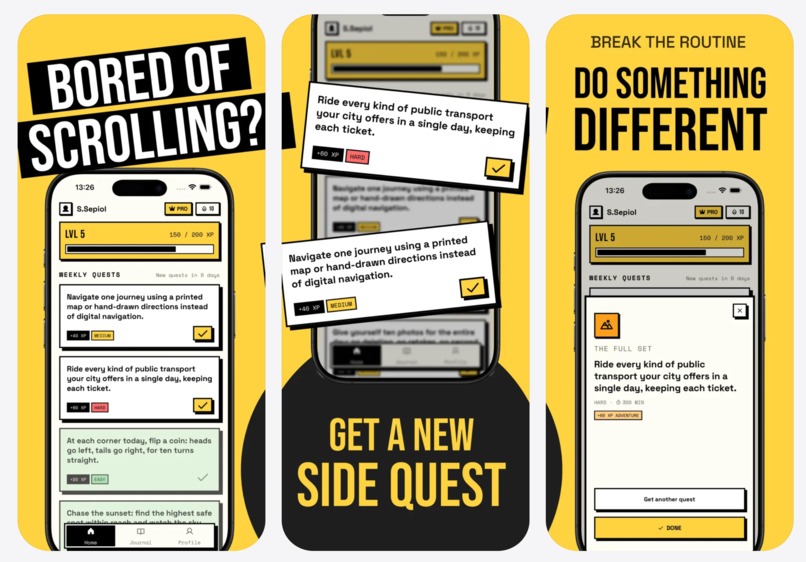
App visuals for side quests - real life side quests app
-

App icon for side quests app
-
-
-
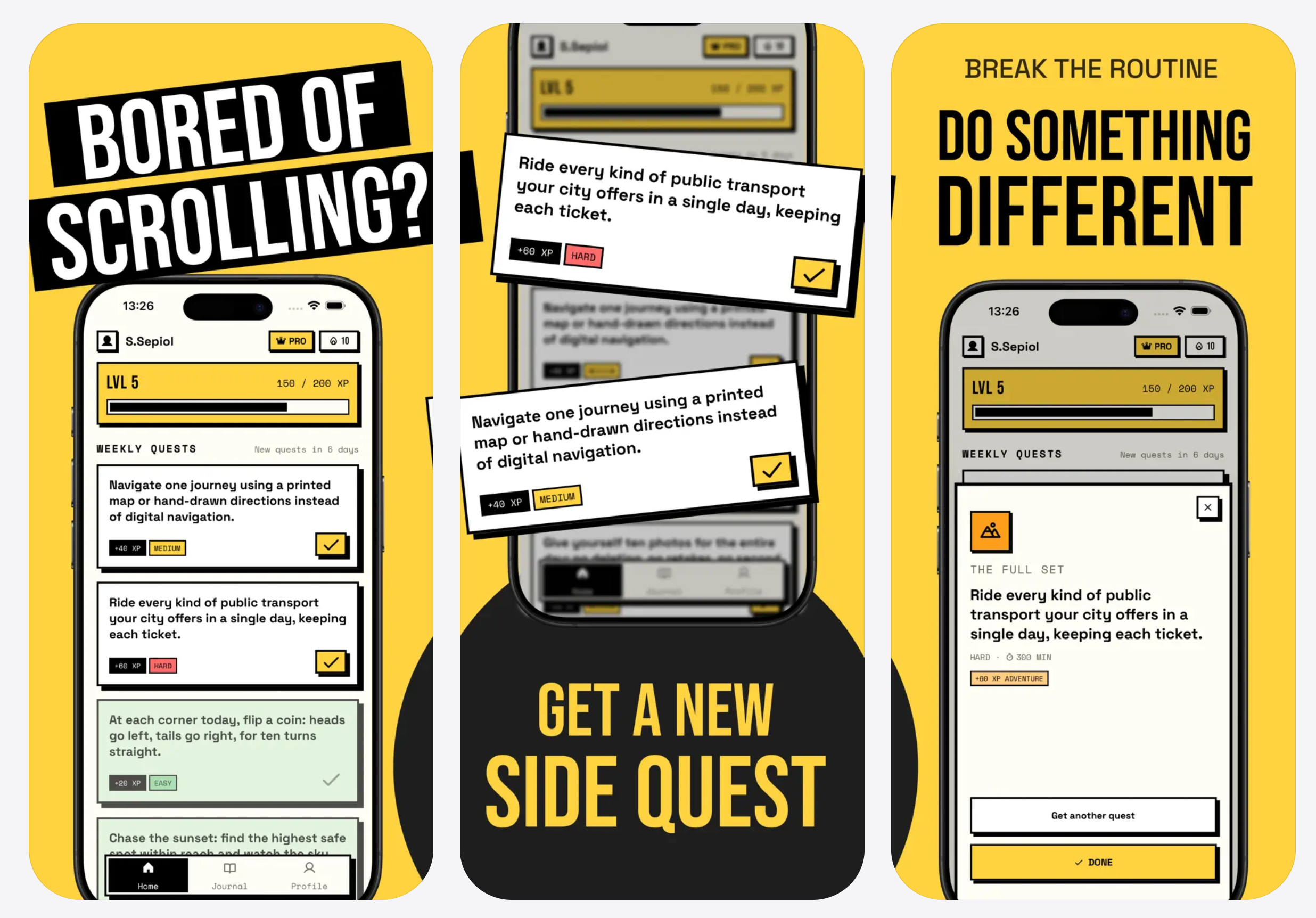

side quests — stop scrolling, start living
Seven real-life quests a week. Earn XP for living, not for productivity. Keep a private journal of what you actually did.
Where this came from
At some point my days started to look identical. Same routine, same screens, same evening. Nothing was wrong, but I wasn't discovering or experiencing anything new. The strange part is that I wanted to do something different — I just never had an idea ready at the moment I actually had time. So the moment passed, and I went back to scrolling.
That's the loop I wanted to break: boredom → no idea → scroll → repeat. Not with another habit tracker, but with a ready-made supply of ideas that are small, concrete, and actually fun.
So I built side quests: an app that hands you a week of quests, turns completing them into a game, and keeps a journal of the memories you made along the way.
What it is
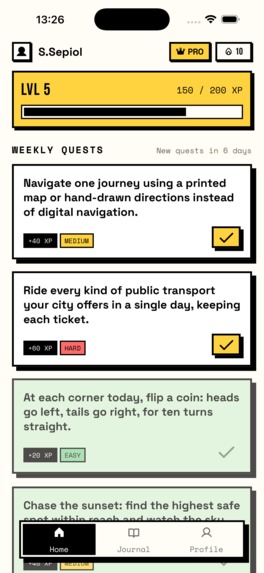
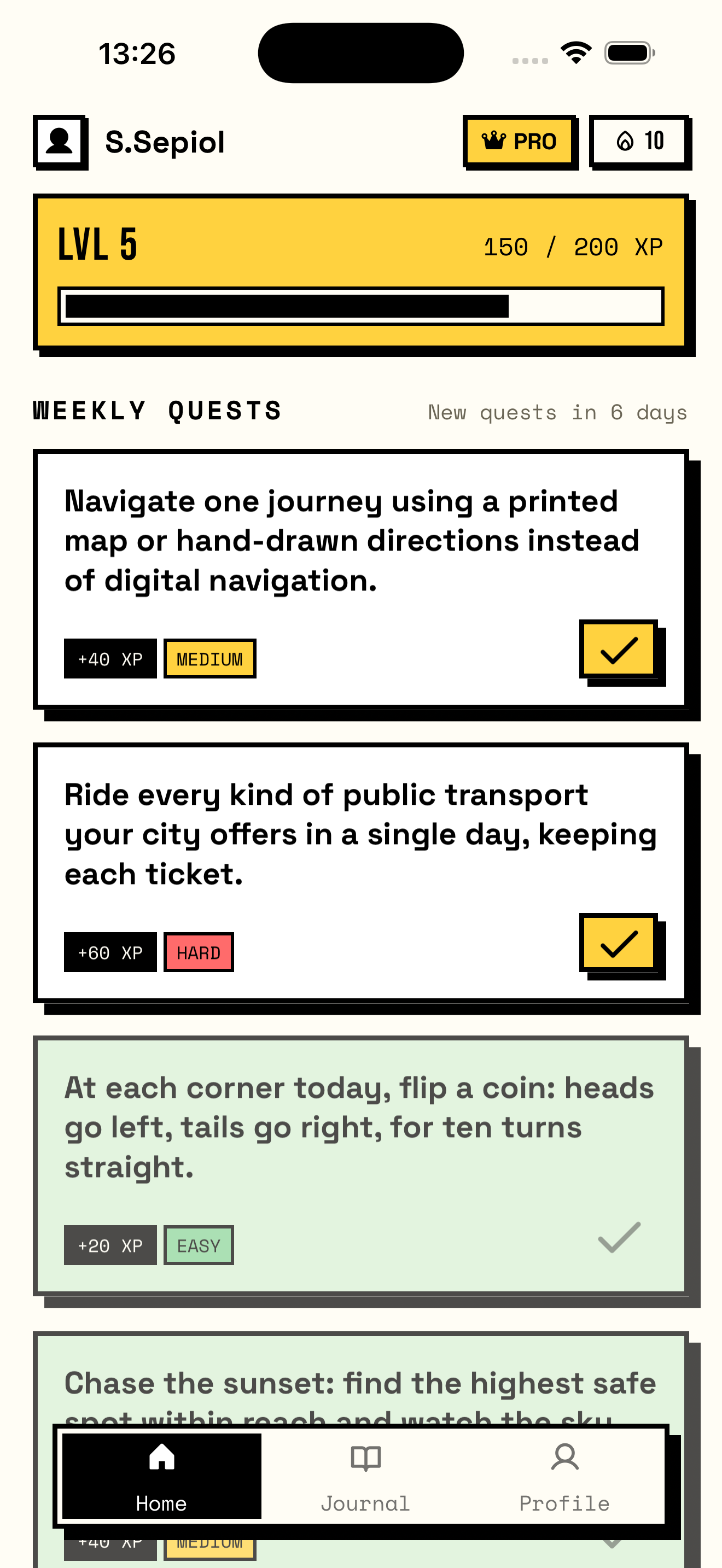
Every weekly cycle gives you seven quests, anchored to the day you joined — not the calendar week. Every quest has to discover something new, teach a skill, create a memory, push you slightly out of your comfort zone, or become a story worth telling.
Real examples from the curated library:
- Find the oldest building on your street and guess its age from clues alone, no searching online.
- Point blindly at a cafe menu and order whatever item your finger lands on.
- Message someone you haven't seen in six months with a concrete plan: a place, a day, your treat.
The loop:
- Get your weekly cycle — seven quests, mixed Easy / Medium / Hard.
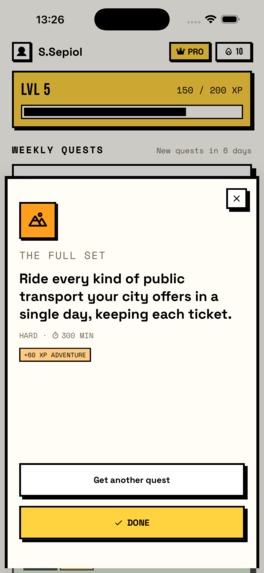
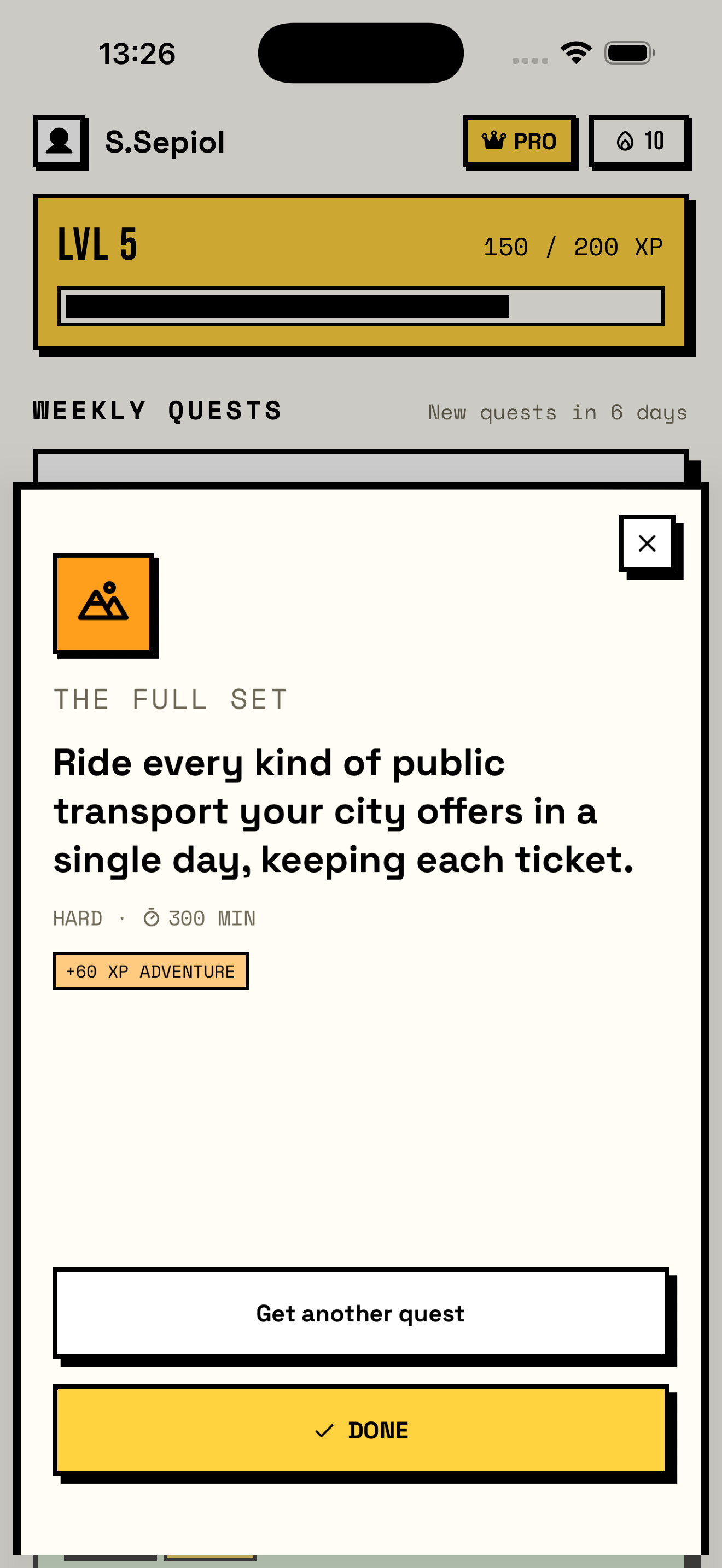
- Complete one in a single tap. XP counts up, your streak grows, and the moment is celebrated with confetti and haptics. No proof uploads, no check-ins, no friction.
- Finish all seven and a bonus quest unlocks.
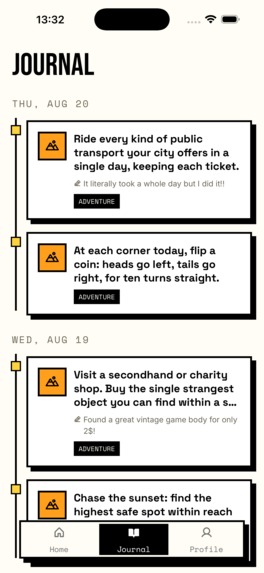
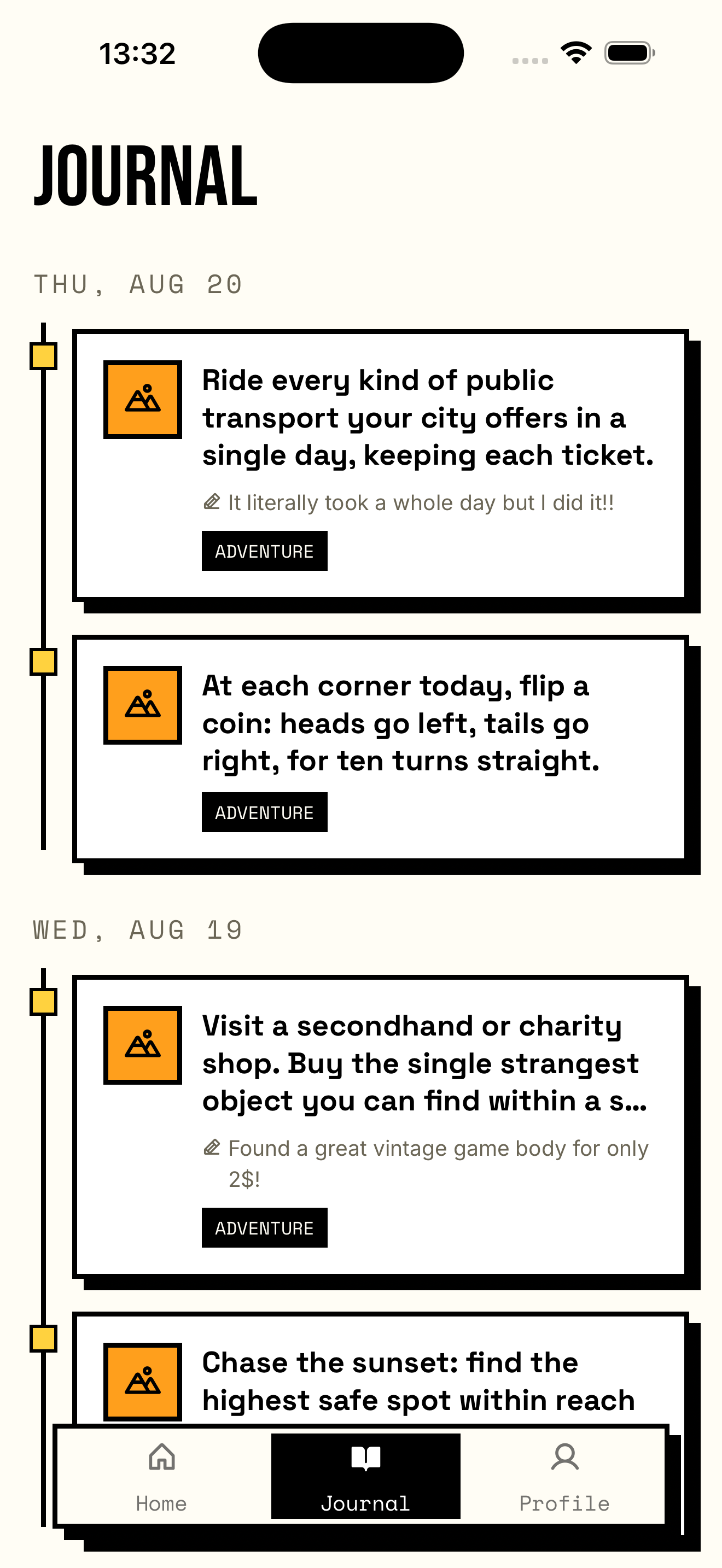
- Remember it. Every completion becomes a journal entry with an optional note or photo — private by default.
- Come back next week to quests that fit a little better than before.
Quests that don't fit your week can be swapped — random from the library, or a tailored "For You" quest. Streaks reward days you actually did something; opening the app counts for nothing.
Design was the part I refused to shortcut
I chose flat neo-brutalist design: heavy type, high contrast, honest borders, no decoration for decoration's sake. I studied the rules of the style and implemented them properly instead of defaulting to generic soft UI. The completion ceremony is the heart of the app — confetti, haptics, XP count-up, weekly progress, streak feedback — because that's the moment the game has to feel real. The goal is an app that rewards your aliveness, not one that nags you like a to-do list.
Free is genuinely useful. Pro sells relevance.
Weekly quests, XP, levels, streaks, the bonus quest, and the journal are free forever. Pro ($29.99/year with a 7-day free trial, powered by RevenueCat) sells relevance and control: more swaps, more tailored swaps, higher-resolution share cards without a watermark.
$\frac{29.99}{365} \approx 0.08$ USD per day. But the philosophy matters more than the math: the first quest has to be free and frictionless, because if the first real-world quest never happens, nothing else in the product matters. RevenueCat powers the subscription lifecycle — trials, entitlements, restore, and the ugly edge cases. If billing state is unavailable, the app preserves known entitlements and offers retry instead of blocking the user.
How I built it
Solo. Expo + React Native (iOS now, Android next), Bun + Hono, PostgreSQL + Drizzle, Better Auth, OpenRouter, RevenueCat, OneSignal, PostHog, Sentry, and an Astro landing site.
My process: I picked the tools deliberately, planned the backend and frontend structure before writing code, then used AI heavily to implement against that plan. AI writes a lot of it — the architecture, product rules, safety rules, and final code review are mine. That balance is the point. User-facing copy never says "AI": quests are "For You" and "Picked for your taste." AI is infrastructure, not the pitch.
Personalization without creepiness: a hand-reviewed curated library is the core; AI tailoring is the second layer. Only an age band, a broad location, chosen interests, and preference signals go to the model — never the full birthdate, never journal notes or photos.
Safety: generated quests are schema-validated and safety-checked, retried once, and silently fall back to a curated quest if they fail. A user report hides the quest for that user and flags it for review. The app is 13+, with no adult, dangerous, or meeting-strangers content.
The challenges
1. Teaching an AI to be creative. The first generated quests were all the same. The model kept returning near-identical variations of safe ideas. Interesting quests come from constraints and context, not from asking for "something fun" — so I iterated on the generation pipeline a lot: constrained approved patterns, completion history, swap and feedback signals, and a curated fallback that guarantees the user never sees a bad quest.
2. A three-week App Store review. My first submission that took anywhere near that long. No rejections, no issues — just waiting, while the Shipaton clock ran. It taught me to submit early and keep improving after, instead of saving the build for the last week.
3. Solo scope. One person, a fixed deadline. The MVP cut list was long: no social features, no leaderboards, no achievements, no Android yet. Every cut was a decision to ship instead of a decision to be lazy.
What I learned
- A deadline forces shipping. You can polish forever. Shipaton gave me a real reason to draw a line, and the app is better for it.
- Motivation design is delicate. XP, streaks, and celebrations only work if they reward living. The moment they start punishing you for having a life, the app becomes another source of guilt.
- AI is infrastructure, not a feature. The value is a quest that actually fits you — not who generated it.
- Distribution is the hard part. Code is the part you control. Attention isn't.
Where it is now
Live on the App Store as of [RELEASE DATE]. [ADD ANY REAL SIGNALS: downloads, first-quest completion, journal entries, TikTok views — even small, real numbers beat adjectives. If none: "The first cohort is small, and the metric I watch closest is first-quest completion: [X]% of onboarded users finish a quest in their first week."]
Next: Android, weekly OneSignal notifications (weekly summaries and trial reminders are in progress), share cards, and the TikTok content engine (@trynewquest) showing quests being done for real.
Try it: App Store link — free, with a 7-day Pro trial.
The main quest is daily obligation. Side quests are what make life feel vibrant.# side quests — stop scrolling, start living
Seven real-life quests a week. Earn XP for living, not for productivity. Keep a private journal of what you actually did.
Where this came from
At some point my days started to look identical. Same routine, same screens, same evening. Nothing was wrong, but I wasn't discovering or experiencing anything new. The strange part is that I wanted to do something different — I just never had an idea ready at the moment I actually had time. So the moment passed, and I went back to scrolling.
That's the loop I wanted to break: boredom → no idea → scroll → repeat. Not with another habit tracker, but with a ready-made supply of ideas that are small, concrete, and actually fun.
So I built side quests: an app that hands you a week of quests, turns completing them into a game, and keeps a journal of the memories you made along the way.
What it is
Every weekly cycle gives you seven quests, anchored to the day you joined — not the calendar week. Every quest has to discover something new, teach a skill, create a memory, push you slightly out of your comfort zone, or become a story worth telling.
Real examples from the curated library:
- Find the oldest building on your street and guess its age from clues alone, no searching online.
- Point blindly at a cafe menu and order whatever item your finger lands on.
- Message someone you haven't seen in six months with a concrete plan: a place, a day, your treat.
The loop:
- Get your weekly cycle — seven quests, mixed Easy / Medium / Hard.
- Complete one in a single tap. XP counts up, your streak grows, and the moment is celebrated with confetti and haptics. No proof uploads, no check-ins, no friction.
- Finish all seven and a bonus quest unlocks.
- Remember it. Every completion becomes a journal entry with an optional note or photo — private by default.
- Come back next week to quests that fit a little better than before.
Quests that don't fit your week can be swapped — random from the library, or a tailored "For You" quest. Streaks reward days you actually did something; opening the app counts for nothing.
Design was the part I refused to shortcut
I chose flat neo-brutalist design: heavy type, high contrast, honest borders, no decoration for decoration's sake. I studied the rules of the style and implemented them properly instead of defaulting to generic soft UI. The completion ceremony is the heart of the app — confetti, haptics, XP count-up, weekly progress, streak feedback — because that's the moment the game has to feel real. The goal is an app that rewards your aliveness, not one that nags you like a to-do list.
Free is genuinely useful. Pro sells relevance.
Weekly quests, XP, levels, streaks, the bonus quest, and the journal are free forever. Pro ($29.99/year with a 7-day free trial, powered by RevenueCat) sells relevance and control: more swaps, more tailored swaps, higher-resolution share cards without a watermark.
$\frac{29.99}{365} \approx 0.08$ USD per day. But the philosophy matters more than the math: the first quest has to be free and frictionless, because if the first real-world quest never happens, nothing else in the product matters. RevenueCat powers the subscription lifecycle — trials, entitlements, restore, and the ugly edge cases. If billing state is unavailable, the app preserves known entitlements and offers retry instead of blocking the user.
How I built it
Solo. Expo + React Native (iOS now, Android next), Bun + Hono, PostgreSQL + Drizzle, Better Auth, OpenRouter, RevenueCat, OneSignal, PostHog, Sentry, and an Astro landing site.
My process: I picked the tools deliberately, planned the backend and frontend structure before writing code, then used AI heavily to implement against that plan. AI writes a lot of it — the architecture, product rules, safety rules, and final code review are mine. That balance is the point. User-facing copy never says "AI": quests are "For You" and "Picked for your taste." AI is infrastructure, not the pitch.
Personalization without creepiness: a hand-reviewed curated library is the core; AI tailoring is the second layer. Only an age band, a broad location, chosen interests, and preference signals go to the model — never the full birthdate, never journal notes or photos.
Safety: generated quests are schema-validated and safety-checked, retried once, and silently fall back to a curated quest if they fail. A user report hides the quest for that user and flags it for review. The app is 13+, with no adult, dangerous, or meeting-strangers content.
The challenges
1. Teaching an AI to be creative. The first generated quests were all the same. The model kept returning near-identical variations of safe ideas. Interesting quests come from constraints and context, not from asking for "something fun" — so I iterated on the generation pipeline a lot: constrained approved patterns, completion history, swap and feedback signals, and a curated fallback that guarantees the user never sees a bad quest.
2. A three-week App Store review. My first submission that took anywhere near that long. No rejections, no issues — just waiting, while the Shipaton clock ran. It taught me to submit early and keep improving after, instead of saving the build for the last week.
3. Solo scope. One person, a fixed deadline. The MVP cut list was long: no social features, no leaderboards, no achievements, no Android yet. Every cut was a decision to ship instead of a decision to be lazy.
What I learned
- A deadline forces shipping. You can polish forever. Shipaton gave me a real reason to draw a line, and the app is better for it.
- Motivation design is delicate. XP, streaks, and celebrations only work if they reward living. The moment they start punishing you for having a life, the app becomes another source of guilt.
- AI is infrastructure, not a feature. The value is a quest that actually fits you — not who generated it.
- Distribution is the hard part. Code is the part you control. Attention isn't.
Where it is now
Live on the App Store as of beginning of September.
Next: Android, weekly OneSignal notifications (weekly summaries and trial reminders are in progress), share cards, and the TikTok content engine (@trynewquest) showing quests being done for real.
Try it: App Store link — free, with a 7-day Pro trial.
The main quest is daily obligation. Side quests are what make life feel vibrant.
Built With
- hono
- node.js
- onesignal
- postgresql
- posthog
- react-native
- revenuecat


Log in or sign up for Devpost to join the conversation.