-
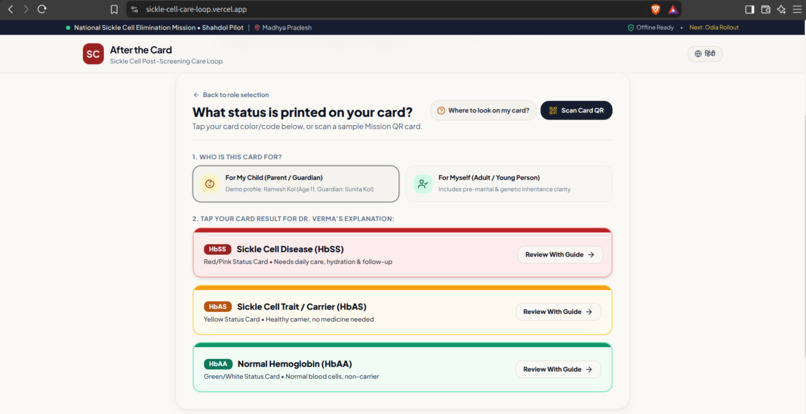
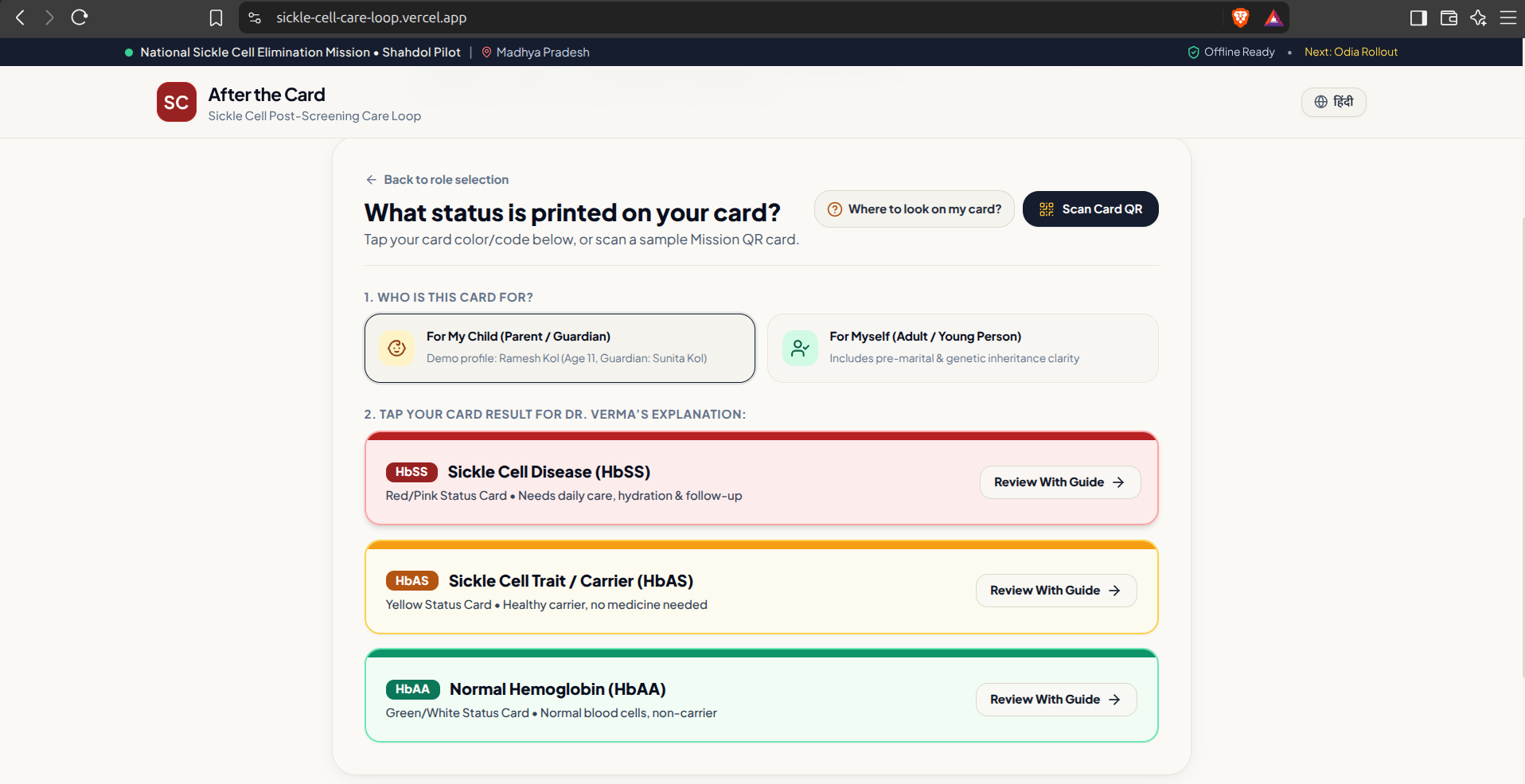
Physical Sickle Cell Status Card Matching (HbSS Red, HbAS Yellow, HbAA Green) + Card Helper & QR Scan
-
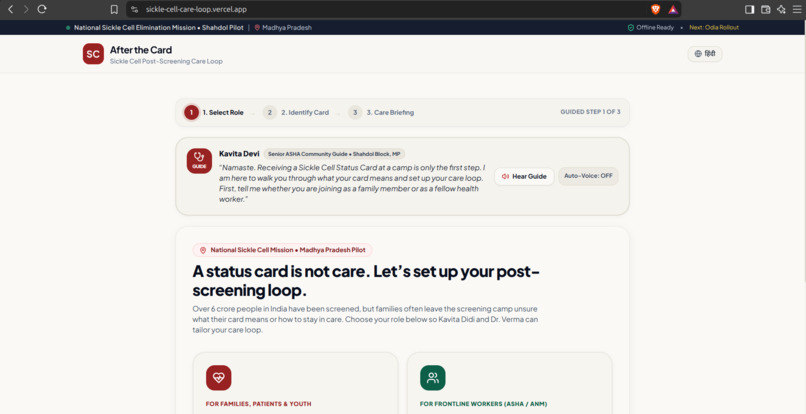
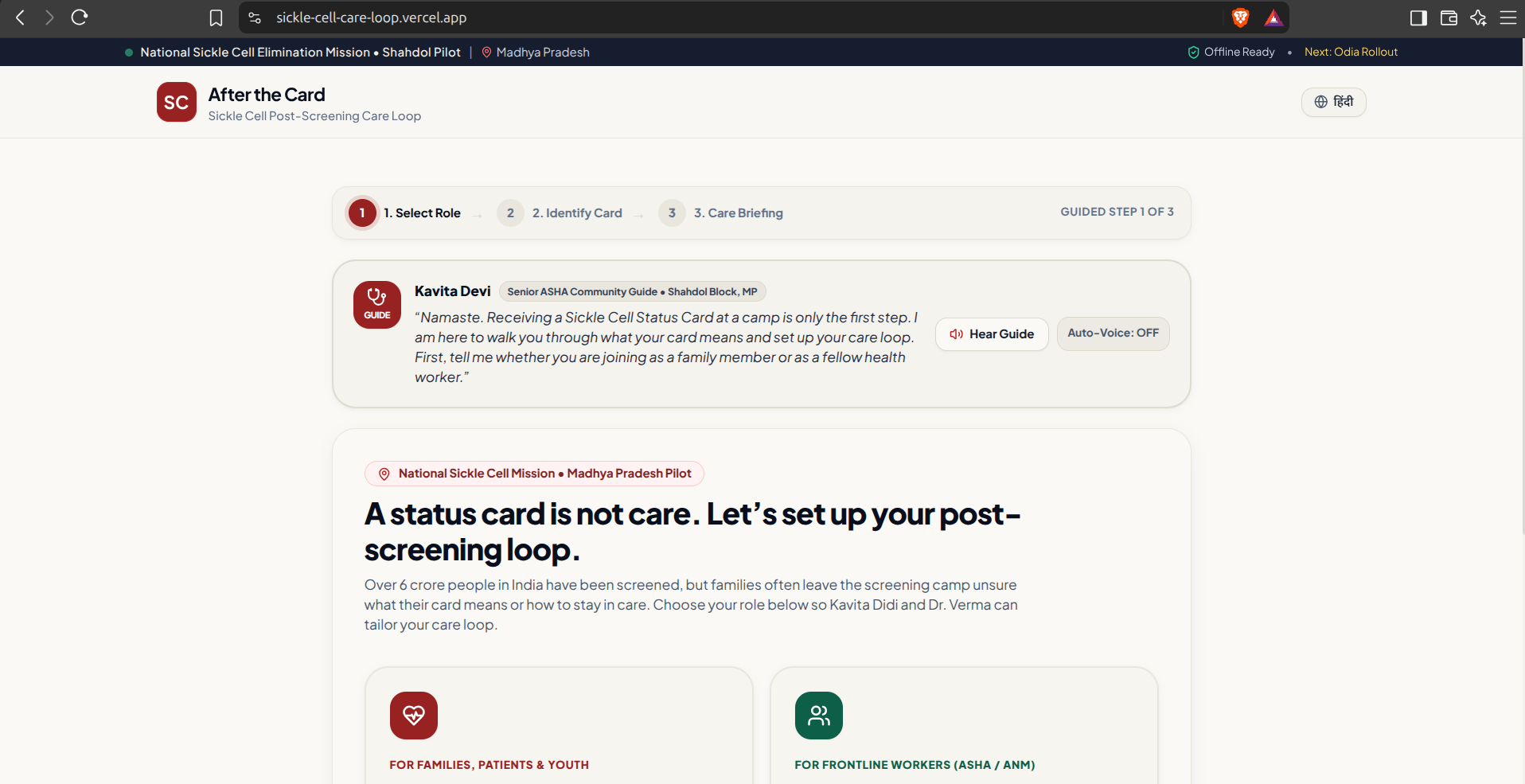
Voice-Assisted Clinical Care Guide (Kavita Devi, ASHA) & Role Selection (English / हिंदी)
-
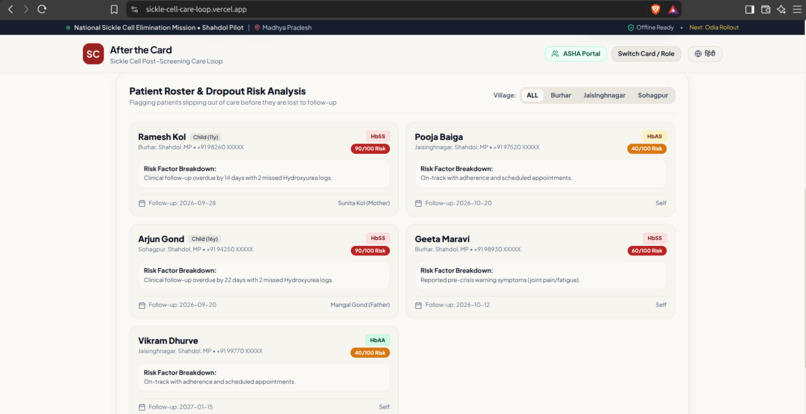
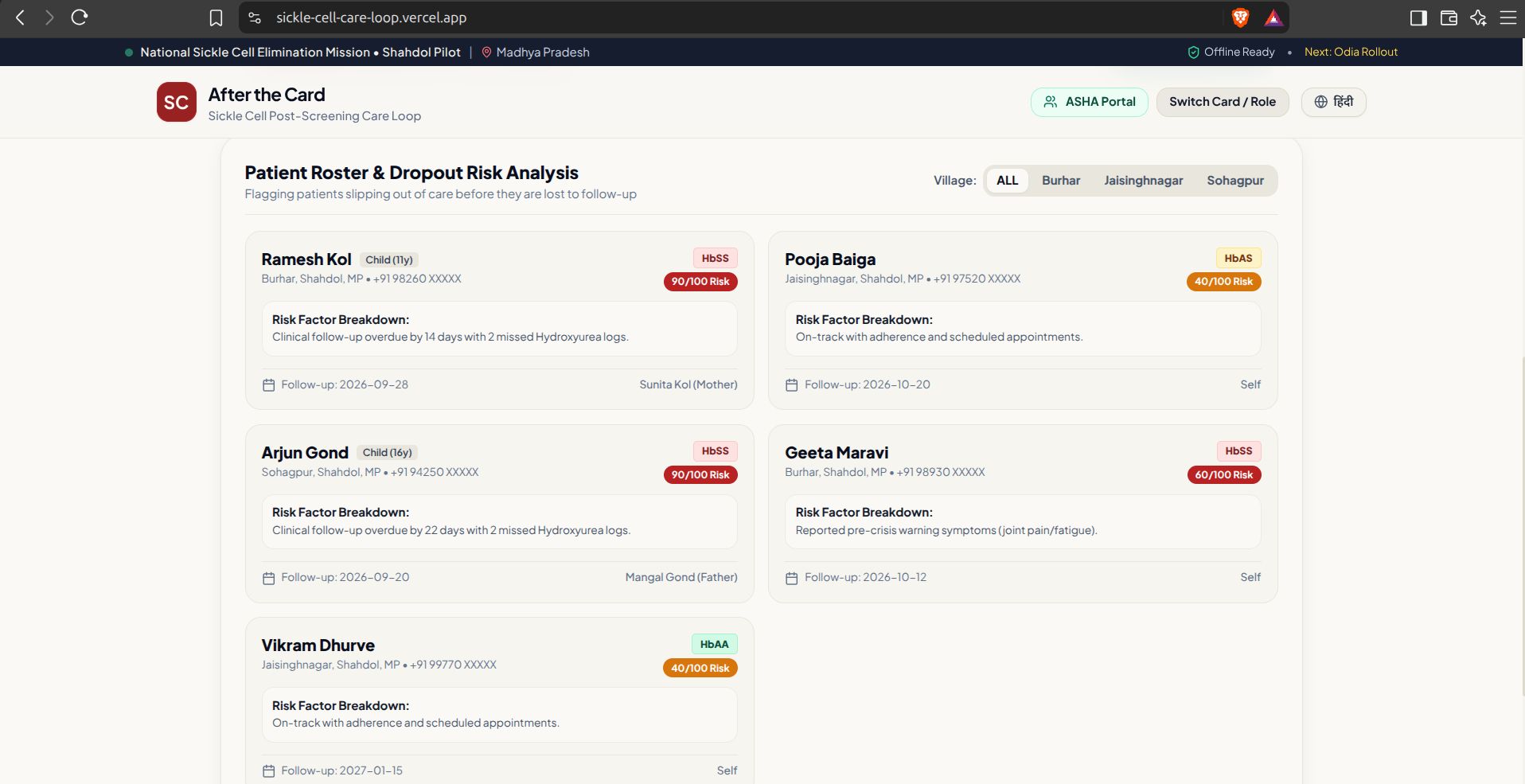
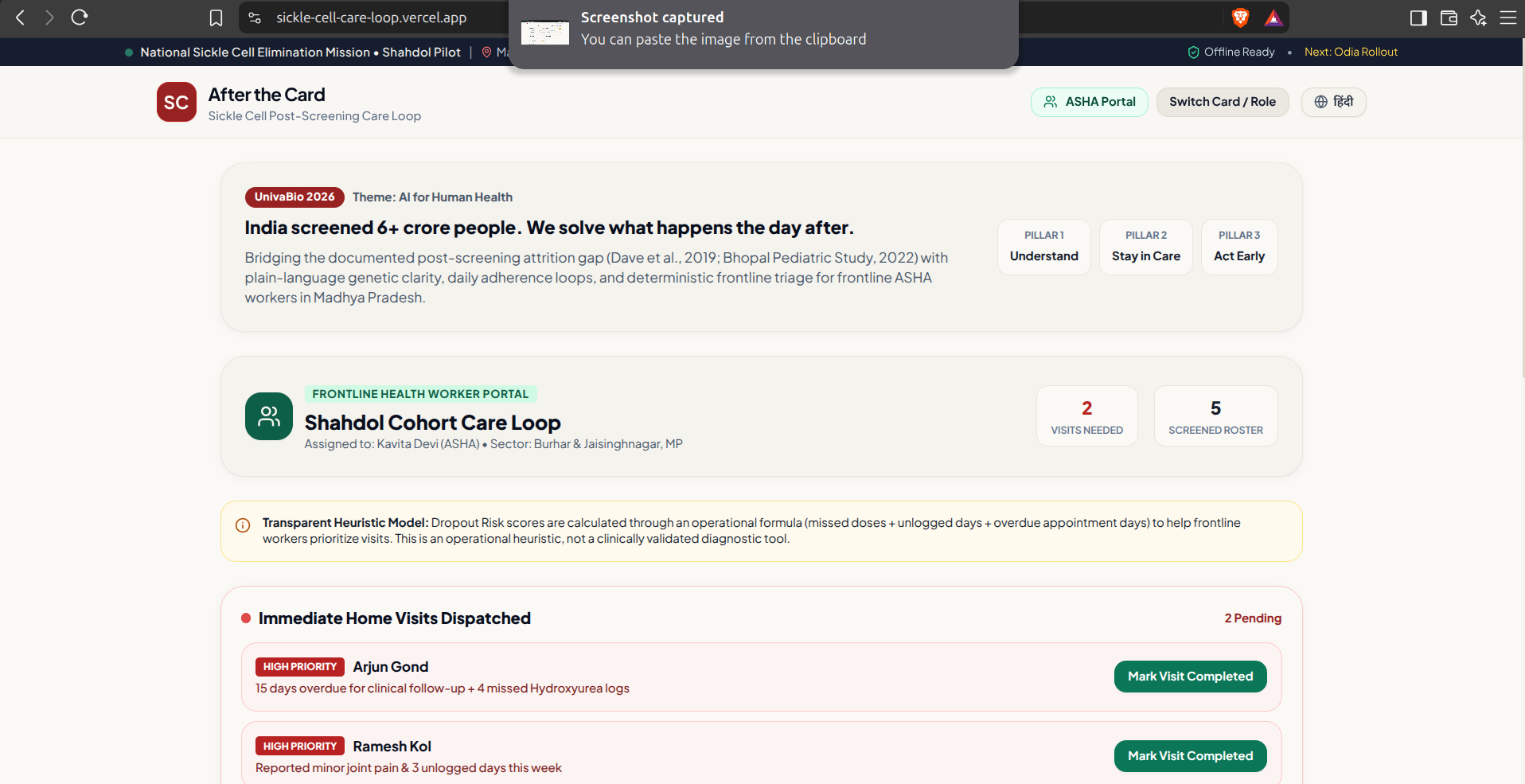
Frontline ASHA Worker Portal — Village Patient Roster & Explainable Dropout Risk Scoring
-
-
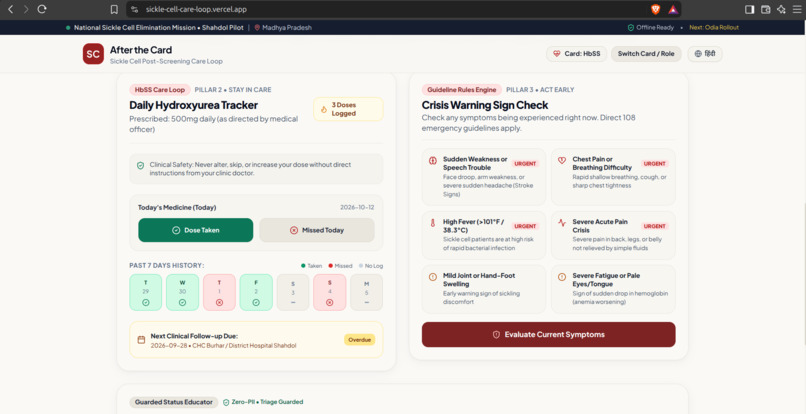
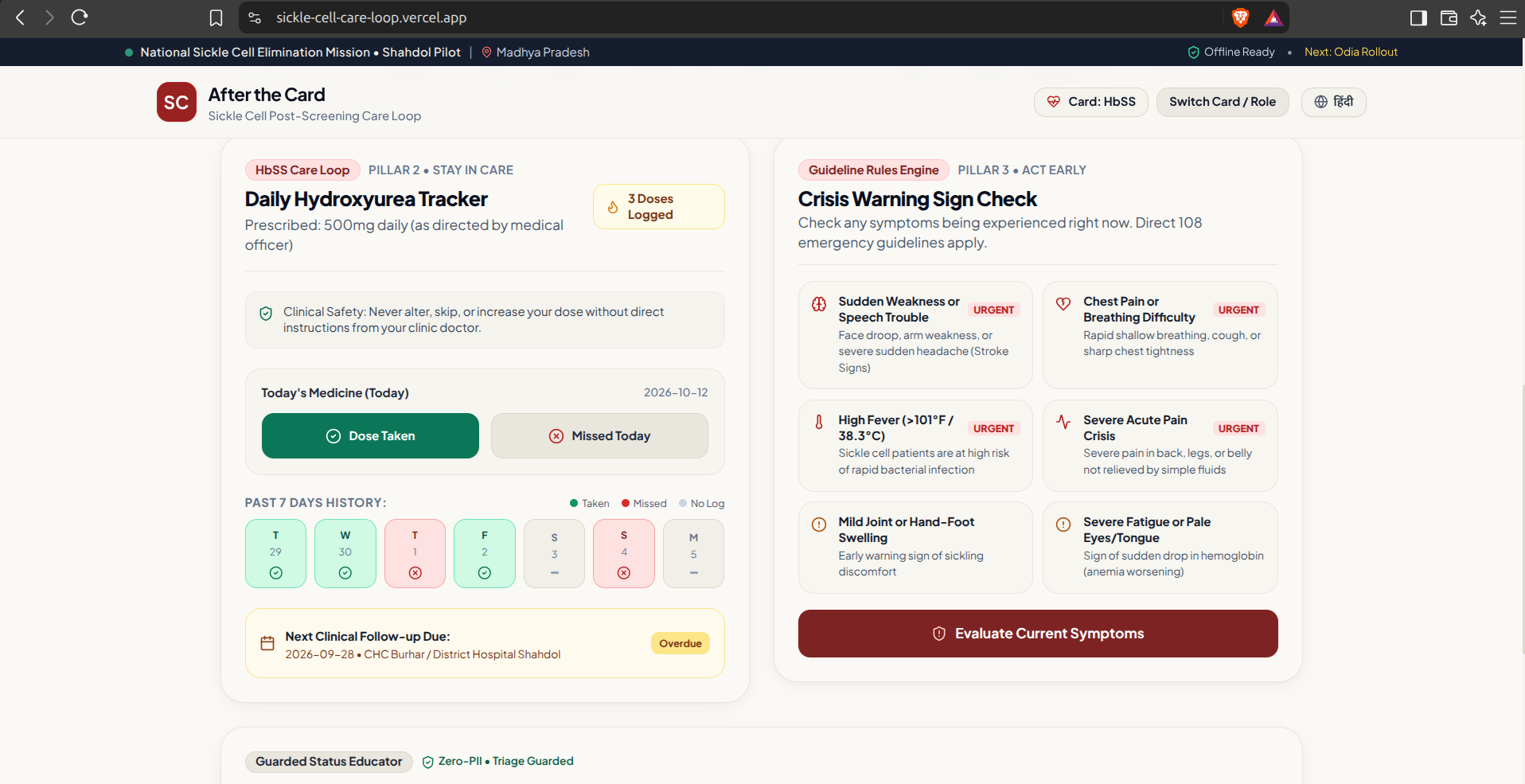
HbSS Care Loop: Daily Hydroxyurea Adherence Tracker, Deterministic Crisis Warning Sign Check & Guarded Educator
Inspiration
India’s National Sickle Cell Anaemia Elimination Mission (launched in Shahdol, Madhya Pradesh) has achieved historic scale—screening over 6.04 crore (60+ million) people, diagnosing 2.16+ lakh patients (HbSS), and identifying 16.7+ lakh carriers (HbAS).
Yet across high-burden tribal districts, a status card is not care. Peer-reviewed Indian clinical studies reveal three critical post-screening gaps:
- Care works, but patients fall out of it: In a tribal Gujarat program of 404 patients, Hydroxyurea raised coverage from 3.5% to 88% and cut vaso-occlusive pain crises from 277 to 53.4 per 100 person-years—yet ~25% of patients were lost to follow-up (Dave et al., 2019). Among pediatric patients in Bhopal, non-adherence was linked to improper follow-up (64.5%), drug unavailability (67.7%), and unawareness (54.8%) (JCDR, 2022).
- People hold a card but misunderstand it: In Koraput, Odisha, most respondents believed carriers actively transmit the disease and did not know that carrier × carrier (
HbAS × HbAS) marriage is the actual genetic risk (PMC7475140). In the Indian SCD Registry, 85.2% of 324 tribal patients did not know their status before enrolling (ISCDR, 2024). - Warning signs are missed at home: Families miss early stroke signs, acute chest tightness, or high fever until a life-threatening emergency escalates.
One line: India solved finding sickle cell. Nobody solved what happens the day after.
What it does
Sickle Cell Care Loop is a bilingual (English default + 1-click Hindi हिंदी toggle), offline-ready Progressive Web App that connects Families at Home with Frontline Health Workers (ASHAs) in Shahdol and Bhopal, Madhya Pradesh.
1. Guided 3-Step Onboarding (Clarity Before the Dashboard)
Instead of dropping low-literacy users straight into a complex dashboard, our guided onboarding flow:
- Asks who is using the app (Family / Patient / Carrier vs. Frontline ASHA Worker).
- Lets families choose whether the card is for their child (Parent/Guardian) or themselves, and either tap their color-coded card (
HbSSRed,HbASYellow,HbAAGreen) or scan a simulated Mission QR Status Card. - Delivers a voice-narrated Pre-Dashboard Clarity Briefing explaining what their card means and how their dashboard has been tailored before they enter.
2. Status-Branched Family Experience
HbSS(Sickle Cell Disease):- Understand: Plain-language bilingual explanation with browser voice readout.
- Stay in Care (Daily Hydroxyurea Tracker): Tracks daily doses while explicitly separating
TAKEN,MISSED, andUNLOGGED(No Log) days so silent app days are never falsely penalized as missed medicine. Strict clinical rule: the app never advises starting, stopping, or changing a prescribed dose. - Act Early (Deterministic 108 Crisis Triage): Evaluates stroke signs (sudden weakness, speech trouble, severe headache), acute chest tightness, high fever ($>101^\circ\text{F}$), and severe pain using fixed clinical guidelines.
HbAS(Sickle Cell Trait / Carrier):- No Hydroxyurea Tracker: Carriers do not take Hydroxyurea, so medication logging is completely removed.
- Genetic & Pre-Marital Counseling: Reassures carriers that they are healthy, visually explains the 1-in-4 (25%) per-pregnancy genetic inheritance rule when two carriers marry, and refers them to Primary Health Centre (CHC) genetic counseling.
HbAA(Normal Hemoglobin): Reassurance and family record guidance.
3. Immediate, Non-Blocking 108 Emergency Path
When a patient selects a critical symptom (such as chest tightness, high fever, or stroke signs), the app does not wait for an ASHA worker (who may not see a notification for hours). It triggers an immediate full-screen emergency protocol instructing the family to Call 108 Ambulance or proceed to District Hospital Shahdol / nearest CHC, while queuing a secondary alert to the assigned ASHA in the background.
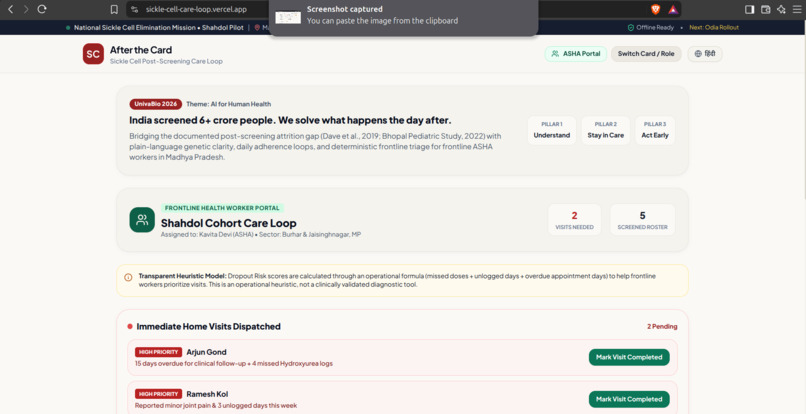
4. Frontline ASHA Health Worker Portal
ASHAs view their village cohort across Shahdol blocks (Burhar, Jaisinghnagar, Sohagpur) sorted by an Explainable Heuristic Dropout Risk Score ($0\text{–}100$):
$$ \text{Risk Score} = \min\Big(100,\; 15 \cdot D_{\text{missed}} + 5 \cdot D_{\text{unlogged}} + \min(3 \cdot T_{\text{overdue}},\, 30) + 20 \cdot S_{\text{warning}}\Big) $$
Every flag displays its exact operational reason (e.g., "Clinical follow-up overdue by 15 days + 4 missed Hydroxyurea logs") so ASHAs know whom to visit first and can mark home visits completed with counseling notes.
How we built it
- Frontend & Accessibility: Built with Next.js 14 (App Router), TypeScript, Tailwind CSS, and Framer Motion. Designed with a grounded public-health palette (terracotta crimson, warm ochre, forest green, and ivory canvas) using Plus Jakarta Sans and Noto Sans Devanagari typography, paired with the Web Speech API (
hi-INanden-IN) for low-literacy audio narration. - Server-Side AI & Clinical Safety Gate: Next.js API routes (
/api/ask,/api/transcribe,/api/models) keep the Groq API key strictly server-side. Before any user question reaches Groq (qwen3.6-27b/gpt-oss-120bandwhisper-large-v3-turbo), our deterministic safety gate (aiSafetyGuard.ts):- Intercepts symptom or dosage queries and routes them to the rule-based checker—zero LLM involvement in triage or dosing.
- Scrubs all PII (Indian phone numbers, Mission Card IDs like
MP-SHD-101, and personal numbers) via regex sanitization. - Pre-generates & caches bilingual status templates so core education works 100% offline without rate-limit or latency failures.
- Database & Privacy: Supabase (PostgreSQL) schema with Row Level Security (RLS) policies ensuring patients can only access their own rows and ASHAs can only view patients assigned to their village sector, plus
localStorageoffline queue support.
Challenges we ran into
- Separating "No Log" from "Missed Dose": In rural low-connectivity settings, a family not opening the app for three days does not mean the child skipped their medicine. Storing
TAKEN,MISSED, andUNLOGGEDas three distinct states and weighting explicit missed doses ($15\text{ pts}$) higher than silent days ($5\text{ pts}$) prevented false-alarm fatigue for ASHA workers. - Preventing Unsafe Free-Form AI Advice: Voice input is essential for low-literacy users, but free-form LLM chat creates clinical risk if a parent speaks about acute pain or fever. Building a deterministic keyword and intent interceptor in front of the LLM guaranteed that urgent symptoms always trigger fixed clinical rules.
- Handling Model Deprecations & Hindi Quality: Several older Groq models (
mixtral-8x7b,llama-3.3-70b-versatile) were deprecated or scheduled for retirement. We built a live/api/modelscheck and paired live inference with clinician-reviewed Hindi templates for core status explanations.
Accomplishments that we're proud of
- Zero-LLM Emergency Triage: A defensible clinical safety architecture where AI helps people understand their card in plain Hindi/English, while fixed national guideline rules handle every emergency escalation.
- Status-Appropriate Care Flows: Ensuring
HbAScarriers never see a disease medication tracker while receiving clear, stigma-free genetic facts ($1\text{ in }4$ risk per pregnancy). - Automated Safety Test Matrix: 8/8 automated verification tests passing across stroke/chest/fever triage rules, risk score weighting, and PII scrubbing.
What we learned
- Designing for India's public health missions means designing for existing frontline workflows (ASHAs and CHCs) rather than inventing standalone clinical silos.
- Transparency beats black-box AI in community health: explicitly labeling our ASHA dropout score as an operational heuristic (rather than a clinically validated diagnostic score) builds trust with clinicians and frontline workers alike.
What's next for Sickle Cell Care Loop
- Odia Language Rollout for Odisha: Expanding voice and text templates to Odia, as Odisha has the highest number of registered sickle cell patients in the Indian SCD Registry.
- Additional Hemoglobin Variants: Adding post-screening education branches for Sickle Beta-Thalassemia (
HbS-β) andHbSC. - Field Validation with CHCs: Partnering with Community Health Centres in Madhya Pradesh to validate the operational dropout risk weights against real-world ASHA visit outcomes.
Built With
- framer-motion
- groq
- next.js
- postgresql
- react
- supabase
- typescript

Log in or sign up for Devpost to join the conversation.