Inspiration
SIBYL SYSTEM was born from a simple, urgent question: how can AI help governments and social services act faster, more fairly, and more transparently when people’s welfare and safety are at stake?
We were inspired by real-world gaps in cross-agency coordination, slow manual triage of welfare cases, and the potential for multi‑agent systems to combine domain expertise, persistent memory, and human oversight into a single operational workflow. The project blends civic responsibility with engineering curiosity: building an agent that augments—not replaces—human decision makers.
What it does
SIBYL SYSTEM is a modular multi‑agent platform for welfare and public safety workflows. Key capabilities:
- Continuous monitoring of incoming reports, alerts, and case updates.
- Autonomous triage that classifies urgency, suggests next steps, and routes cases to the right team.
- Persistent memory that stores user preferences, case history, and policy exceptions to improve decisions across sessions.
- Human‑in‑the‑loop checkpoints for high‑risk or ambiguous cases.
- Audit trails and explainability so every recommendation includes the rationale and data sources.
How we built it
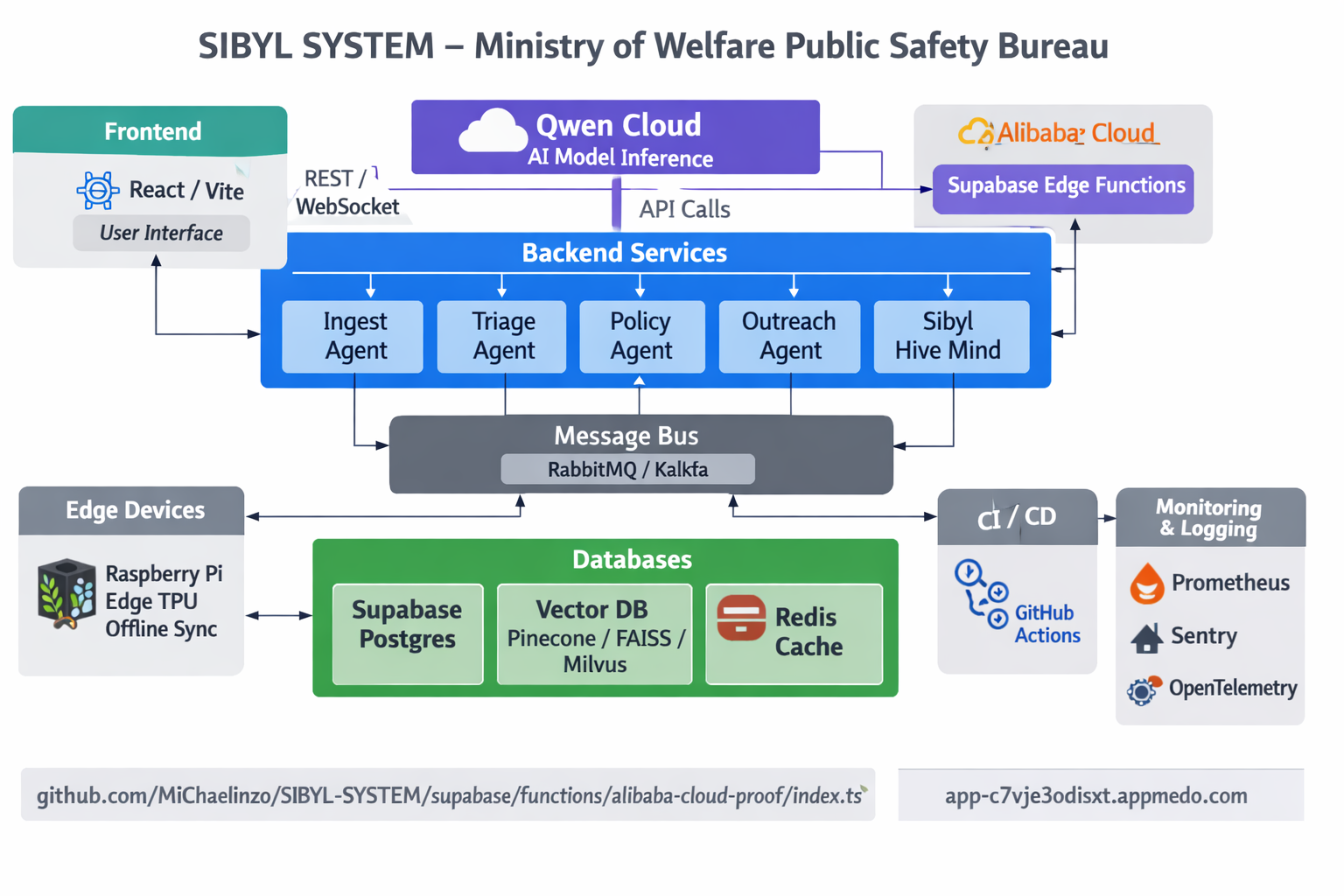
Architecture overview
- Frontend: responsive web UI for case review and dashboards.
- Backend: microservices that host agent orchestration, memory store, and policy modules.
- Memory layer: a hybrid store combining vector embeddings for semantic recall and a relational DB for structured case metadata.
- Agents: specialized agents (ingest, triage, policy, outreach) that communicate via a message bus and negotiate task ownership.
- Cloud deployment: backend services run on cloud instances with logging, monitoring, and CI/CD pipelines.
Technical highlights
- Memory retrieval: we use approximate nearest neighbor search for semantic recall to keep retrieval fast; naive retrieval is (O(n)) while indexed retrieval is approximately (O(\log n)).
[ \text{Naive retrieval: } O(n) \quad\text{Indexed retrieval: } O(\log n) ] - Safety and audit: every agent action is logged with a human‑readable justification and a cryptographic hash for tamper evidence.
- Integration: REST and webhook endpoints let SIBYL connect to existing case management systems and notification channels.
Submission notes
We prepared the repository, architecture diagram, and a short demo video to meet the hackathon submission requirements. devpost.com
Challenges we ran into
- Memory design tradeoffs: balancing recall accuracy, storage cost, and privacy constraints required iterating between dense embeddings and structured metadata.
- Multi‑agent coordination: designing robust negotiation and conflict resolution so agents don’t duplicate work or contradict each other took several protocol revisions.
- Explainability under token limits: producing concise, transparent rationales for recommendations while staying within model token budgets forced us to compress reasoning into structured templates.
- Deployment constraints: ensuring graceful degradation when cloud connectivity is poor (EdgeAgent scenarios) required building local fallback logic and lightweight models for critical checks.
Accomplishments that we're proud of
- Working multi‑agent pipeline: agents reliably decompose tasks, assign roles, and complete end‑to‑end workflows in our demo scenarios.
- Persistent memory with privacy controls: we implemented selective forgetting and consented memory scopes so sensitive data can be redacted or expired automatically.
- Human‑in‑the‑loop UX: reviewers can accept, modify, or reject agent recommendations with one click; every change updates the memory and audit log.
- Polished demo and documentation: complete repo, architecture diagram, and a 3‑minute video that clearly show the system in action.
What we learned
- Designing for humans first: automation is only useful when humans trust it; small UX details (clear rationales, easy overrides) dramatically increase acceptance.
- Memory is a product problem, not just an engineering one: deciding what to remember, for how long, and how to surface it requires policy thinking as much as technical work.
- Multi‑agent systems need explicit conflict resolution: without clear arbitration rules, agents can thrash or produce inconsistent outputs.
- Operational constraints matter: latency, token budgets, and deployment targets (cloud vs edge) shape architecture choices early and often.
What’s next for SIBYL SYSTEM – Ministry of Welfare Public Safety Bureau
- Policy tuning and pilot deployments: partner with a local welfare agency for a controlled pilot to validate real‑world impact and gather human feedback.
- Advanced memory policies: add adaptive forgetting, consented sharing across agencies, and differential privacy options.
- Agent marketplace: enable third‑party modules (e.g., legal advisor, mental‑health triage) to plug into the agent society with clear capability contracts.
- Edge resilience: optimize lightweight local agents for offline operation and secure sync when connectivity returns.
- Open source and community: publish the core repo with clear docs and reproducible demos so other builders can extend SIBYL for different civic domains.
Built With
- alibaba-cloud
- apache-kafka
- docker
- docker-compose
- edge-tpu
- express.js
- faiss
- fastapi
- figma
- git
- github-actions
- grafana
- grpc
- hugging-face-transformers
- json
- jwt
- kubernetes
- langchain
- material-ui
- milvus
- mongodb
- mqtt
- next.js
- nginx
- node.js
- oauth2
- openapi/swagger
- opentelemetry
- pinecone
- postgresql
- prisma
- prometheus
- python
- pytorch
- qwen-cloud
- rabbitmq
- raspberry-pi-(edge)
- react
- redis
- rest-apis
- sentry
- sqlalchemy
- tailwind-css
- tensorflow
- terraform
- typescript
- webhooks
- webrtc
- websockets
- yaml



Log in or sign up for Devpost to join the conversation.