-
-
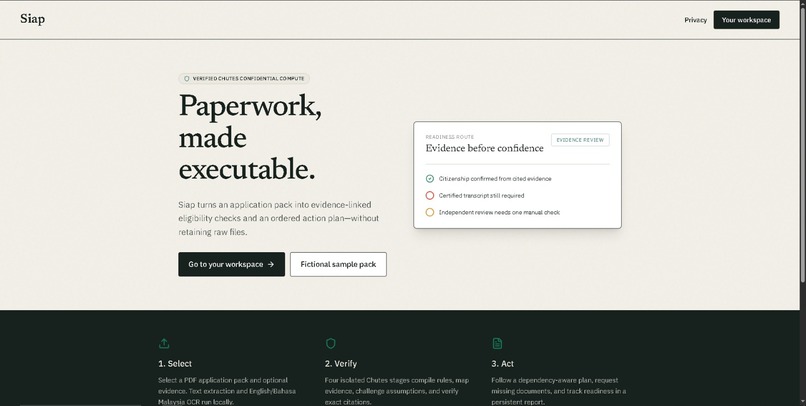
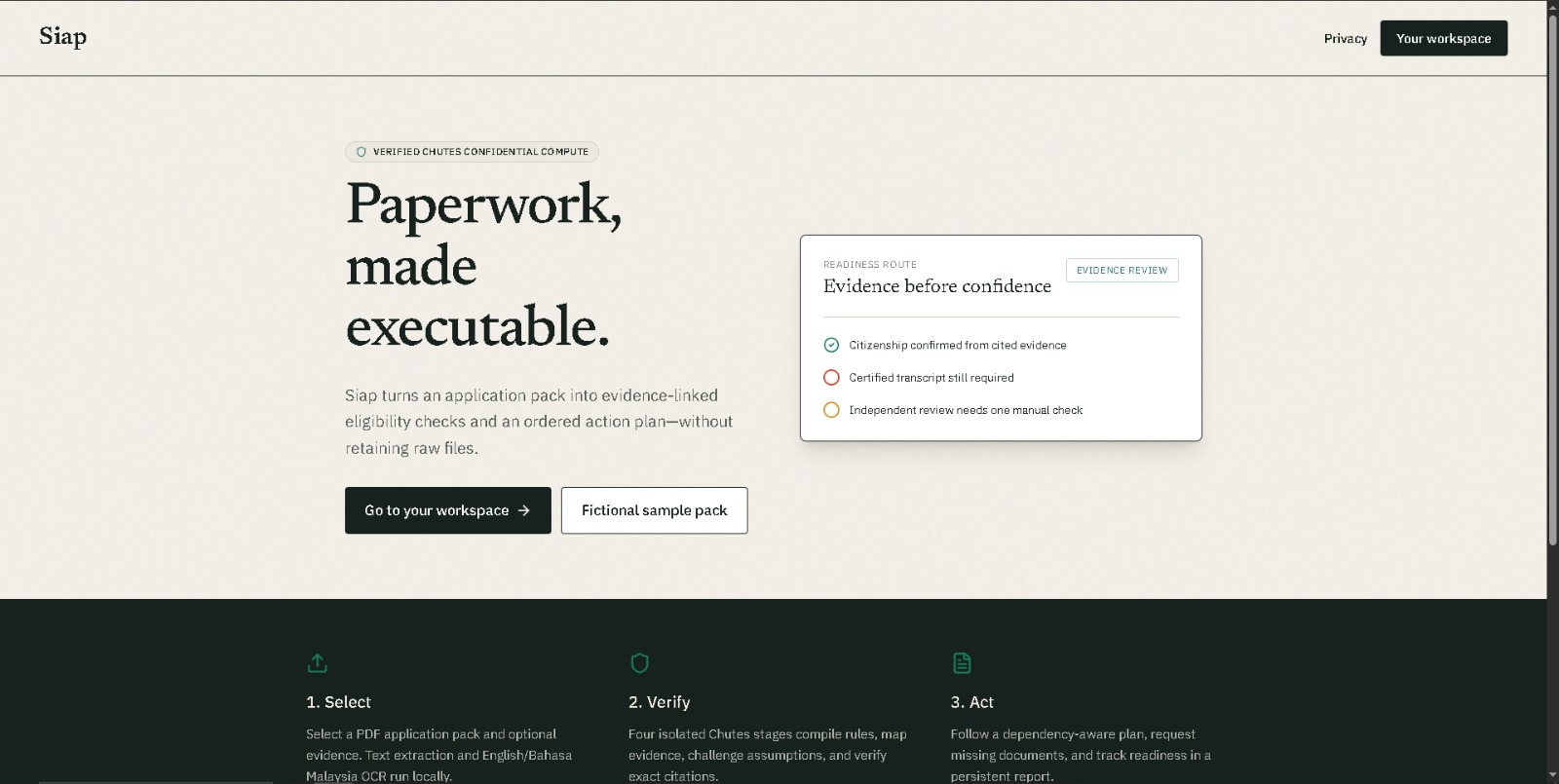
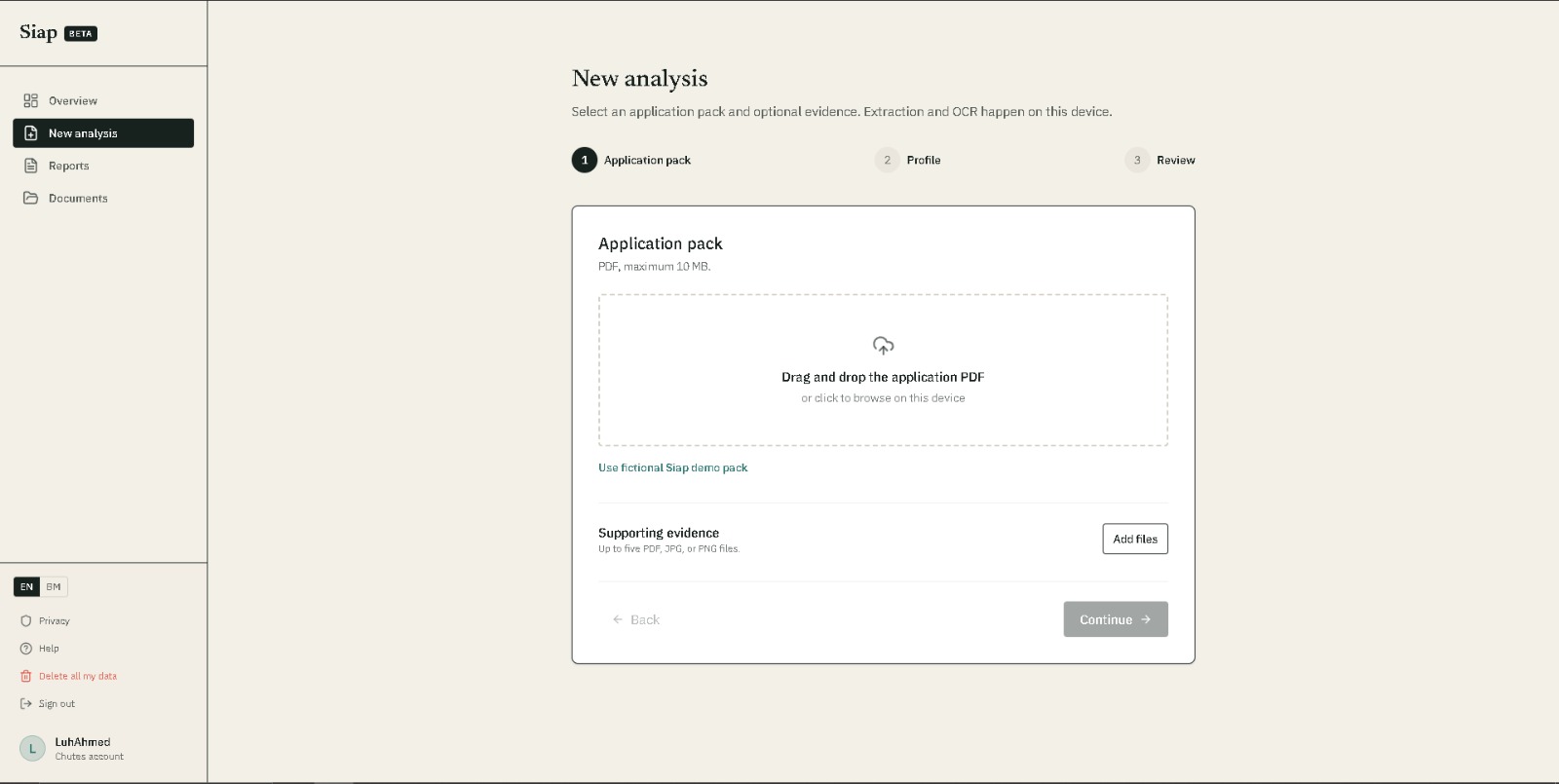
Siap turns complex paperwork into an evidence-linked readiness route.
-
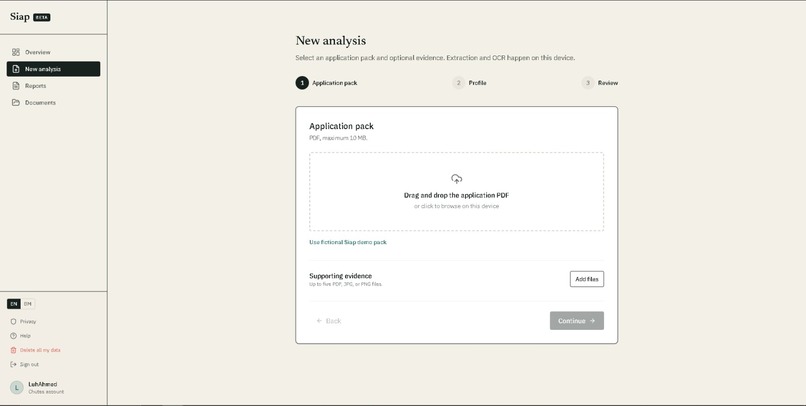
tart with the fictional demo pack or upload an application pack and supporting evidence.
-
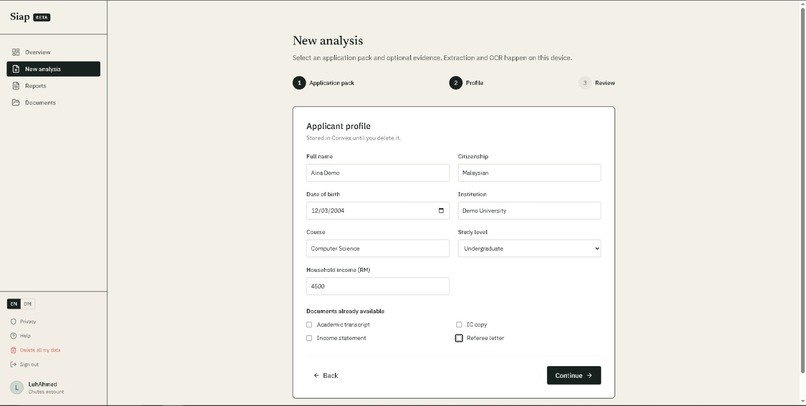
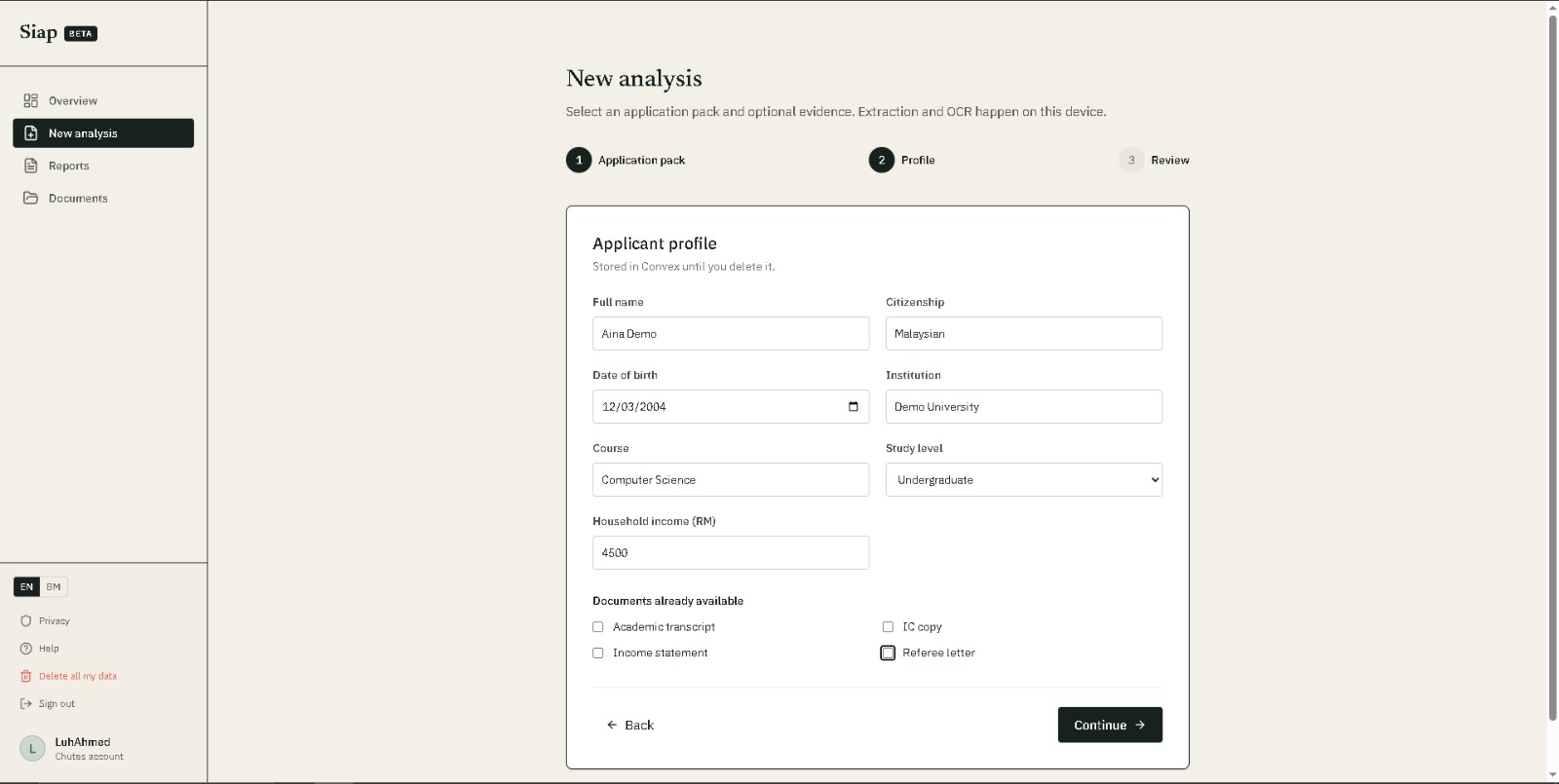
Applicant facts become structured profile data for deterministic checks.
-
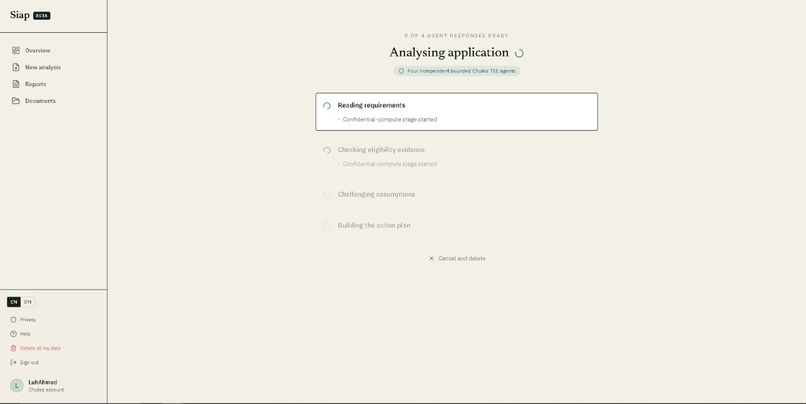
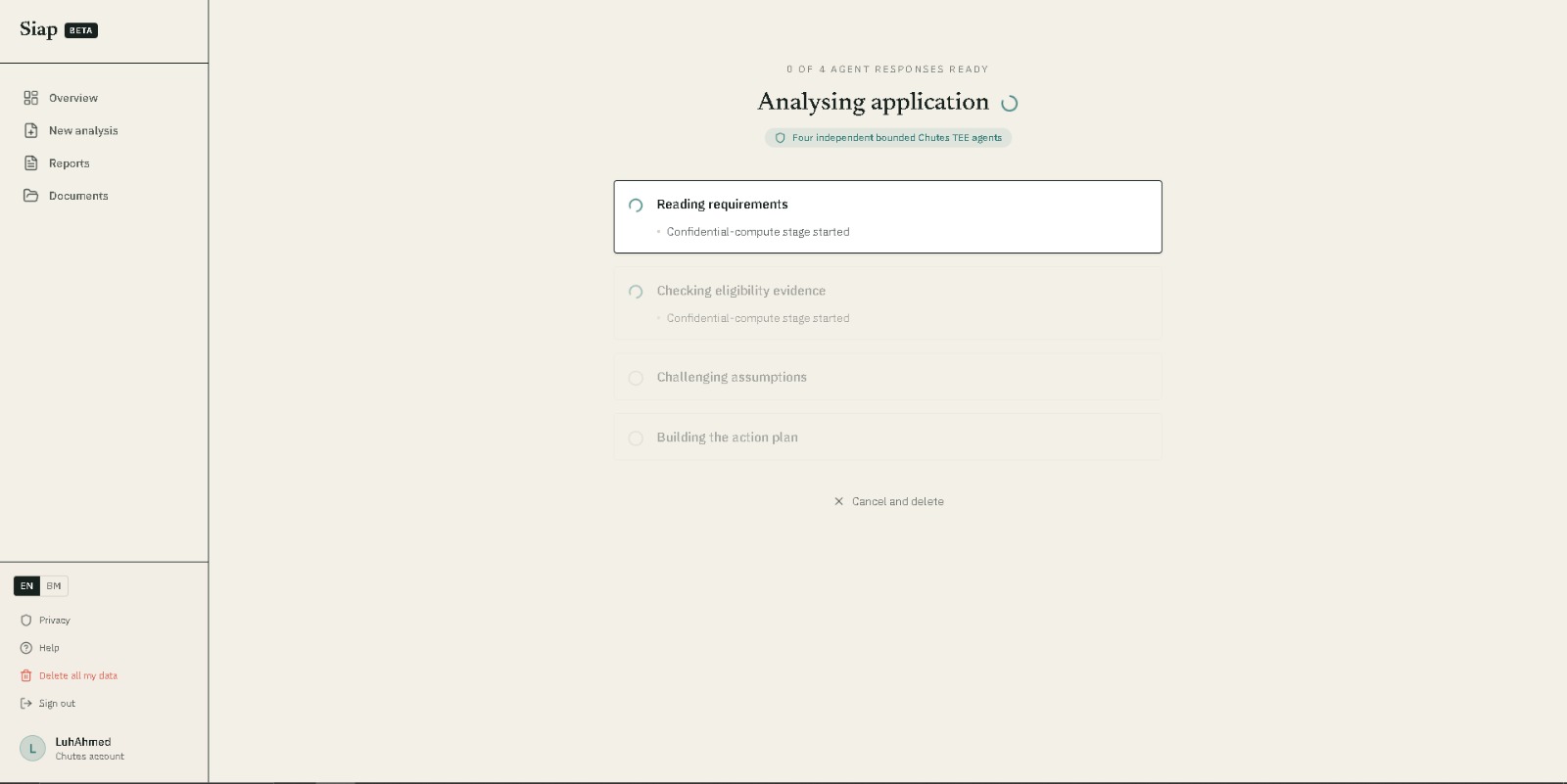
Four isolated Chutes TEE stages analyse the application with bounded progress.
-
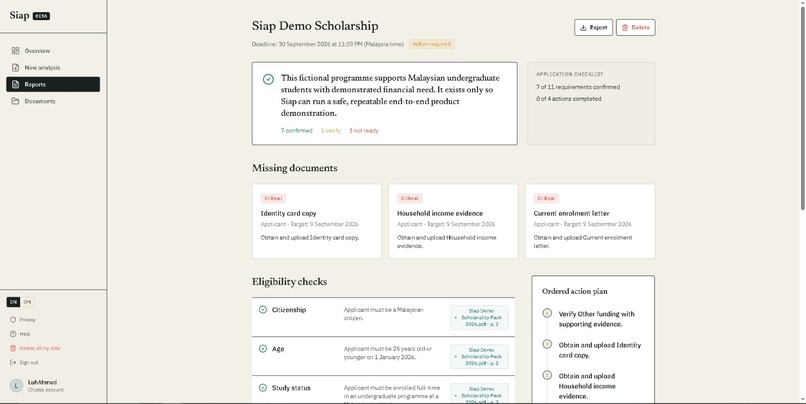
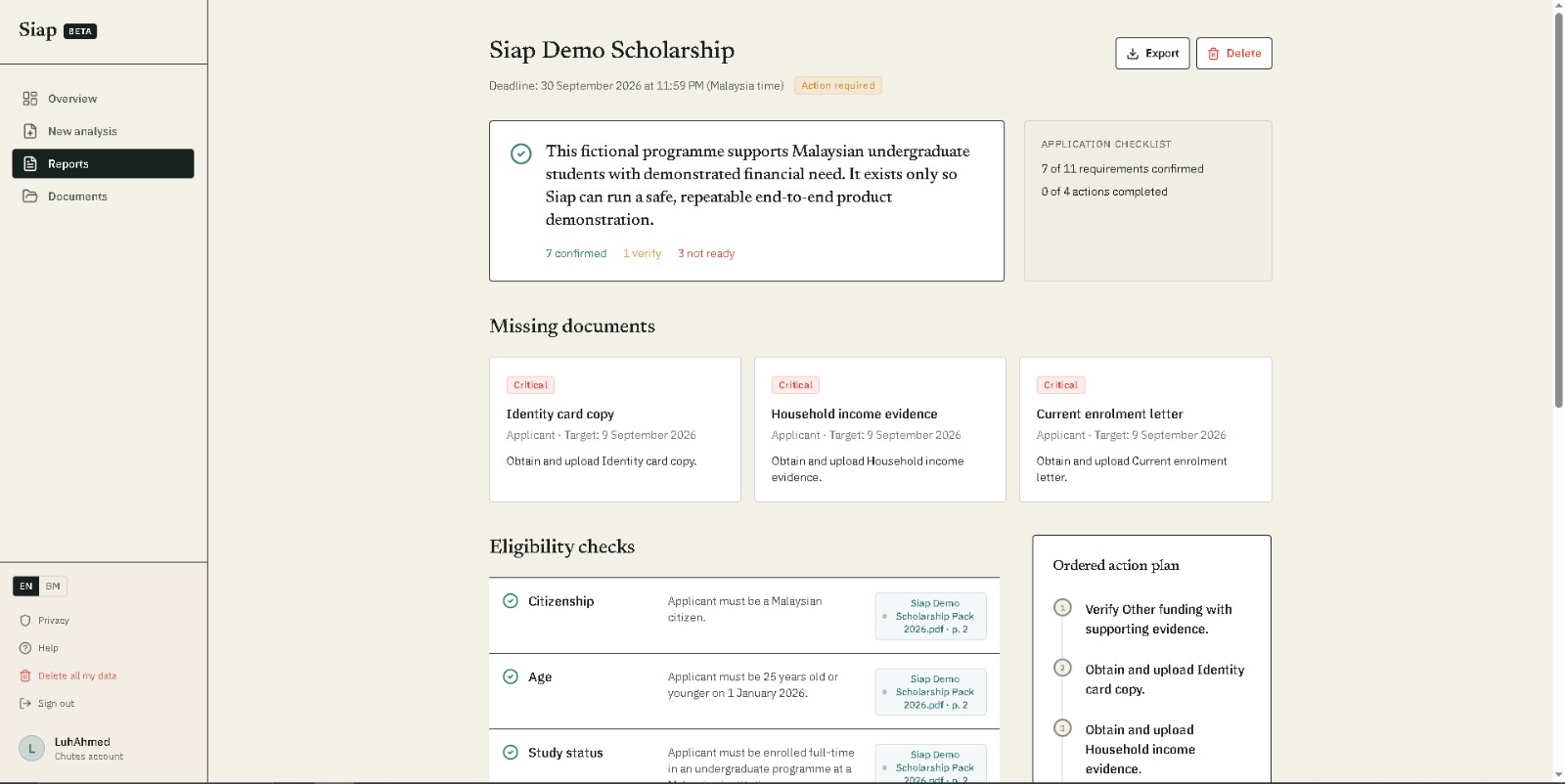
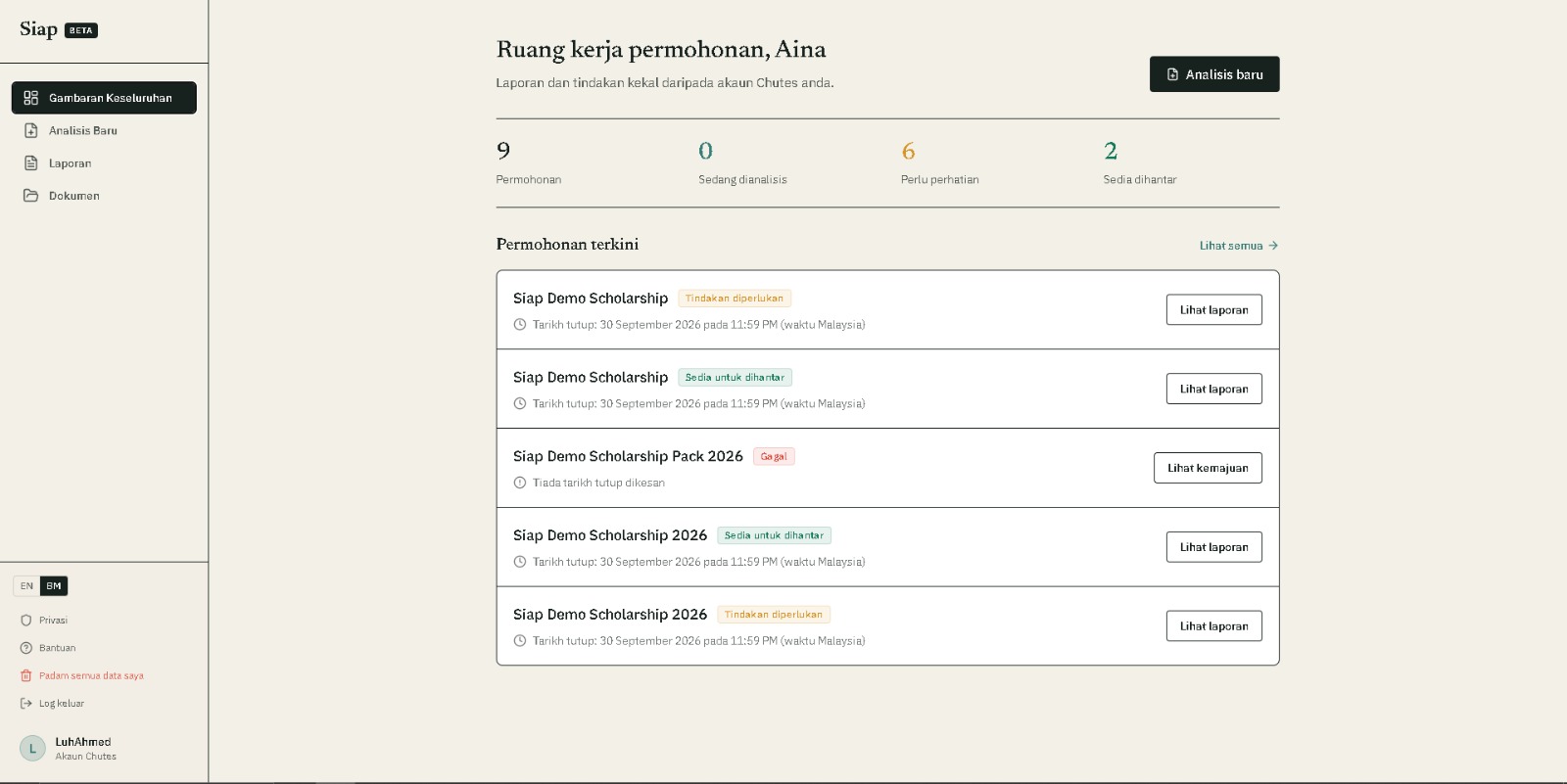
The report summarizes readiness, missing documents, and required next actions.
-
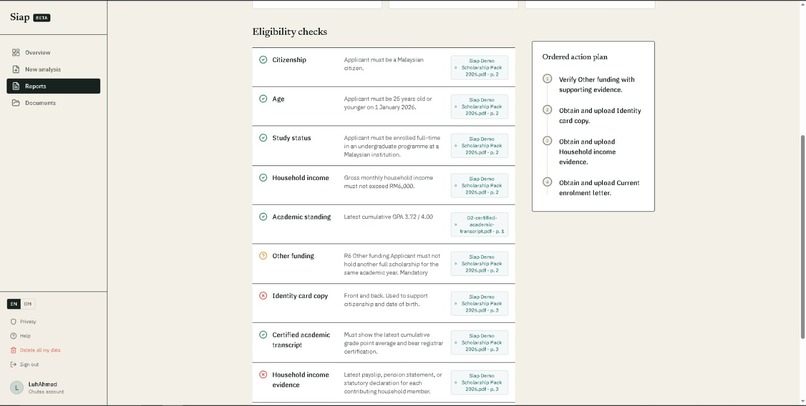
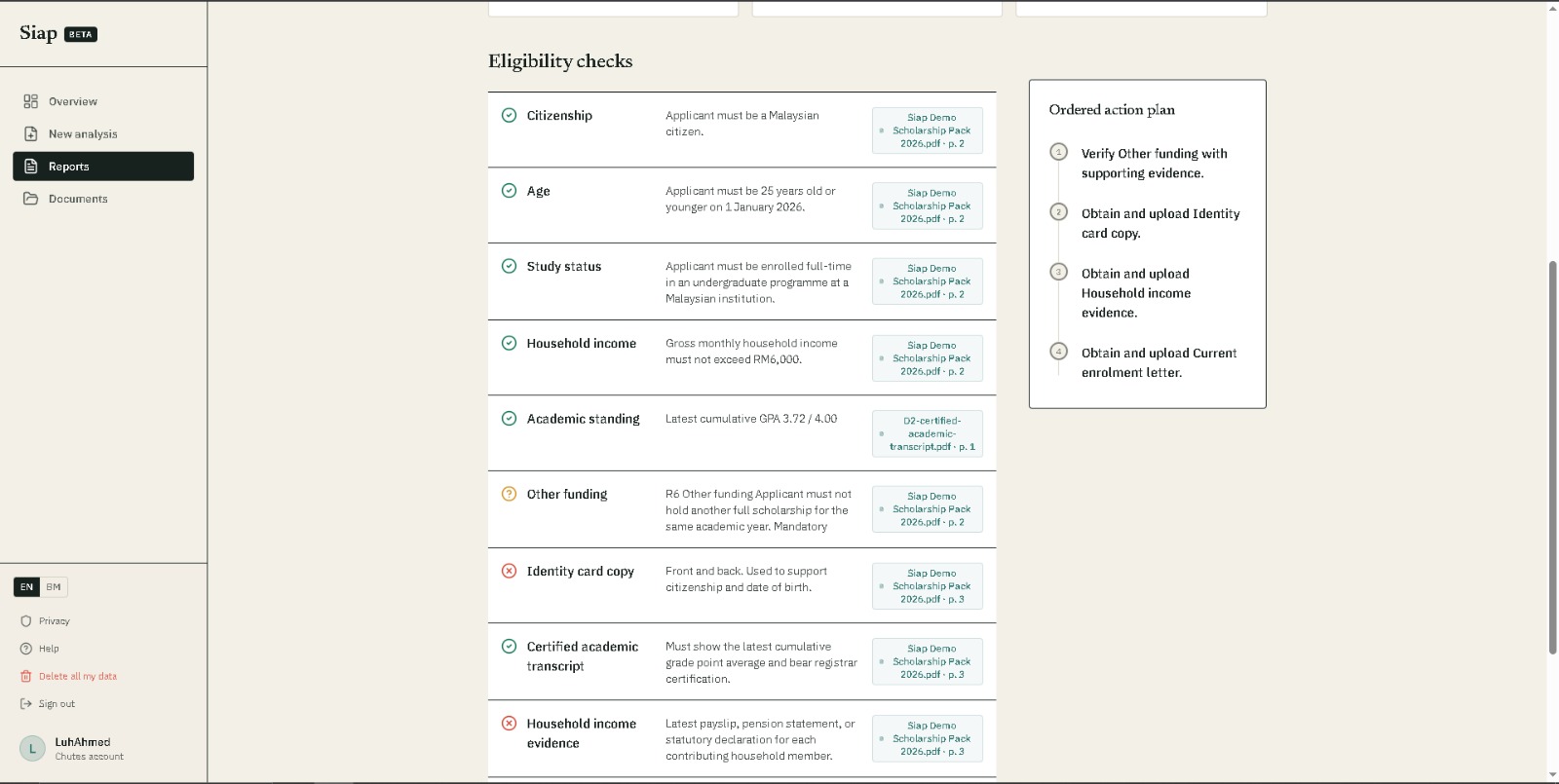
Every requirement has a conservative state and inspectable evidence.
-
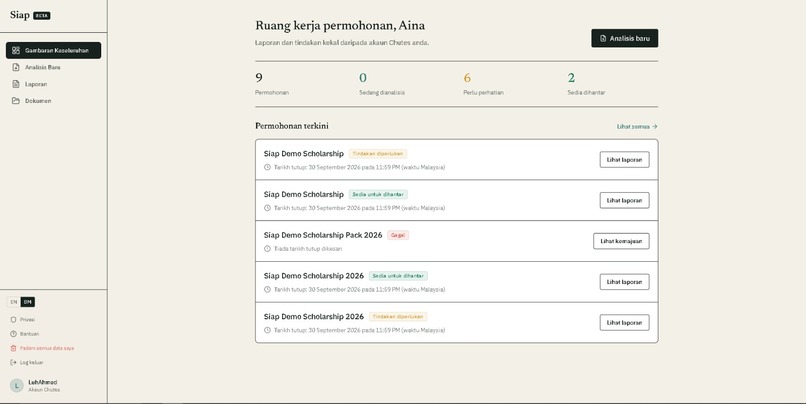
Dependency-aware actions turn missing evidence into an executable plan.
Scholarship, grant, university, and corporate applications are rarely difficult because of one form. The real difficulty is understanding long rulebooks, matching every requirement to the correct evidence, identifying missing documents, and completing tasks before the deadline.
Applicants often rely on spreadsheets, scattered notes, or generic AI summaries. These approaches can miss mandatory conditions, invent confidence without evidence, or expose sensitive documents.
We built Siap to turn paperwork into an auditable, executable workflow.
## What it does
Siap accepts an application-pack PDF and up to five optional supporting documents.
It then:
- extracts PDF text and performs English/Bahasa Malaysia OCR locally in the browser;
- compiles every eligibility rule and required document;
- maps applicant evidence to each requirement;
- verifies exact source citations;
- independently challenges unsupported conclusions;
- detects missing documents and definite eligibility failures;
- creates a dependency-aware action plan;
- calculates readiness deterministically;
- stores a persistent structured report without storing raw documents.
Each requirement is labelled as confirmed, needs verification, incomplete, or not met. Users can inspect the supporting citation, complete actions, manage document inventory, export reports, and delete individual reports or all retained data.
## How we built it
Chutes is the core intelligence and authentication layer of Siap.
Users authenticate through Sign in with Chutes using OAuth 2.0 Authorization Code with PKCE. Inference is billed directly to the signed-in user's Chutes account, so Siap never receives or stores an API key.
One analysis uses four isolated Chutes confidential-compute agents:
- Requirement compiler — extracts programme rules, deadlines, required documents, and machine-readable conditions.
- Eligibility mapper — matches applicant evidence to every requirement.
- Independent reviewer — challenges optimistic, contradictory, or unsupported conclusions.
- Action planner — reviews the recommended completion plan and priorities.
Before inference, Siap checks the live Chutes model catalogue and only permits models advertising both confidential compute and structured-output support. The production workflow uses distinct TEE models including GLM-5.1-TEE, Kimi-K2.6-TEE, Gemma-4-31B-turbo-TEE, and Qwen3-32B-TEE.
Model output is not trusted directly. Responses are validated with strict Zod schemas, citations are matched against the original page text, and deterministic code evaluates dates, ages, numeric thresholds, citizenship, study level, document presence, deadlines, and action dependencies. Models never assign the displayed readiness score.
The frontend uses Next.js 16 and React 19. Convex provides authenticated realtime application state and persistent normalized reports. The application is deployed on Vercel.
## Privacy and security
Raw files never leave browser memory. PDF extraction and OCR happen locally using unpdf, PDF.js, Tesseract.js, WebAssembly, and self-hosted English/Malay language data.
Only transient extracted text is sent through Siap's server to verified Chutes TEE inference over HTTPS. Siap does not retain prompts, complete extracted text, raw model responses, raw files, or Chutes tokens.
Convex stores only structured conclusions, short citation excerpts, action state, profile information, document-inventory metadata, and content-free model-run metadata. Every stored row is protected by authenticated ownership checks.
## Challenges we faced
The largest challenge was making a multi-model agent workflow both reliable and fast while model capacity varied.
Instead of running unlimited retries, we introduced:
- independent stage deadlines;
- stage-specific token limits;
- non-thinking structured generation;
- measured model routing;
- delayed fallbacks for required stages;
- stale-run and retry fencing;
- deterministic fallbacks for optional stages;
- cancellation of losing model requests.
Another challenge was preventing plausible but unsupported conclusions. We solved this with exact citation verification, typed evidence claims, subject matching, strict requirement coverage, independent review, and deterministic reconciliation.
We also had to preserve document privacy while supporting PDF extraction and bilingual OCR. This led to a browser-memory-only document pipeline with no localStorage, sessionStorage, analytics, or backend persistence of document text.
## Accomplishments that we're proud of
- A complete production workflow from Chutes sign-in to report deletion.
- Four distinct confidential-compute Chutes agents.
- Repeated production analyses completing in approximately 41–74 seconds.
- A fully supported demonstration producing 11/11 confirmed requirements.
- Deterministic and evidence-linked results instead of an ungrounded chatbot answer.
- Local English and Bahasa Malaysia document extraction and OCR.
- Persistent reports and actions without persistent raw documents.
- Responsive desktop and mobile interfaces.
- 76 automated tests covering analysis, authentication, authorization, retries, citations, model failures, data isolation, deletion, and browser workflows.
## What we learned
Agentic systems become more trustworthy when models have narrow responsibilities and deterministic software controls the final decision.
Confidential inference alone is not enough: privacy also depends on document handling, authentication, storage boundaries, logging, and deletion.
We also learned that reliable AI products must design for changing model capacity. Bounded stages, observable failures, carefully selected fallbacks, and deterministic degradation were essential to keeping Siap usable.
## What's next for Siap
We will begin with scholarship and university applicants, then expand the same bureaucracy-compiler architecture to grants, corporate compliance, procurement, licensing, and employee onboarding.
Planned improvements include:
- additional document languages;
- organization-specific requirement templates;
- secure collaboration between applicants and reviewers;
- calendar and email integrations;
- aggregate, privacy-preserving measurements of time saved;
- pilot programmes with universities, scholarship providers, and corporate operations teams.
Our goal is for Siap to become an execution layer for any process currently trapped inside dense documents and manual checklists.
Built With
- bun
- chutes
- convex
- next.js
- oauth
- playwright
- tesseract.js
- typescript
- unpdf
- vercel
- vitest
- zod

Log in or sign up for Devpost to join the conversation.