Inspiration
The idea for SIAGNOSTICS came from a frustratingly common experience.
You sit in front of a doctor, nervous, and suddenly you can't remember when the pain started. You describe it wrong. You forget the detail that would have changed everything. The doctor asks questions you weren't prepared for. The consultation runs long, something important gets missed, and you leave feeling like you didn't quite communicate what you came to say.
This happens everywhere. But in Ghana and across much of West Africa . it happens at a scale that has real consequences. Clinics are overcrowded, consultation times are short, and patients often travel far to see a doctor. When that conversation goes poorly, the cost isn't just frustration. It's a delayed diagnosis. A repeated visit. A condition that gets worse because it wasn't described clearly enough the first time.
We didn't build SIAGNOSTICS to replace doctors. We built it to make every conversation with one more effective.
What It Does
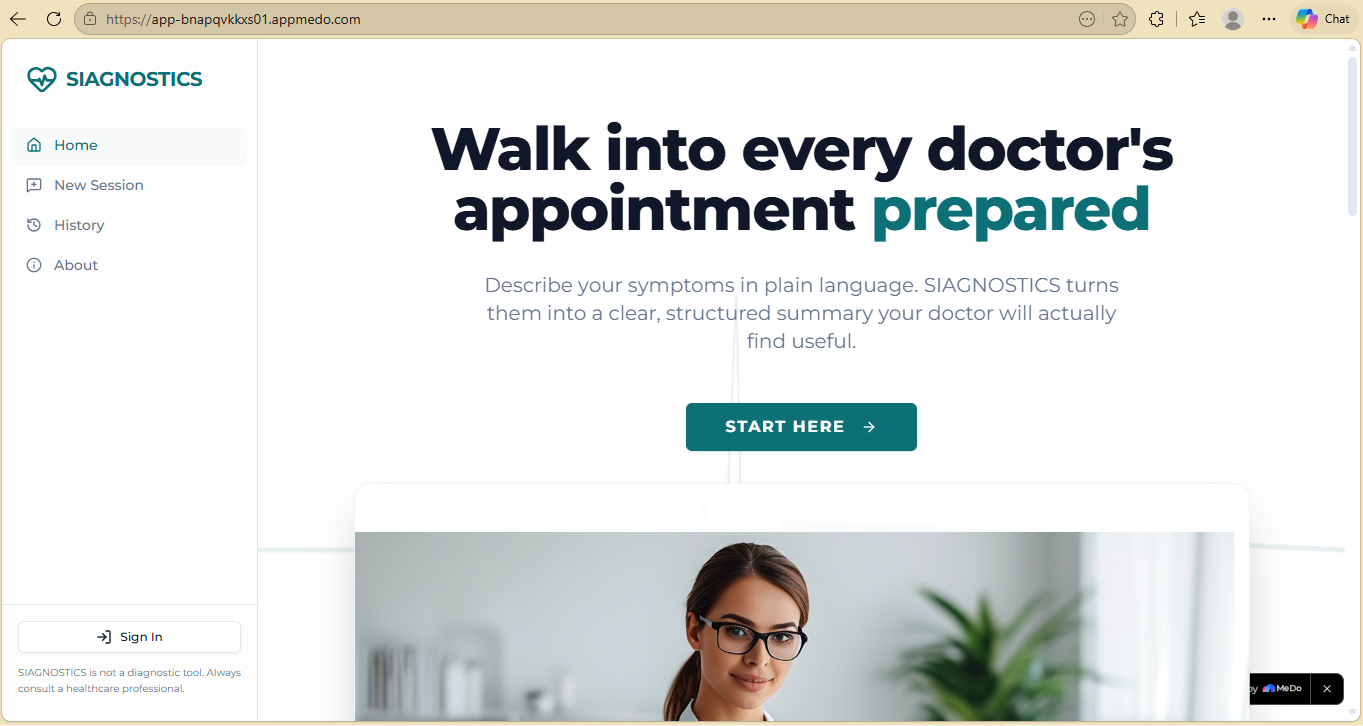
SIAGNOSTICS is an AI-powered pre-consultation health assistant. Before you see a doctor, you chat with Siago — a calm, intelligent AI health assistant that helps you articulate your symptoms clearly and completely.
'Siago' asks structured, adaptive follow-up questions, one at a time, adjusting each question based on what you've already said. It never asks something you've already answered. It listens, acknowledges, and builds a complete picture of what you're experiencing.
At the end of the conversation, SIAGNOSTICS generates:
- A structured medical summary — chief complaint, location, duration, severity, triggers, associated symptoms, medical history, and allergies
- An urgency level — LOW, MODERATE, HIGH, or EMERGENCY with appropriate guidance
- A specialist recommendation — which type of doctor to see and why
- A closing insight — a thoughtful, grounded suggestion of what the symptoms might indicate, clearly framed as context rather than diagnosis
- A downloadable PDF report — ready to hand to any doctor
SIAGNOSTICS also features:
- Emergency detection — critical symptoms trigger an immediate alert and stop the regular flow
- Image analysis — users can upload photos of rashes, swelling, or visible conditions for AI-powered visual observation
- Cross-session memory — Siago remembers your health history across sessions and uses it to ask smarter questions over time
- Resumable sessions — return to any past conversation and continue exactly where you left off
How We Built It
SIAGNOSTICS was built entirely on MeDo, Baidu's no-code AI application platform, as part of the Build with MeDo Hackathon.
The AI conversation engine is powered by Groq running
llama-3.3-70b-versatile, with a carefully engineered system prompt governing
Siago's full behavior — adaptive questioning logic, emergency detection, JSON
response formatting, and structured summary generation.
Image analysis uses a separate vision model (meta-llama/llama-4-scout-17b)
via Groq, with findings injected into the conversation as context for Siago
to reason over.
The backend includes:
- A three-stage JSON parser with keyword-based chip fallback — ensuring quick reply options always appear on questions even if the AI deviates from the expected format
- Automatic model rotation across four Groq models when rate limits are hit, with cooldown timers and silent failover
- A memory system that generates a health profile after each completed session and injects it into future conversations
- Supabase for per-user data isolation with Row Level Security — every user sees only their own data
The frontend is a full React application with TypeScript and Tailwind CSS, featuring a real-time live summary panel, adaptive chip-based quick replies, image upload with crop support, and session history with resumption.
Challenges We Ran Into
Getting the AI to behave like a conversation, not a form. The natural failure mode is a scripted chatbot that asks the same questions in the same order regardless of what the user says. Getting Siago to genuinely parse each answer, identify what information had already been provided, and adapt the next question accordingly required extensive prompt engineering and multiple iterations.
Consistent JSON output from the AI. The AI would occasionally return plain text instead of the expected JSON structure, causing chips to disappear and raw syntax to leak into the chat. We solved this with a three-stage parsing system — JSON fence extraction, brace matching, and a plain-text fallback that auto-generates contextually relevant chips from keyword matching on the question text.
Rate limits across multiple free API tiers. Running a real AI chat on free API quotas meant hitting rate limits mid-conversation. We built an automatic model rotation system across four Groq models, each with its own quota, with cooldown timers and silent failover so users never see an error — just a brief pause.
Chips persistence across navigation. Quick reply options were stored in React state only, so navigating away and returning to a session caused chips to disappear and old JSON to bleed into message text. We solved this by persisting chips to the database alongside each message and applying a multi-pattern content cleaning function on every message render.
Scoping in a hackathon window. The full vision for SIAGNOSTICS includes a doctor-patient messaging platform with AI assistance on both sides, doctor profiles, and appointment booking. Shipping something complete and polished rather than something sprawling and half-broken was a deliberate and difficult choice.
Accomplishments That We're Proud Of
- A genuinely adaptive AI conversation that feels like talking to a knowledgeable, calm friend — not filling out a form
- Emergency detection that errs on the side of caution without being alarmist
- A cross-session memory system that makes Siago smarter the more you use it
- Image analysis that adds visual observations directly into the medical summary
- Automatic model rotation that keeps the app running smoothly on free API tiers
- A clean, trustworthy design that feels medical without feeling cold
What We Learned
Medical communication is a design problem as much as a technology problem. Every feature decision had an ethical dimension — what can the AI say, what must it never say, and where is the line between helpful context and irresponsible suggestion.
We also learned that no-code platforms like MeDo shift the real work from writing code to writing intent clearly. The quality of what you build is determined almost entirely by how precisely you can describe what you want — and how quickly you can diagnose what went wrong when the output doesn't match the intent.
What's Next for SIAGNOSTICS
- Doctor-patient messaging — a secure chat platform where patients can share their SIAGNOSTICS summary directly with a doctor, with a
Built With
- css
- groq
- html
- javascript
- llama
- medo
- react
- supabase
- tailwind
- typescript
- vite


Log in or sign up for Devpost to join the conversation.