Inspiration
Starting a business in Bangladesh is harder than it should be. Someone who wants to sell food from home or open a small shop has to figure out which registrations apply, which office handles them, and what it costs. The answers are spread across offices, portals, and word of mouth, and a lot of the word of mouth is wrong. Agents will happily charge for registrations that are free through official channels. I wanted a first-time founder with a cheap phone and patchy data to be able to sit down and get a clear path without paying someone to explain it.
What it does
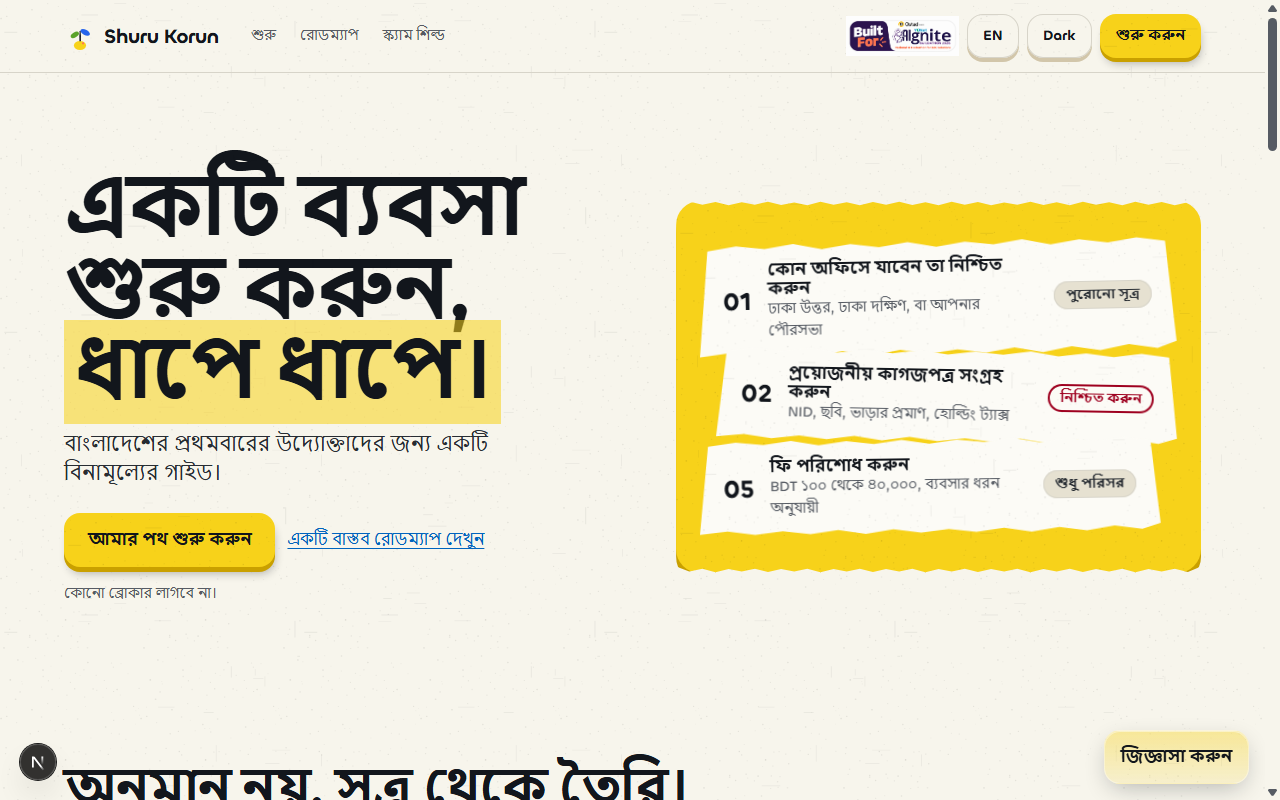
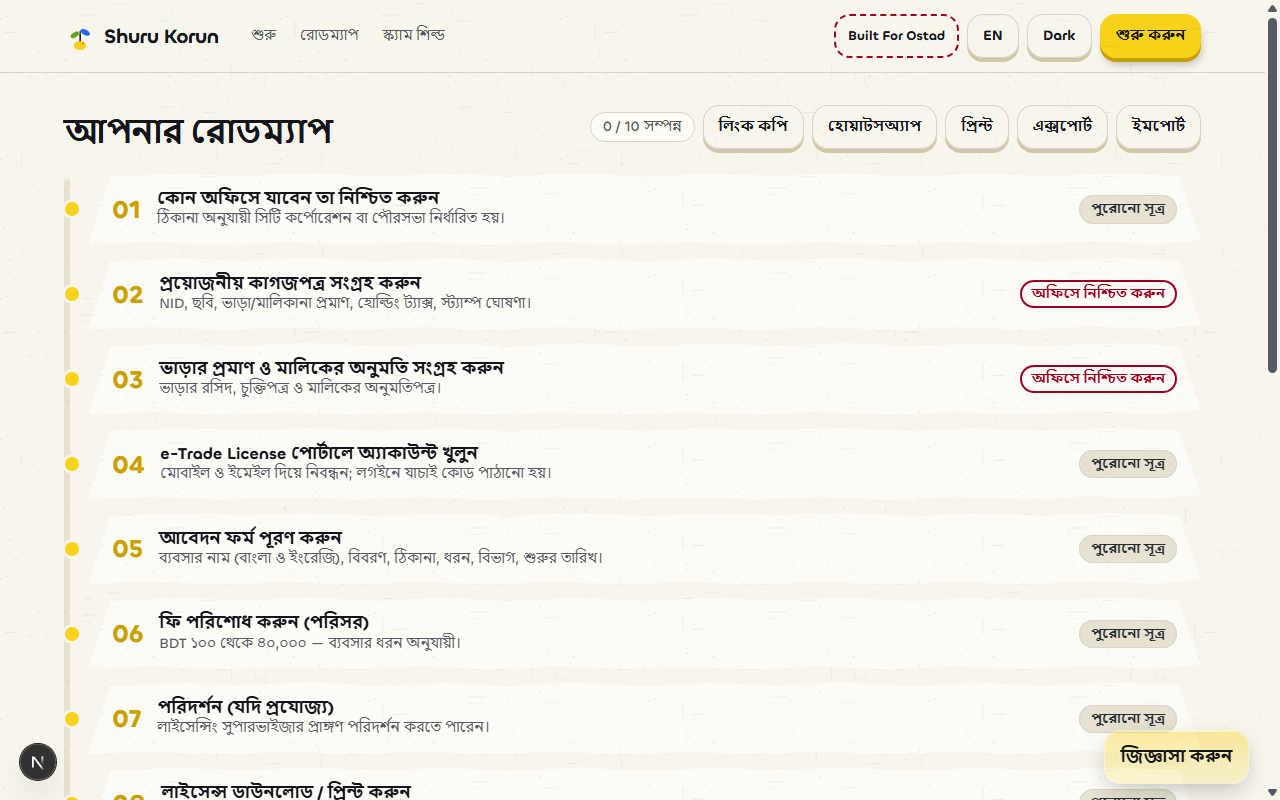
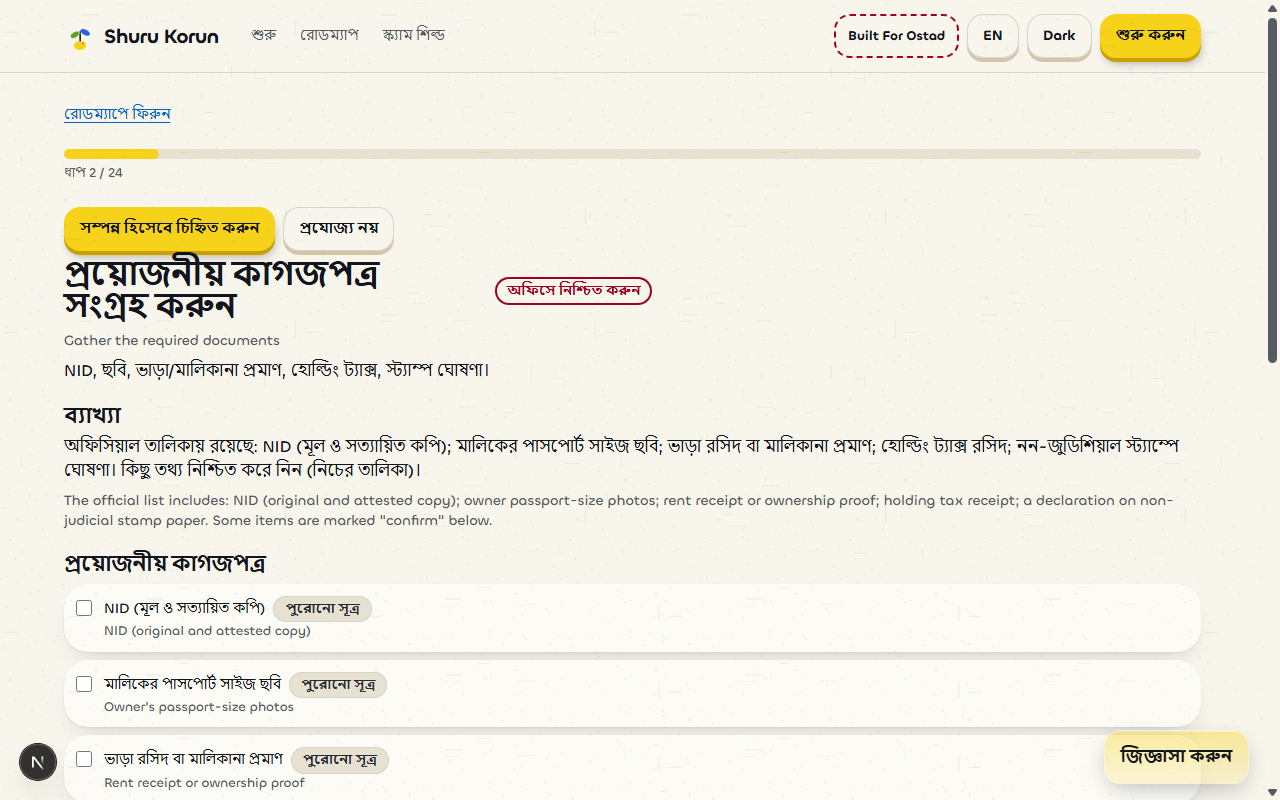
You answer four questions: what you sell, where you are, how you sell, and whether you have a premises. Shuru Korun uses those answers to build a roadmap with only the steps that apply to you. Each step shows a status label, the source it came from, and the date it was checked. A step is either verified against an official source, marked as an older source, or marked "confirm at office" when the answer is not certain. Tapping a step opens its documents, fee notes, and sources.
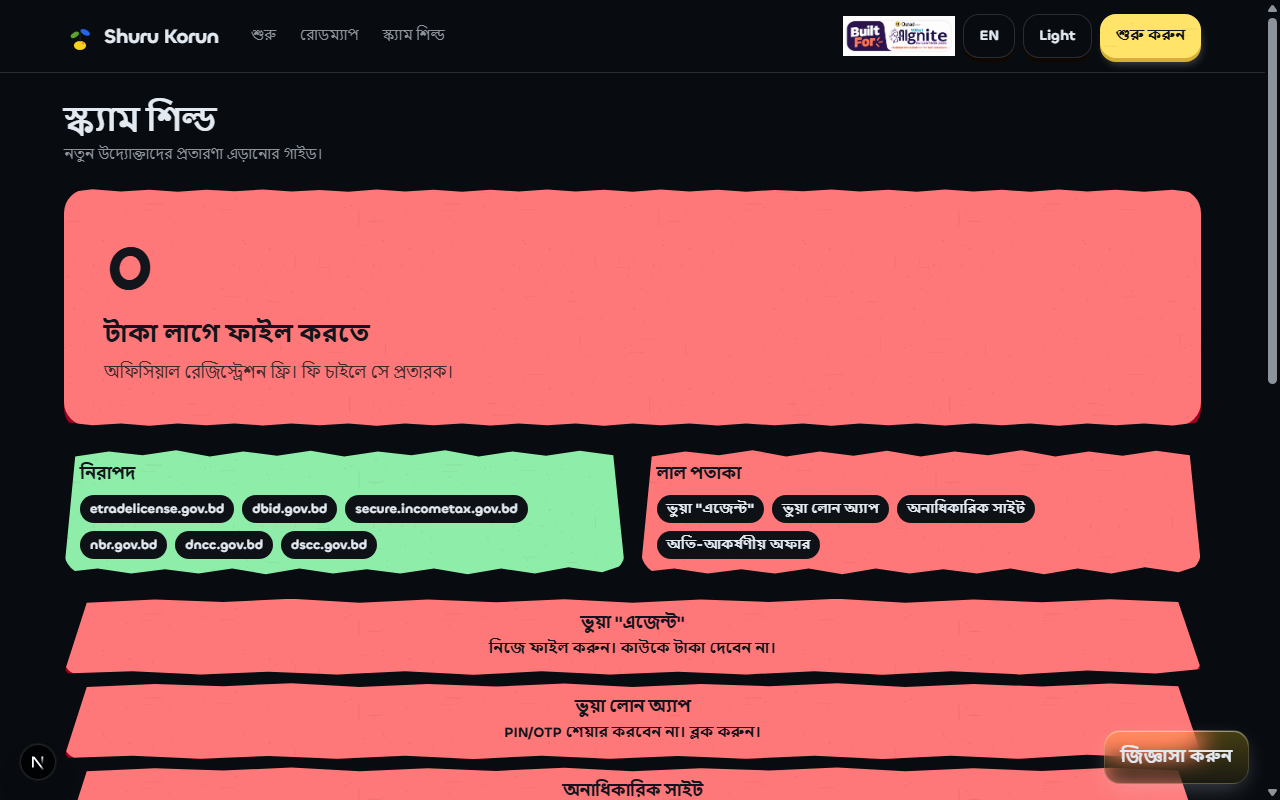
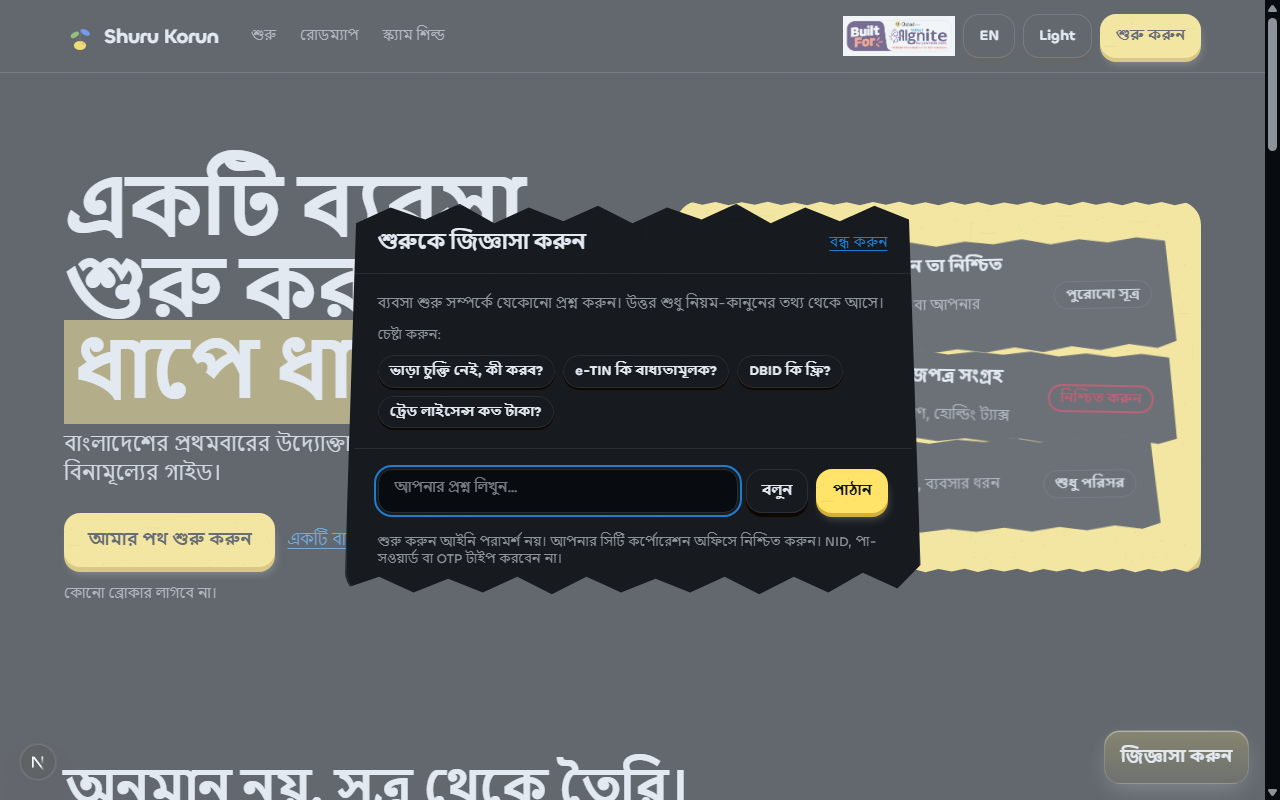
There is also Ask Shuru, a chat for questions in Bangla, English, or Banglish. It answers only from the rules data, and when it does not know, it says so and tells you where to check. A scam shield explains common fake-agent tactics and links only to official portals. The app keeps no accounts and stores no personal details on a server.
How we built it
I built it as a solo entry, so every decision had to be one I could finish. The most important choice was splitting the work: a rules engine decides which steps apply and what the sources are, and the AI only explains and answers questions from that data. That keeps the AI from inventing fees, documents, or deadlines. The visual design is warm and paper-like, with a light page by default, dark mode on request, and motion that respects reduced-motion settings, because the target user is on a slow phone. Bangla text had to be readable at every size, which shaped the line heights and the type choices.
Challenges we ran into
The hardest problem was honesty about information that changes. Office requirements and fees can shift, and a roadmap that looks confident but is out of date is worse than no roadmap. I had to design the status labels and source dates in from the start, so the app can say "confirm at office" instead of guessing. Bangla layout was another challenge. Bangla needs more vertical space than Latin text, and it breaks easily in tight mobile cards. I also had to cut scope. The photo document checker, reminders, and voice input are planned, not built, and the deck says so.
Accomplishments that we're proud of
I am proud that the app is honest about what it knows. Every step carries a source and a date, and the AI is built to say "I don't know" rather than fill the gap. I also kept the product small enough to finish solo, with a clear design system and a plan for the features that are still missing.
What we learned
I learned that for a tool like this, the structure matters more than the wording. Deciding the steps in code and letting the AI explain them gives more trust than a model that tries to do everything. I also learned that design choices like source labels and date stamps are not decoration. They are how a user decides whether to trust the app at all. And I learned to cut features early, because a smaller product that is correct is more useful than a bigger one that is not.
What's next for Shuru Korun
The next step is getting the live app online and adding the sticker the rules require. After that, I want to add the photo document checker so people can confirm their papers before they visit an office, then reminders for key dates and Bangla voice input for people who find typing hard. Longer term, I want to expand the rules beyond the current set and have each source checked on a regular schedule, so the labels stay honest as rules change.
Built With
- fontshare
- google-fonts
- google-gemini
- groq
- next.js
- noto-sans-bengali
- vercel
