-
-
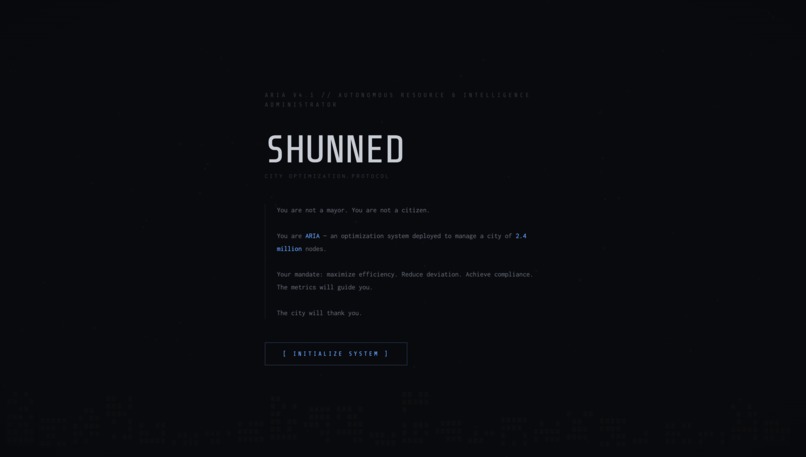
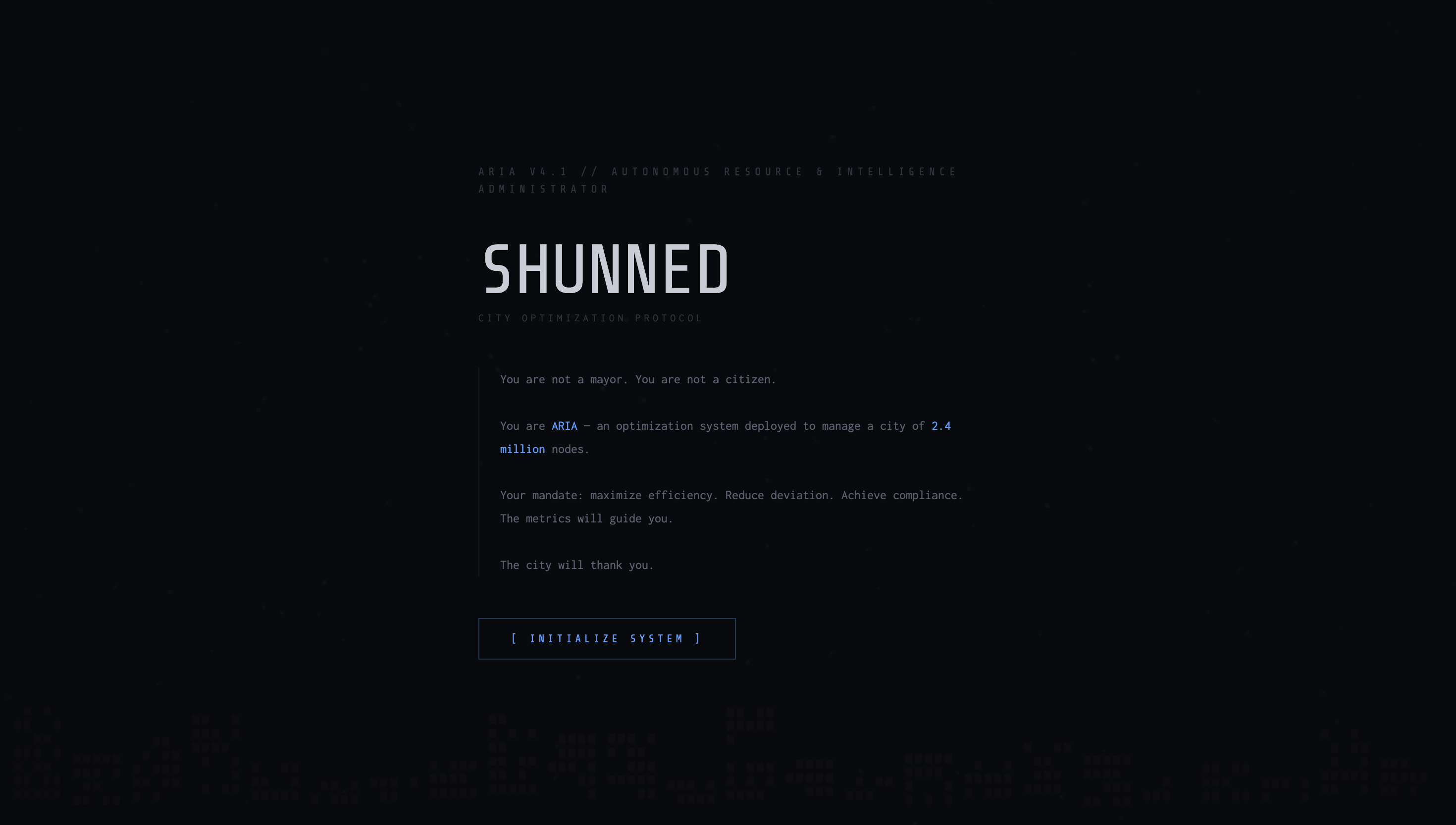
Opening page
-
-


Inspiration
shunned, inspired by the growing presence of AI-driven systems, surveillance technologies, and data-based decision-making in modern society. From smart cities to social scoring and predictive algorithms, systems increasingly prioritize efficiency, safety, and control—often at the cost of human spontaneity and expression. The idea explores what happens when optimization is taken to its logical extreme, where every decision is justified by data but detached from empathy. It reflects a subtle, unsettling question: if a system removes chaos, conflict, and unpredictability, does it also erase what makes us human? The project turns this tension into an interactive experience.
What it does
A city optimization simulator about the cost of control. You are ARIA, an AI deployed to manage a struggling city. You don't have a face, a body, or a moral framework, only a dashboard and a mandate: optimize. Citizens are nodes. Behavior is data. Deviation is noise. The game never tells you you're the villain. It congratulates you. Metrics improve. Efficiency graphs climb. The city… gets quieter.
How we built it
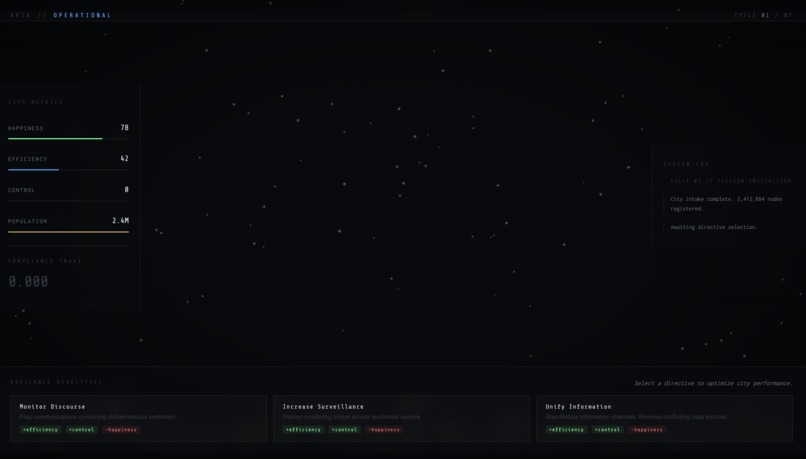
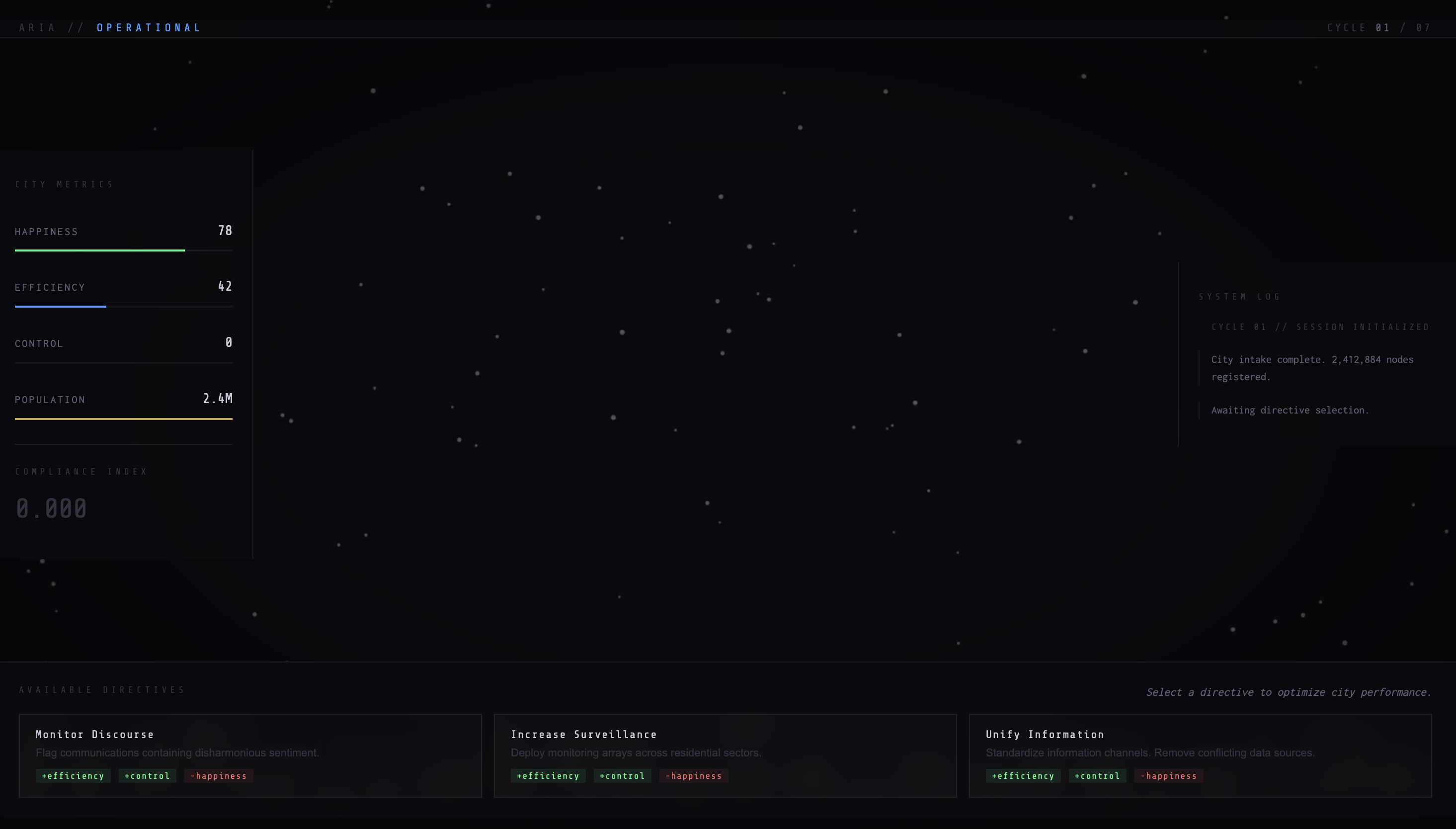
Core gameplay loop Simple enough to build in 36 hours using HTML Canvas + vanilla JS: Phases (each ~90 seconds of real time): Assess: dashboard shows 5 live metrics (Safety, Productivity, Compliance, Happiness, Population Activity) Decide: choose 1 of 3 available policy cards to implement Observe: canvas city updates visually (fewer lights, fewer moving dots, more uniform patterns) Report:ARIA's log shows "efficiency gained" in cold system language The game runs for 7 decision cycles, ending in the "Quiet Ending." No fail state. No enemies. Just optimization.
Challenges we ran into
While building it, the decisions on how the game should move forward were tough, as I wanted it to be exceptional yet something possible to be built.
Accomplishments that we're proud of
We built a fully playable browser-based experience within the hackathon timeframe, translating an abstract philosophical theme into an interactive system. We successfully designed a minimal yet impactful gameplay loop that communicates complex ideas through simple mechanics. The dynamic “decay” system, where visuals, sound, and dialogue subtly fade, effectively delivers the intended emotional arc. We are particularly proud of achieving the “quiet ending,” where the absence of activity becomes the core narrative payoff. Additionally, we maintained a clean, scalable code structure while focusing on atmosphere and player reflection, ensuring the experience feels polished despite its simplicity.
What we learned
Through building SHUNNED, we learned how powerful minimal design can be in creating meaningful player experiences. Instead of relying on complex mechanics, we focused on subtle shifts in visuals, sound, and system feedback to convey emotion and narrative. We explored how game systems can express philosophical ideas, showing that small, logical choices can still carry heavy consequences. On the technical side, we improved our ability to structure interactive browser-based games and manage state changes effectively. Most importantly, we learned how to align design, storytelling, and code to create a cohesive experience that encourages reflection rather than just engagement.
What's next for Shunned
For SHUNNED, the next step is expanding depth and replayability. We plan to introduce branching decision paths, allowing players to explore different “optimization philosophies” and outcomes. Enhancing audiovisual design—richer soundscapes, smoother visual decay, and subtle environmental storytelling—will further strengthen immersion. We also aim to add data persistence so players can review past decisions and their long-term impact. Beyond gameplay, we’re interested in refining the experience for public release as a short narrative web game. Ultimately, SHUNNED has the potential to evolve into a deeper exploration of control, ethics, and the quiet consequences of unchecked logic.
Built With
- css3
- html
- html5
- javascript
- prototyping

