Inspiration
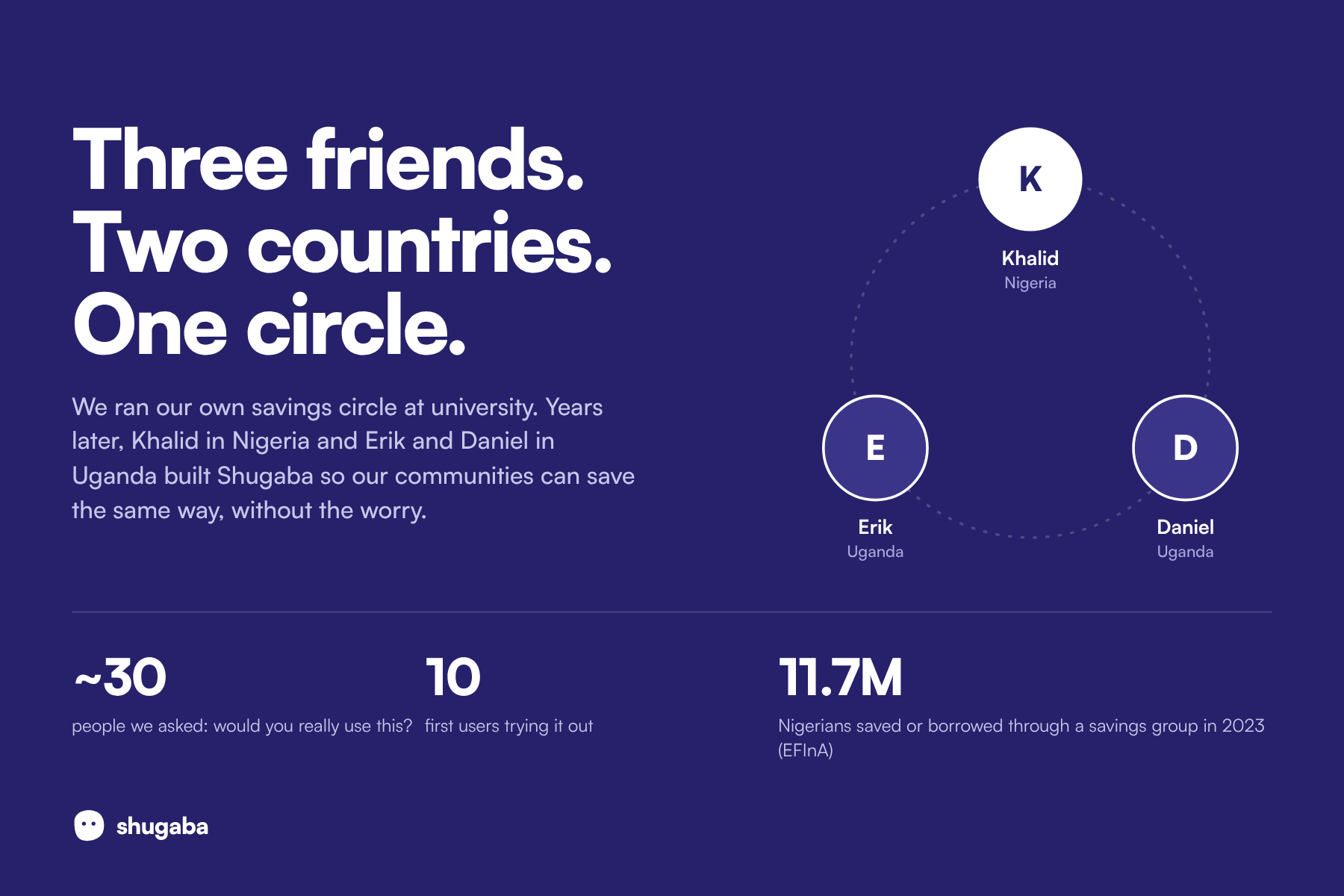
Shugaba started long before this hackathon. Khalid, Erik and Daniel met at university, and like a lot of students we ran our own small savings circle. Every month each of us put money in, one of us took the whole pot, and we kept each other accountable, with our savings and with our work. Years later we're still friends, still holding each other to account, and still building together, even though Erik and Daniel are in Uganda and Khalid is in Nigeria.
Back home, this way of saving is everywhere. In Nigeria it's called ajo, esusu or adashe, and 11.7 million Nigerians saved or borrowed through a savings group in 2023 (EFInA). But it runs entirely on trust and WhatsApp groups. When one person misses a payment, whoever's turn it is comes up short, and friendships suffer. Family members abroad struggle to pay in at all. We wanted to keep everything people love about the circle and fix the part that breaks it.
What it does
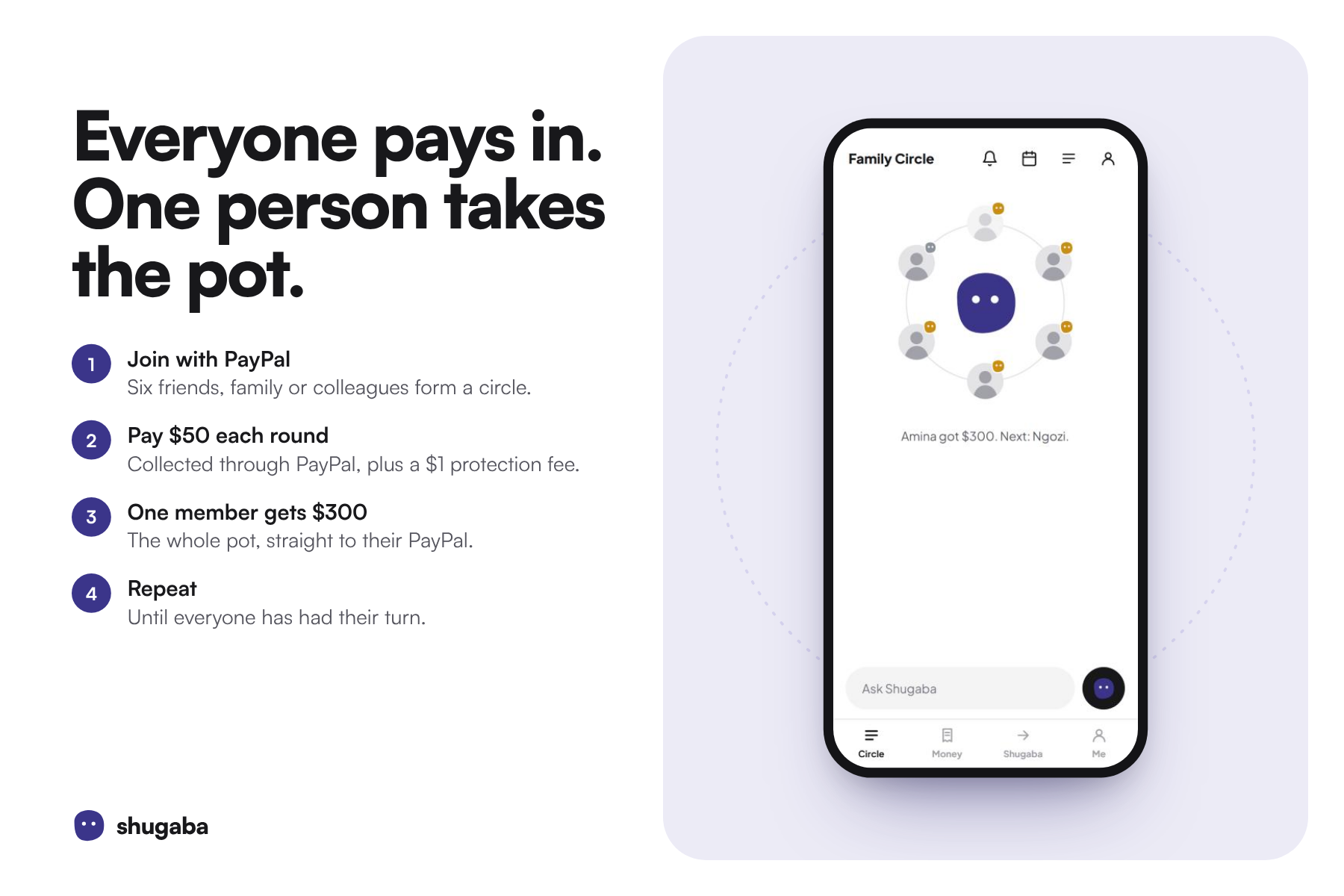
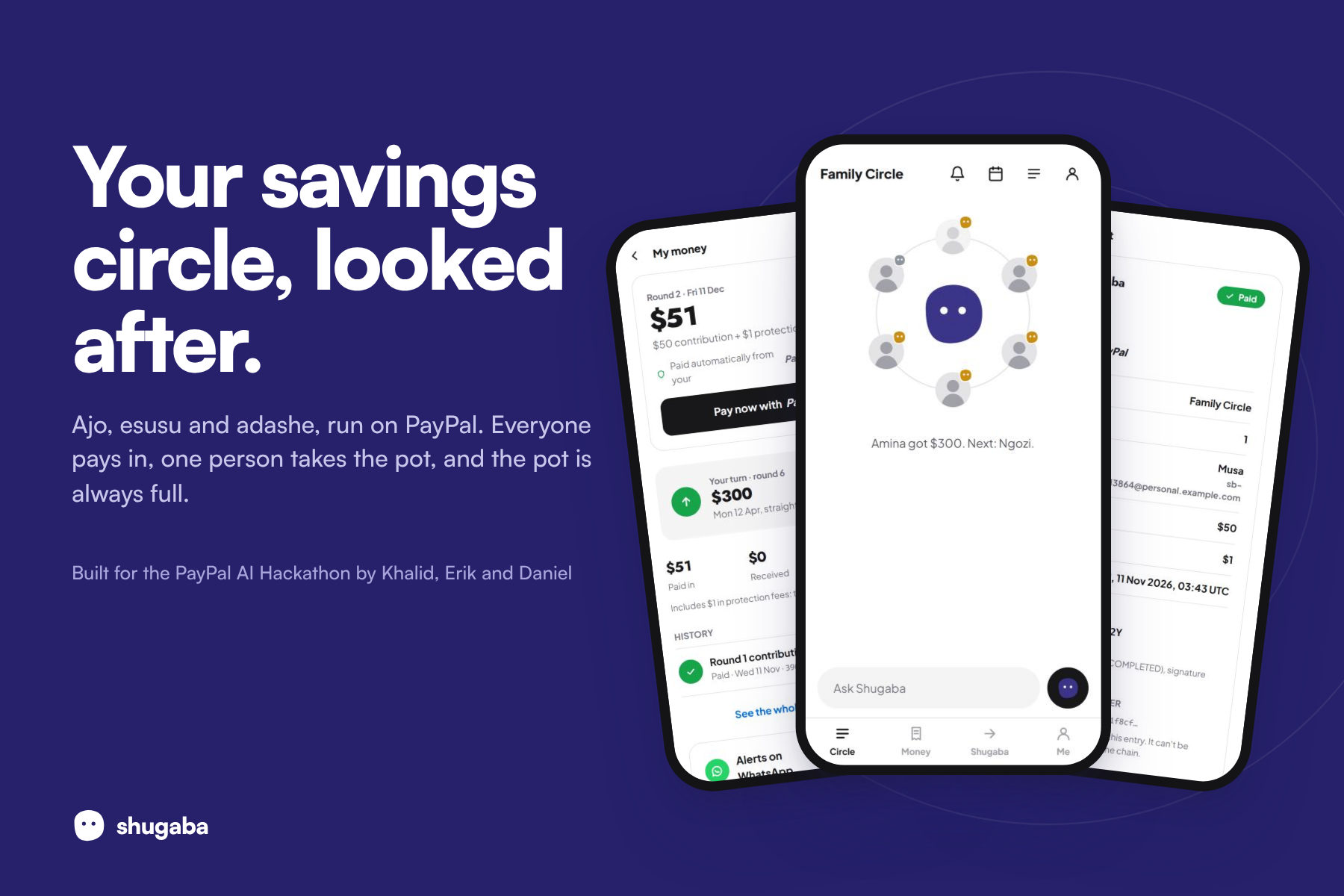
Shugaba runs a rotating savings circle on PayPal.
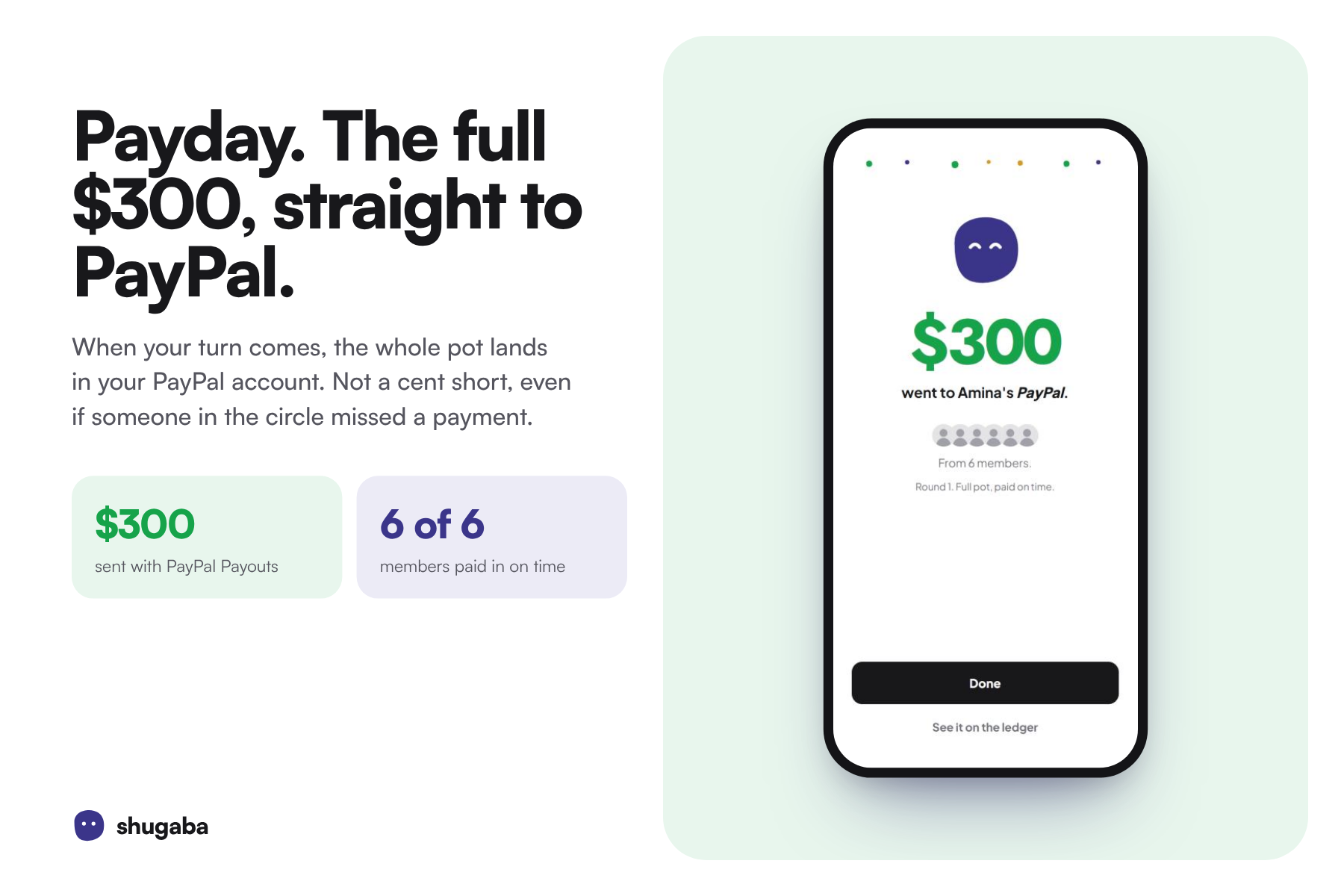
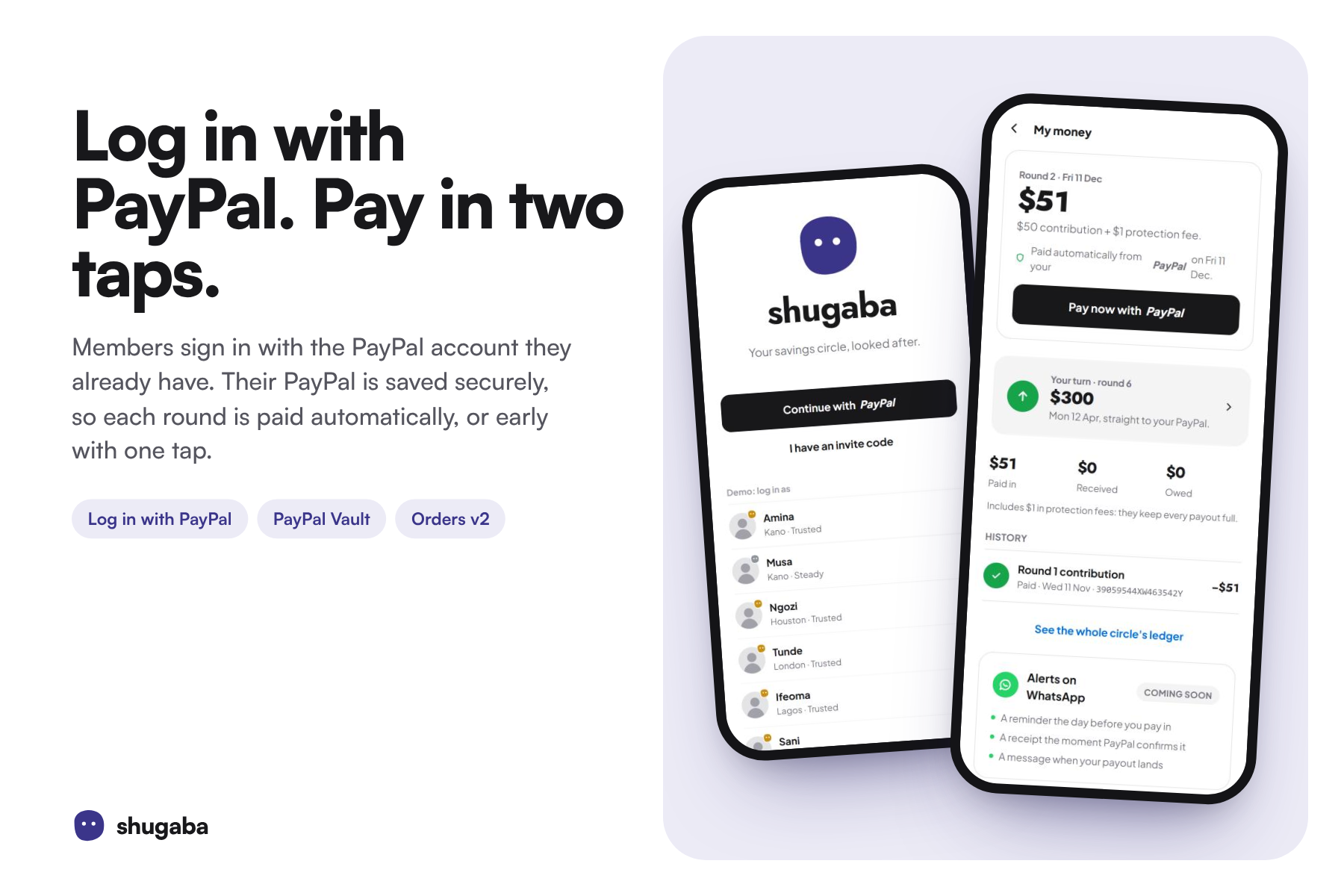
- Everyone pays in, one person takes the pot. Each round, every member pays the same amount through PayPal and one member receives the whole pot.
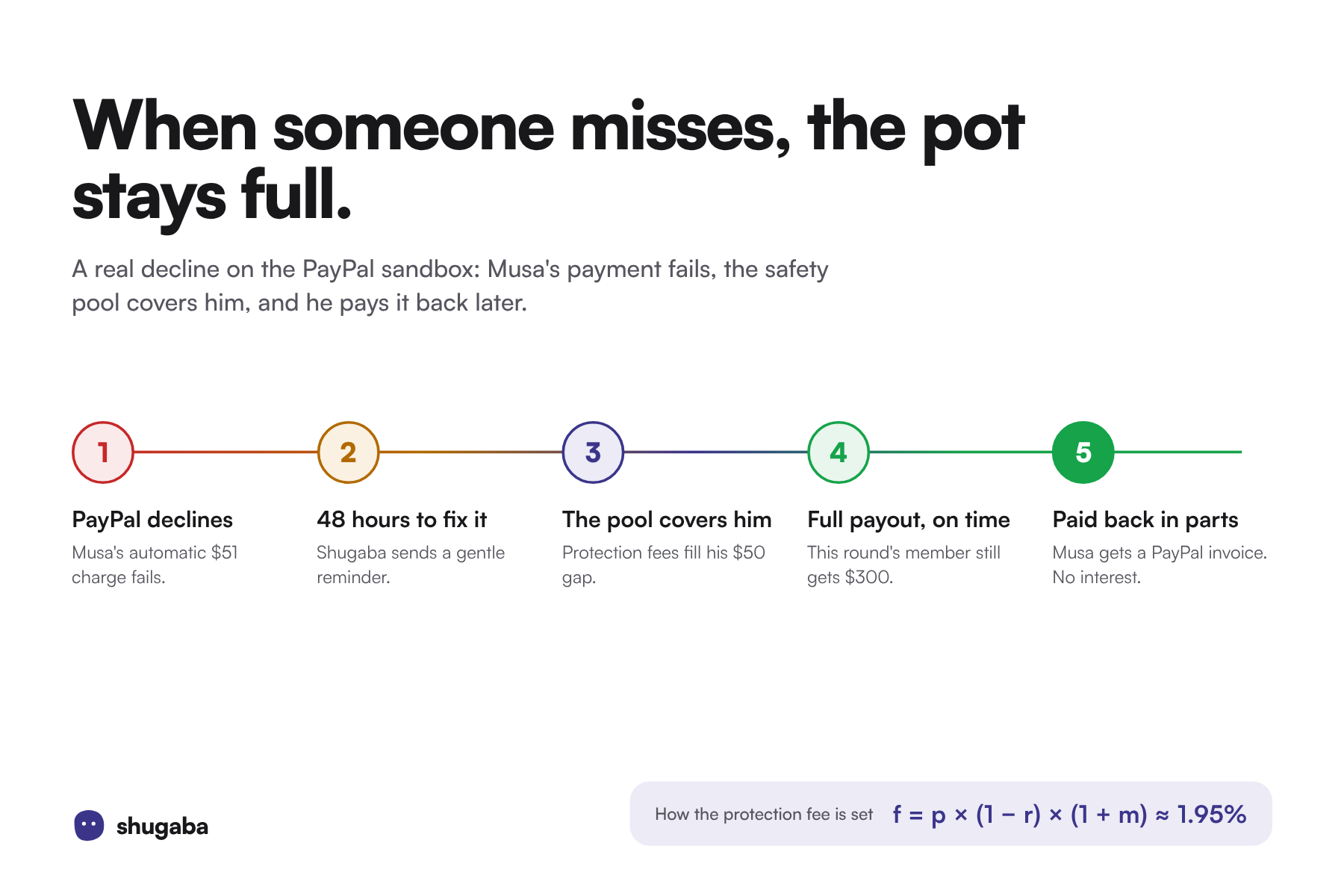
- The pot is always full. A small protection fee (1–3%) builds a safety pool. If someone misses a payment, the pool covers them so the payout stays full. The member who missed gets a PayPal invoice they can pay back in parts, with no interest.
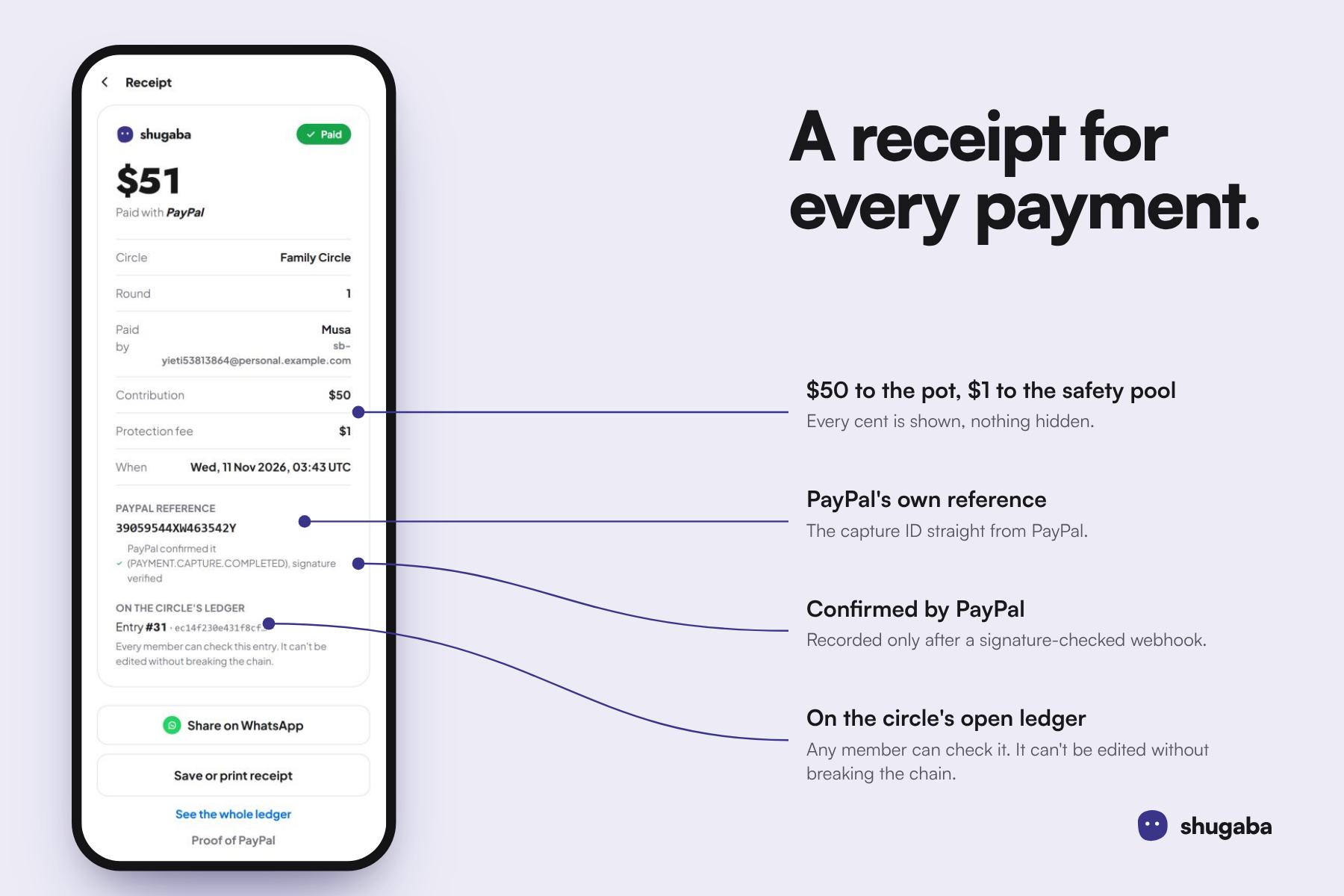
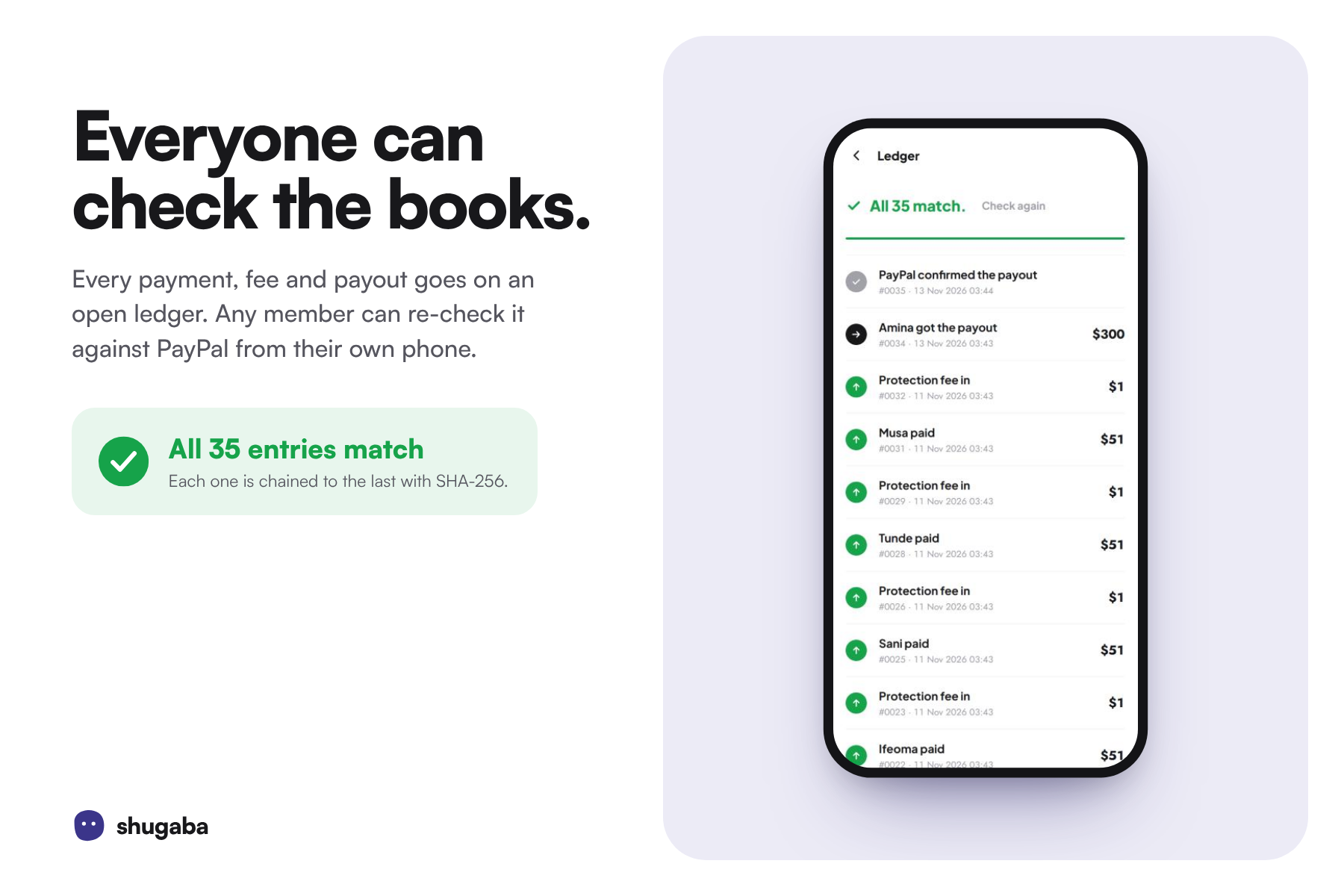
- Everyone can check the books. Every payment goes on an open ledger, and anyone in the circle can verify it on their own phone.
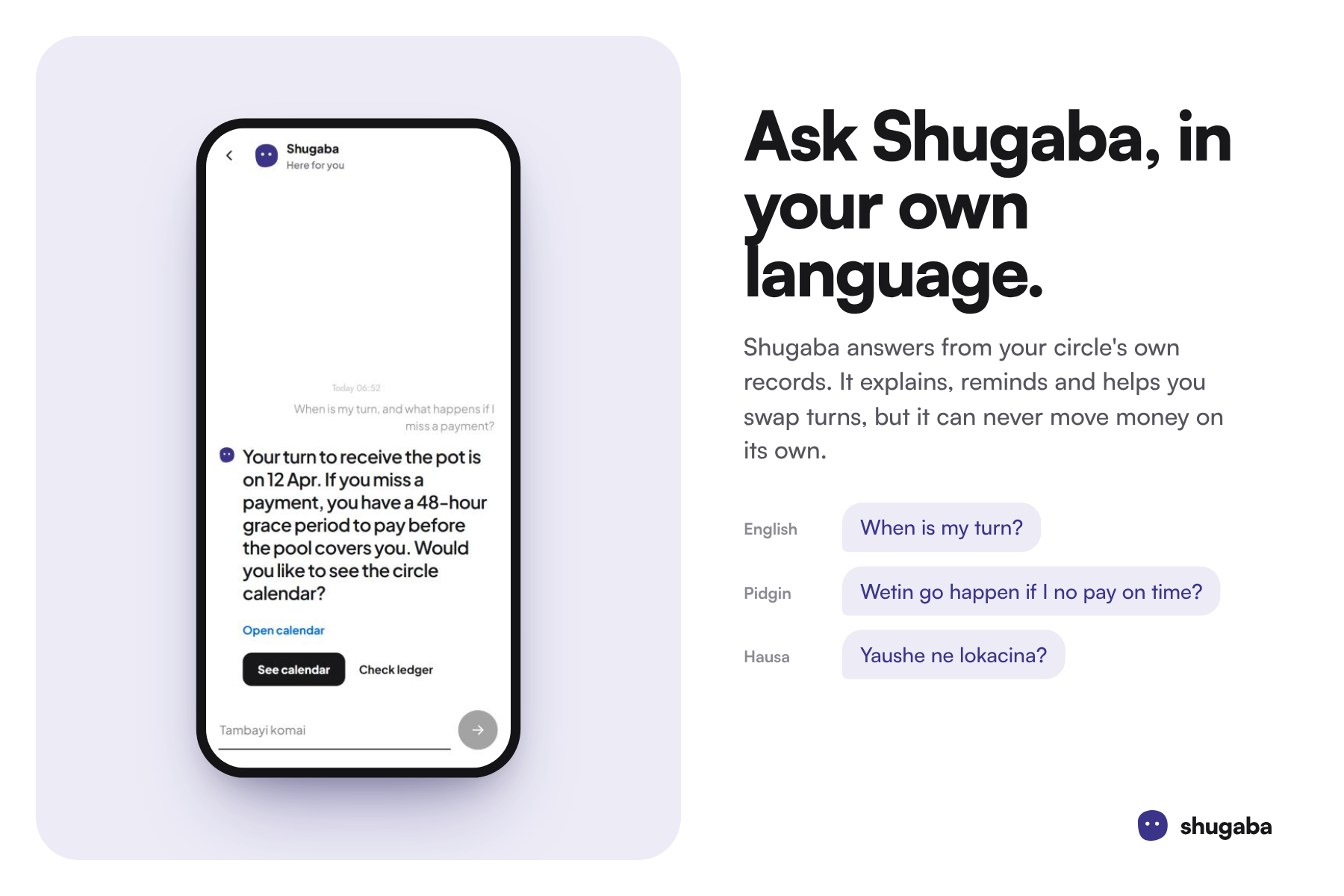
- A helper that speaks your language. Shugaba, a calm pebble who lives in the app, answers questions in English, Pidgin and Hausa, sends gentle reminders and helps members swap turns. It can explain and suggest, but it can never move money on its own.
- Feels like a real app. Members log in with PayPal, pay early in a couple of taps, and get a receipt for every payment with PayPal's own reference.
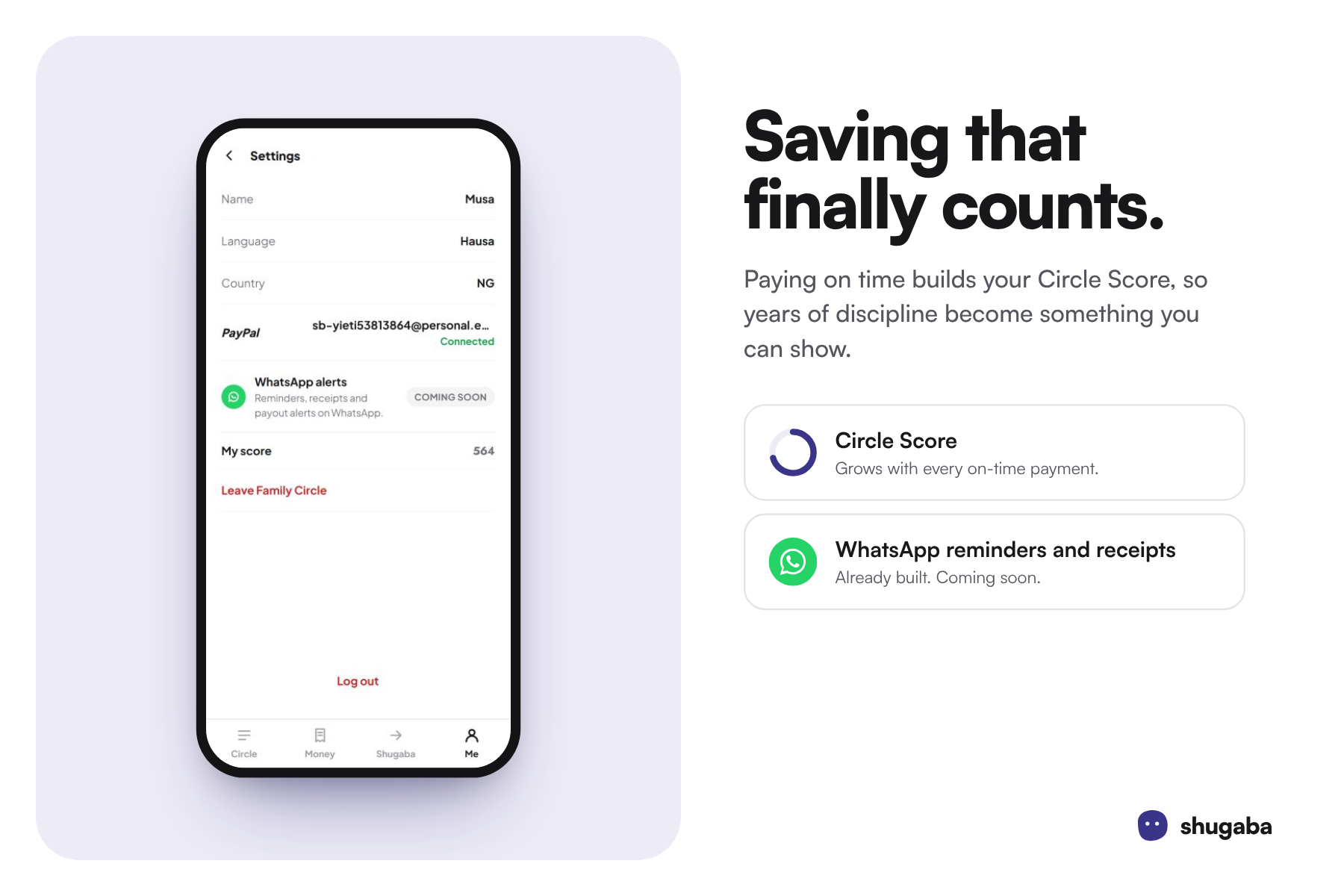
- Saving finally counts. Paying on time builds a Circle Score, so years of discipline become something you can show.
How we built it
We built Shugaba with Claude Code as our pair programmer, which let three people in two countries work like a much bigger team.
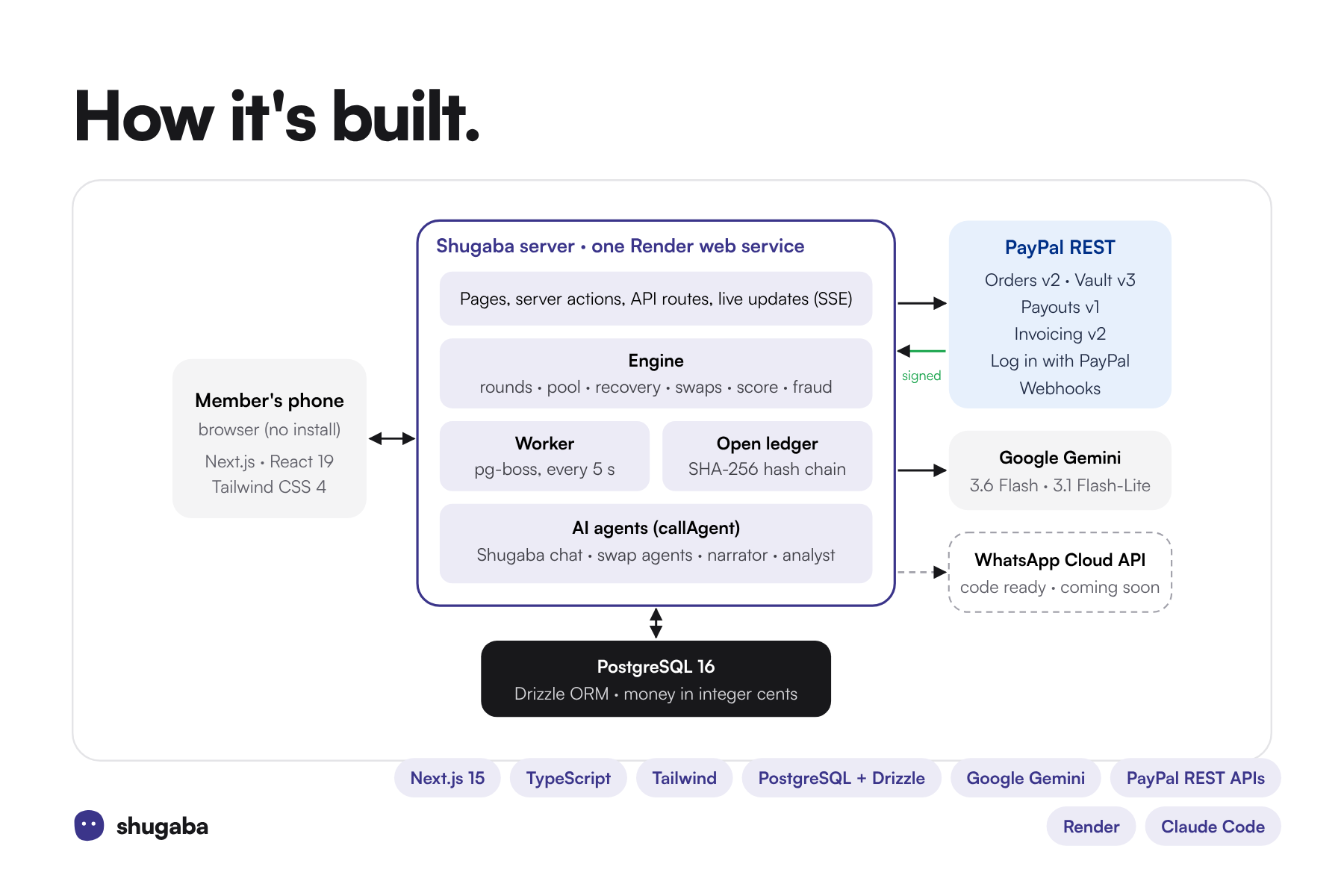
- App: Next.js and TypeScript with Tailwind, PostgreSQL (with Drizzle) for the database, and a background worker that collects payments and sends payouts on schedule.
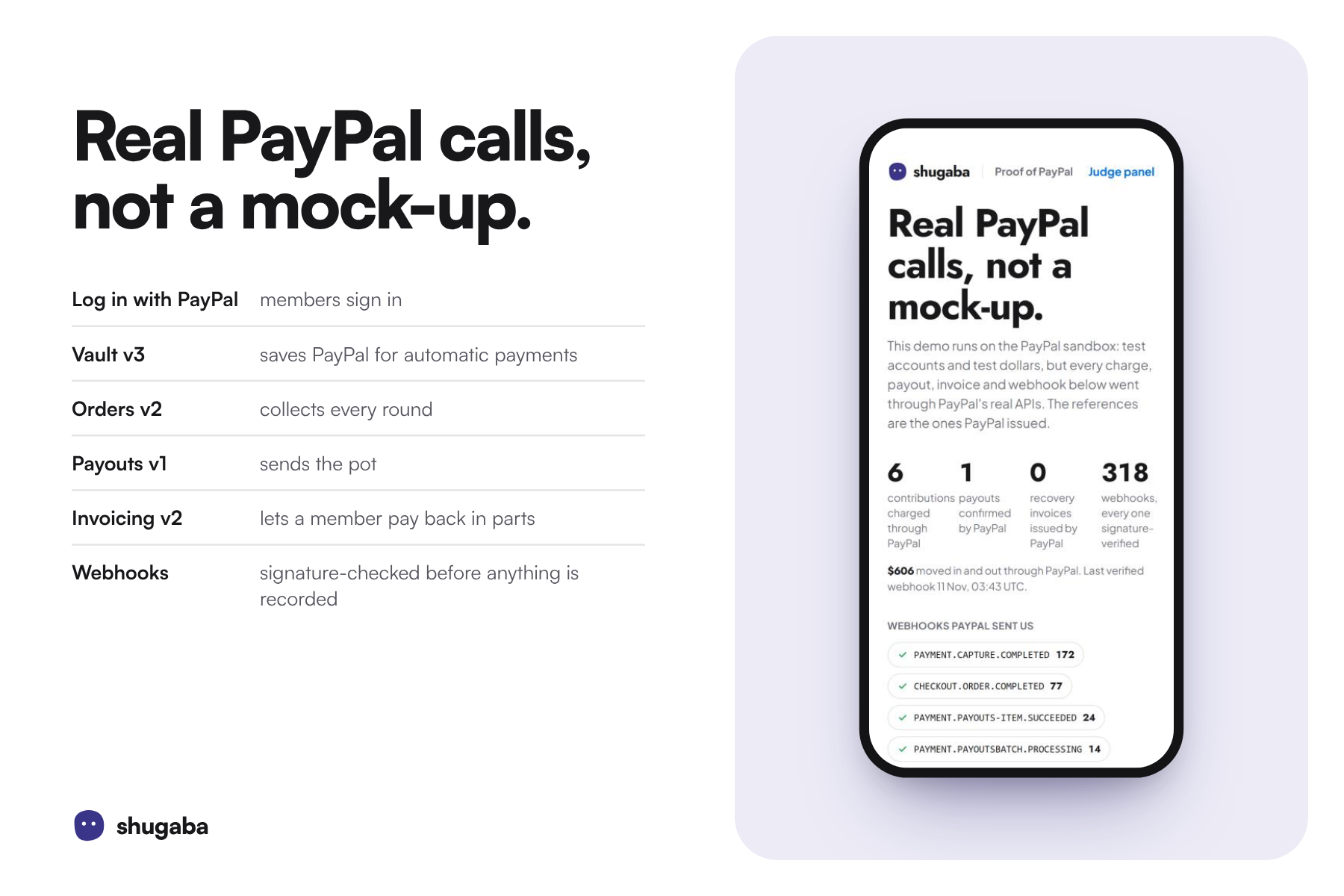
- PayPal: Log in with PayPal for sign-in, the Vault to save each member's PayPal for automatic contributions, Orders v2 to collect each round, Payouts to send the pot, Invoicing for repayments, and signed webhooks to confirm every step before we record it.
- AI: Google Gemini powers Shugaba's conversations and the agents that negotiate turn swaps. The agents only use facts from the circle's own ledger.
- Hosting: Render.
The protection fee is based on simple maths. If $p$ is the chance a payment is missed, $r$ is the share we later recover and $m$ is a safety margin, the fee needs to be:
$$f = p \times (1 - r) \times (1 + m)$$
With $p = 3\%$, $r = 50\%$ and $m = 30\%$, that gives $f \approx 1.95\%$, so a 2% fee keeps the pool healthy.
Challenges we ran into
- Asking people if they'd really use it. This was our first time building something this complex. We spoke with almost 30 university students and people in our communities in Uganda and Nigeria, showed them what we'd built and asked the honest question: would you actually use this? It was challenging and deeply rewarding, and that feeling was worth every sleepless night.
- Learning PayPal from scratch. This was our first time using the PayPal API. Getting saved payments, payouts, invoices and webhooks to work together took a lot of late nights.
- Nigerian accounts can't receive PayPal payouts. Halfway through, PayPal refused our payouts to Nigerian accounts. Members in Nigeria can still pay in, so we built Shugaba to catch a refused payout and send it again, and finding a local payout route is now at the top of our launch list.
- Money has to be exact. Every amount is stored in whole cents, every payout waits for PayPal's signed confirmation, and we tested 1,000 random circles to make sure the books always balance to the cent.
- Building across borders. We built it across two countries and two time zones in one codebase.
Accomplishments that we're proud of
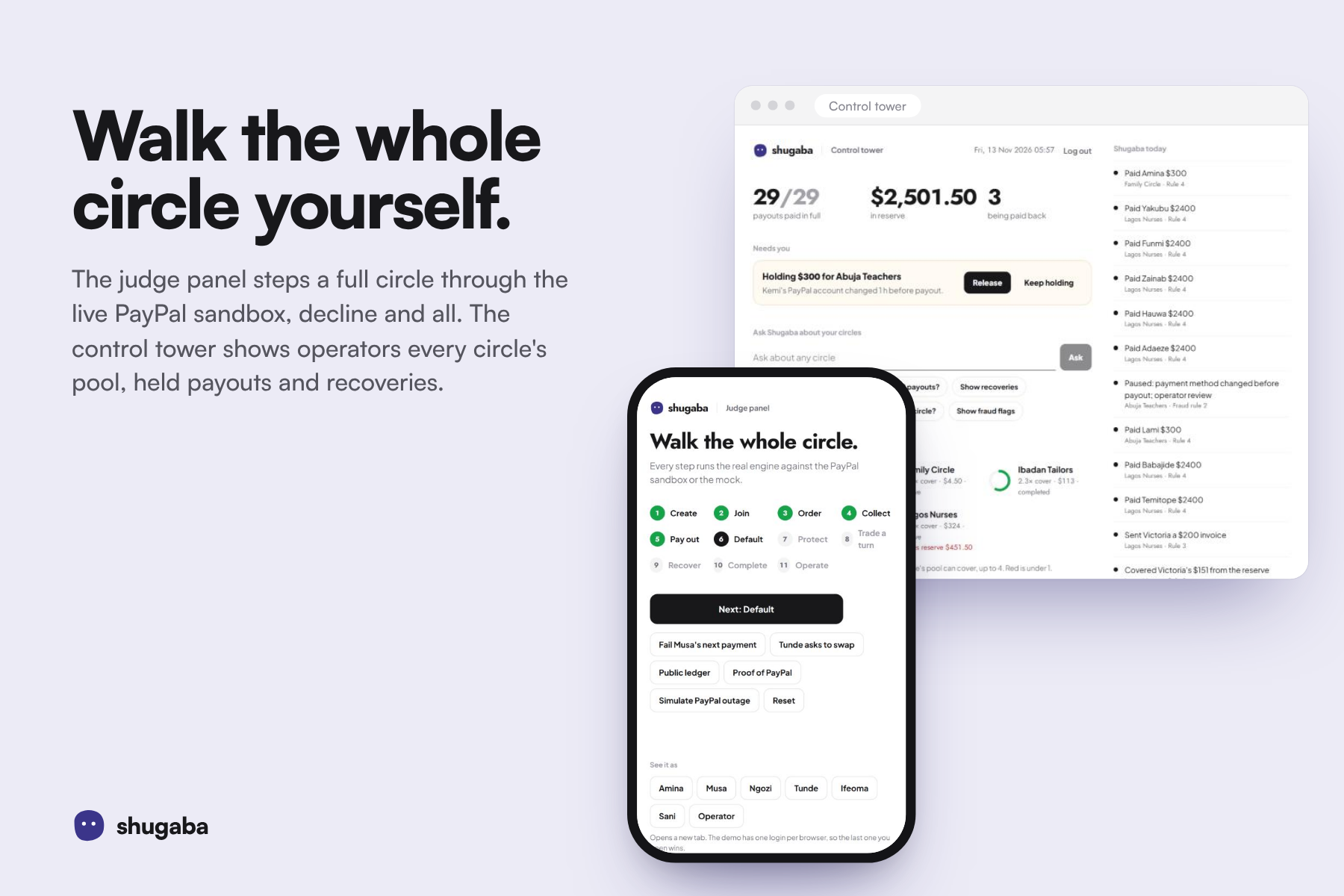
- A full circle of six members and six rounds, run end to end on PayPal's sandbox: 36 contributions, six $300 payouts, and every PayPal webhook signature-checked.
- A real missed payment, live: PayPal declines Musa's charge, the pool covers him, and he pays it back through a PayPal invoice.
- Shugaba speaking Pidgin and Hausa, the way our families actually talk.
- Our first 10 users trying it out.
- Taking the savings circle we started as students and turning it into something our communities can use.
What we learned
- Trust is the real product. A savings circle only works if everyone believes they'll be paid, so the guarantee and the open ledger mattered more than any other feature.
- Payments are about the unhappy paths. Declines, refused payouts, duplicate requests and fees taught us more than the happy path did.
- AI works best when it explains and the system enforces the rules. Shugaba can talk, but only the treasury code moves money.
- Listening beats guessing. Those 30 conversations shaped Shugaba more than any plan we wrote.
What's next for Shugaba
- Get our first 10 users saving in real circles, then grow through campuses and community groups in Nigeria and Uganda.
- Partner with a licensed provider to hold pooled funds, and add a local payout route for members in Nigeria.
- Switch on WhatsApp reminders and receipts, which are already built.
- Add more languages, including Yoruba and Igbo for Nigeria and Luganda and Swahili for Uganda.
- In the long run, help our communities go from a saving habit to investing what they save.
Built With
- claude-code
- docker
- drizzle-orm
- google-gemini
- javascript
- log-in-with-paypal
- next.js
- node.js
- paypal
- paypal-orders-api
- paypal-payouts
- paypal-vault
- pg-boss
- playwright
- postgresql
- react
- render
- tailwindcss
- typescript
- vercel-ai-sdk
- vitest
- webhooks
- zod
