-
-
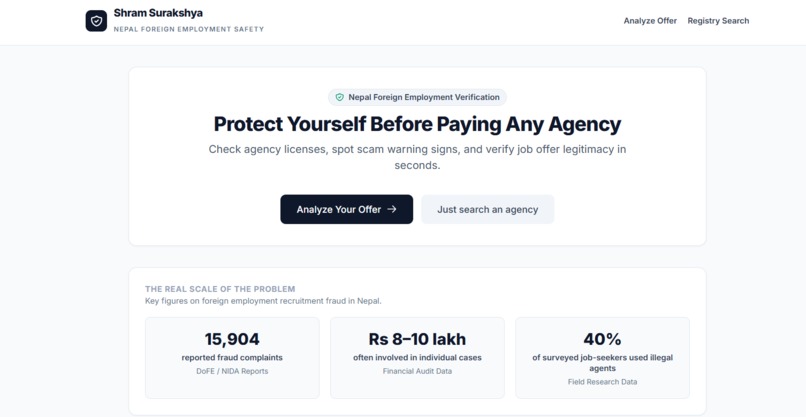
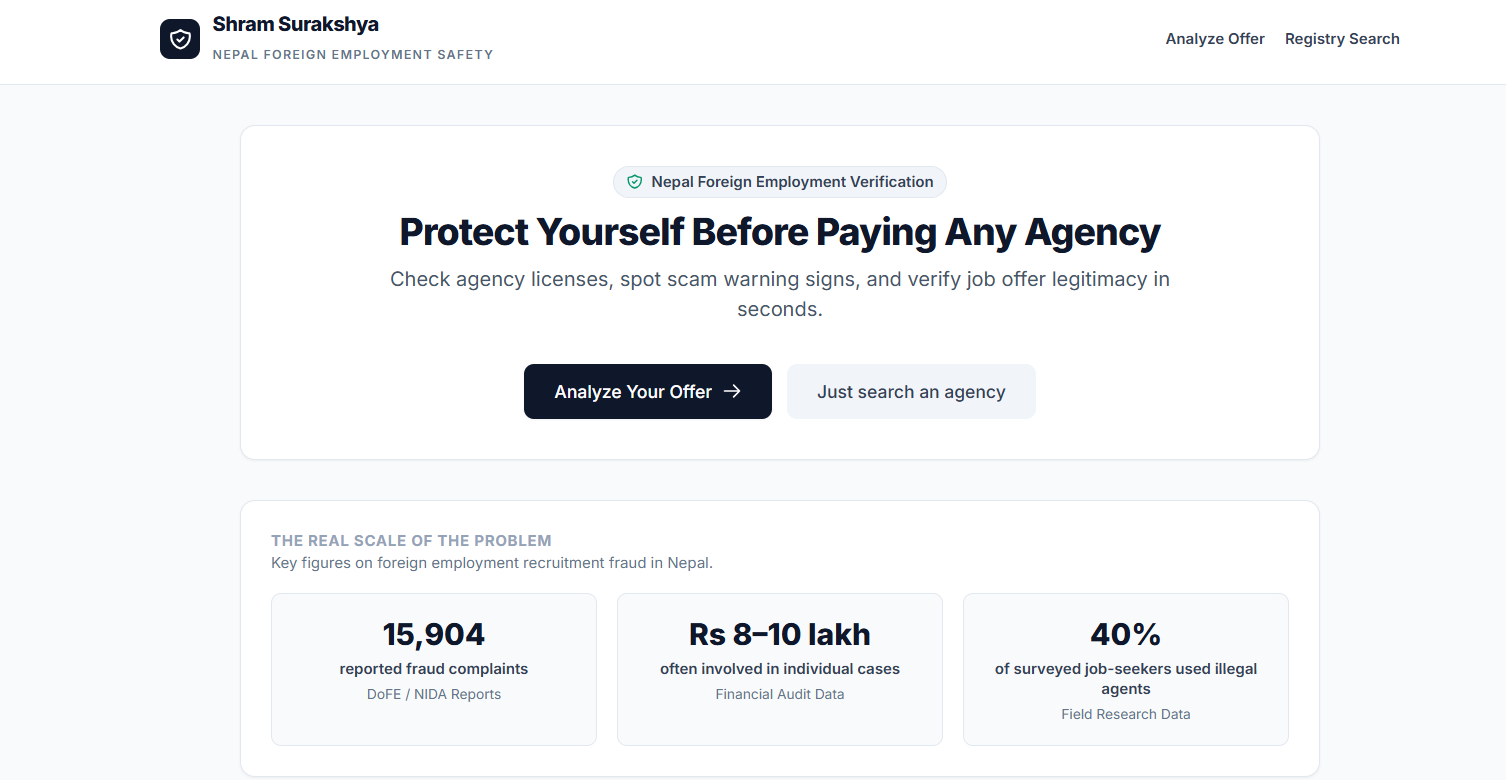
This is the front page of the web page
Inspiration
For many people in Nepal, going abroad for employment is a major decision that involves significant financial investment and personal risk. A single fraudulent job offer or recruitment agency can result in financial loss and serious consequences for a worker and their family.
We were inspired by the lack of simple, accessible ways for ordinary people to check foreign-employment agencies and report suspicious activity. We wanted to build something that could make this process easier and help people take a moment to verify an opportunity before trusting it.
This led us to the idea of Shram Surakshya, a platform focused on making foreign-employment verification and scam reporting more accessible.
What it does
Shram Surakshya is a web application designed to help people make more informed decisions about foreign-employment opportunities.
The platform allows users to:
- Search and verify foreign-employment agencies
- Identify potentially suspicious agencies or job offers
- Flag suspicious information
- Report suspected scams
- Access relevant information before making a decision
- Use a simple interface without needing advanced technical knowledge
The main idea behind the platform is simple: verify before you trust, and report before someone else becomes a victim.
How we built it
We built Shram Surakshya as a web-based application with a backend responsible for handling data, searches, and reports.
Our technology stack includes:
- Python
- FastAPI
- SQLite
- HTML, CSS, and JavaScript
- REST APIs
- Web scraping and data processing
We organized foreign-employment agency information into a searchable database and developed backend functionality to retrieve and process that information.
We focused on keeping the interface straightforward so that users can quickly find the information they need instead of navigating through a complicated system.
Challenges we ran into
One of our biggest challenges was working with real-world data. Information is not always perfectly structured, complete, or easy to organize, so preparing data for reliable searching required additional work.
We also faced technical challenges while developing and connecting the different parts of the application, including database setup, backend configuration, API development, and connecting the frontend with the backend.
Another challenge was deciding how much information to present to users. We wanted the platform to provide useful details without overwhelming someone who may have little technical knowledge.
Working within the time constraints of a hackathon also required us to prioritize the most important features and focus on building a functional prototype.
Accomplishments that we're proud of
We are proud that we were able to turn a real-world problem into a working technology prototype.
One of our biggest accomplishments was building a system that combines agency information, verification, and reporting into a single platform rather than treating them as separate problems.
We are also proud of the fact that we built the core backend, database, search functionality, and reporting system ourselves while learning and solving technical problems along the way.
Most importantly, we are proud that our project is focused on a problem that can directly affect people and their families.
What we learned
Shram Surakshya taught us that building a useful application requires more than simply writing code.
We learned how to:
- Work with real-world and imperfect data
- Design and structure a database
- Build APIs using FastAPI
- Connect frontend and backend components
- Think about usability from a non-technical user's perspective
- Debug problems under time constraints
- Prioritize features when building a project within a limited timeframe
We also learned that understanding the problem deeply before building the solution can significantly influence the quality of the final product.
What's next for Shram Surakshya
Shram Surakshya is currently a prototype, but we want to continue developing it into a more complete platform.
Our future plans include improving the agency verification system, expanding the database, adding multilingual support including Nepali, and making the reporting process more robust.
We also want to explore features such as document and contract verification, suspicious job-offer detection, notifications about reported agencies, better integration with official foreign-employment information, and community-based reporting.
Our long-term goal is to make foreign-employment information easier to verify and understand, so that people can make better-informed decisions before putting their savings and future at risk.


Log in or sign up for Devpost to join the conversation.