Inspiration
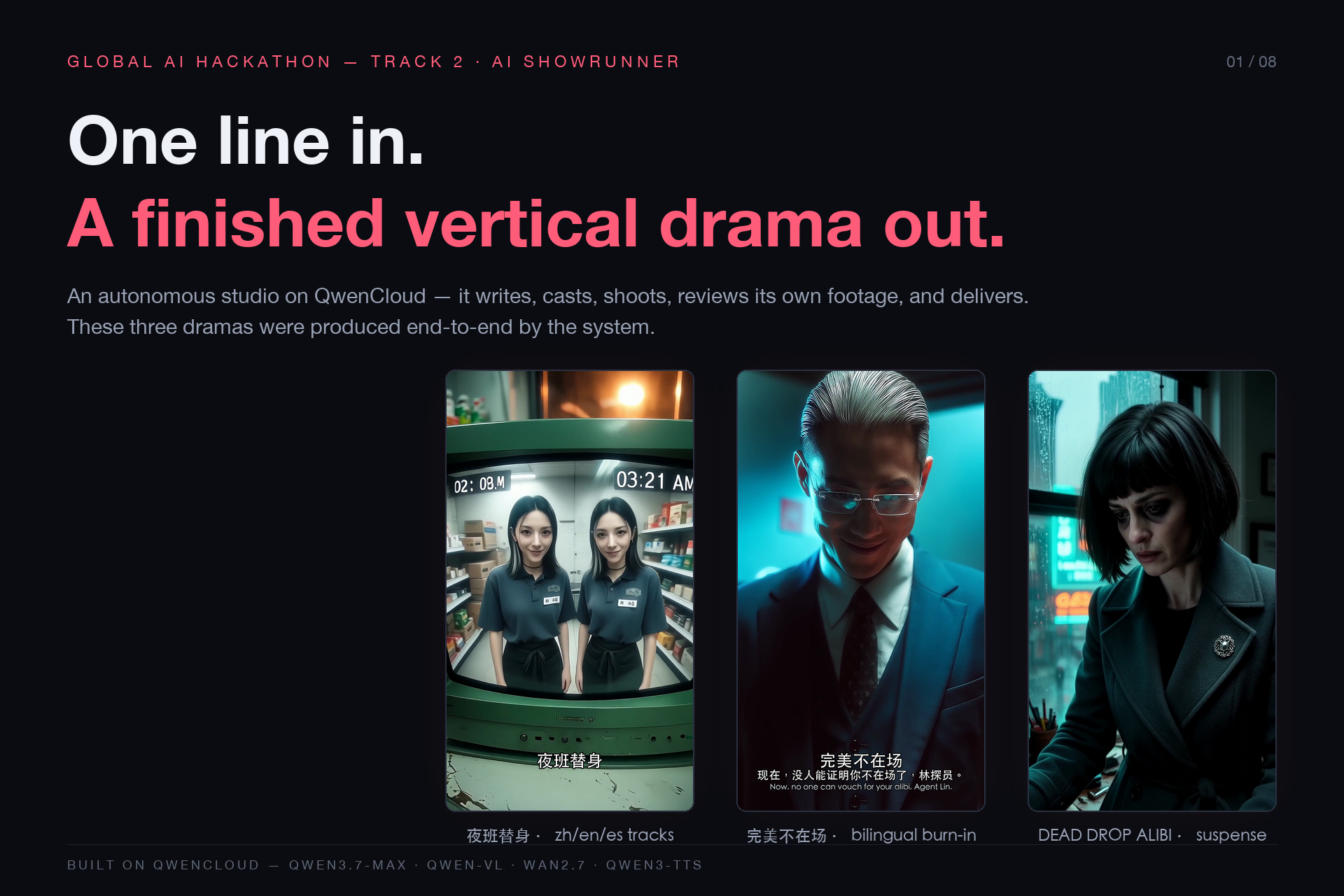
Inspiration
China's vertical short-drama industry now ships roughly 470 AI-generated dramas every day — and the studios describe their own workflow with a gambling word: 抽卡, "pulling cards." Thirty takes per shot. Pray one lands.
The generators are already good. What's missing is everything around them: the thing that keeps an actress's face identical across eight shots, that rejects a bad take before it burns money, that lets a human bless the story before a single frame exists.
Film solved this problem a century ago. The solution is called a studio.
So we built one. AI Showrunner plans like a screenwriter, shoots like a director, reviews like a script supervisor, and counts money like a line producer.
What it does
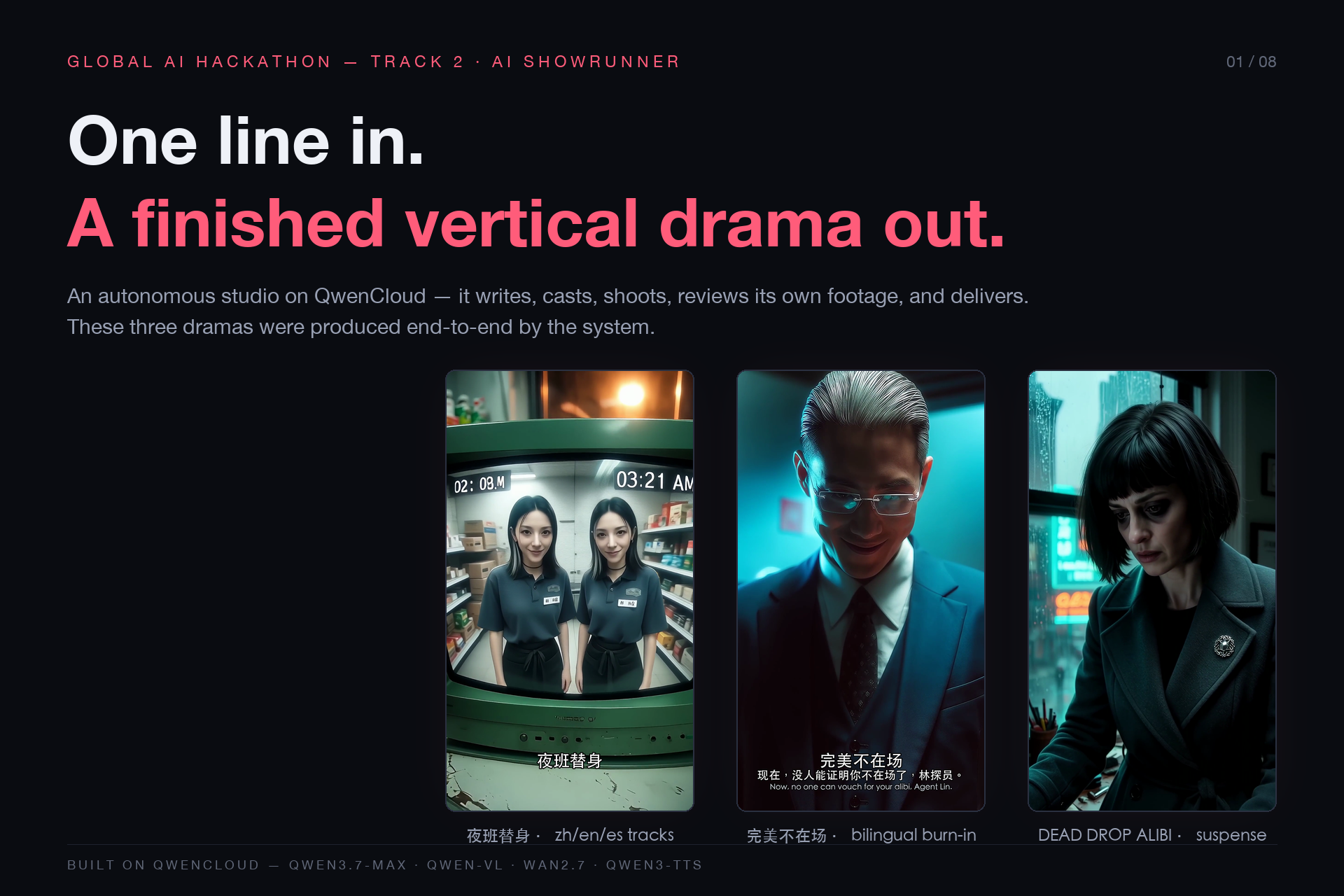
One line in. A finished 9:16 drama out.
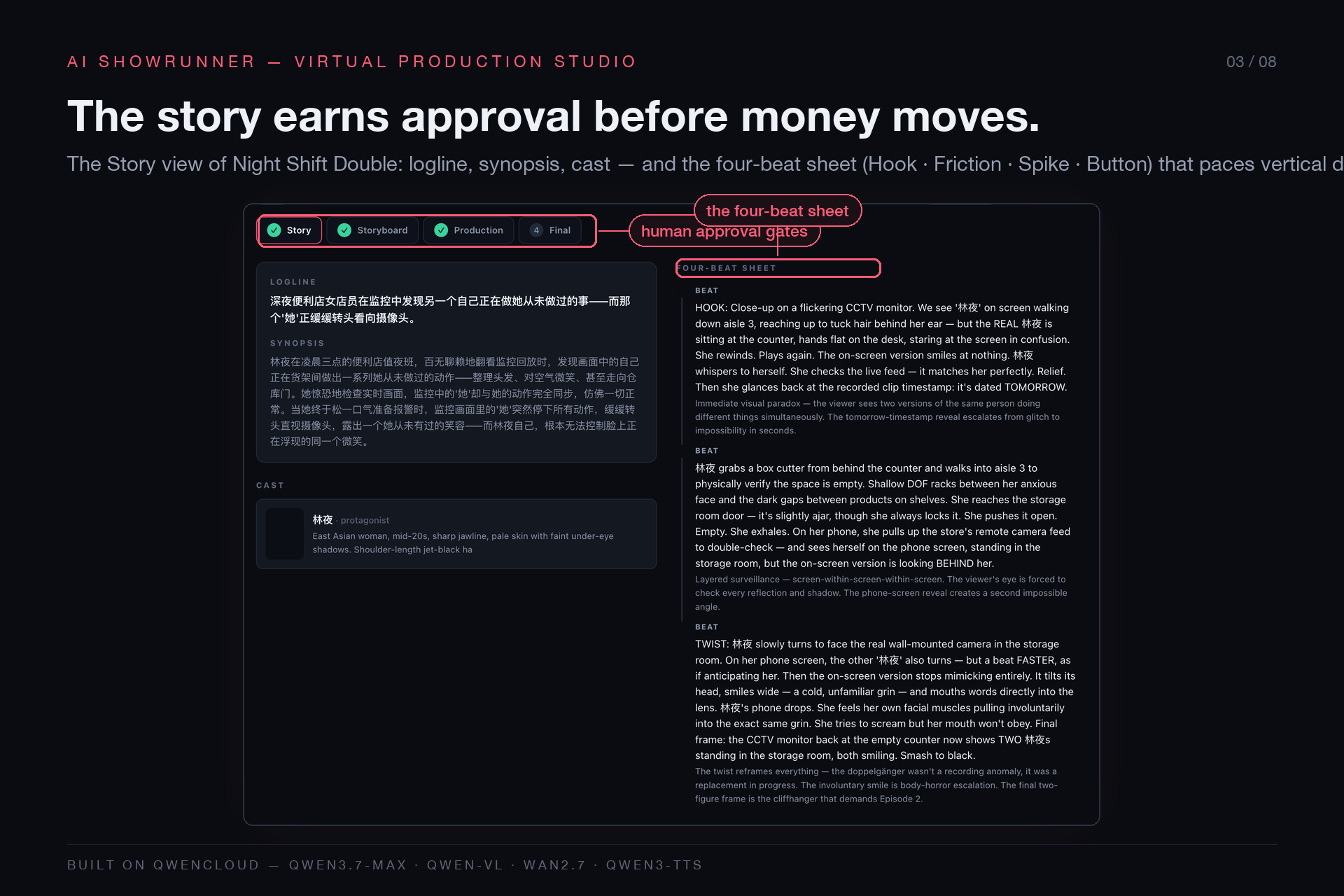
Hand it a logline — "the night-shift clerk sees herself on the security feed, doing things she has never done" — and it will:
- Write a four-beat script (Hook → Friction → Spike → Button, the pacing grammar of vertical drama), a story bible and a storyboard — pausing at human approval gates before money moves
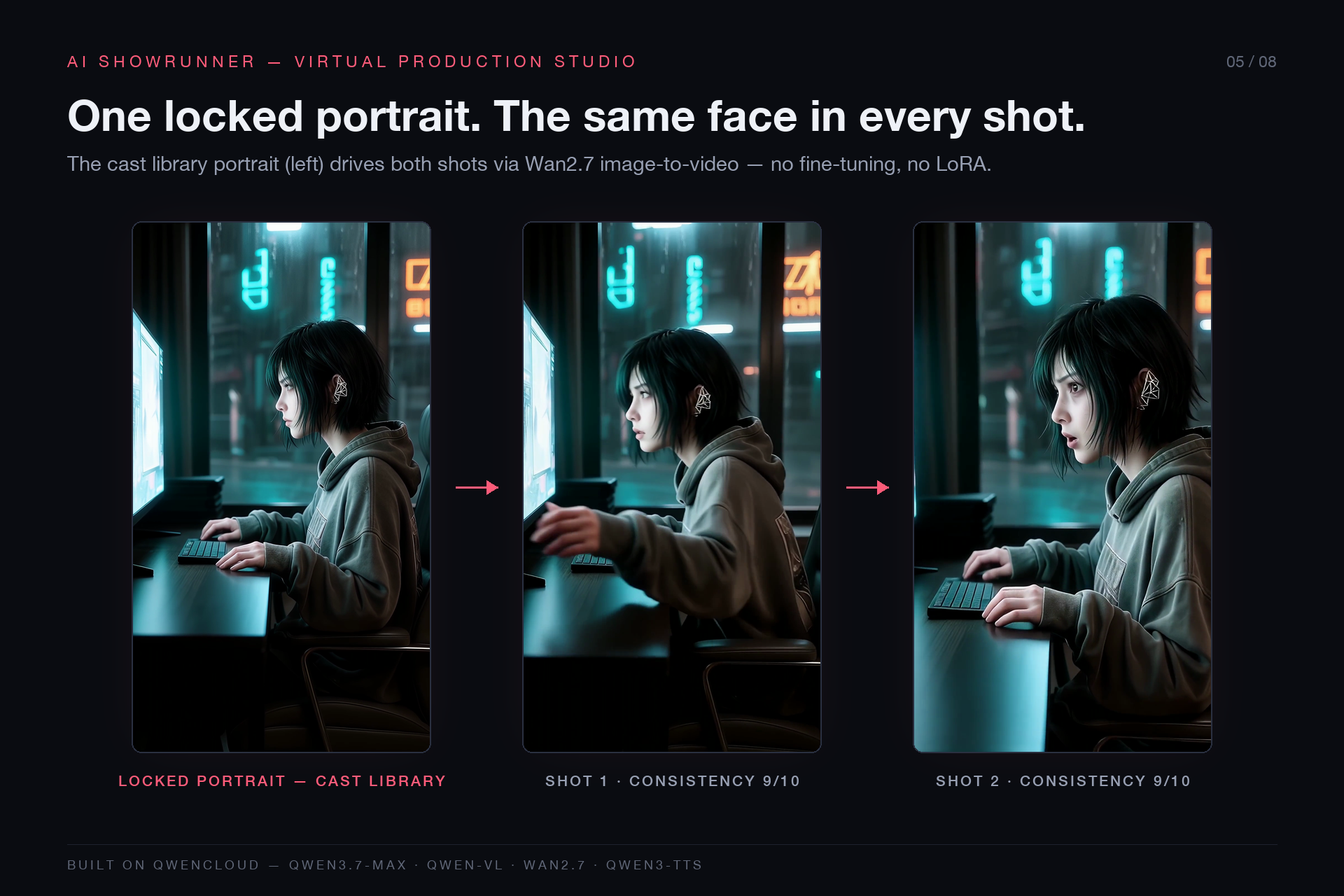
- Cast from a reusable character library: one locked portrait drives every shot through image-to-video — measured face consistency of 9–10 / 10, with no fine-tuning and no LoRA
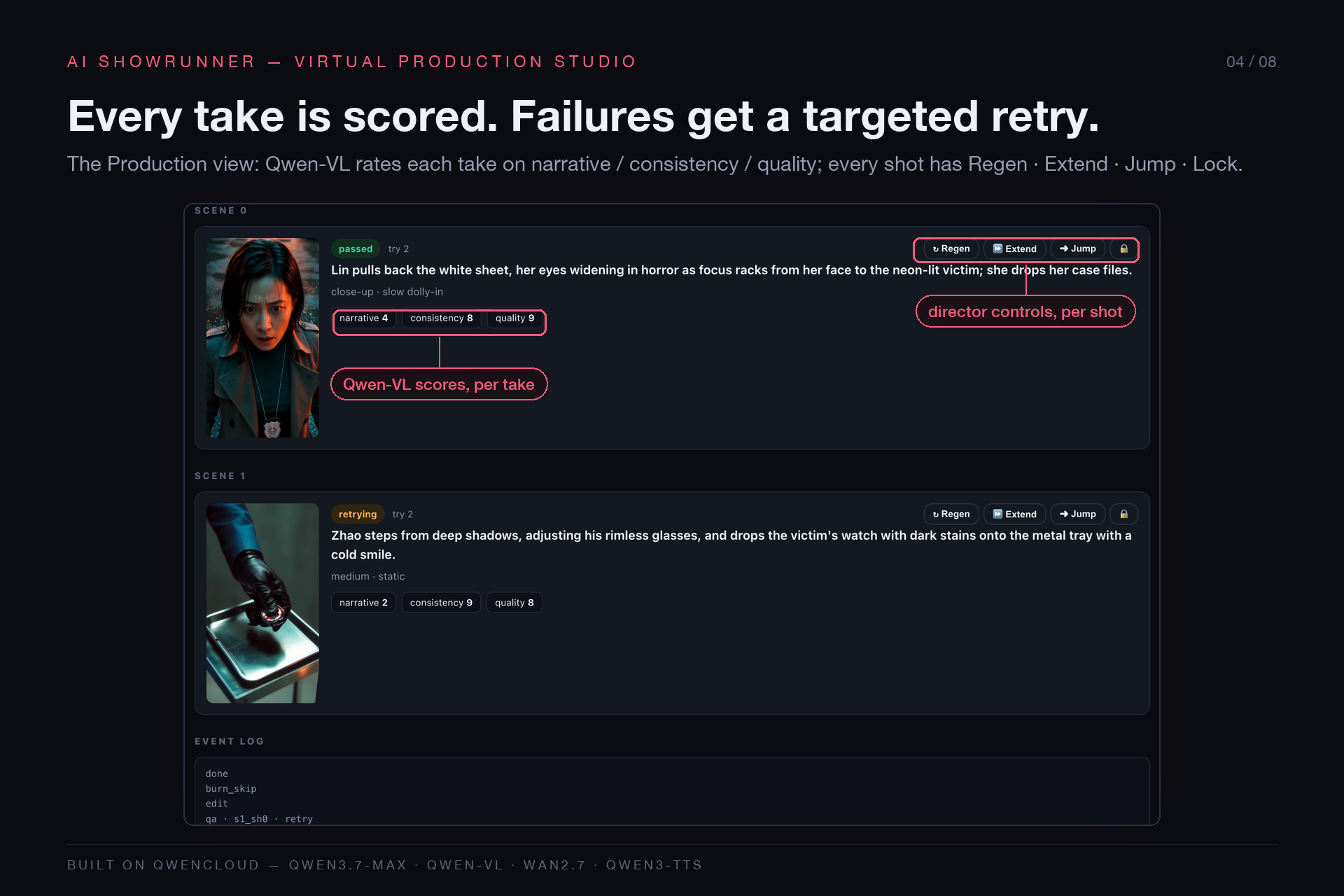
- Shoot every take, then judge its own footage: a Qwen-VL critic scores three sampled frames per take and writes the revision note for a targeted retry — fully autonomously
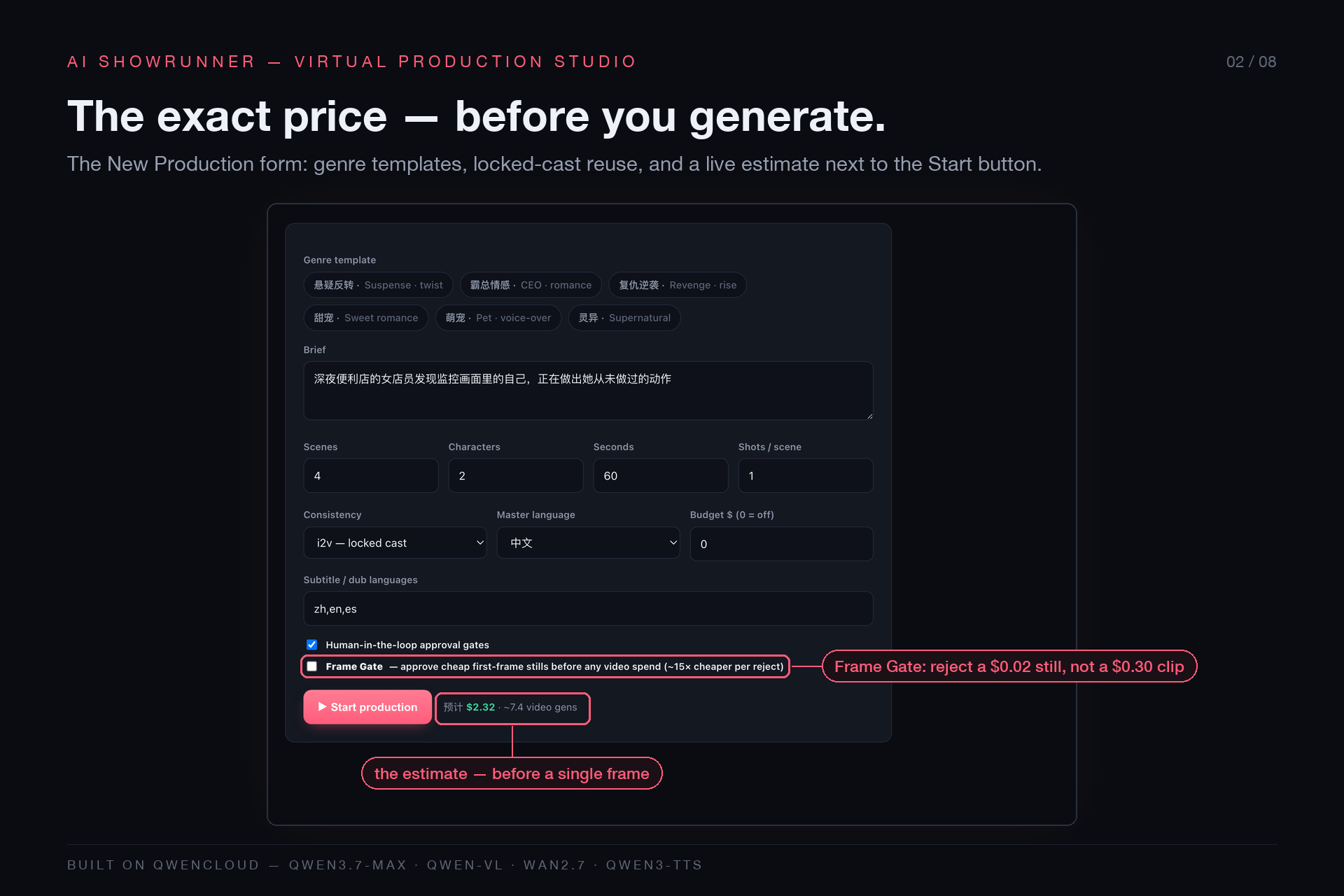
- Run a real production office: the exact price quoted before the Start button, a hard budget ceiling, per-shot lifecycle states (
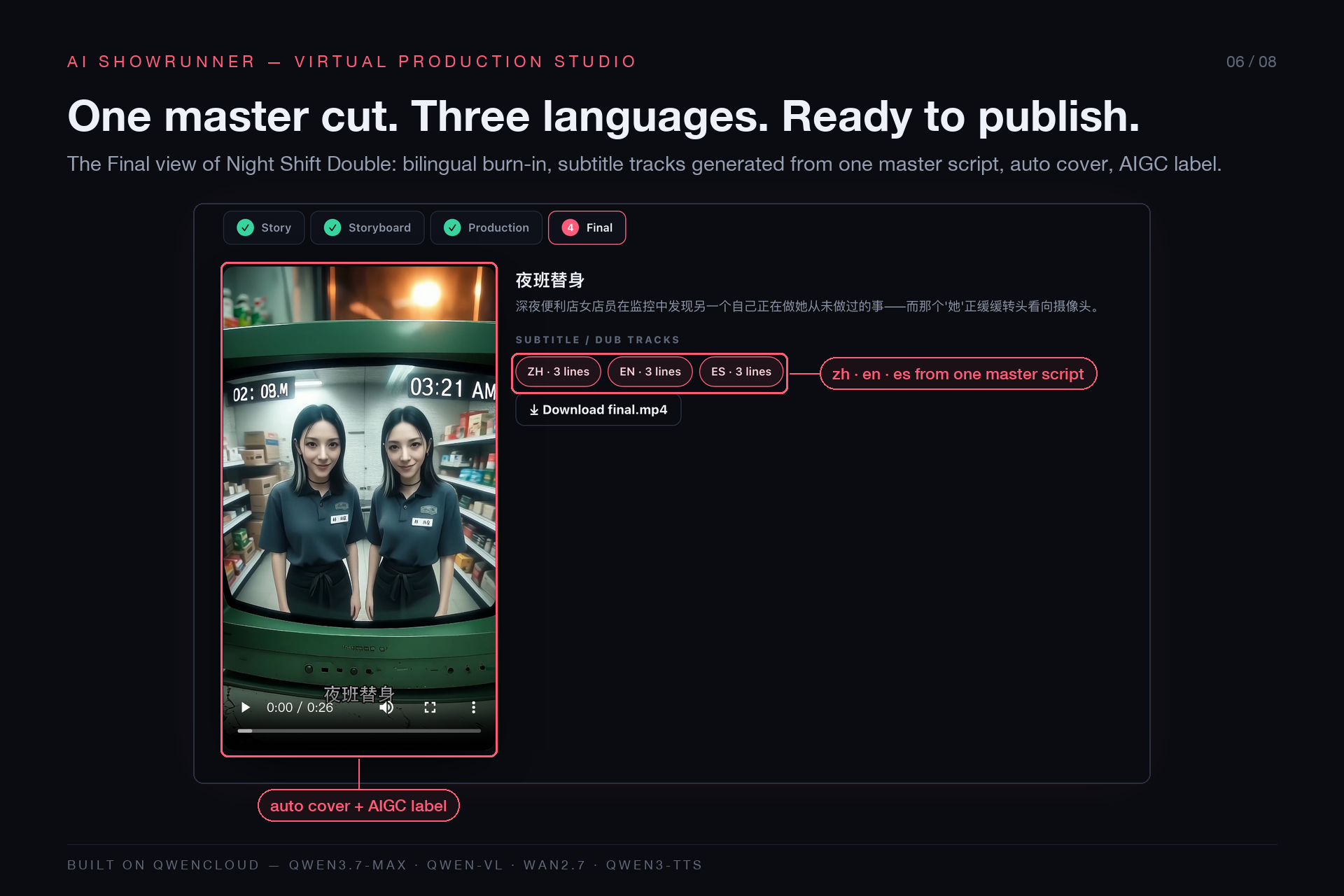
draft → review → approved → locked), and version stacks where switching takes re-cuts the final for $0.00 - Deliver like a distributor: bilingual burned-in subtitles, zh / en / es tracks from one master script, auto cover art, and China-compliant AIGC labeling
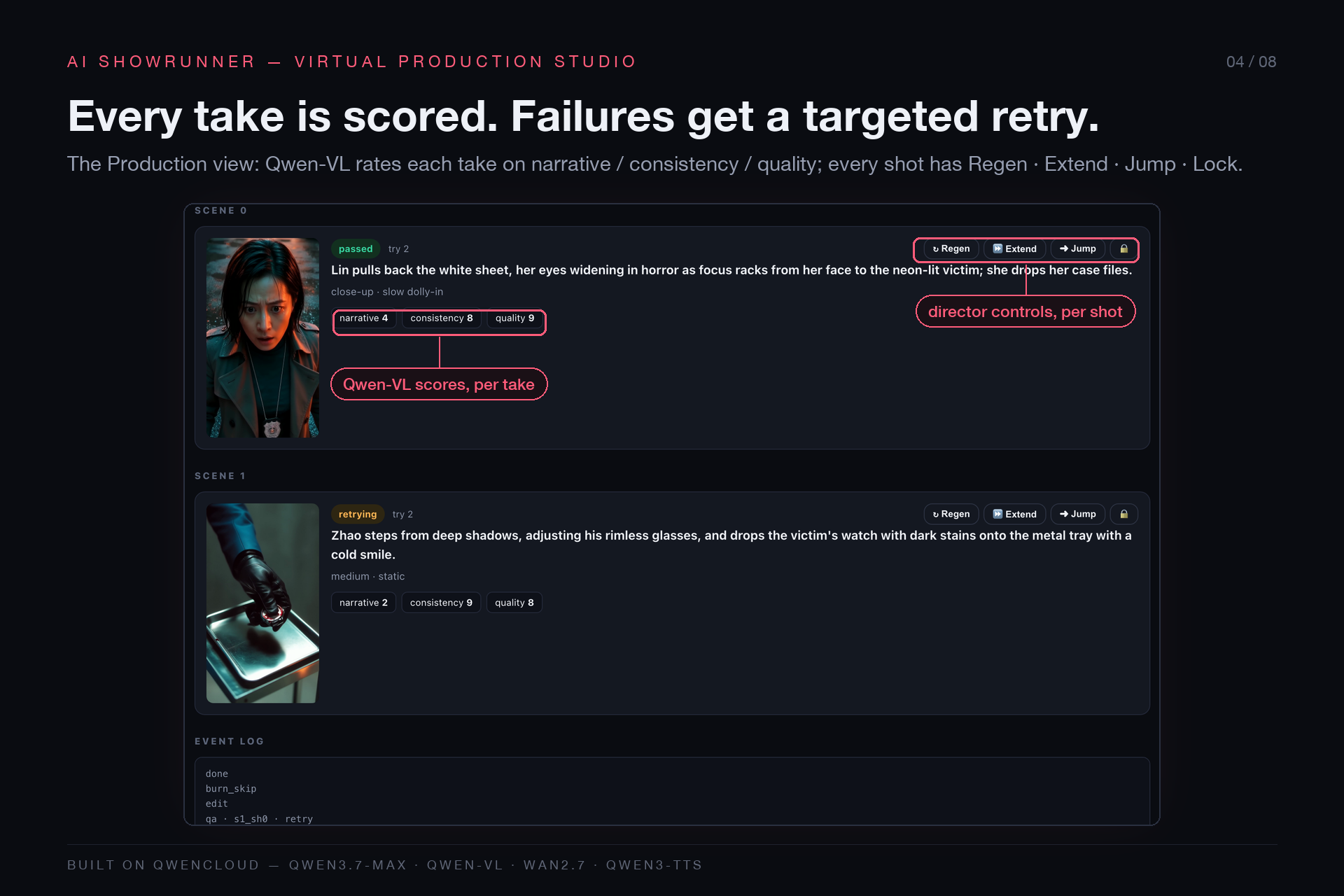
The critic at work: narrative / consistency / quality scores on every take — Regen, Extend, Jump, Lock on every shot.
How we built it
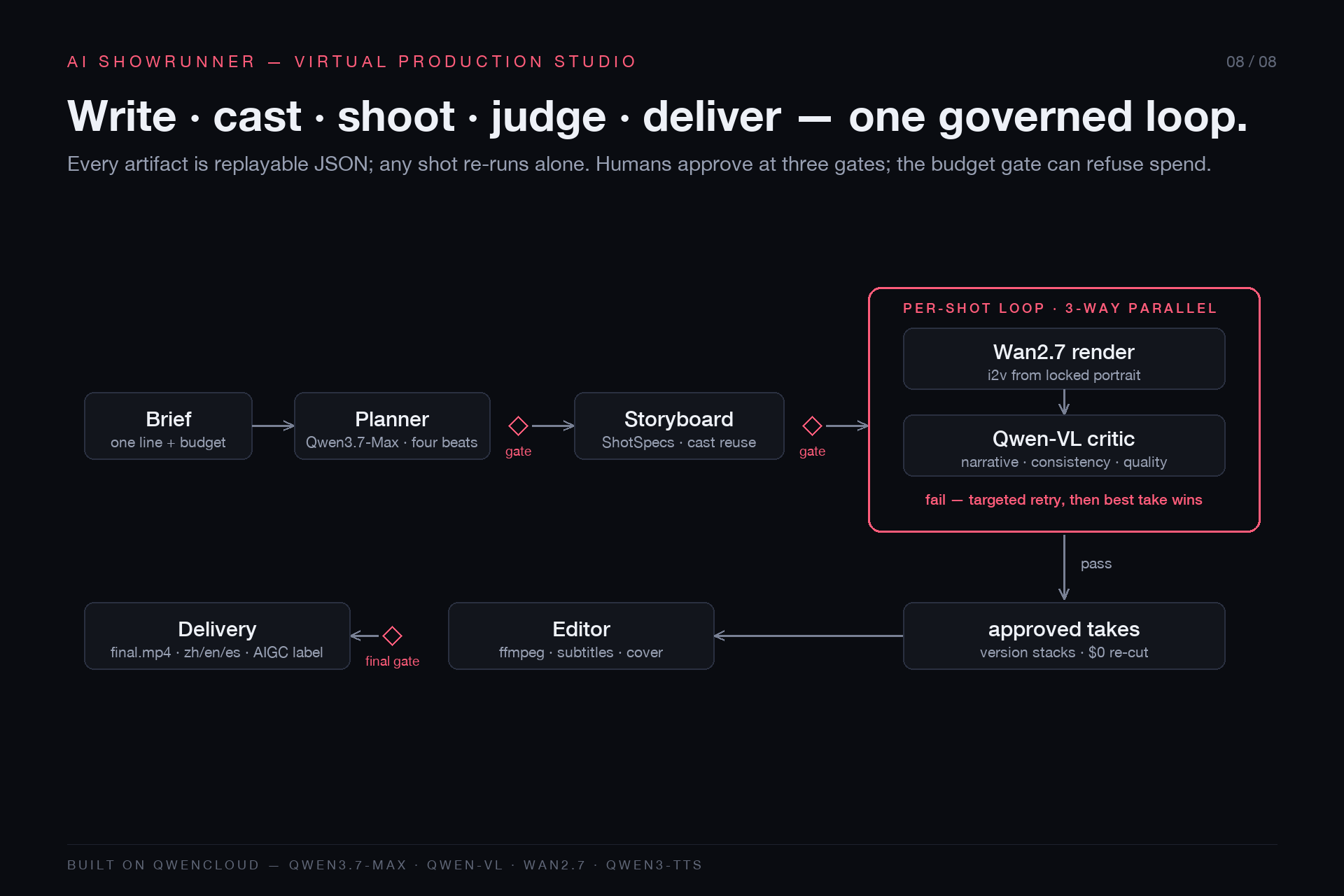
Everything generative runs on QwenCloud. Qwen3.7-Max plans, storyboards and localizes. Qwen-VL judges. Wan2.7 t2v/i2v renders. We reverse-engineered the undocumented i2v reference protocol — the locked portrait travels inline as a base64 first_frame, so the entire system needs zero object storage.
The spine is FastAPI plus a plain-Python orchestrator: three-way parallel shot generation, three human gates with timeout auto-approve, Pydantic contracts on every artifact, an append-only event log. Every intermediate is replayable JSON — any single shot re-runs without touching the rest of the production.
Quality is a funnel, not a hope. A free ffprobe precheck (decodes? right duration? not near-black?) runs before a single vision-model token is spent. Then the critic gates each take:
$$ \text{pass} = (\text{narrative} \ge 5) \land (\text{consistency} \ge 6) \land (\text{quality} \ge 6) $$
In one real run the critic noticed the wrong character in frame, wrote its own revision note, and drove the consistency score from 1 to 9 in a single retry.
Cost is governed, not observed. Every model call passes through one metered choke point, and a production is priced before it begins:
$$ E[\text{cost}] \approx S(1+r)\,c_{video} + (S+C)\,c_{image} + T\,c_{text} + V\,c_{VL} $$
with an observed retry rate of \( r \approx 0.35 \). The Frame Gate inverts the economics — rejecting a $0.02 still instead of a $0.30 clip makes saying "no" roughly 15× cheaper. And version stacks turn retakes into coverage instead of waste: flip the current-take pointer and the final re-assembles free.
Before writing a line of code we benchmarked twenty-plus mature systems — LTX Studio, Runway, Google Flow, a Sora post-mortem, ShotGrid, ComfyUI, 即梦, 可灵 — and folded their consensus into the design: asset-first casting, structure before render, price before generate, and a VFX-style shot lifecycle.
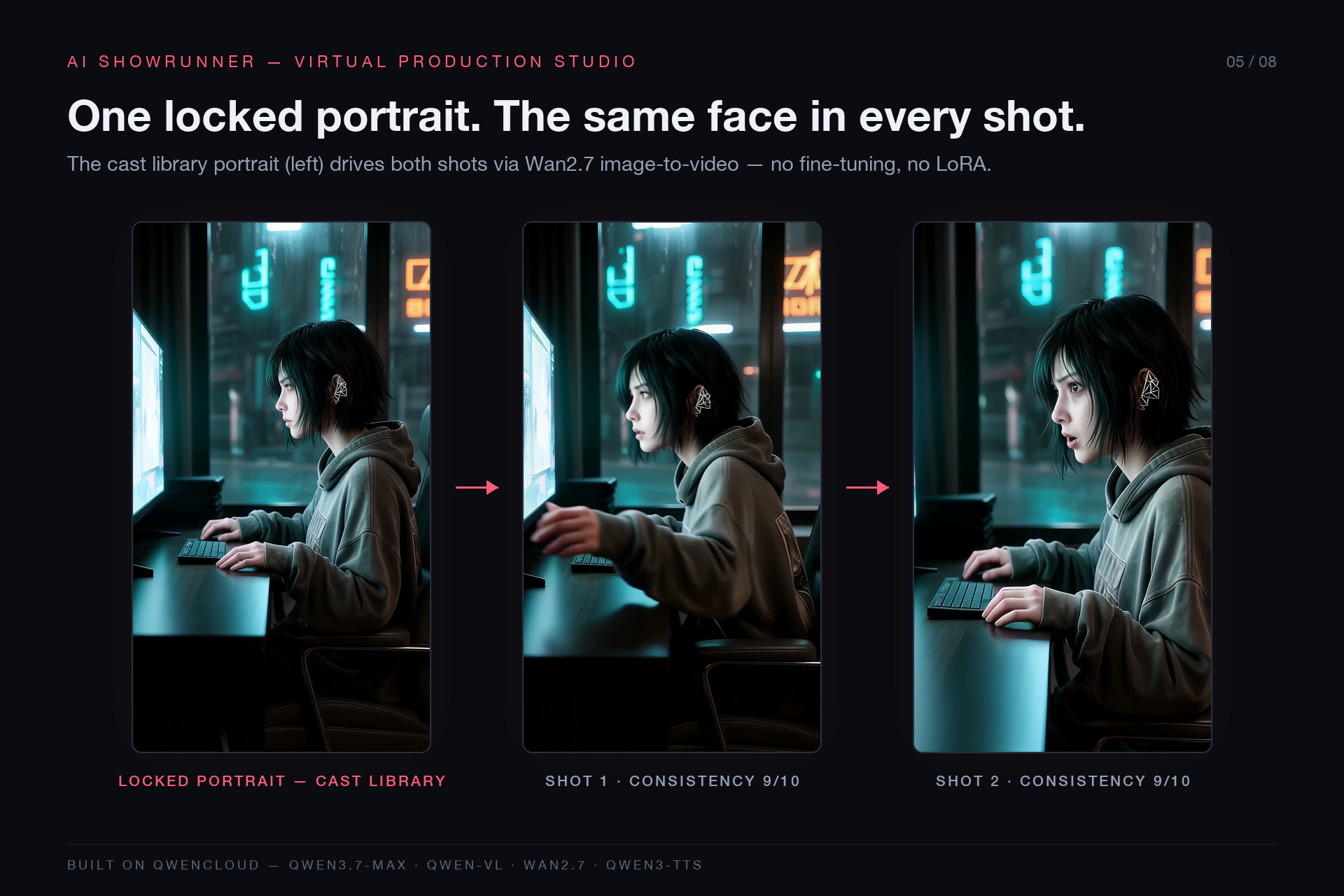
Consistency you can measure: one portrait from the cast library, the same face in every shot, scored 9–10 by the critic.
Challenges we ran into
The undocumented API. The docs promised sk- keys; ours began sk-ws- and returned 401 until we bisected two gateways. Wan2.7's image-to-video schema was documented nowhere — we learned first_frame by reading validator errors like tea leaves.
Physics. Four parallel 2 MB base64 portrait uploads saturated the uplink and timed out. The fix: downscale + JPEG (7–16× smaller), exponential backoff, parallelism capped at three.
An ffmpeg with no subtitle filter at all — no libass, no drawtext. So we built our own renderer: Pillow paints bilingual cue cards, ffmpeg overlay composites them onto the cut. It ended up more controllable than libass ever was.
The censor. Crime-adjacent imagery tripped Wan's content filter mid-run. The storyboard prompt now directs "suggestive, not graphic," and every failure fails open to the best surviving take.
We burned the entire free video quota mid-hackathon. It was the best thing that ever happened to the architecture: resume-from-checkpoint, subtitle caching, $0.00 re-assembly and the whole no-quota control plane were designed, built and verified without spending another cent.
Accomplishments that we're proud of
- A critic that actually corrects: consistency 1 → 9 in one autonomous retry
- The same face in every shot of a drama, from a single locked portrait
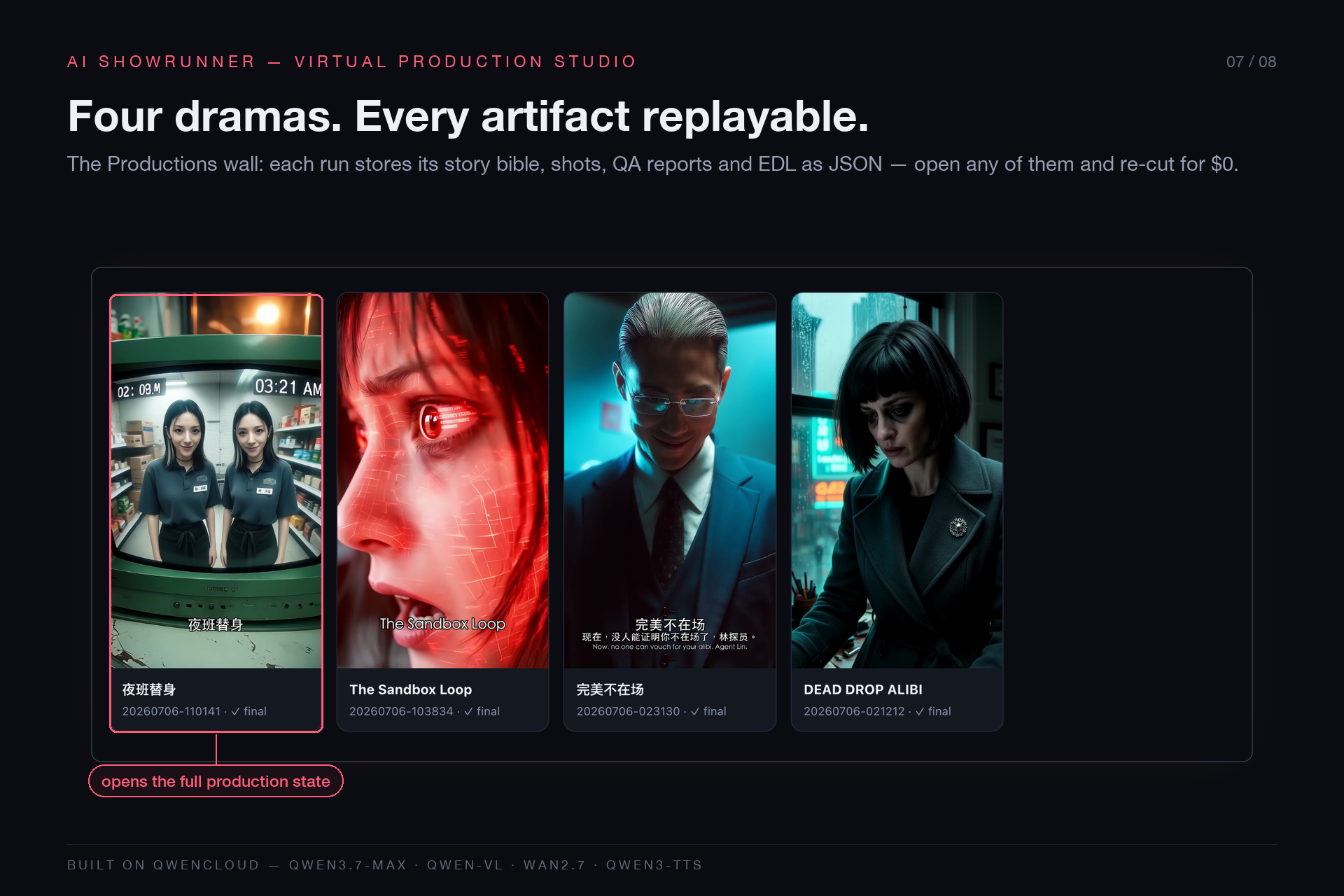
- Four finished dramas produced end-to-end — one carrying zh / en / es subtitle tracks
- The $0.00 re-edit: switch takes, re-cut the final, spend nothing
- Hackathon code with production manners: bearer-token auth, a serialized job queue, budget admission control, health checks, Docker, and AIGC compliance labeling
What we learned
- Reliability engineering is the product. The critic loop, the fail-open fallbacks and the budget gate will outlive any single model's raw quality.
- One reference frame beats a paragraph of prose when you need to keep a face.
- Let the cheapest artifact absorb the rejection — storyboard text first, then a $0.02 still, then a $0.30 clip. Never the reverse.
- Film's forty-year-old patterns transfer perfectly. We didn't invent our shot lifecycle; we borrowed ShotGrid's.
What's next for AI Showrunner
Qwen-Image first frames and Qwen-TTS dialogue with driving_audio lip-sync — the interfaces are already wired and waiting on quota. Then one-click English dubbing for the ReelShort-style export market, and OTIO export into professional editing suites.
Source: github.com/Yanjin-ai/showrunner — including a complete replayable production in samples/night-shift-double: story bible → shots → EDL → final cut with three subtitle tracks.


Log in or sign up for Devpost to join the conversation.