Inspiration
An empty chair on a Saturday morning is a day's rent gone for a braider or a barber. Deposits should fix no-shows, but clients won't send money to a stranger who might cancel on them. Both sides are right, and neither can trust the other. We wanted a deposit that protects the provider without asking the client to trust anyone.
What it does
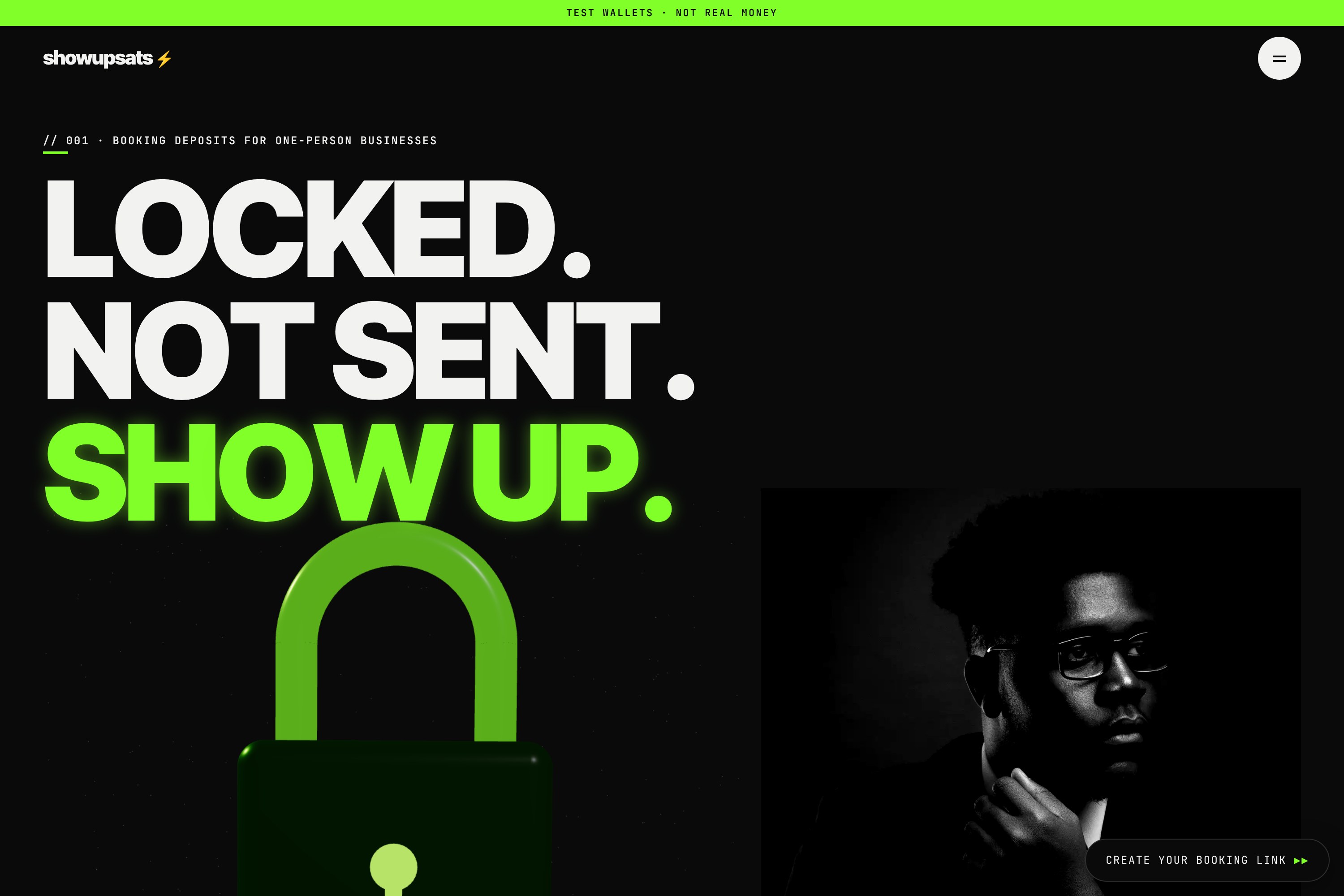
ShowUpSats is a booking link for one-person service businesses: barbers, braiders, nail techs, tutors and phone repairers, in any country.
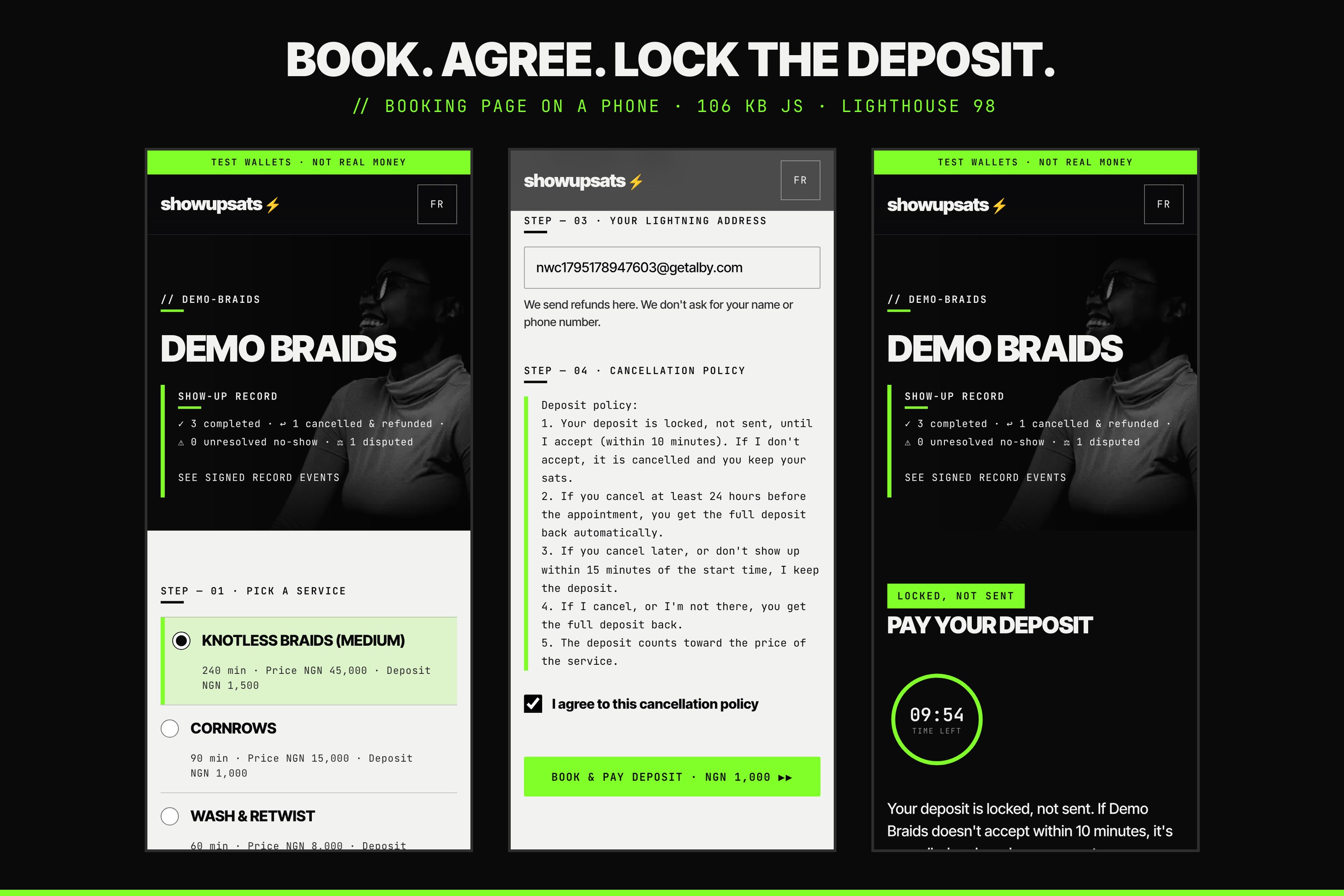
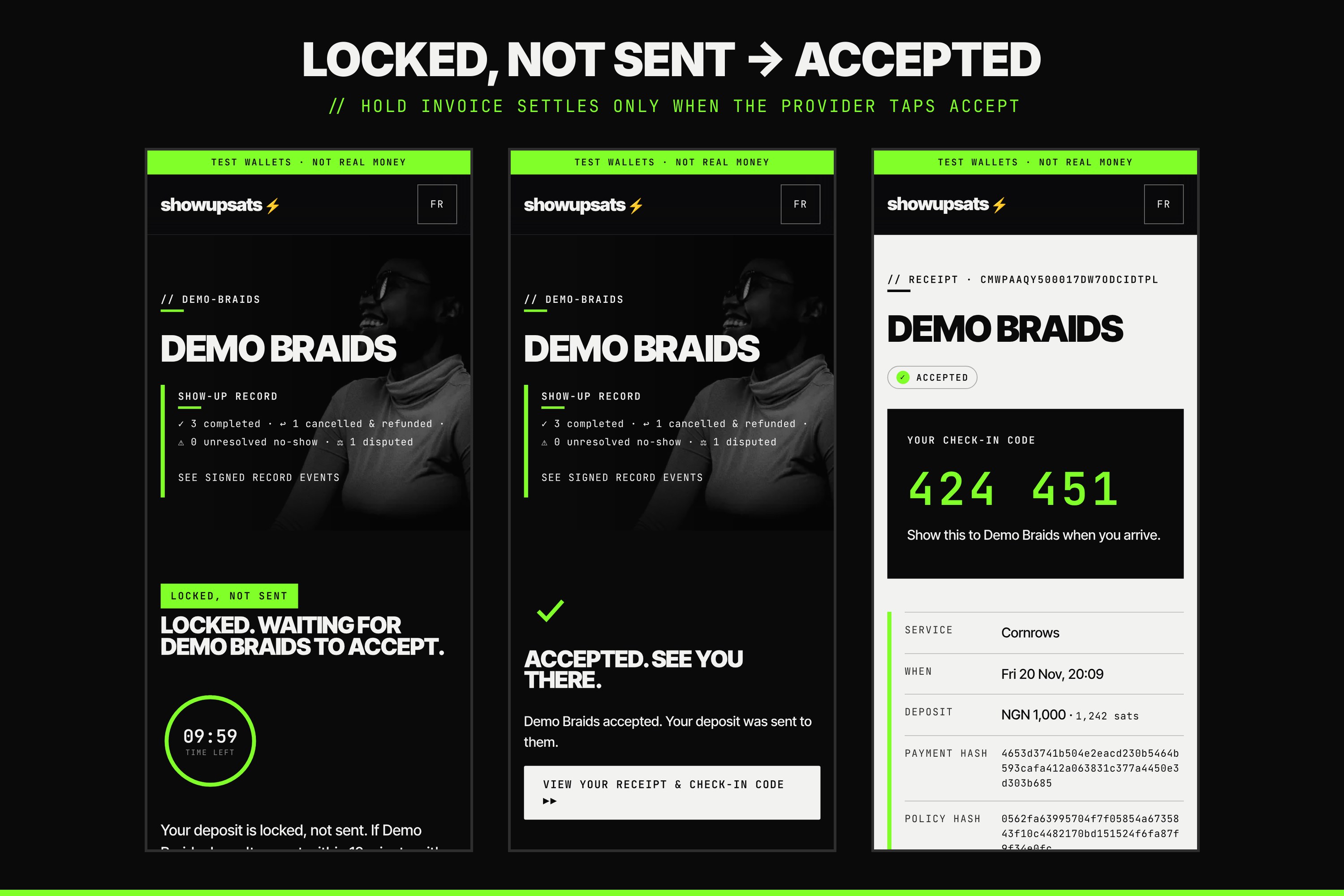
- The client picks a service and a slot, agrees to the cancellation policy, and pays a small Lightning deposit as a hold invoice. The sats are locked, not sent.
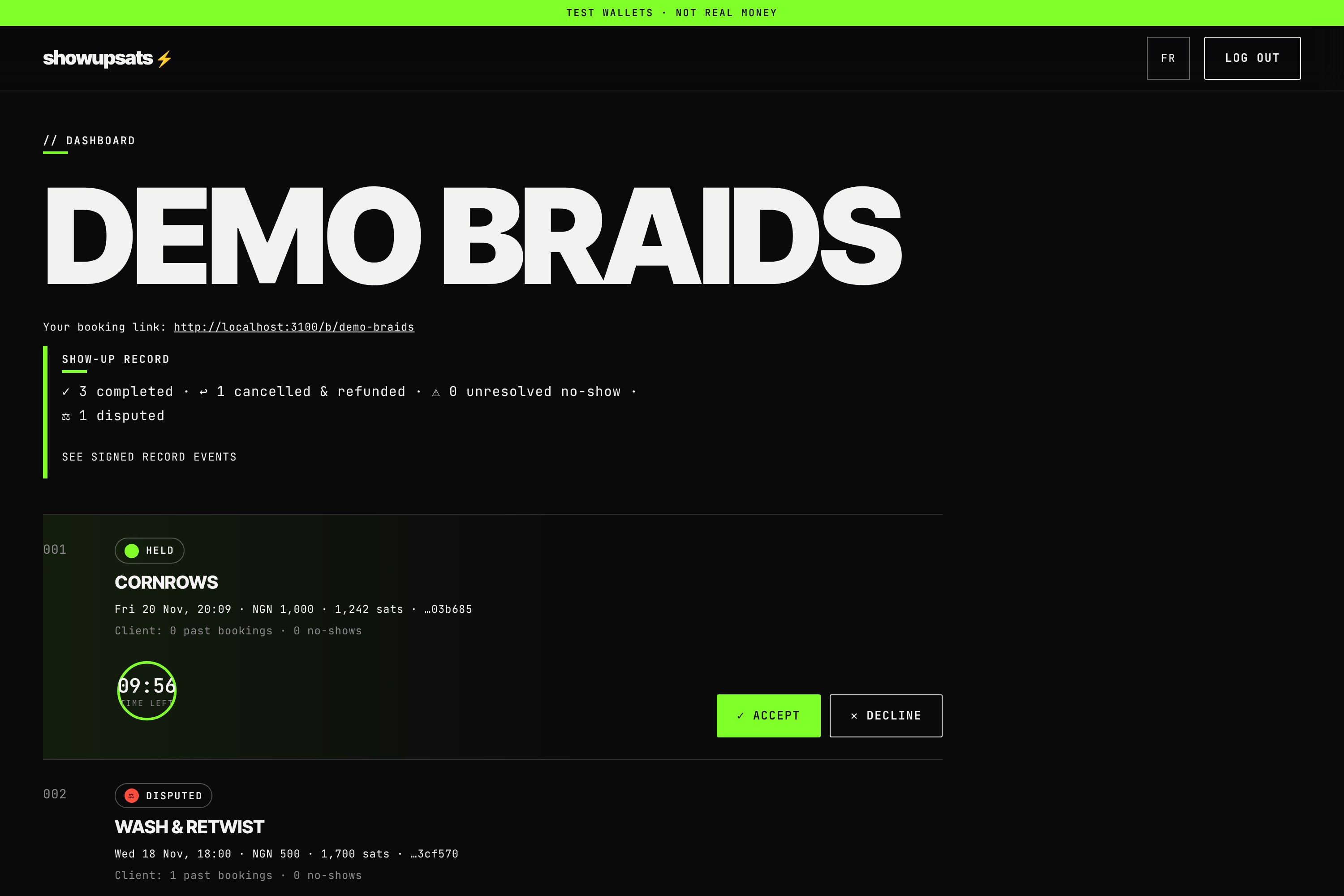
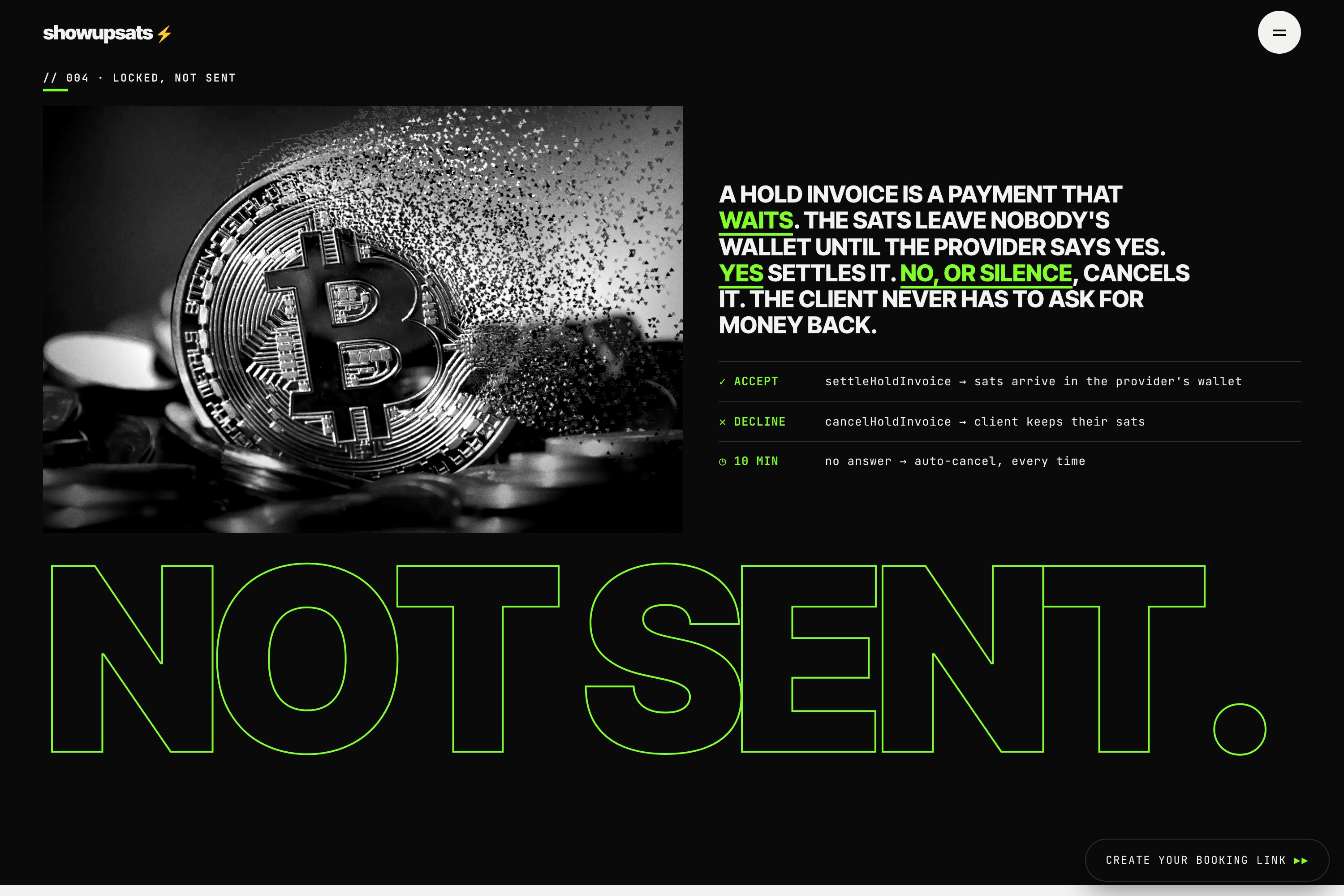
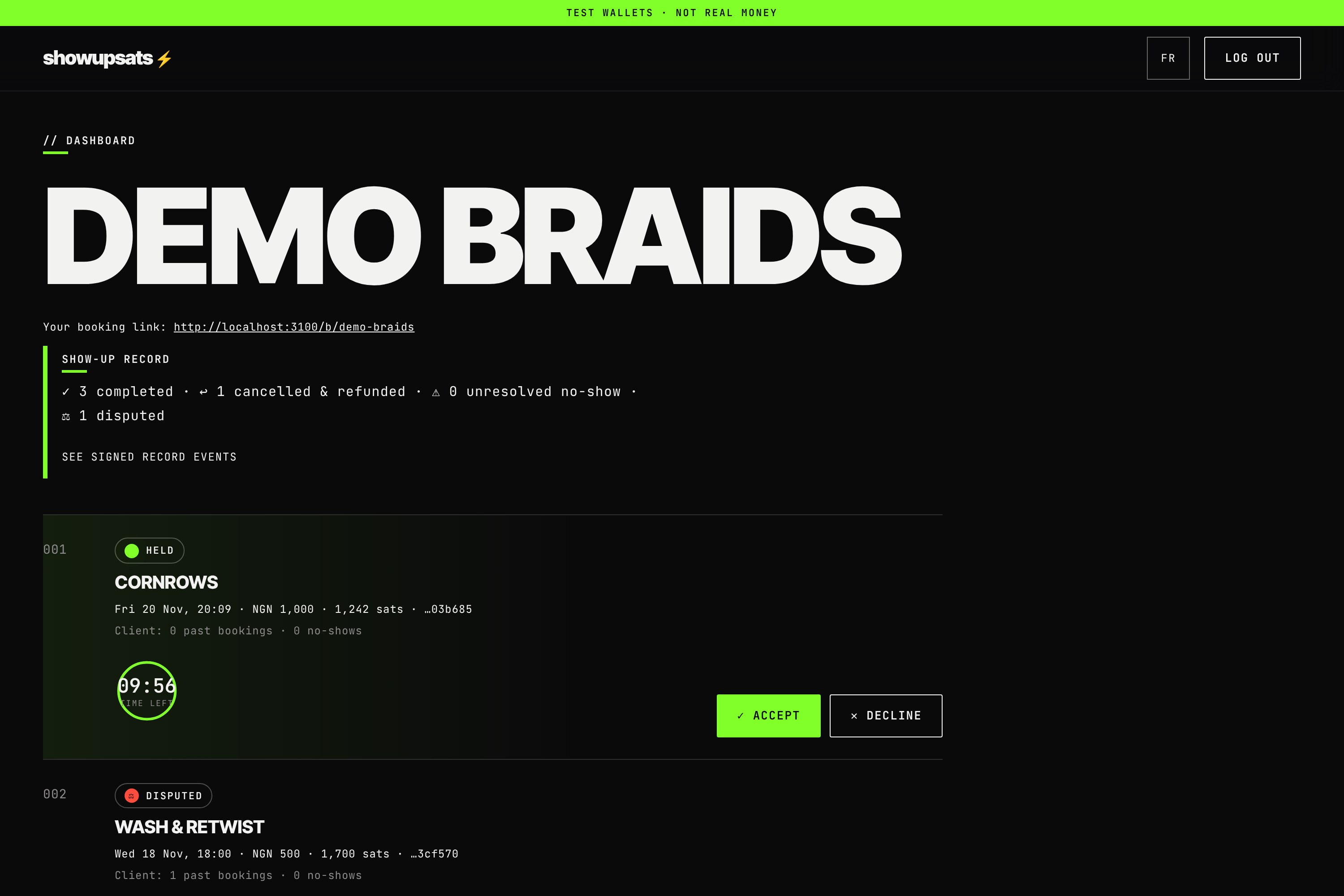
- The provider has 10 minutes to tap Accept. Accept settles the invoice and the sats land in the provider's own wallet. If they decline or don't answer, the invoice is cancelled and the client's sats never leave their wallet.
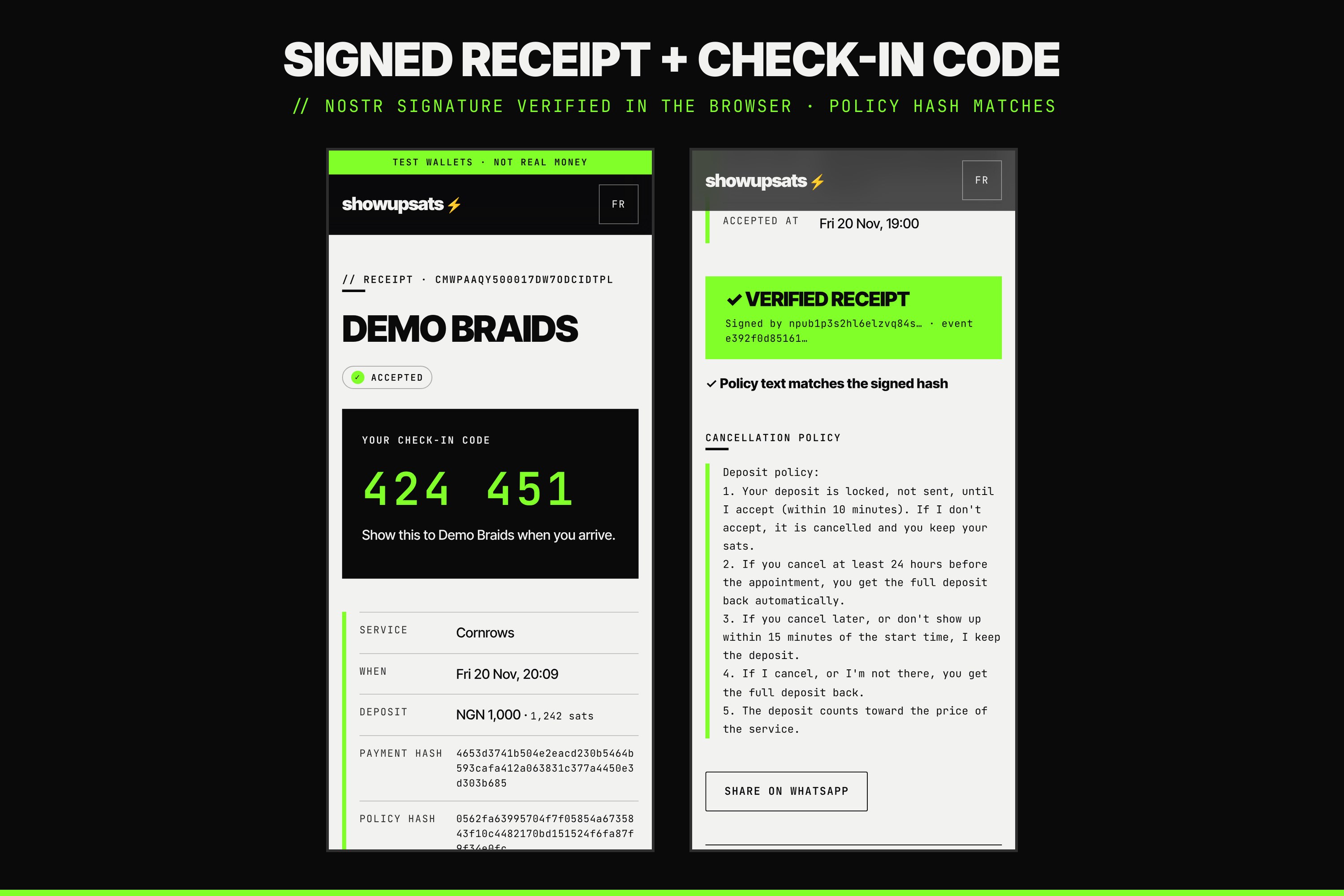
- Both sides get a Nostr-signed receipt that includes the SHA-256 hash of the exact policy they agreed to. The browser verifies the signature itself.
- The client gets a 6-digit check-in code. The provider enters it when the client arrives, which proves they showed up.
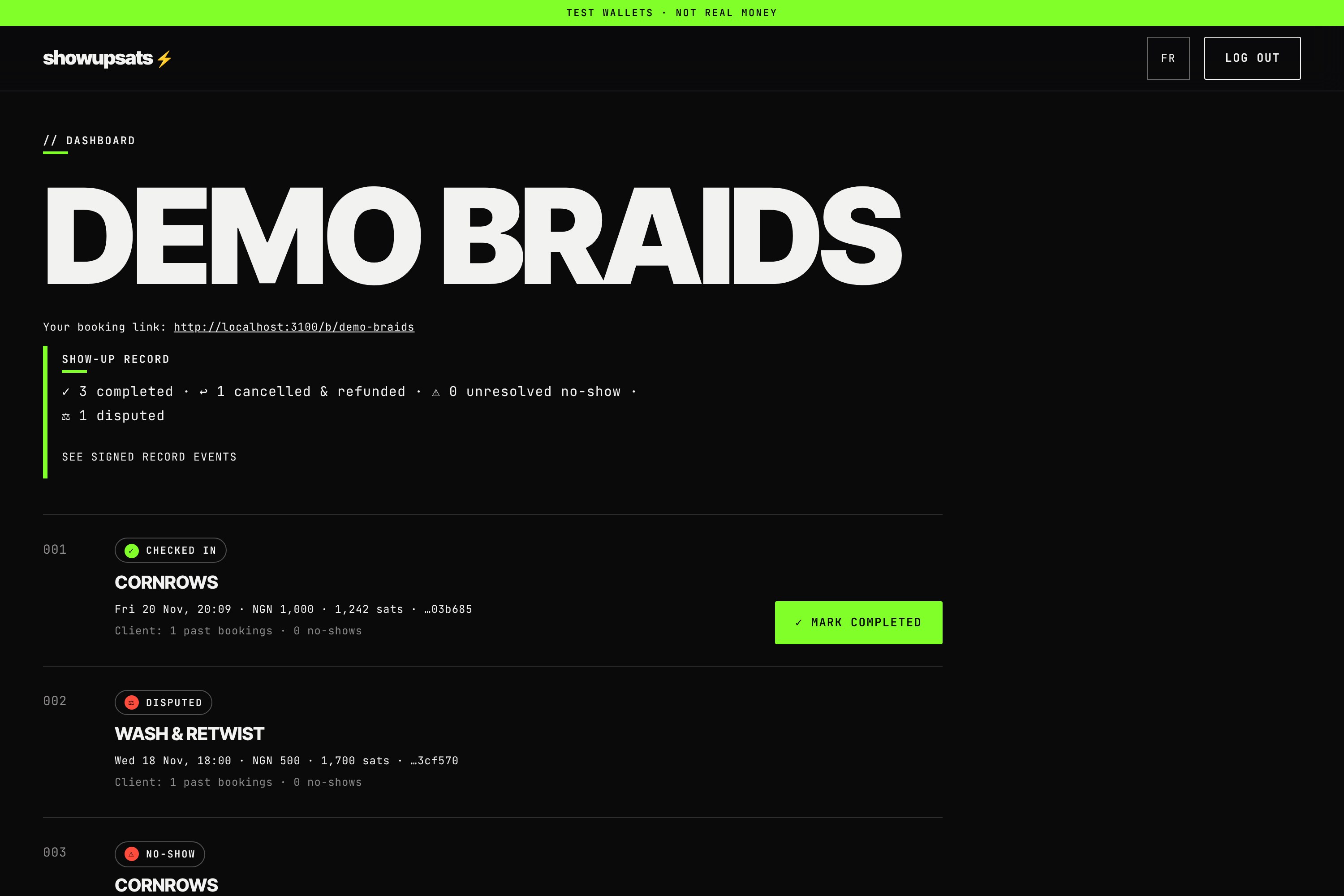
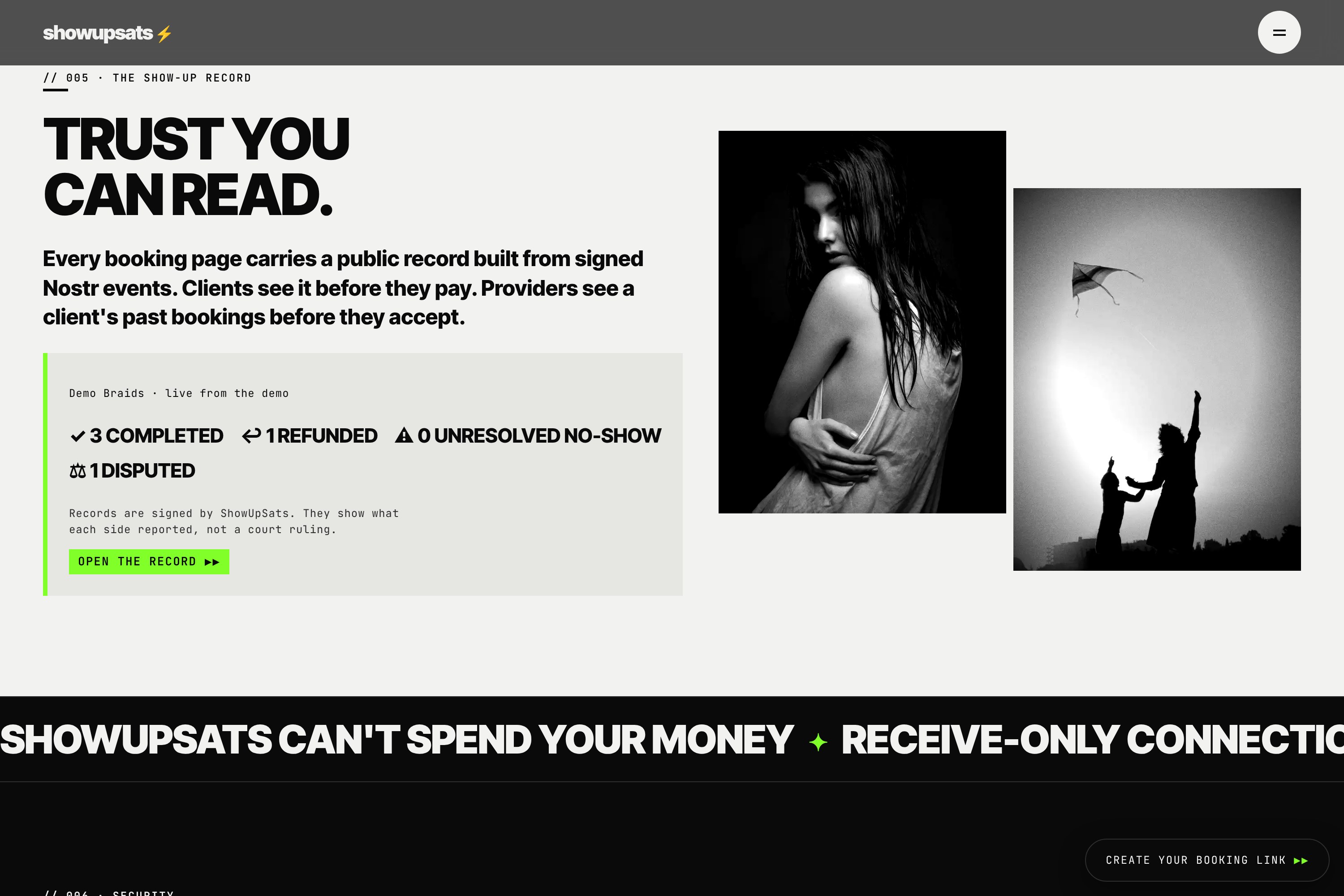
- Every booking page shows a public show-up record: completed bookings, refunded cancellations, unresolved no-shows and disputes. Each entry is a signed Nostr event.
- If the provider cancels, or the client cancels in time, a refund goes back to the client's Lightning address automatically. If a client reports that the provider wasn't there, the provider has 24 hours to refund or dispute. Otherwise it becomes a public unresolved no-show.
ShowUpSats never holds money. It is not escrow.
How we built it
- Next.js 15 + TypeScript on Vercel, Prisma on Neon Postgres (SQLite for local one-command setup), and zod on every API input.
- Nostr Wallet Connect (NIP-47) via
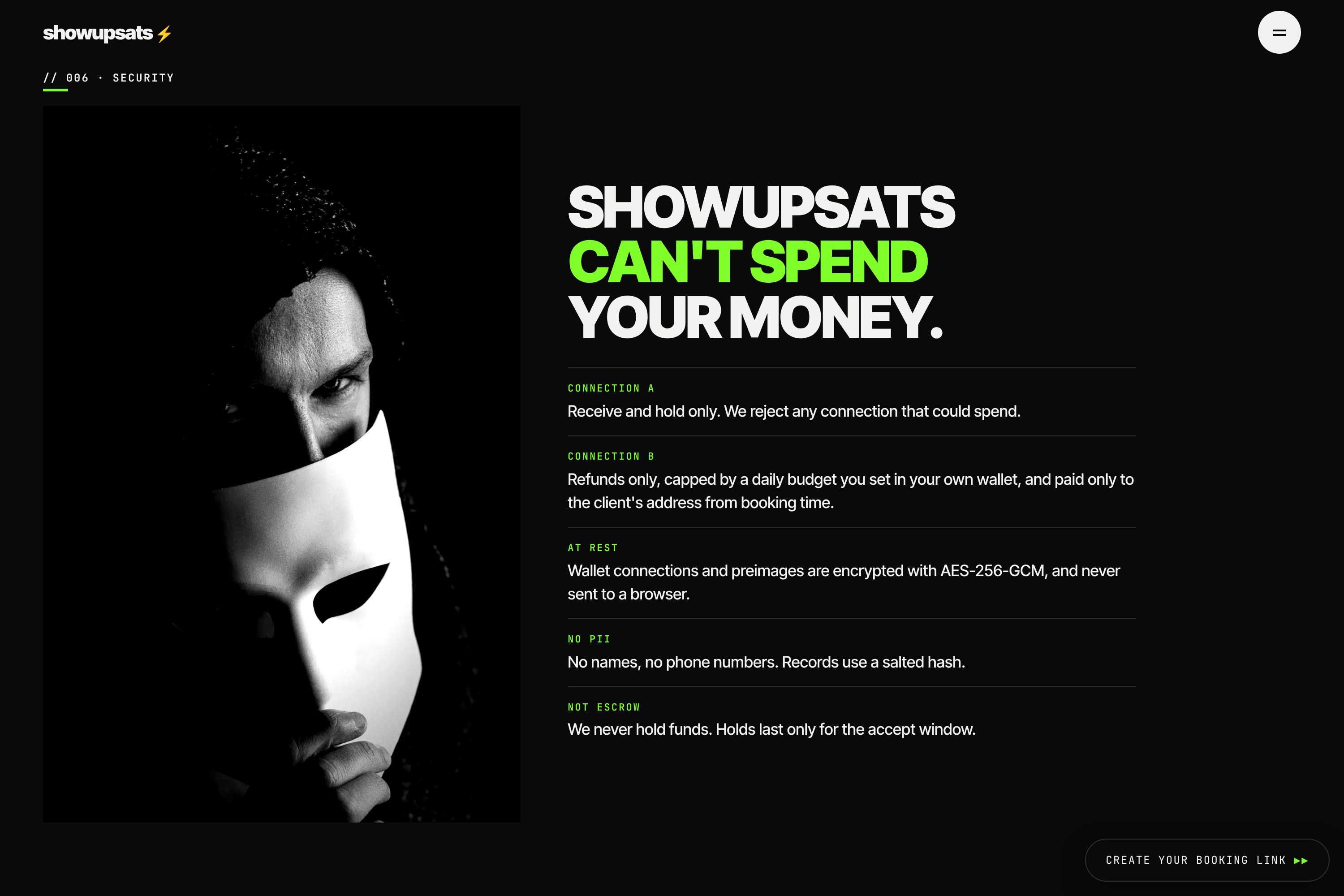
@getalby/sdk, using two connections with least privilege:- Connection A can make, settle and cancel hold invoices but cannot spend. Onboarding calls
get_infoand rejects any connection that includespay_invoice. - Connection B can only pay refunds, capped by a daily budget set in the provider's own wallet. It only pays an invoice the server resolved from the Lightning address recorded at booking time, for the exact deposit amount.
- Connection A can make, settle and cancel hold invoices but cannot spend. Onboarding calls
- nostr-tools signs receipts and record events with the app key. The receipt page re-hashes the policy and runs
verifyEventin the browser. - @getalby/lightning-tools handles Lightning address → invoice for refunds, and the fiat ↔ sats rate. The rate is cached for 5 minutes and checked against sanity bounds.
- Bitcoin Connect provides the payment QR and wallet button.
- Wallet connections, preimages and check-in codes are encrypted with AES-256-GCM. We store no names and no phone numbers: records use a salted hash of the Lightning address.
- Design: an editorial dark/lime look; a React Three Fiber padlock that locks and then bursts open on scroll; GSAP, Lenis and CSS-only text animations. The booking page loads 106 kB of JS and scores 98 on Lighthouse mobile, because it has to work on 3G.
Challenges we ran into
- Idempotency. Settle, cancel and refund all have to survive double taps, timeouts and retries. We used compare-and-swap status claims (
held → settling), allowed one refund per booking, reused the stored bolt11 on retry (an invoice can only be paid once), and treatNOT_FOUND/ already-cancelled as success. - Racing for slots. Two clients can try to book the same time. A slot is locked inside a DB transaction with an overlap check, and pending holds are capped per client and per IP.
- Units. NIP-47 uses millisats while the DB uses sats. One tested helper converts at the boundary.
- Being honest about trust after settlement. Once the sats move we can't claw them back. So we made the guarantees explicit: the confirm-or-cancel window, capped automatic refunds, and a public signed record that says what each side reported, not a court ruling.
Accomplishments that we're proud of
- The whole flow runs on real Lightning test wallets: hold → accept → settle, timeout → auto-cancel with the client's balance unchanged, and provider cancel → automatic refund, where a replayed refund doesn't pay twice.
- A threat model covering a stolen connection A (can't spend), a stolen connection B (capped and revocable), a provider who never accepts, a provider who settles and disappears, slot squatting, forged receipts and FX manipulation.
- A booking page that's fast on a mid-range Android phone on 3G.
What we learned
Hold invoices are a natural fit for "confirm or refund." The hard part isn't moving sats; it's the human trust layer after the sats move. Signed, honest, public records do more than any promise of escrow.
Impact
Deposits protected per week:
$$D = B \times r \times \bar{d}$$
where $B$ is bookings per week, $r$ is the no-show rate and $\bar{d}$ is the average deposit. A braider with 25 bookings a week, a 15% no-show rate and a ₦1,500 deposit recovers about ₦5,600 a week, with no bank account, no card processor and no platform holding her money.
What's next
- Keeping same-day deposits locked until the appointment
- A provider bond that clients can claim
- USSD/SMS check-in codes for feature phones
- NIP-52 calendar publishing
- AI intake from WhatsApp messages
- Pilots with real braiders and barbers on mainnet
Built With
- alby
- bitcoin
- bitcoin-connect
- css
- framer-motion
- gsap
- lenis
- lightning-network
- neon
- next.js
- node.js
- nostr
- nostr-tools
- nostr-wallet-connect
- playwright
- postgresql
- prisma
- react
- react-three-fiber
- sqlite
- three.js
- typescript
- vercel
- zod
