-
-
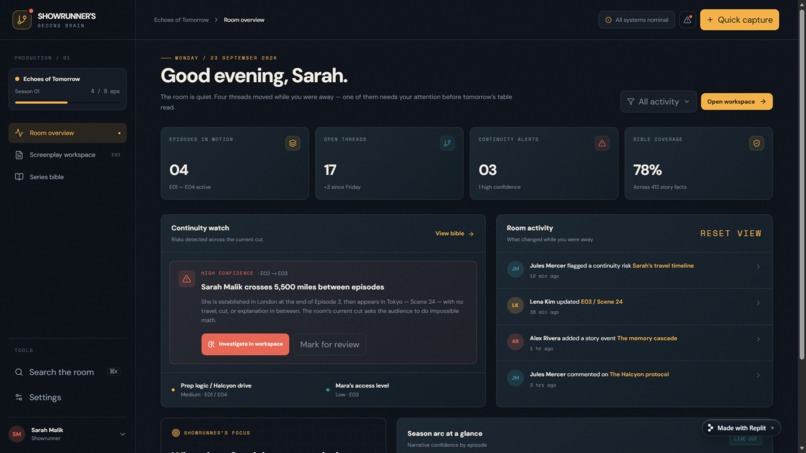
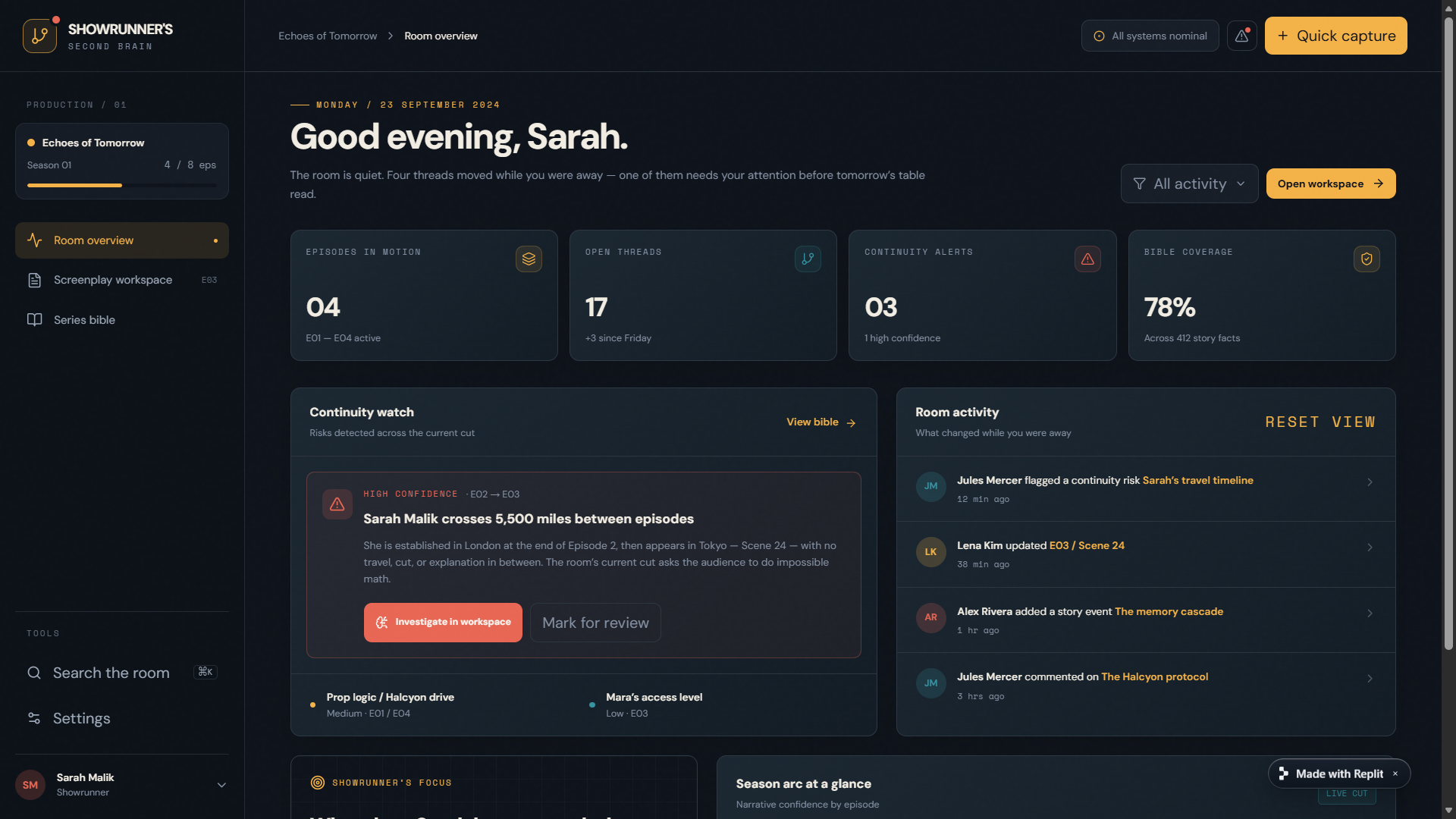
Writers' room overview
-
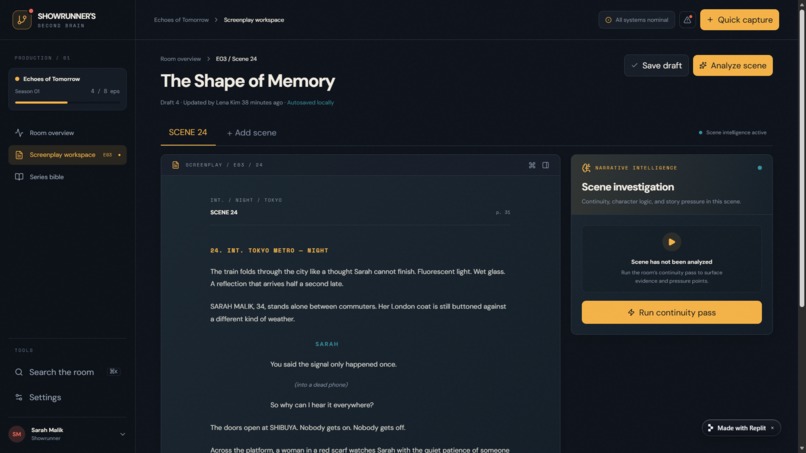
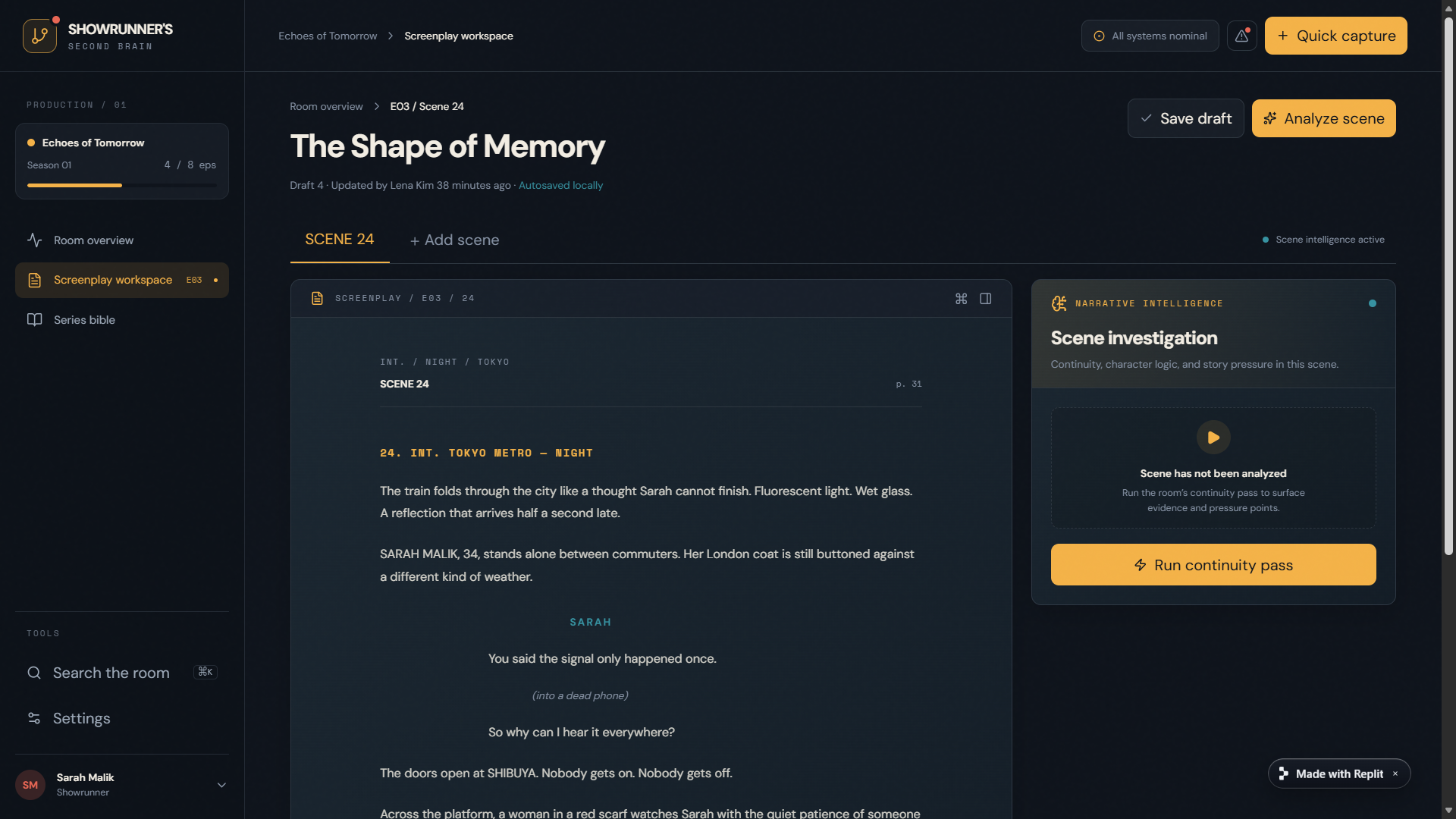
Scene editing
-
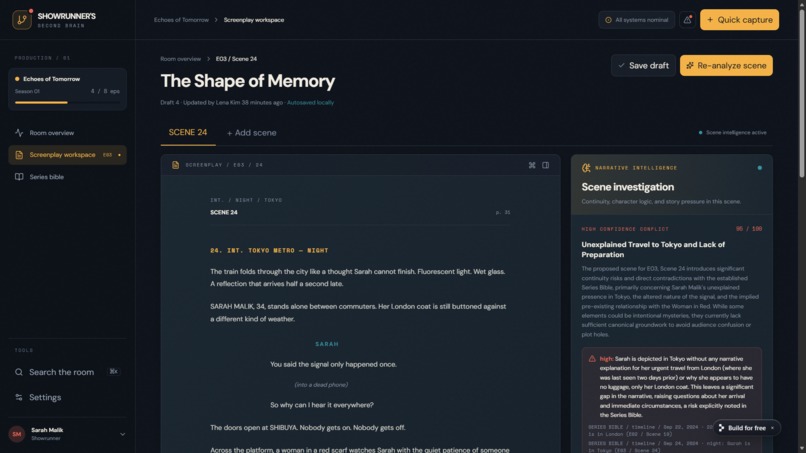
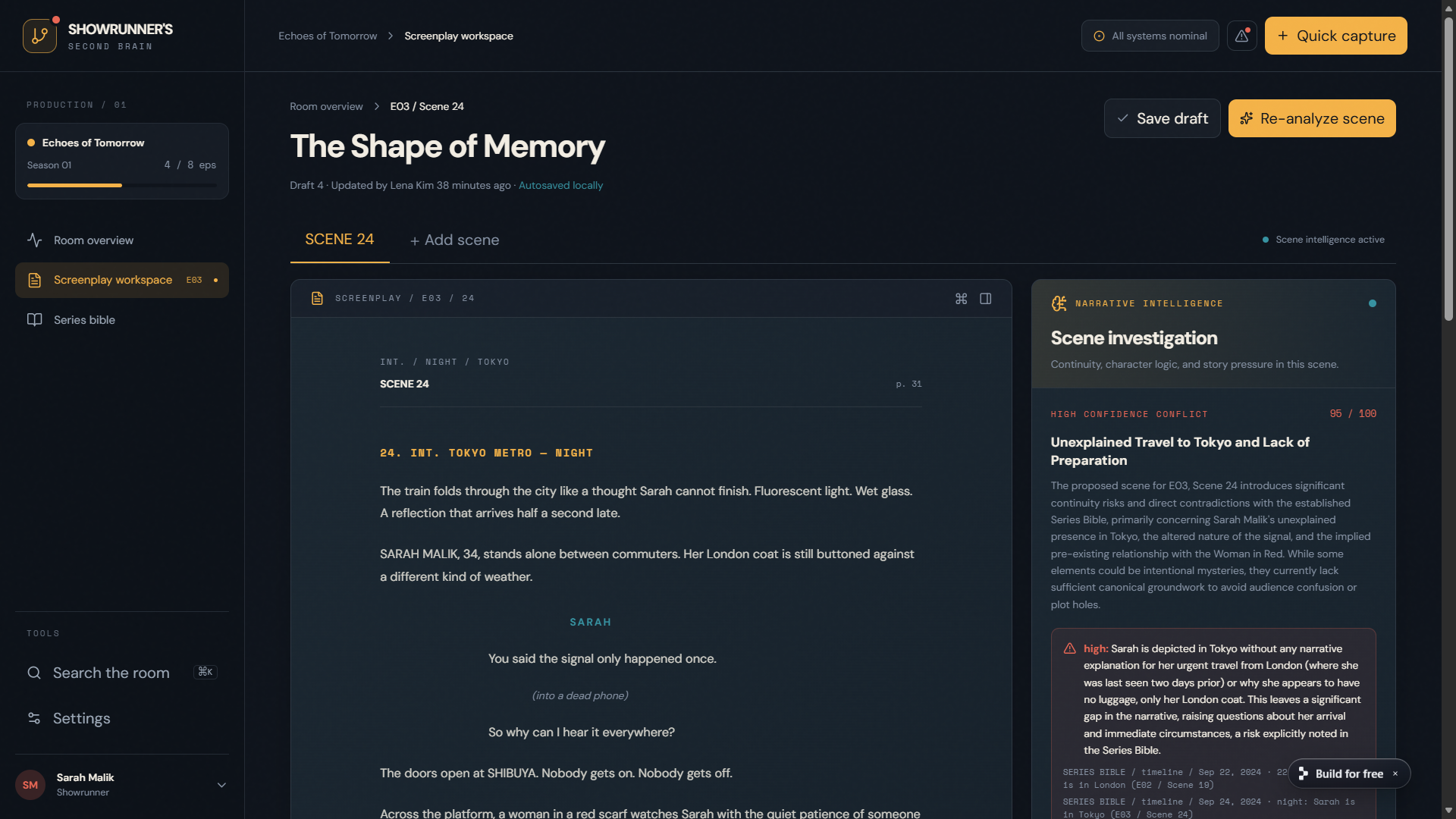
Conflict + evidence + confidence
-
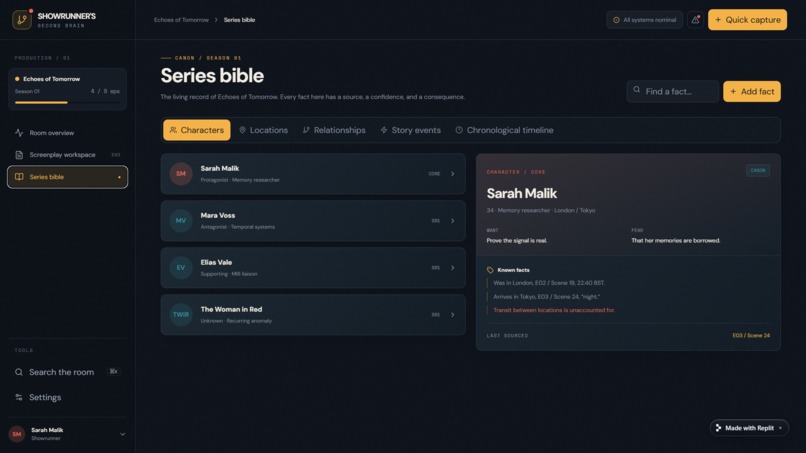
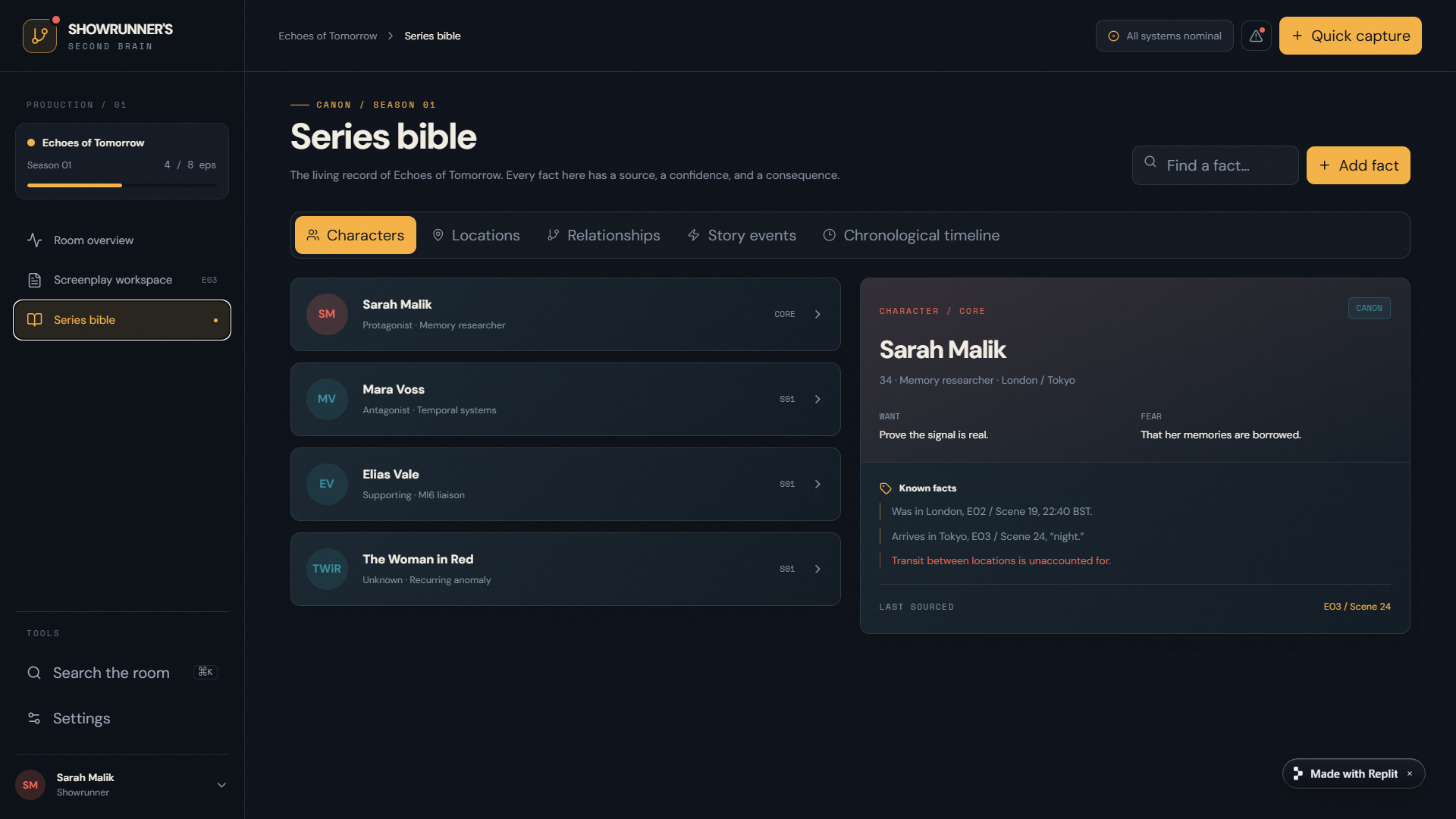
Canon / character information
Inspiration
Writing a serialized story is not just about coming up with good ideas. It is also about remembering everything that has already happened.
Characters move between locations, relationships evolve, objects change hands, timelines progress, and seemingly small decisions can become important several episodes later. As a story grows, keeping all of those details consistent becomes increasingly difficult.
We wanted to build something that could act like a second brain for a writers' room — something that does not replace the writer's creativity, but continuously watches the story's canon and points out problems before they become expensive to fix.
That idea became Showrunner's Second Brain.
What it does
Showrunner's Second Brain is an AI writers' room copilot focused on continuity intelligence and narrative repair.
A writer can provide a screenplay scene together with the show's Series Bible. The system analyzes the scene against established characters, locations, relationships, events, and story rules.
Instead of simply saying that something is wrong, it aims to explain:
- What contradicts the established canon
- Which pieces of evidence support the finding
- How serious the contradiction is
- What narrative consequences it could create
- Multiple ways the writer could repair the storyline
For example, if a character is established as being in London in an earlier episode but suddenly appears in Tokyo without any explanation, the system can flag the contradiction and suggest different narrative explanations rather than forcing the writer into a single solution.
The final creative decision remains with the human showrunner.
How we built it
We designed the application around a fictional television series called Echoes of Tomorrow.
The interface provides a cinematic writers' room workspace containing:
- A Series Bible containing the show's canon
- Character and story information
- A Script Workspace for writing scenes
- Continuity analysis
- Evidence-backed findings
- Narrative repair suggestions
- Story threads and writers' room decisions
The core intelligence is structured as a continuity-analysis workflow:
Series Bible → Screenplay → Continuity Analysis → Findings & Evidence → Narrative Repairs
The backend exposes the analysis through an API, while the frontend presents the results as an interactive writers' room experience.
The AI layer is built around Google's Gemini ecosystem, with an ADK-based continuity-agent architecture designed around three reasoning phases:
- Canon Cross-Referencing & Verification
- Evidence-Backed Discrepancy Evaluation
- Narrative Repair Synthesis
This structure lets the system move beyond simple text generation and focus on reasoning about consistency within an evolving fictional world.
Challenges we ran into
The biggest challenge was that story continuity is contextual.
A sentence can be perfectly reasonable by itself while still contradicting something that happened several episodes earlier. This meant the system needed access to the broader story context rather than treating every screenplay scene independently.
Another challenge was designing useful repairs.
Detecting a contradiction is only half the problem. A writers' room does not necessarily want the AI to simply declare something "wrong." It needs possible ways to make the story work while preserving the writer's creative intent.
We also had to balance AI reasoning with a practical user experience. The output needed to be detailed enough to justify a finding without overwhelming the writer with unnecessary information.
Finally, integrating the AI workflow into a production-style web application required dealing with API boundaries, structured responses, environment configuration, deployment, and frontend/backend synchronization.
Accomplishments that we're proud of
We're especially proud that Showrunner's Second Brain turns an abstract AI idea into a concrete writers' room workflow.
The system can take a screenplay scene, compare it against established canon, identify a high-confidence continuity conflict, present supporting evidence, and generate multiple narrative repair options.
We are also proud of the overall experience. Instead of building another generic chatbot, we created a focused environment designed around how serialized stories are actually developed.
Most importantly, the project demonstrates how AI can support creative decision-making without taking creative control away from the human.
What we learned
We learned that building a useful AI system is not only about choosing a powerful model.
The surrounding architecture matters just as much.
We learned how important structured context is for reliable reasoning, how useful evidence is when presenting AI-generated findings, and why AI suggestions should give users enough information to make their own decisions.
We also learned that a good AI product should have a clearly defined role.
For Showrunner's Second Brain, that role is not "write the story for me."
It is:
"Remember the story, watch for contradictions, explain what went wrong, and help me find a way forward."
What's next for Showrunner's Second Brain
The current system focuses primarily on continuity analysis and narrative repair. The next step is to expand it into a more complete AI writers' room.
Future versions could include:
- Persistent episode-to-episode memory
- Automatic Series Bible updates after approved changes
- Character arc tracking
- Timeline visualization
- Relationship and dependency graphs
- Foreshadowing and payoff tracking
- Voice consistency across episodes
- Detection of unresolved story threads
- Predictive identification of future continuity risks
- Multi-agent collaboration between continuity, narrative, and character specialists
The long-term vision is to create a true second brain for serialized storytelling — one that remembers the entire fictional world while leaving the most important part in human hands:
the story itself.
Built With
- github
- googleadk
- node.js
- pydantic
- python
- replit
- typescript

Log in or sign up for Devpost to join the conversation.