Project name: showroom by SHE
Team: Yuree Hong, Tilman Schlenker, Sean Robert Huff
Project Description: Reinventing co-innovation units to empower problem-solving at a global scale during the era of COVID-19
Inspiration
The global COVID-19 pandemic has acted as a driving force behind the large number of hackathons conducted worldwide thus far in 2020. The digital nature of these hackathon events has allowed eager innovators to participate from any location in the world. NASA, the United Nations and the European Commission have so far supported global virtual hackathons accommodating over 42,000 participants all together.
Gathering this many eager participants is certain to produce loads of prize-winning ideas worthy of practical implementation. However, there is unfortunately no structured way to give life to the award-winning ideas that could benefit the changing world around us. Furthermore, these innovators often lack experience in the crucial steps that take place after garnering initial attention or praise. This experience gap can leave innovators and potential business partners separated not only physically but also in terms of skills and background.
Consequently, the ability of innovators and potential business partners to connect and facilitate the development of market-ready services is sorely lacking at this time. This stands in contrast to the appetite of corporations to develop programs, both internally and externally, that respond to the issues raised by social distancing, border closure, and other realities of the COVID-19 world. These corporations are in urgent need of new solutions that not only stabilize internal operations but also foster innovation in a time of crisis.
Showroom by SHE offers a platform to facilitate the co-innovation process from ideation to launch, bridging the gap between innovative solutions worthy of practical implication and the needs of corporate innovators.
What it does
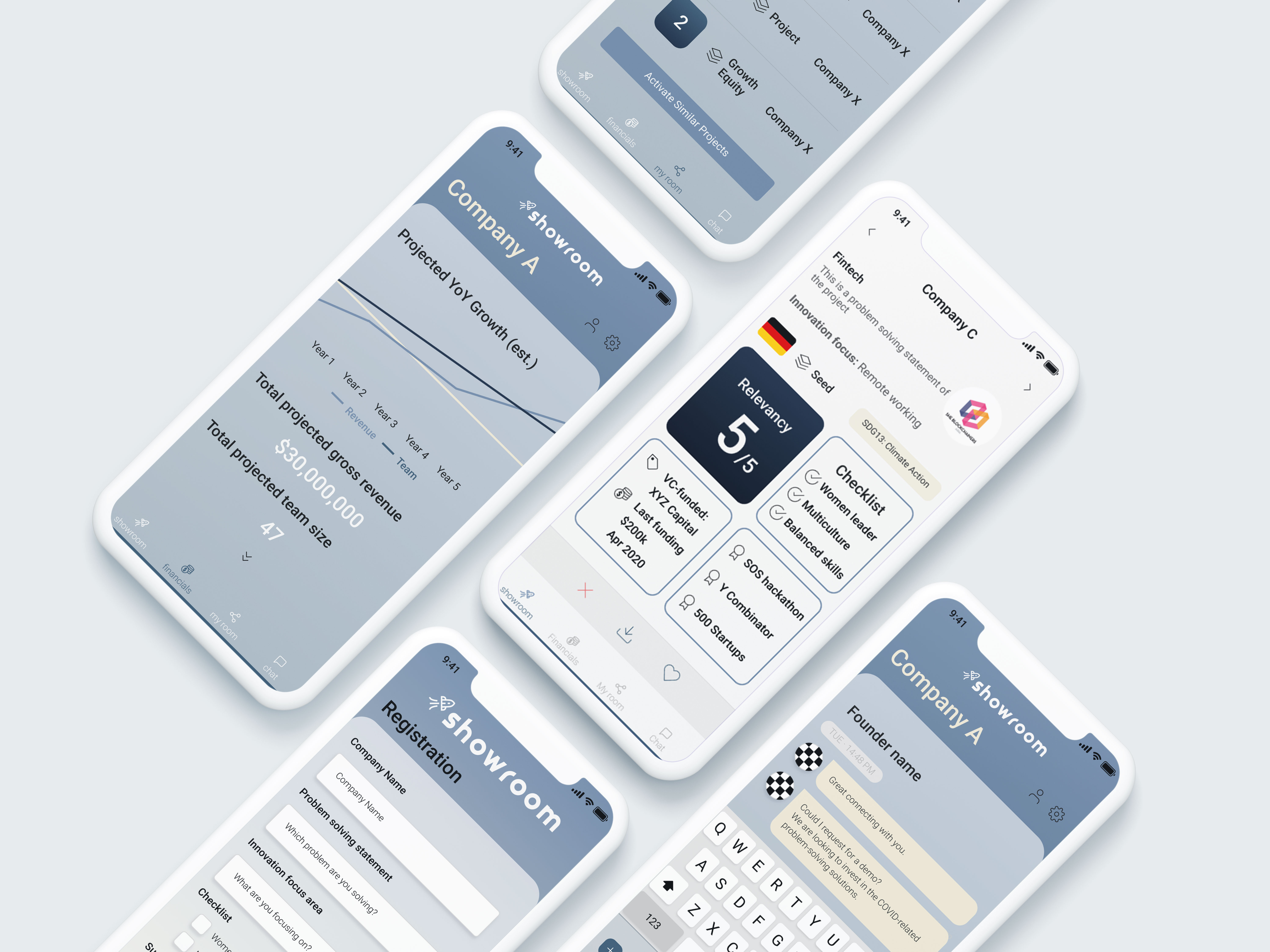
The initial value that Showroom adds to the process of implementing innovative ideas lies in facilitating the conversations and collaboration that must take place once an idea leaves the ideation stage. To bridge innovators and potential business partners, the Showroom mobile platform allows innovators to demonstrate relevant and distinguishing information to potential business partners.
Outsiders can then view this information in a streamlined and efficient fashion, allowing investors, corporates, incubators, and accelerators to find solutions that match their preferences. Within the Showroom interface, a space will be dedicated to factors like employee diversity, skillset balance, and whether or not an idea contributes to UN Sustainable Development Goals.
Key to the successful matchmaking process is the relevance algorithm used to suggest or front-load ideas relevant to user needs and preferences. This relevance score will not remain static, but adaptive to the use pattern of both parties and the development stage of the idea.
Of course, the matchmaking process is not without risks for both parties. Innovators must know that their ideas are safe from copy-cats or intellectual property theft. For their part, Investors must be able to run detailed feasibility checks that ensure an idea is worthy of their attention.
Therefore, Showroom will incorporate immutable distributed ledger technology (i.e., blockchain) to address these concerns and minimize the risk of conflict of interest. Blockchain will act as a secure means of sharing the right information with the right parties at the right time. Additionally, secure chat history will be used not only to support the ease and dependability of communications, but also facilitate the entry and exit of new parties as the process of idea implementation unfolds.
At first, Showroom’s secure digital environment will enable requests for access and supplemental information as both parties develop an understanding of their mutual fit. Afterwards, this digital infrastructure allows outside parties to be included into the innovative process to facilitate procurement and other activities. To serve as a guide for entrepreneurs and business partners alike, Showroom will facilitate pre-set standardized processes that establish checkpoints and provide an accountable means of task management.
How I built it
Mobile app: We first developed a user-centric design based on the survey we ran with the potential target users. Through this survey, we learned that corporate and other potential idea buyers approach an idea in a two-stage process. First, they would like to see and understand clearly what ‘problem’ the ideas are solving. Then, buyers or investors place their focus on the core innovation associated with each idea.
In the interest of sustainable and socially responsible business practices, we then redirects buyers and investors to a subsequent step: considering whether or not an innovative idea furthers sustainable development (e.g., UN SDGs) or satisfies checklists surrounding the topics of diversity, inclusion, and skillset balance.
Deep tech: At present, the deep tech to be used in our idea exists in the conceptual stage. We will further develop the relevance-matching algorithm through gathering and analyzing quality, improving the relevancy score over time. We plan to leverage existing public blockchain technologies to support the hashing algorithm that facilitates data encryption and user-specific access layers.
Challenges I ran into
One challenge encountered during the design of the product was producing the product and business model within the three weeks allotted. Because we were also juggling other responsibilities, the team had to collaborate remotely and work over the weekends to make things work.
Key to overcoming this challenge was the initial process of defining a team member’s roles and responsibilities in a way that allowed each team member to know what is expected of them. This process also allowed team members to feel as though they are making genuine contributions. Luckily, having a team full of self-disciplining individuals makes organizing workflows much easier.
Furthermore, another core element of our approach to the constrained time was the practice of remaining focused on the core problem we are trying to solve. At each stage of the ideation and execution process, keeping the question of “What problem are we really solving?” at the forefront of our minds was key to guiding our discussion and collaboration.
Accomplishments that I'm proud of
The accomplishment we are most proud of is building a scalable prototype from zero. One aspect of our prototype building that we are most happy with was developing an idea that remained true to the needs of potential users. Online research, questionnaires, and consulting with industry experts was key to building a prototype that worked toward solving problems experienced by real people.
Another component of building our prototype was the approach that we took to making it. Rather than focusing on dramatic innovation that stretched the bounds of what was technically possible or implementable, we thought that making a series of small process improvements could add more value to the industry. Packaging these incremental changes within our prototype seemed like the best way for us to respond to the business climate as it is shaped by COVID-19.
What I learned
We’ve learned that the process of working as a virtual team can be uneasy. This is especially true in terms of time management and communication, which are insights that we plan to incorporate when remaining focused on the problems that we can solve for our users through the prototype we’ve created.
Ultimately, we are thankful for the SOS Hackathon’s Discord team channel as it was helpful in streamlining workflows and saving each team member’s time.
What's next for showroom by SHE
So far we’ve developed a prototype of the showroom mobile app, which has features that showcase award-winning solutions and startups built during the COVID-19 pandemic. The next version of the mobile app will implement development of features surrounding user preferences, registration, and uploading information necessary to the verification process. To this end, we began the process of beta tester registration during the hackathon.
Following that, attention will be devoted to development of the Showroom web platform. The web platform will incorporate e-procurement standards widely used within the industry. It will also facilitate the legal and financial documentation portion of the procurement process.
Lastly, the Showroom web platform will assist in digital purchase ordering, auction, and payment processes. When a financial agreement is reached between both parties, Showroom’s secure payment system allows for milestone-applied payments. This payment system accompanies the business arrangement all the way from the initial stages of running a pilot until the eventual purchase, a process that usually takes six months to a one year.
At its core, Showroom will act to reduce the hassles caused by complicated legal and financial processes currently used during the procurement stage.


Log in or sign up for Devpost to join the conversation.