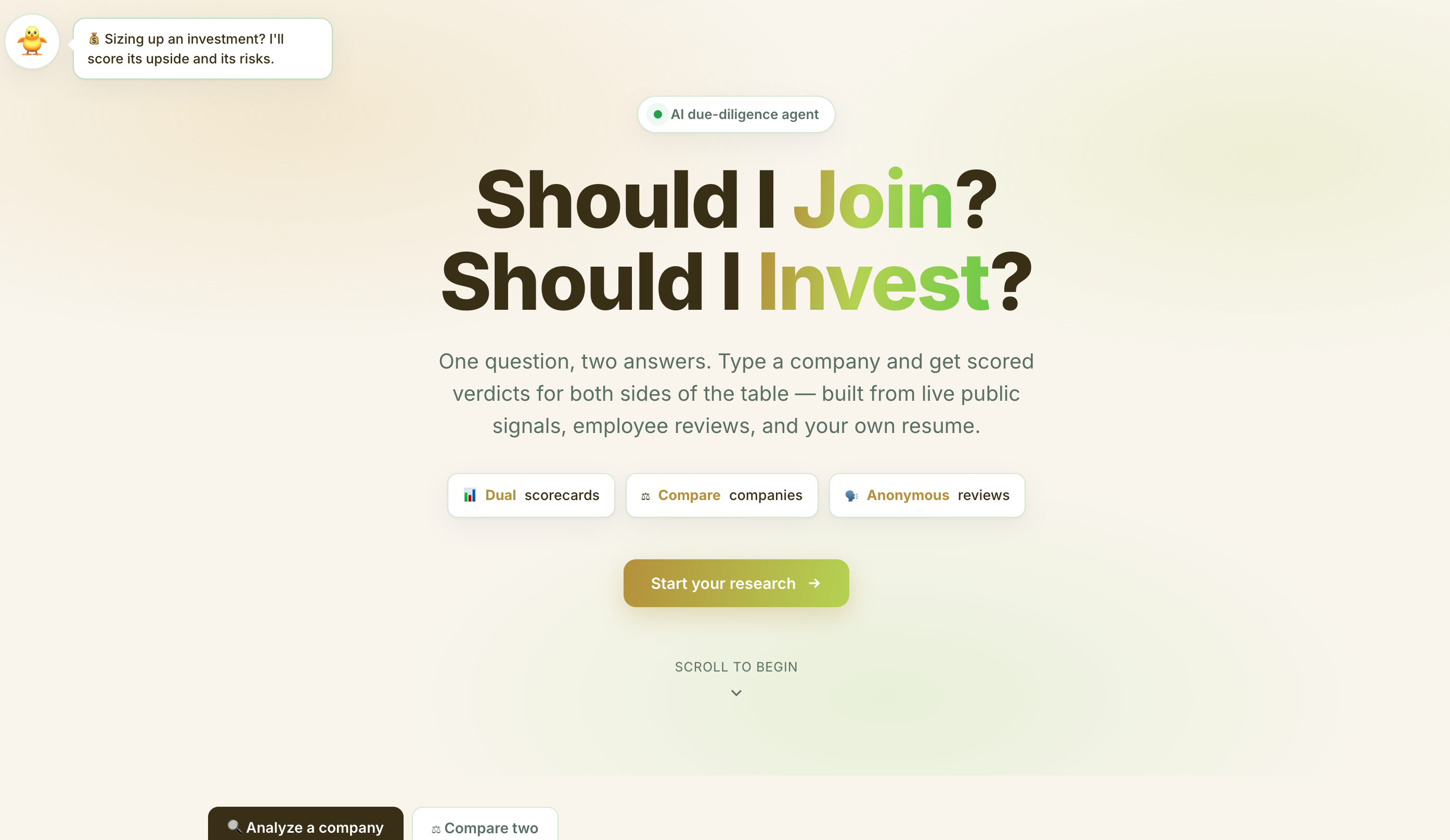
Inspiration Two of the biggest decisions anyone makes about a company are really the same question from opposite sides of the table: should I work here? and should I invest here? Both run into the same unfair truth — the company knows everything about itself, and you know almost nothing. Job-seekers scrape Glassdoor; investors pay for Crunchbase; everyone else just asks ChatGPT and gets a confident, sourceless guess. We wanted to close that information gap and give an individual the same diligence power a VC analyst or an HR insider has — for free, in seconds.
What it does You type a company name — or just paste its website — and get two scored verdicts from live public signals:
👤 As a job-seeker: Join / Consider / Avoid 📈 As an investor: Invest / Watch / Pass Each verdict is broken into weighted dimensions (team, market, financials, culture, risk…), every dimension cites the sources it used, and red flags are surfaced explicitly. You can compare two companies side by side, see a 3D dimension radar and a financial-strength trajectory, and — if you've worked somewhere — leave an anonymous review for a reward that feeds back into future analyses. If a company name is ambiguous, it asks which one you mean instead of guessing.
How we built it Backend: A single FastAPI service that also serves the UI (no CORS headaches). Multi-agent engine (Google Gemini): Five specialist agents — team, market, financials, culture, and risk — each investigate only their slice of evidence in parallel, then two synthesizer agents reweigh their findings through the investor lens and the job-seeker lens. Specialists run on fast Gemini 2.5 Flash; final synthesis on 2.5 Pro. Live evidence: Tavily (18 search angles + deep page extraction), the GitHub API for engineering health, and the company's own website. Data layer: ClickHouse Cloud stores signals, scorecard history, and anonymous employee reviews. Frontend: A single dynamic dashboard — hero landing, hand-built SVG 3D radar and line charts, a compare view, and a playful theme that shifts color each visit. Challenges we ran into Hallucination vs. grounding: Early single-prompt versions produced confident, wrong answers. Splitting work across focused agents and forcing "cite sources / say 'not disclosed'" rules fixed it. JSON truncation: Gemini 2.5 Flash is a thinking model — its hidden reasoning ate the output budget and cut off the JSON. We disabled thinking for structured calls and raised the token cap. Same-named companies: Analyzing the wrong "Atlas" is worse than no answer, so we built a disambiguation step that asks first. Failing loudly: When our search quota ran out, the app silently produced empty reports. We made it detect the failure and tell the user instead of faking confidence. Pasted URLs and niche companies: A pasted link broke every query; tiny startups returned almost nothing. We normalized URLs and deepened company-site extraction so even low-footprint companies get real coverage. Accomplishments that we're proud of A genuinely multi-agent pipeline — not one mega-prompt — that's faster and deeper thanks to parallelism. Dual-persona verdicts from one run — the same evidence, judged two different ways, that actually diverge. Evidence-grounded and honest by design: cited sources, disambiguation, no-guess rules, and loud failures. A community data flywheel (anonymous reviews + rewards) that makes the product smarter the more it's used. A polished, decision-grade UI built from scratch — 3D radar, financial trajectory charts, and a side-by-side compare — with no chart libraries. What we learned For high-stakes answers, orchestration and grounding beat a bigger prompt. Narrow agents with relevant context are more accurate than one model trying to do everything. Honesty is a feature. Asking "which company?" and admitting "not disclosed" builds more trust than a fluent guess. The hardest part of an AI product isn't the model — it's data quality, disambiguation, and graceful failure. What's next for Should you JOIN or INVEST? A browser extension that drops a verdict right onto any LinkedIn profile or job posting — diligence where the decision actually happens. Grow the anonymous-review network with real rewards until that proprietary dataset becomes the moat. Autonomous research (agents that decide their own follow-up searches) and "similar companies" via ClickHouse vector search. Go-to-market: free for individuals, premium for recruiters and VC analysts, and an API for job boards and accelerators — on the way to becoming the trust layer every candidate and investor checks before they sign.
Built With
- claude
- clickhouse
- fastapi
- python
- tavily

Log in or sign up for Devpost to join the conversation.