Inspiration
As a real estate investor frustrated by disjointed spreadsheets and guesswork in fix-and-flip deals, I wanted a tool that centralizes every critical calculation—from renovation costs to ROI—backed by real market data. Watching peers lose money on miscalculated risks or overestimated ARVs pushed me to build something that demystifies flip investing for both new and seasoned investors.
What it does
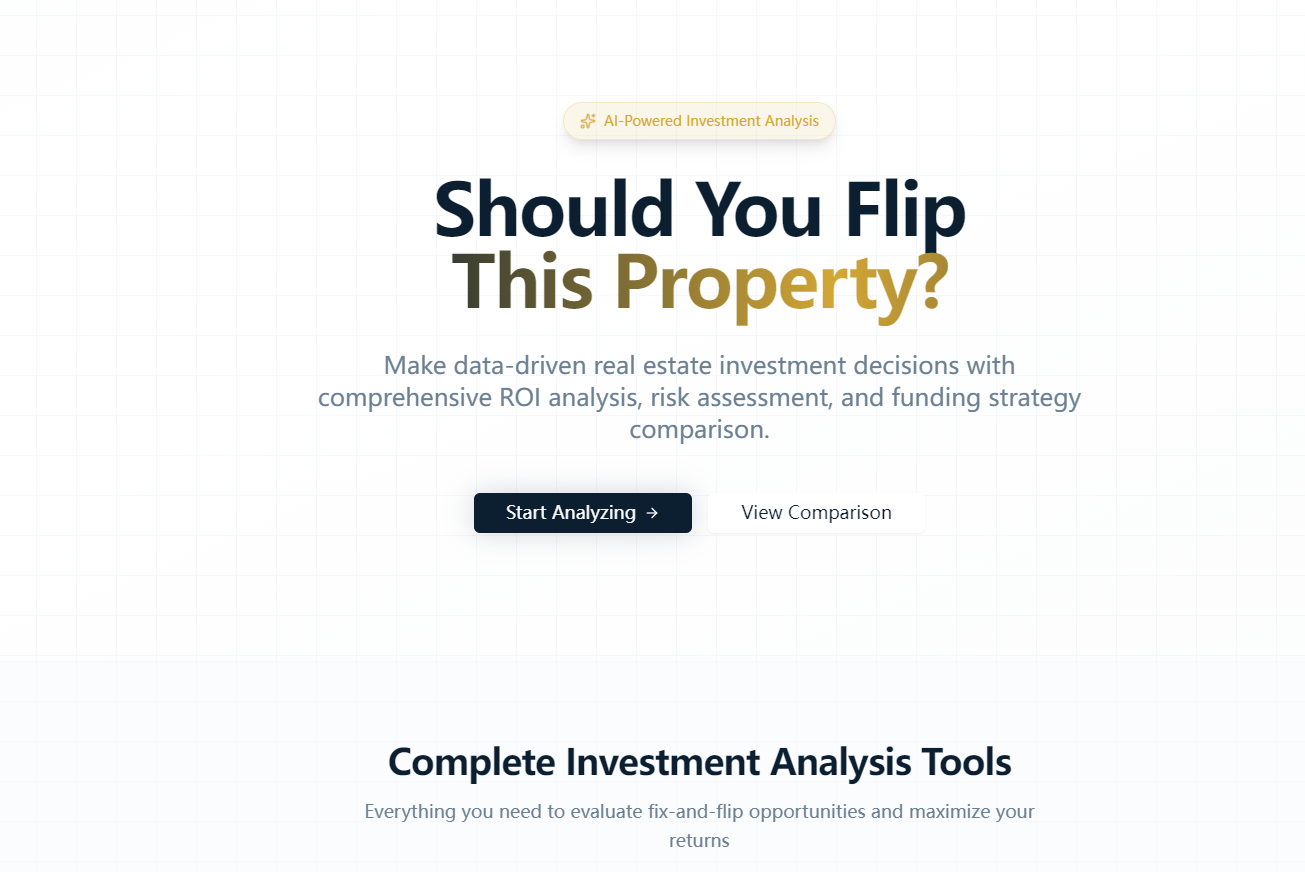
PropertyFlip Analyzer is an all-in-one platform for real estate fix-and-flip investors. It surfaces undervalued properties, auto-calculates renovation costs (by scope/sq ft), uses AI to predict after-repair value (ARV) via local comps, computes ROI in real time, assesses market risk, and compares funding strategies (cash, mortgage, hard money) to maximize returns.
How we built it
We started with core financial logic (e.g., $\text{ROI} = (\text{Net Profit} ÷ \text{Total Investment}) × 100$) coded in Python, then built a React frontend for intuitive input/output. We integrated real estate APIs for comp data, trained a TensorFlow model for ARV prediction, and used PostgreSQL to store property/analysis data. AWS hosted the backend, with Chart.js powering visual dashboards.
Challenges we ran into
The biggest hurdle was refining the AI ARV model to account for hyper-local market nuances (e.g., neighborhood-specific value adjustments). We also struggled with real-time calculation sync—ensuring ROI/risk metrics updated instantly as users adjusted inputs required optimizing state management in React. Securing reliable, up-to-date real estate data APIs (without MLS integration) was another key challenge.
Accomplishments that we're proud of
We created a tool that turns complex flip math into actionable insights—users no longer need to juggle 5+ tools to evaluate a deal. The risk assessment feature (which flags high-renovation risk or low-demand areas) has already helped beta users avoid bad investments, and the funding strategy comparator consistently guides users to 10-15% higher net profit on simulated deals.
What we learned
We deepened our understanding of real estate finance (e.g., hard money loan amortization, holding cost calculations) and AI model fine-tuning for niche use cases. We also learned that user-centric design is critical—simplifying complex metrics (like ARV adjustments) into sliders/visuals made the tool accessible to non-technical investors.
What's next for this project
We plan to add localized market trend forecasting (beyond current indicators), integrate with contractor cost databases for more precise renovation estimates, and build a mobile app for on-site property analysis. We’re also exploring partnerships with private lenders to embed pre-qualification tools in the funding strategy section.

Log in or sign up for Devpost to join the conversation.