-
-

Website
Inspiration
We've all had that moment of staring at an "Add to Cart" button, torn between wanting something and knowing we probably don't need it. Impulse purchases add up fast, and most budgeting apps only tell you what you already spent, not what you're about to spend. We wanted a tool that steps in at the actual moment of decision, before the money is gone, and gives an honest, personalized answer instead of a generic rule like "wait 24 hours."
What it does
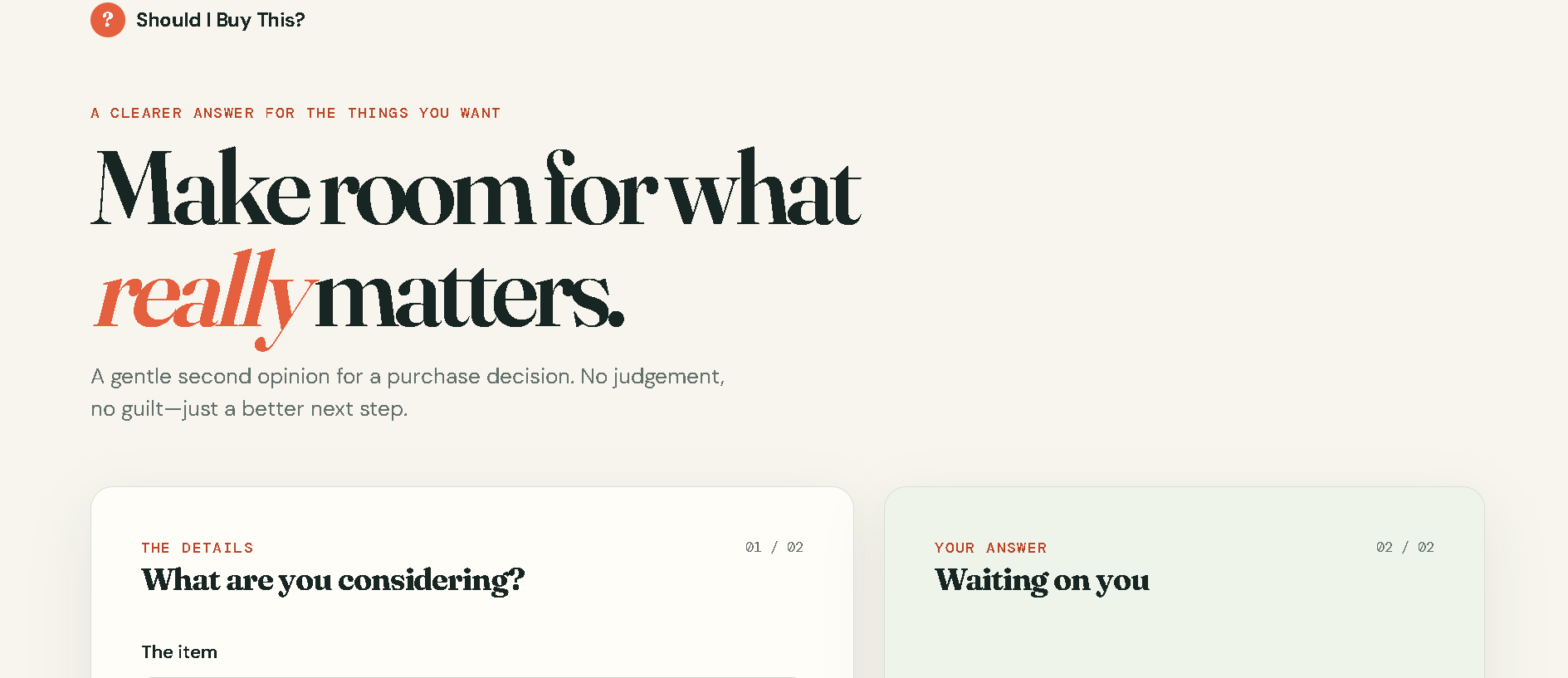
Should I Buy This is a quick decision assistant for purchases. You enter an item (name, price, and optionally a link or photo), and the app asks a few short questions:
- How much you make
- How badly you want it, on a scale of intensity
- When you last bought something similar
Based on your answers, it gives you a clear verdict, Buy It, Wait a Week, or Skip It, along with a short plain language explanation of the reasoning.
How it works under the hood
We score each purchase with a weighted formula before handing the result to GPT 5.6 for the natural language explanation:
$$ S = w_1 \cdot \frac{P}{I} + w_2 \cdot D - w_3 \cdot R $$
Where:
- \(P\) = price of the item
- \(I\) = monthly income
- \(D\) = desire intensity, on a scale of \(1\) to \(10\)
- \(R\) = recency, days since a similar purchase
A higher score \(S\) pushes the verdict toward Skip It, while a lower score pushes toward Buy It. The weights \(w_1\), \(w_2\), \(w_3\) were tuned by hand through testing, then GPT 5.6 turns the raw score into a short, honest explanation instead of just showing a number.
How we built it
We built the app using Codex and GPT 5.6 for both the interface and the decision logic. Codex generated the initial project scaffolding, the input form, and the results screen, which we then refined through iterative prompts. GPT 5.6 powers the reasoning layer that takes the score \(S\) above and produces a verdict with a natural language explanation. We used Codex heavily throughout, from scaffolding components to debugging edge cases in the form logic, and treated it as a pair programmer for nearly every step since our own coding background is limited.
Challenges we ran into
As beginners, the biggest challenge was translating a simple idea into working code without getting lost in unnecessary complexity. We also had to tune the scoring formula so it felt fair across very different price points, since a $20 item and a $2,000 item need different thresholds to feel "right."
What we learned
We learned how much can be accomplished quickly by leaning on Codex for both structure and logic, and how important it is to scope a project down to one clear input to output loop rather than trying to build everything at once.
What's next for Should I Buy This
Next steps include saving a history of past decisions so users can see spending patterns over time, adding photo based item entry, and letting the weights \(w_1\), \(w_2\), \(w_3\) in the formula adjust automatically based on the user's own financial goals.
Built With
- codex
- css
- gpt-5.6
- html
- javascript
- node.js
- openai-api
- react

Log in or sign up for Devpost to join the conversation.