-
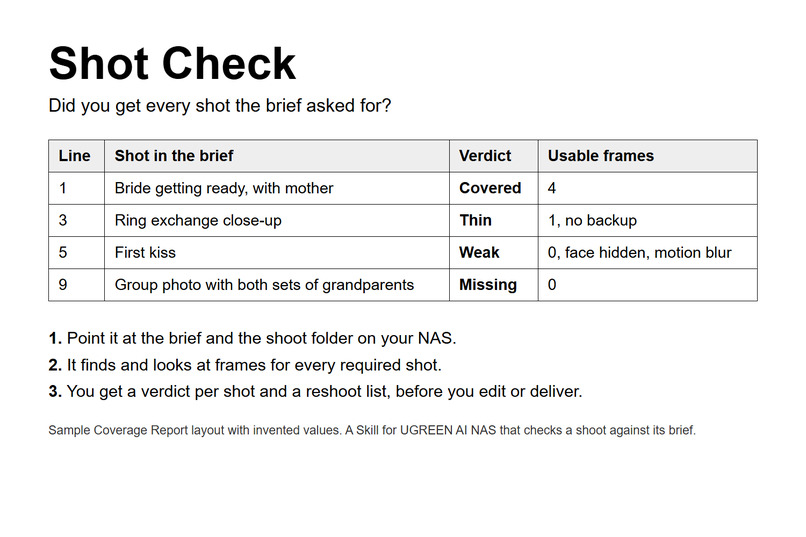
shot check
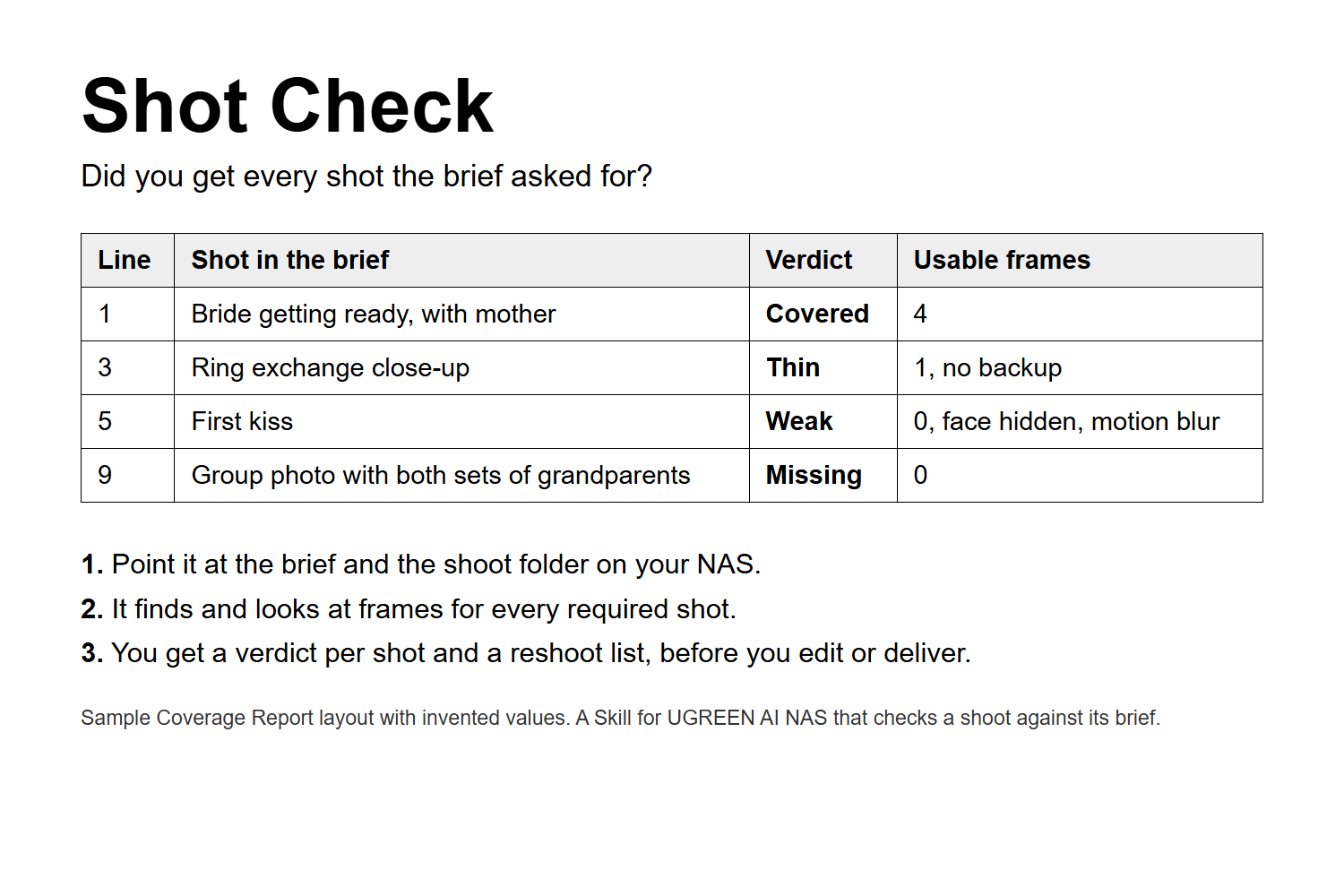
Inspiration
Every shoot has two things: a brief that says what the client needs, and a folder with thousands of frames. The check between them is still done by eye. When a must-have shot is missing, you usually find out during the edit, after the venue is empty and the people have gone home. Culling tools can tell you which frames are sharp, but none of them know what the job actually required. A NAS already holds both the brief and the shoot, so it is the right place to compare them.
What it does
Shot Check compares a photo or video shoot stored on a UGREEN AI NAS with the shot list or client brief for that job.
- It reads the brief and turns it into a numbered shot list, which you confirm.
- It finds candidate frames for each shot inside the shoot folder only.
- It looks at the strthey really show theshot and are usable.
- It gives each shot or more usableframes), Thin (one usable frame, no backup), Weak (frames exist but all have a visiblsed eyes) or*Missing*.
- It produces a reshot.
- On request it saves the report, creates a selects album and tags the selected frames.
- After a reshoot it rechecks only the shots that were not yet covered.
Nothing is written to the NAS unless you ask for it and the platform approves it.
How we built it
Shot Check is a Markdbuilt with the UGREENSkill Developer Package 0.7.7 against capability catalog 2.2.0. The Skill does not run coach step to aregistered expert and passes only real results forward:
- file-agent locates the brief and the shoot folder, and tags the selects.
- document-agent reads the brief into shot lines.
- photo-agent seand person, checks each frame with the on-device vision model, and creates the album.
- knowledge-agent The verdict rules, re separate referencefiles linked from SKILL.md. I used Claude Code to help develop the iread the capability ce files. ## Challenges we ran - **No hardware in Ro designed against thepublished catalog without seeing real expert output, so each step stexactly which facts iy are absent.
- Search hits are not proof. A search result can look right and still be the wrong shCovered after a framehas actually been looked at.
- **Not borrowing frome from a differentshoot would hide a real gap, so every search is limited to the one shoofolder.
- Keeping it bounded. Vision checks are expensive, so each run is capped at 40 shots an. ## Accomplishments th - The package passes ith zero errors andzero warnings. - The Thin verdict: ihot rests on a singleusable frame. - It reports what is search cannot show.
- It is honest about its limits: unchecked shots are labelled Uncheckedand an unindexed foldd of twelve falseMissing results.
## What we learned - How UGOS Skills work: the Skill describes the workflow and registeredexperts do the real N
- Clear failure handling matters as much as the main path. Most of the design time went intos, failed steps anddeclined approvals.
- Starting from the u gives a more usefulresult than starting from the media.
## What's next for Shot Check - Test on a real UGREEN AI NAS iDX6011 Pro with a seeded shoot and a 12-line brief.
- Measure how well content search and the vision model judge blur and closed eyes, and tune
- Review full video clips, not only a still.
- Support storyboards, so coverage can bechecked scene by scene.
Built With
- markdown
- ugos
- ugreen-ai-nas
- uliya-skill-kit
