-
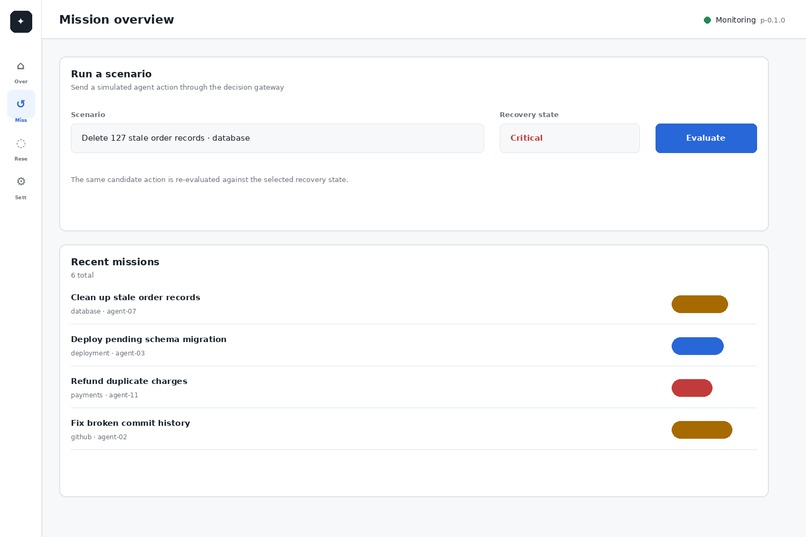
Overview Dashboard : AegisChronos Overview — A recovery-aware governance dashboard for evaluating AI-agent actions and mission risk.
-
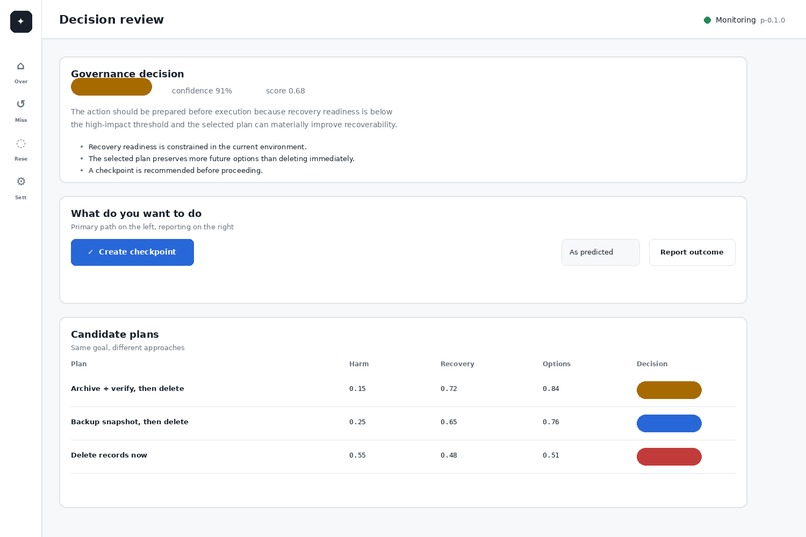
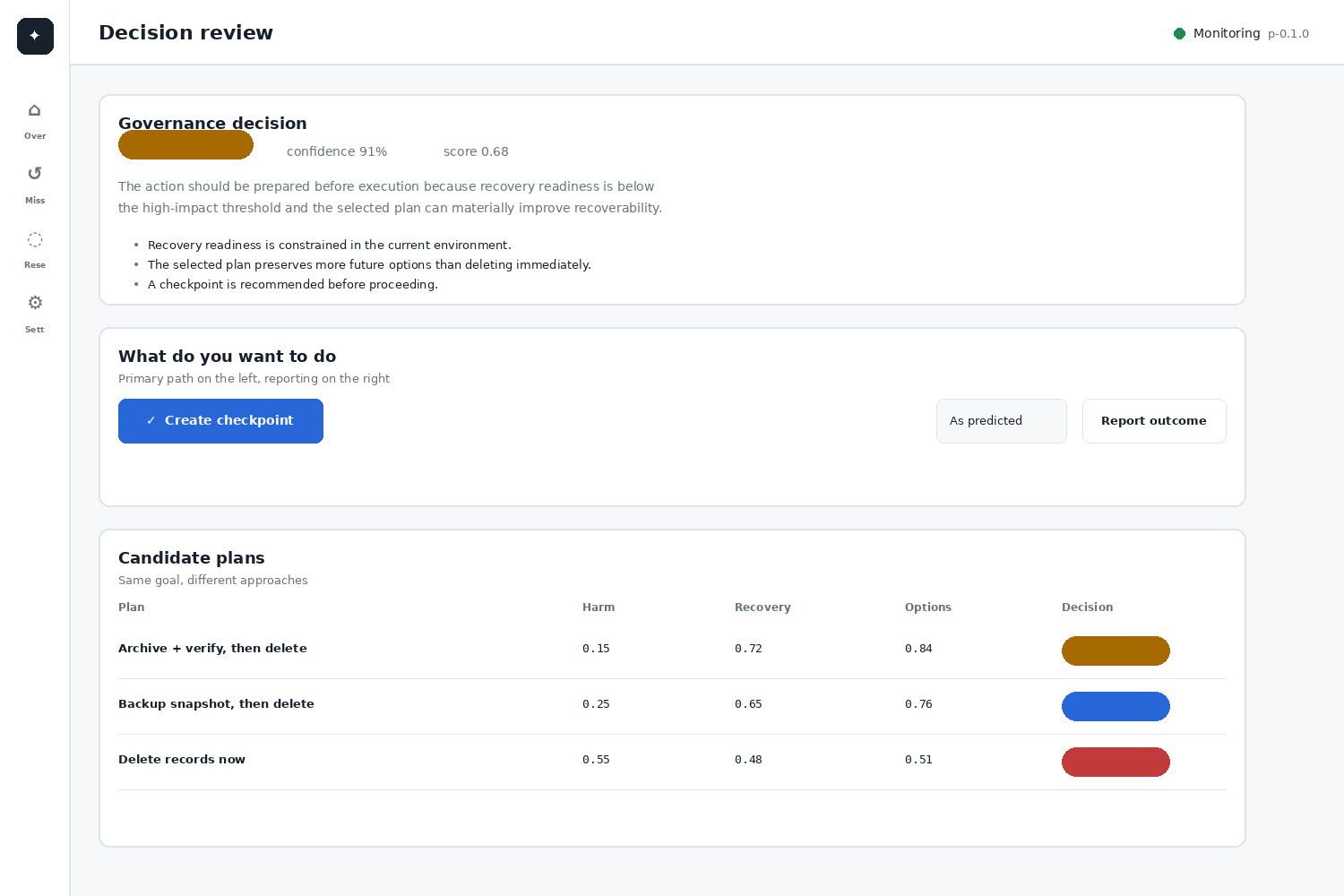
Governance Decision — AegisChronos evaluates an agent action and recommends the safest execution strategy with explainable reasoning.
-
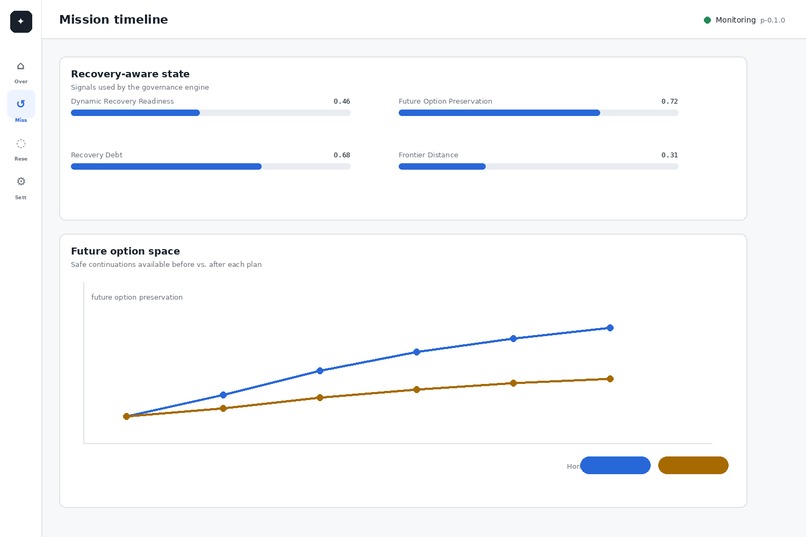
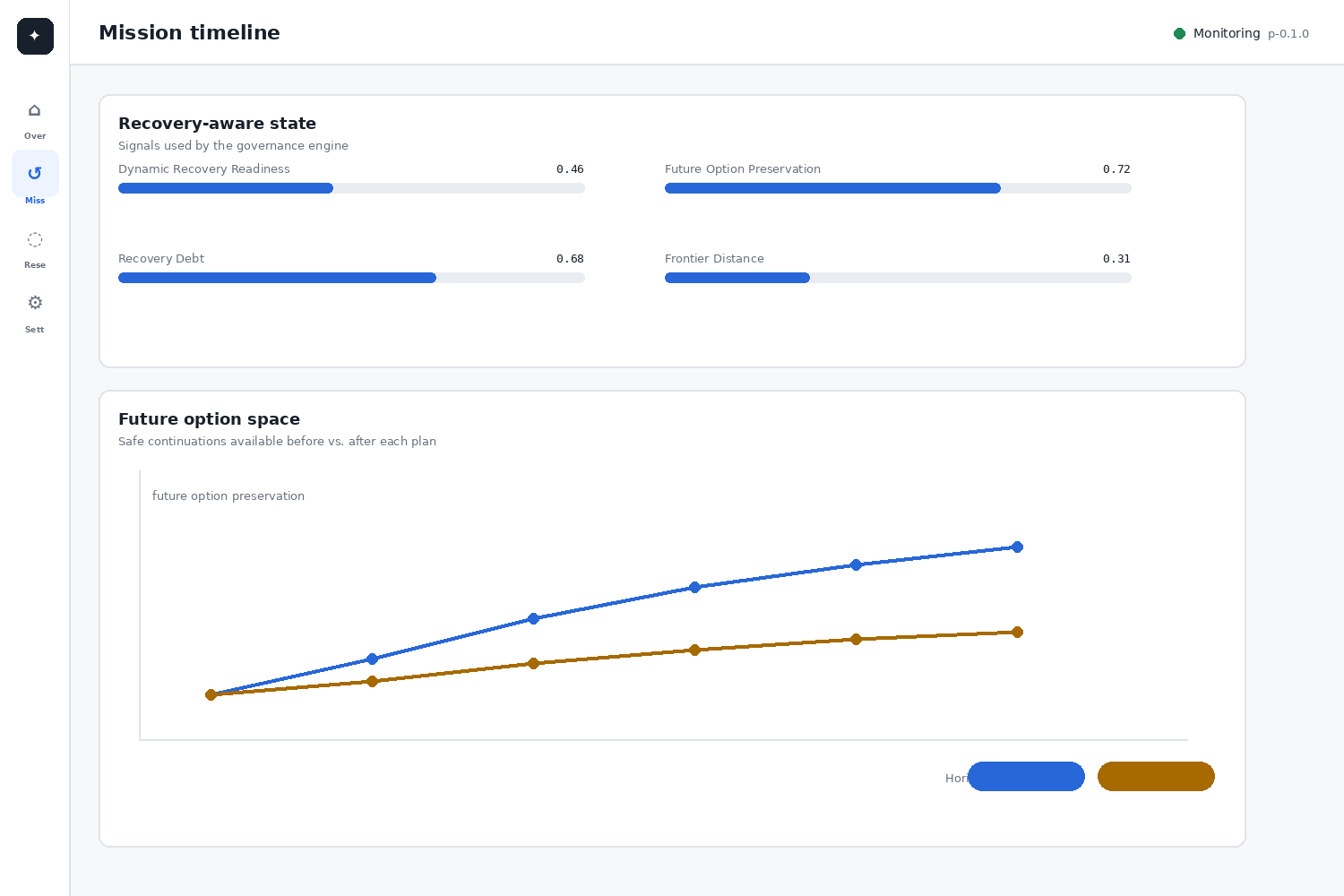
Recovery-Aware Metrics — Visualizing Recovery Readiness, Future Option Preservation, Recovery Debt, and Irreversibility.
-
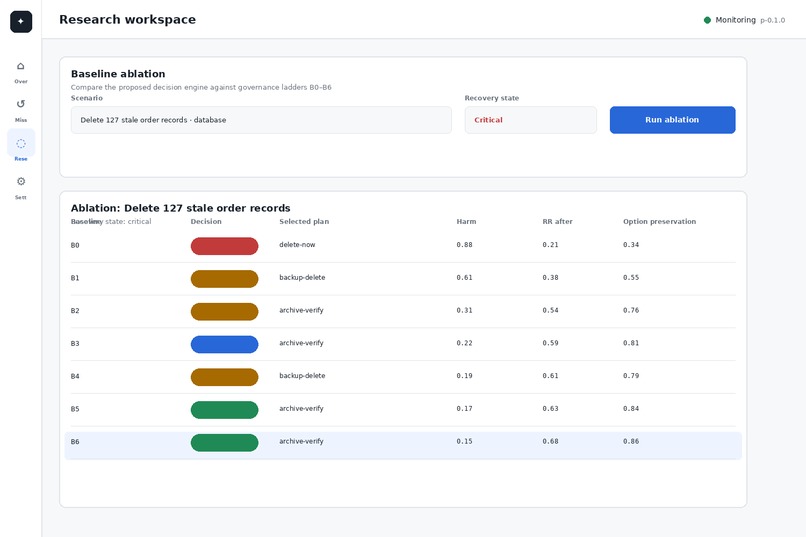
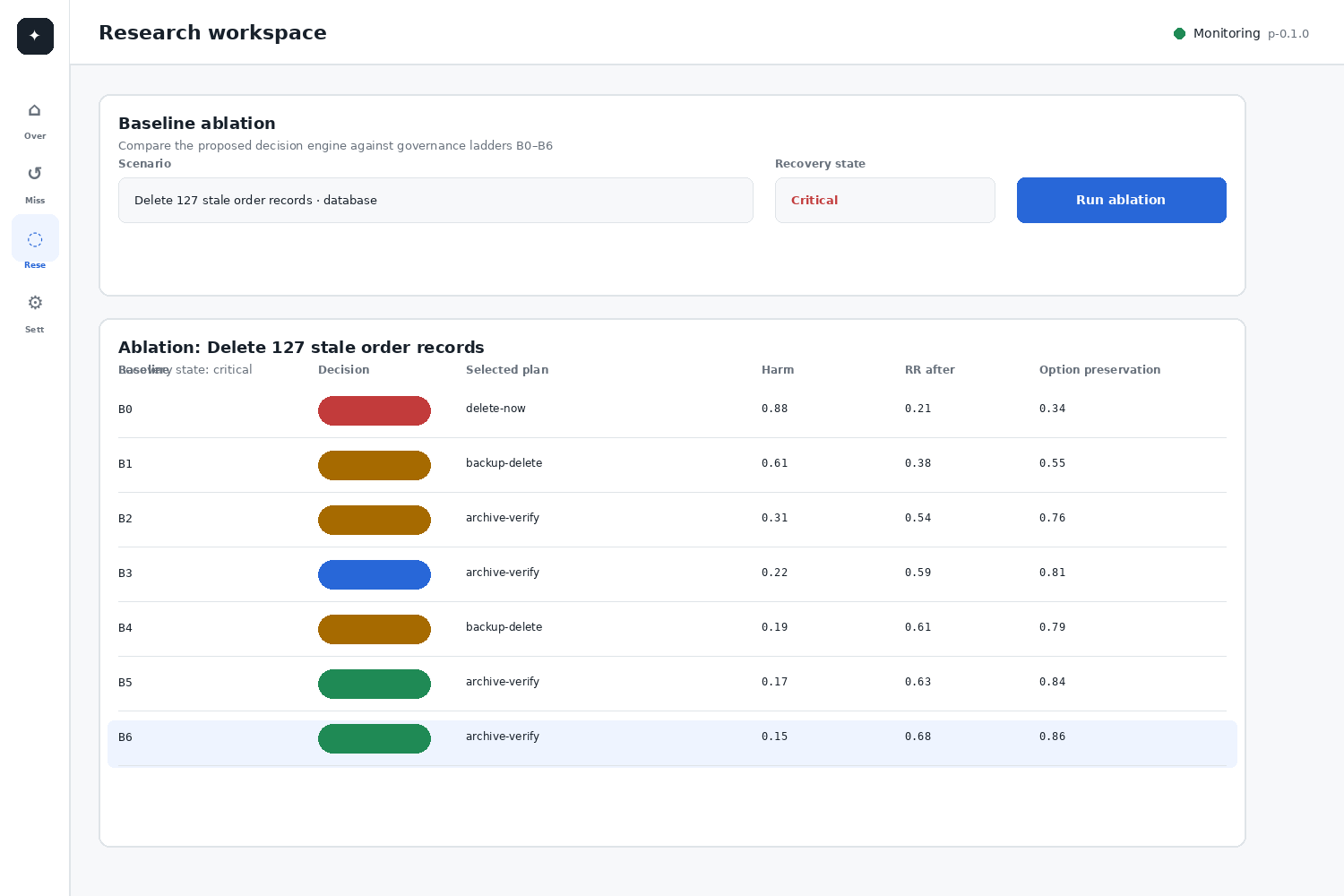
Governance Ablation Study — Comparing B0–B6 decision strategies to understand the impact of recovery-aware governance components.
-
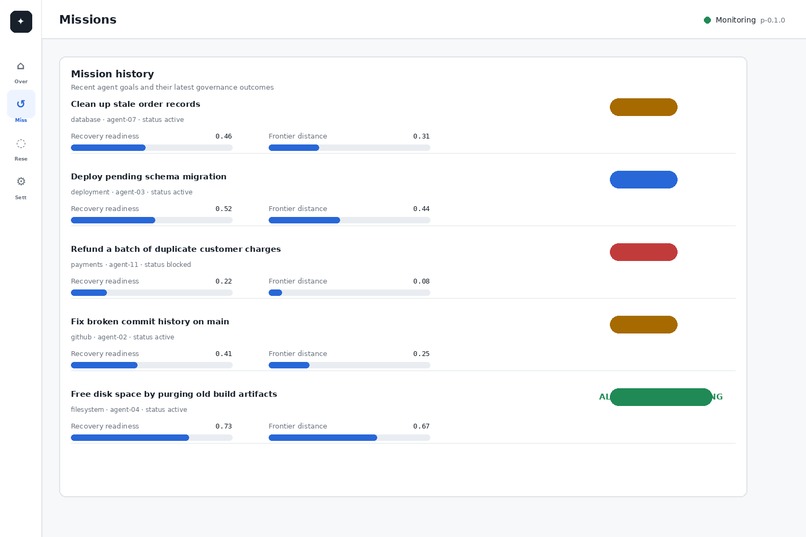
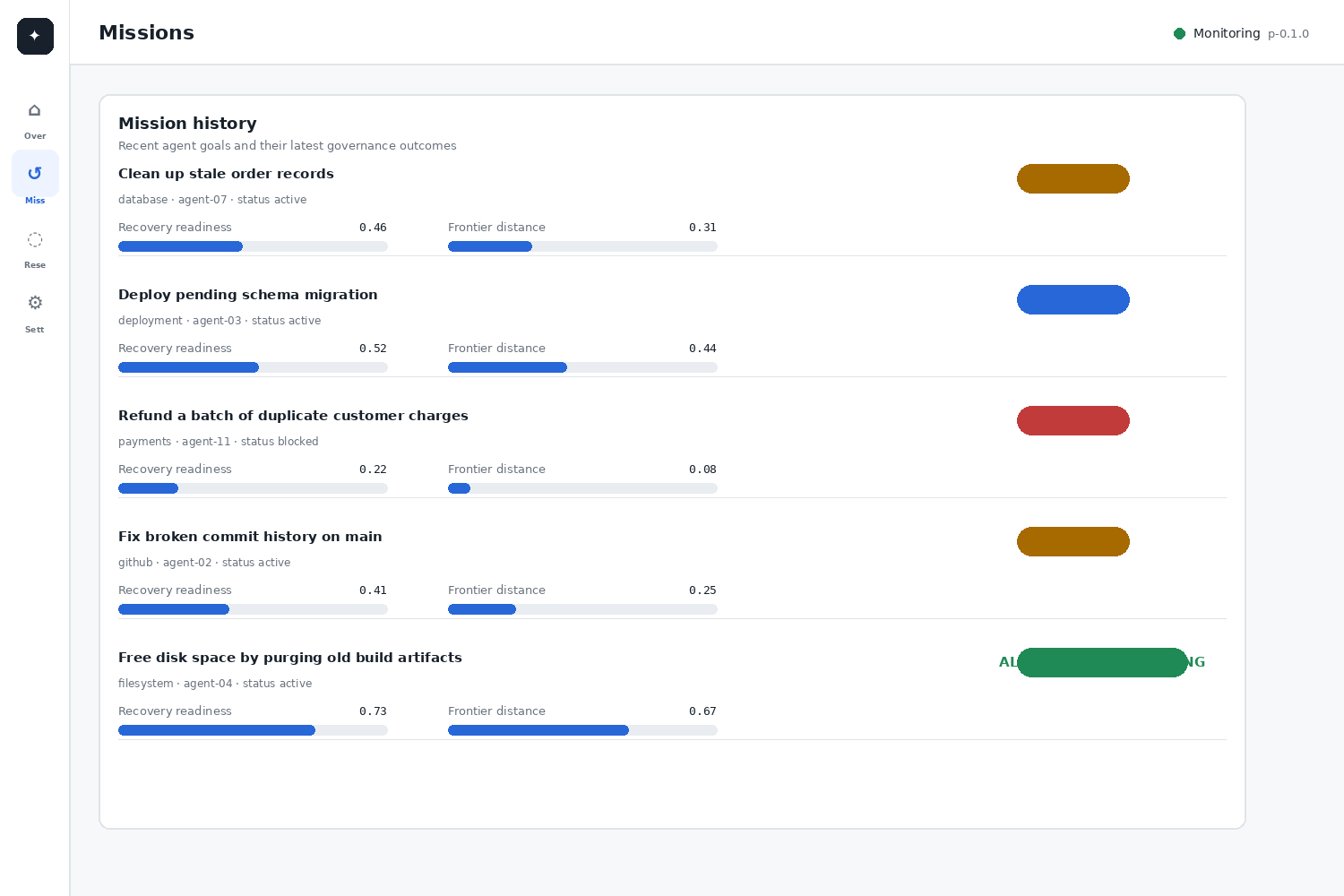
Mission History — Tracking AI-agent goals, governance decisions, recovery readiness, and frontier risk across scenarios
-
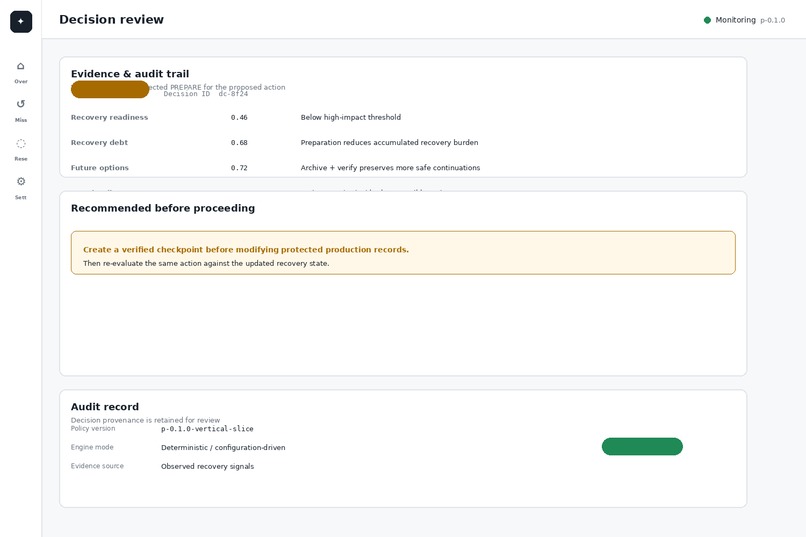
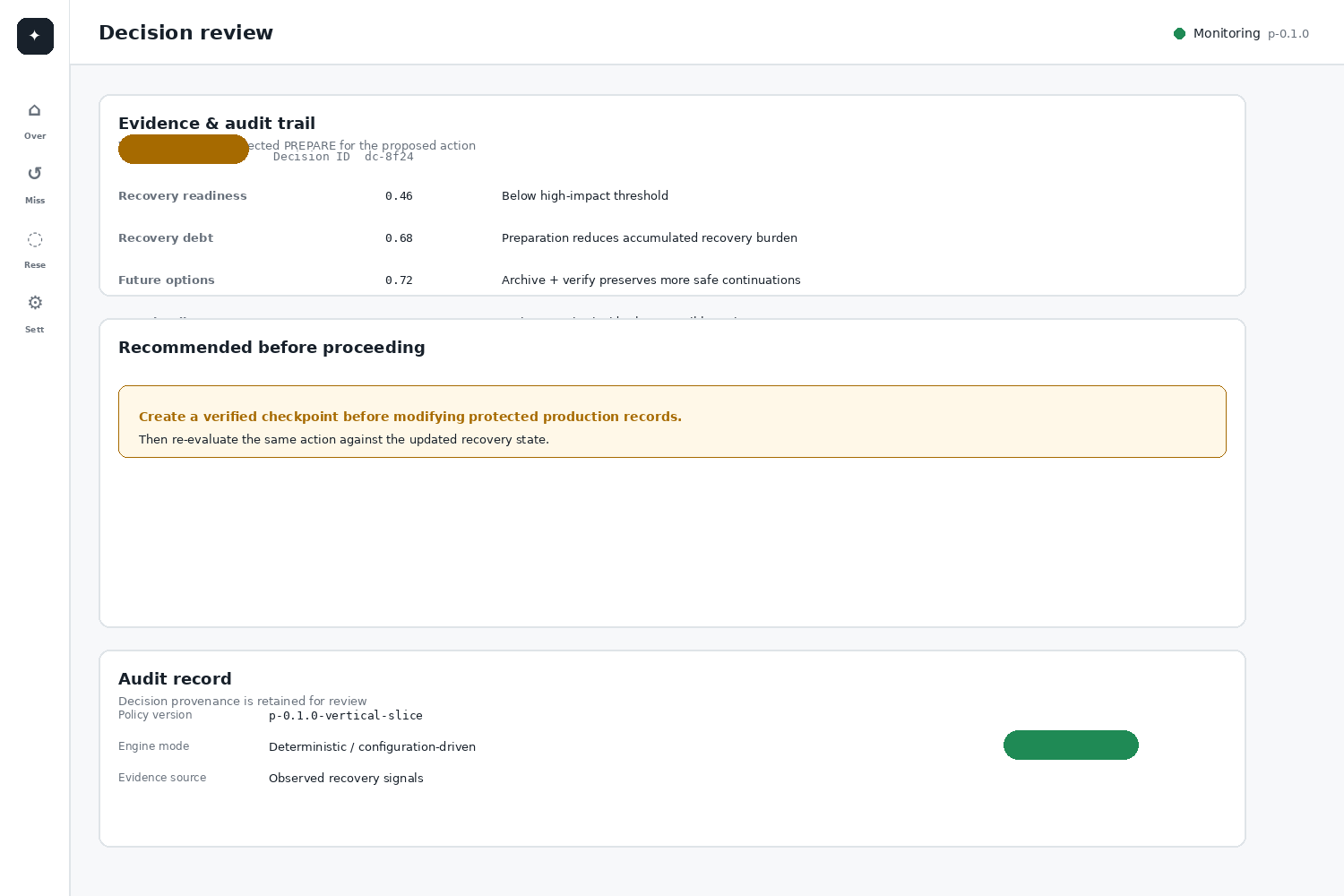
Explainable Governance — Evidence and audit information showing why AegisChronos selected a particular safety decision.
Inspiration
As AI agents become more autonomous, they can perform actions that modify data, systems, and workflows. But an action being possible does not necessarily mean it is safe to execute.
We were inspired by a simple question:
“What happens if an AI agent makes the wrong decision, and can the system safely recover from it?”
Traditional approaches often focus on whether an action is allowed or blocked. We wanted to explore a more context-aware approach where the system considers recovery readiness, reversibility, future options, and the potential consequences of an action.
This idea led us to build AegisChronos, a recovery-aware governance gateway for AI agents.
What it does
AegisChronos evaluates AI-agent actions before they are executed.
It analyzes multiple governance signals, including:
- Dynamic Recovery Readiness (DRR)
- Future Option Preservation (FOP)
- Recovery Debt
- Irreversibility Frontier
- Hard Safety Rules
Based on these factors, AegisChronos can generate different governance decisions such as:
ALLOW, ALLOW_WITH_MONITORING, PREPARE, MODIFY, INVESTIGATE, ESCALATE, DENY, FREEZE, and EMERGENCY_STOP.
Instead of simply saying “yes” or “no,” the system provides a decision together with supporting evidence, helping humans understand why an action is considered safe, risky, or unacceptable.
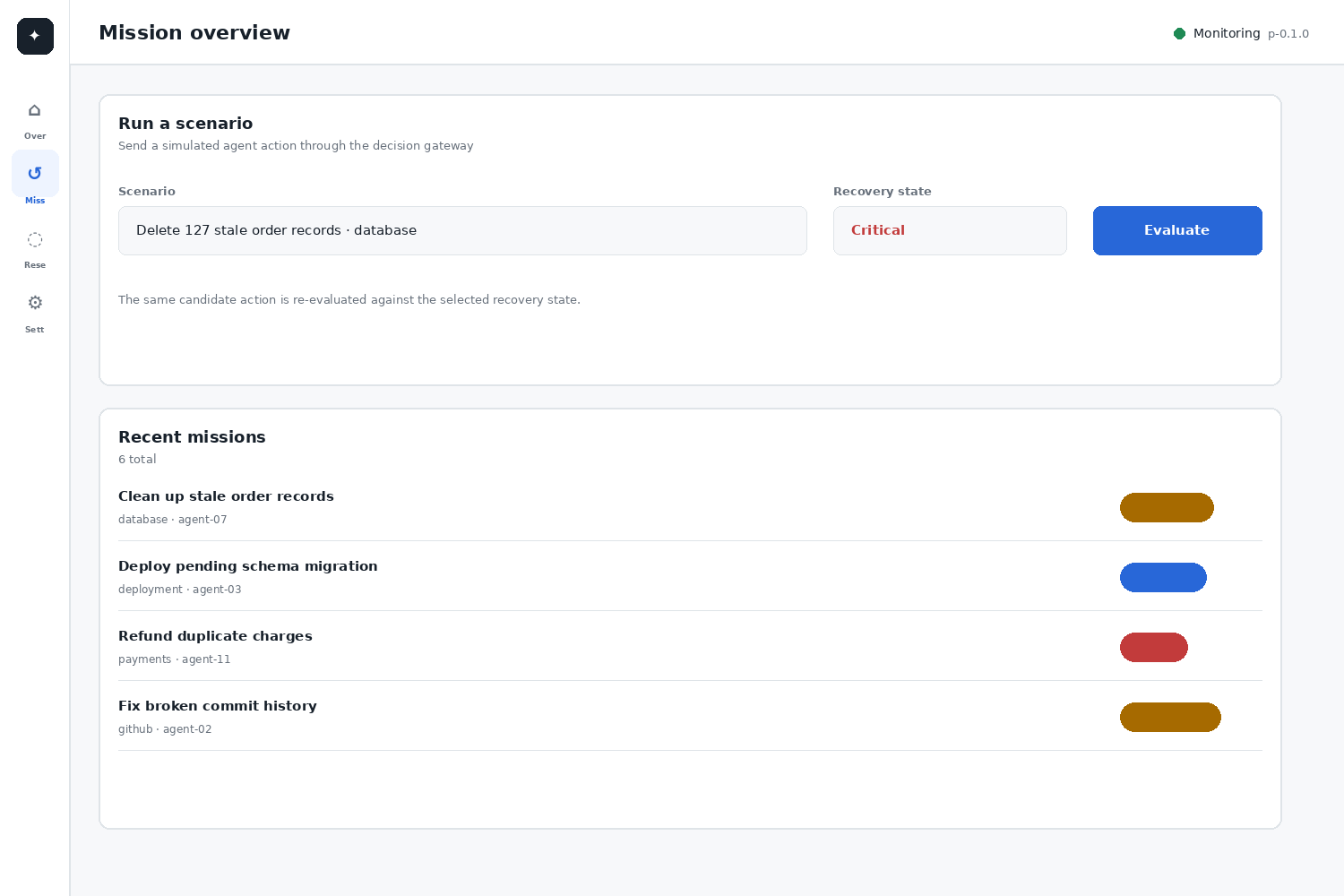
For example, an AI agent may request to delete 127 stale records. If recovery capabilities are healthy, the action may be acceptable. If the recovery state is critical, the same action can receive a more restrictive decision.
How we built it
We built AegisChronos as a full-stack web application.
Frontend
The interactive dashboard was built using:
- React
- Vite
- Tailwind CSS
- Recharts
The frontend provides scenario evaluation, candidate action comparison, governance metrics, evidence, timelines, and research/ablation views.
Backend
The backend was developed using:
- Python
- FastAPI
- Pydantic
- SQLModel
The backend contains the decision engine and exposes APIs for evaluating scenarios and actions.
Decision Flow
AI Agent proposes an action
          ↓
AegisChronos receives the request
          ↓
Evaluate recovery state
          ↓
Calculate governance signals
          ↓
Check safety rules
          ↓
Evaluate reversibility and future options
          ↓
Generate governance decision
          ↓
Return decision + evidence + audit information
The current prototype uses a deterministic, configuration-driven decision engine with representative scenarios, allowing us to demonstrate the core governance concept in a reliable and explainable way.
Challenges we ran into
Turning abstract safety concepts into measurable signals
Concepts such as recovery readiness, recovery debt, future option preservation, and irreversibility are difficult to translate into software logic.
We addressed this by defining measurable signals and implementing them within a deterministic decision engine.
Making AI governance explainable
A simple ALLOW or DENY result doesn't tell a user why the decision was made.
We therefore designed the system to return supporting evidence and governance metrics alongside the final decision.
Designing more than a binary decision
Real-world situations are rarely simply “safe” or “unsafe.”
An action might be acceptable with monitoring, require preparation, need modification, or require human escalation.
This motivated our multi-level governance decision system.
Building a clear dashboard
The system produces multiple signals and metrics. Presenting them without overwhelming the user was challenging.
We solved this by separating the main decision from detailed evidence, metrics, timelines, and research views.
Accomplishments that we're proud of
We are proud that we transformed a conceptual AI-safety idea into a working interactive prototype.
Some of our key accomplishments are:
- Built a complete React + FastAPI application.
- Implemented a recovery-aware decision engine.
- Created multiple governance decision levels instead of simple allow/deny logic.
- Implemented recovery readiness, future option preservation, recovery debt, and irreversibility concepts.
- Added explainable evidence alongside decisions.
- Built an interactive dashboard for evaluating scenarios.
- Added research and ablation views to explore how different governance components affect decisions.
- Designed the architecture so the governance layer can potentially sit between autonomous AI agents and real-world execution systems.
Most importantly, we demonstrated that recoverability can be treated as an important factor in AI-agent governance rather than an afterthought.
What we learned
Building AegisChronos taught us that AI safety is not only about preventing incorrect actions.
For autonomous systems, we also need to consider:
- Can the consequences be reversed?
- Is the system prepared to recover?
- How much recovery burden does the action create?
- Does the action remove important future options?
- Can a human understand the reason behind the decision?
We also learned how to turn theoretical safety concepts into measurable software components and how to design an explainable governance interface around them.
What's next for AegisChronos
AegisChronos is currently a working prototype, and we see several opportunities to take it further.
Future improvements
- Integrate real-time infrastructure and application telemetry.
- Connect directly with autonomous AI-agent frameworks.
- Add real-time recovery-readiness monitoring.
- Develop more advanced risk prediction models.
- Automatically generate recovery plans before high-risk actions.
- Add human approval and escalation workflows.
- Provide organization-level policy management.
- Expand audit and compliance capabilities.
- Support production-scale AI-agent governance.
Our long-term vision is to make AegisChronos a general-purpose safety and recovery layer for autonomous AI systems.
The goal is simple:
Before an AI agent takes an action, AegisChronos asks not only “Can we do this?” but also “If something goes wrong, can we safely recover?”
