-
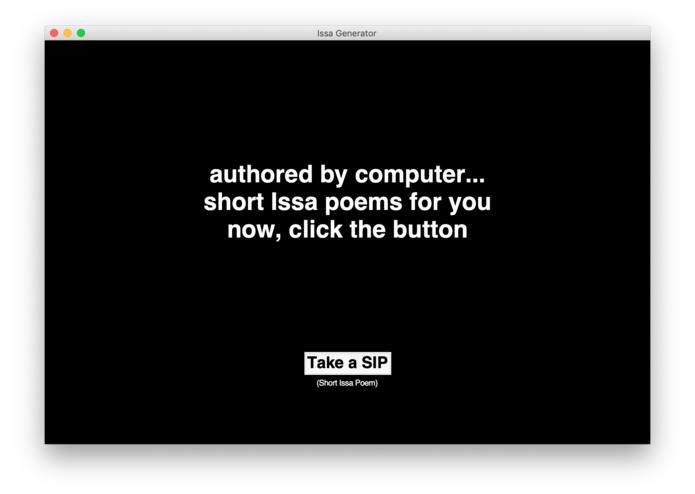
An actual haiku serves as a placeholder until the user clicks the button.
-

Creator
Bruno Freeman, a senior at Saranac Lake High School.
General info
Check out this presentation!
Inspiration
I have been interested in AI for a while, but it has remained one of the fields of computer science I have yet to use... until now! I knew I wanted to train on data and then generate new data in the same style. I went with haiku because they are short (and thus I figured more easily trained on) and I was able to parse a large dataset by a single author (Kobayashi Issa).
What it does
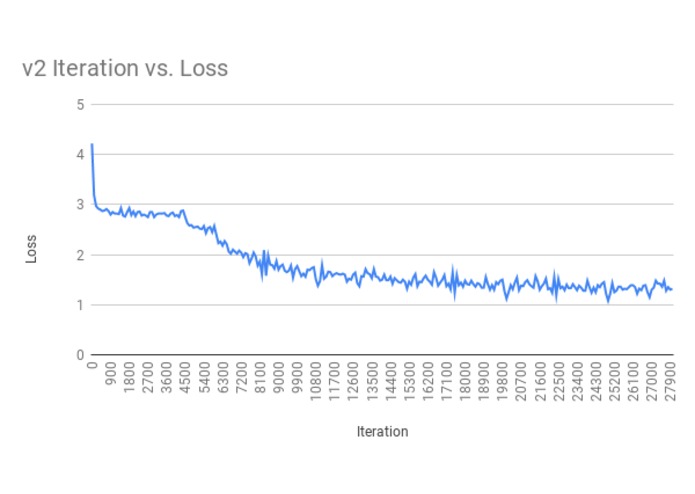
Using an LSTM trained on 28,000 iterations, SIP Generator produces its own SIPs, or Short Issa Poems. I call them SIPs and not haiku because the model was trained on English translations of Issa's Japanese haiku and the 5-7-5 syllable structure was lost in translation.
How I built it
Github, Sublime Text, FloydHub, Python, Tensorflow, Siraj Raval, and David G. Lanoue.
Challenges I ran into
Wrapping my head around programming my first neural network was not easy, but rewarding when it was complete. My biggest challenges after completing the architecture of the neural network were saving training progress and moving the training to the cloud. Another issue was a lack of sufficient time to train the model, especially the second version.
Accomplishments that I'm proud of
In the end, the generated SIPs are not very cogent. Despite this, I am happy that I managed to get the neural network functioning at all.
What I learned
I programmed my first neural network! In doing so, I pushed my knowledge of AI further than it has ever been before.
What's next for SIP Generator
Tinkering with the parameters of the neural network and retraining could yield improvements. Additionally, implementing visuals similar to InspiroBot would be a nice touch (although the backgrounds for SIP Generator would be solely nature-related).
Built With
- cloud-computing
- python
- tensorflow

Log in or sign up for Devpost to join the conversation.