Inspiration
During several major political and geopolitical events, we noticed something intriguing about prediction markets like Polymarket: prices sometimes appeared to move before widely reported public news. These markets are designed to aggregate collective belief, but that also means they can reflect subtle information asymmetries, coordinated trading behavior, or shifts in sentiment that aren’t obvious to the average observer.
While price charts show what moved, they don’t explain why a movement is unusual. A small price change can be far more interesting than a large one if it breaks historical patterns, correlations, or timing expectations. This gap inspired our project. We wanted to build a system that doesn’t just monitor prices, but actively identifies abnormal market behavior by learning what “normal” looks like across time, structure, and related markets.
Our goal was to create an intelligent anomaly detection platform that can surface moments worth investigating — not by predicting outcomes, but by detecting statistically and structurally rare behavior in real prediction markets.
Our Anomaly Detection Platform
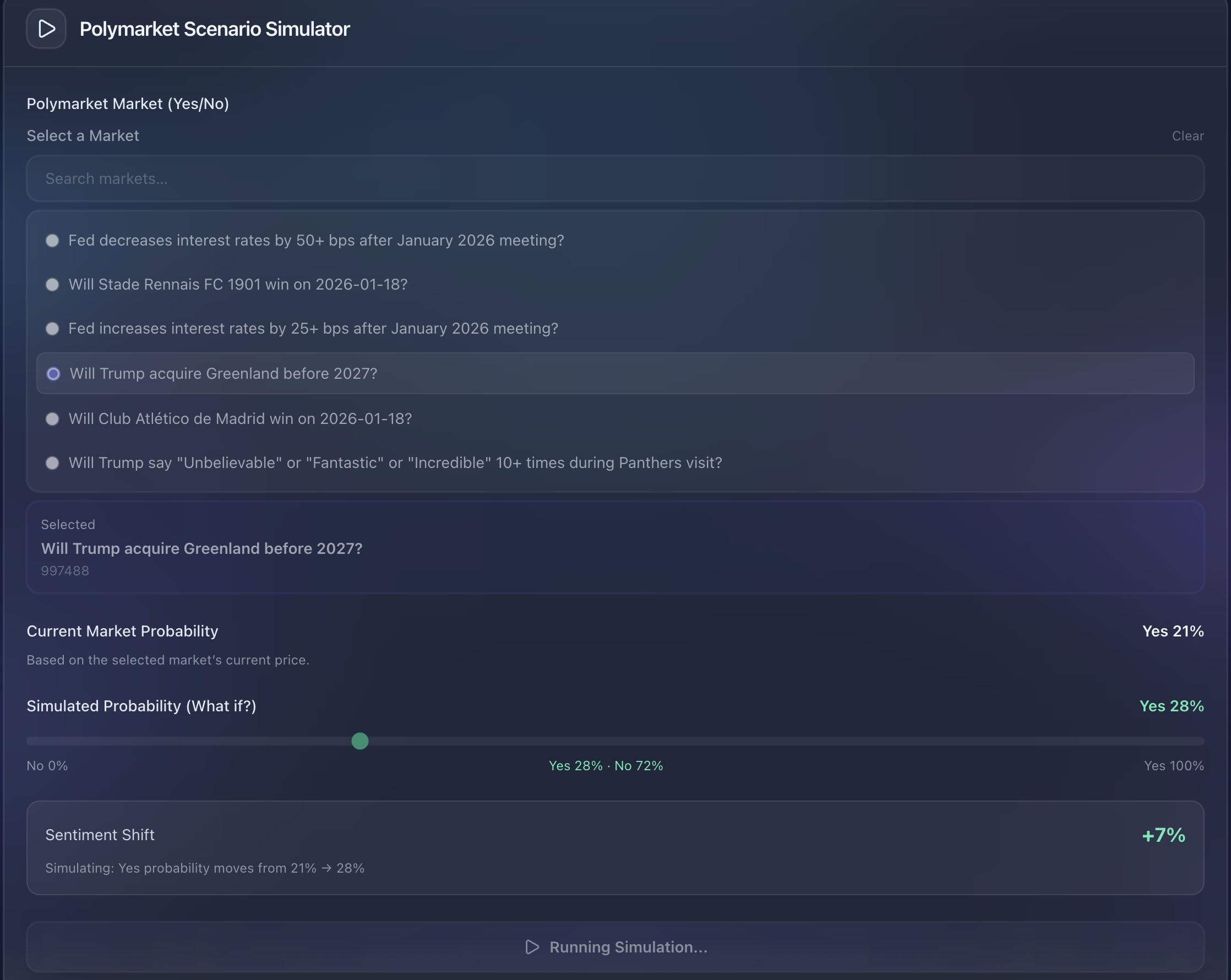
We built a full end-to-end anomaly detection and correlation analysis platform tailored specifically for Polymarket. The system ingests real historical data through Polymarket’s Gamma and CLOB APIs, including market metadata, probabilities, volume, liquidity, and order book snapshots.
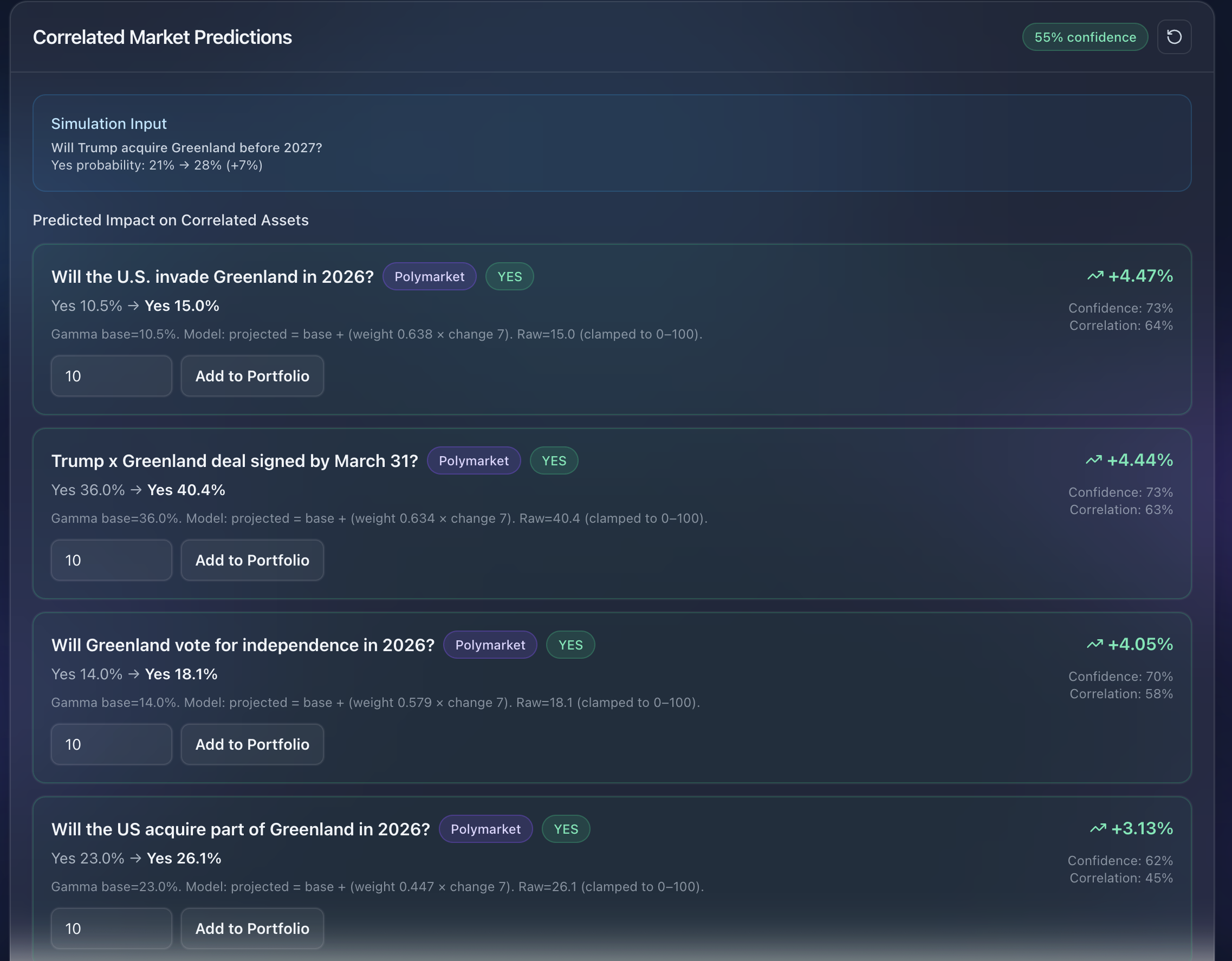
Each market is modeled as a time series with a rich set of engineered features. On top of this, we construct a market correlation graph, allowing the system to understand how related markets typically move together. This enables us to distinguish between expected sector-wide movements and truly independent or leading behavior.
Rather than relying on a single method, our system uses a layered approach. We combine robust statistical techniques with deep learning models to capture multiple notions of abnormality, then fuse these signals into a single anomaly score that is both sensitive and resistant to noise.
Deep Learning Models
We use two primary deep learning models, each targeting a different failure mode of traditional monitoring.
First, we train a deep autoencoder on historical market data. The autoencoder learns a low-dimensional representation of normal market behavior across all features simultaneously. When a market enters a state that cannot be well reconstructed by the model, reconstruction error spikes, indicating structural novelty — even if no single metric looks extreme on its own.
Second, we use a recurrent neural network (GRU) to model temporal dynamics. This model learns how markets typically evolve over time and forecasts the next state based on recent history. Large deviations between the forecast and reality are treated as temporal anomalies, capturing sudden belief shifts or unexpected information arrival.
These deep signals are normalized, combined with classical anomaly scores, and adjusted using market correlations to reduce false positives from expected co-movements.
Challenges We Ran Into
One major challenge was working with real-world market microstructure data. Prediction markets are noisy, heavy-tailed, and non-stationary, which makes naive statistical assumptions unreliable. We had to use robust statistics and careful normalization to prevent extreme values from overwhelming the models.
Training deep models efficiently was another challenge. With hundreds of markets and hundreds of thousands of time points, we had to balance expressiveness with practicality, limiting training windows and simplifying architectures to keep runtimes reasonable while still learning meaningful structure.
Finally, anomaly detection itself is difficult because there are no ground-truth labels. True anomalies are rare and ambiguous, so we focused on unsupervised learning and designed our alerting logic to require agreement across multiple independent signals.
Accomplishments We’re Proud Of
Built an end-to-end anomaly detection pipeline using real Polymarket data
Designed an unsupervised learning system that requires no labeled anomalies
Implemented deep autoencoders to detect structural market novelty
Built recurrent neural networks to flag unexpected temporal behavior
Constructed a correlation-aware market graph to reduce false positives
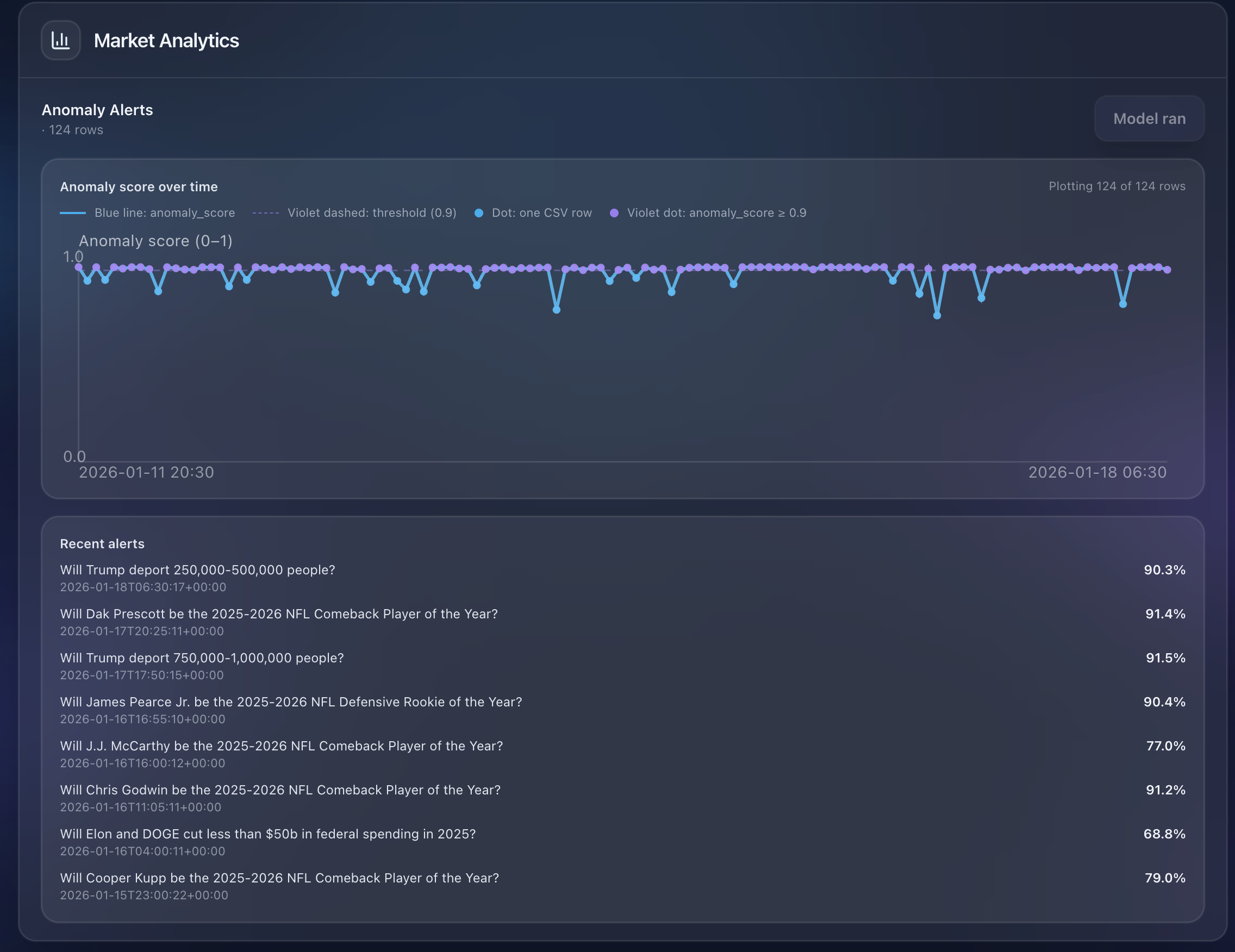
Developed a unified anomaly score that balances sensitivity and robustness
Generated interpretable alerts highlighting statistically rare market events
Scaled the system to hundreds of markets and large historical datasets
Created a foundation for market surveillance, research, and risk analysis

Log in or sign up for Devpost to join the conversation.