ShopSense — TikTok TechJam
ShopSense is our TikTok TechJam conversational shopping copilot, built by Team TikTechToe.
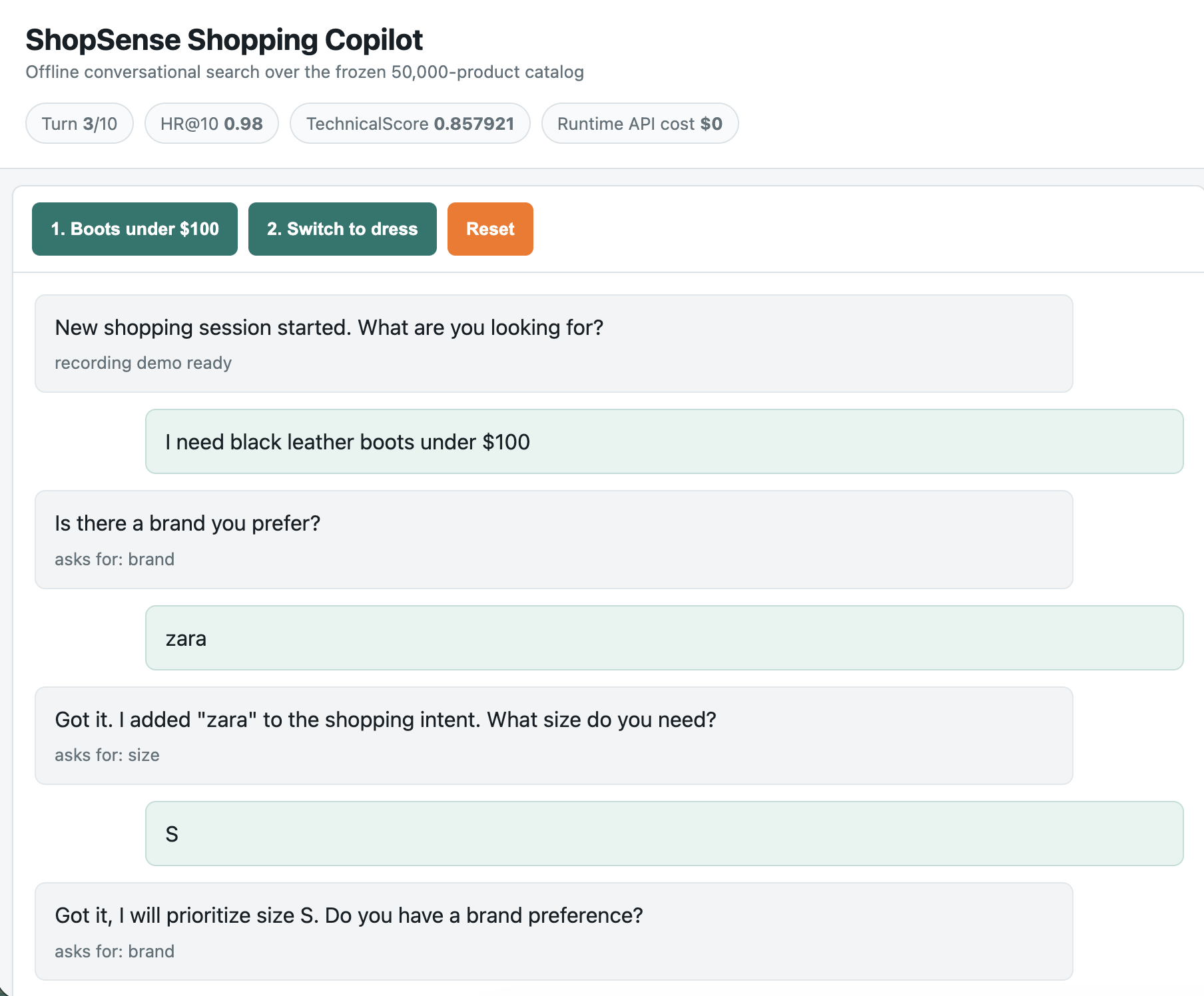
It addresses the challenge by building a multi-turn shopping agent that helps a user find a hidden target product from a frozen 50,000-product e-commerce catalog. The agent:
- Asks useful follow-up questions
- Tracks the user's preferences across turns
- Handles "no preference" answers
- Handles changes in user intent
- Returns a ranked Top 10 list of product recommendations using valid
parent_asinIDs
Technical Approach
Our solution works through the official backend entry point, starter.agent.Agent.
The evaluator:
- Calls
reset(session_id, user_profile)once at the start of each session. - Calls
respond(session_id, user_message, turn, top_k)for up to 10 turns.
Each response contains:
- A natural-language
message - A structured
ask_attribute - A ranked list of recommendations containing valid
parent_asinvalues
Scoring Formula
The technical score is calculated as:
$$ \text{TechnicalScore} = 0.50 \times \text{HitRate@10}
- 0.30 \times \text{MRR}
- 0.20 \times \text{Efficiency} $$
where:
$$ \text{Efficiency} = \text{clip}\left(\frac{11 - \text{MTTC}}{10}, 0, 1\right) $$
Team Contributions
We built ShopSense by splitting the project into three main areas:
Shayna
- Preference extraction
- Dialogue state
- Conversation memory
- Follow-up question strategy
Leon
- Offline catalog retrieval
- Candidate filtering
- Ranking
- Validation
Rhea
- Integration
- Release management
- Official Agent contract compliance
- Evaluator verification
- README and documentation
- Demo packaging
Development Tools
We used the following tools throughout development:
- VSCode — local code editing
- GitHub — source control and public repository hosting
- GitHub Desktop — branch management and pull requests
- Terminal — running tests and the evaluator
- Codex — integration support, release checks, documentation, and demo preparation
No external runtime APIs are required.
The final submitted agent:
- Runs offline
- Runs deterministically
- Does not require OpenAI, Google, TikTok, or any paid external API key during evaluation
- Has a runtime model/API cost of
$0 - Uses
0/0prompt/completion tokens
Libraries and Frameworks
The final runtime system uses:
- Python standard library — official agent implementation
sqlite3— offline catalog search supportunittest— automated testinghttp.server— optional local demo UI- HTML, CSS, and JavaScript — optional frontend demo
No Hugging Face, PyTorch, scikit-learn, pandas, or external ML framework is required for the final runtime system.
Datasets and Assets
The project uses:
- The official frozen 50,000-product Clothing, Shoes, and Jewelry catalog derived from Amazon Reviews 2023
- The official 200-session public development set provided by the challenge organizers
Organizer-held private evaluation sessions were not included or accessed.
The demo bundles no third-party:
- Images
- Logos
- Music
- Video
- Font files
The interface is team-authored.
Textual product metadata shown in the demo comes from the official challenge catalog and may contain names or marks belonging to their respective owners.
Evaluation Results
On the public evaluator, ShopSense achieved:
| Metric | Result |
|---|---|
| Hit Rate@10 | 0.98 |
| MRR | 0.690403 |
| MTTC | 2.96 |
| TechnicalScore | 0.857921 |
Runtime Performance
| Measurement | Result |
|---|---|
| Initialization | 9.66 seconds |
| Response p50 | 110.94 ms |
| Response p95 | 314.99 ms |
| Response max | 498.60 ms |
| Evaluator wall time | 78.29 seconds |
| Whole-process peak working set | 608.77 MiB |
What We Learned
During this hackathon, we learned how important integration and reproducibility are when building an AI system as a team.
It was not enough to only build a ranking model or a conversation module. Everything had to work through the official Agent interface, follow the required response format, and run correctly with the evaluator.
One major challenge was making the agent handle multi-turn conversations instead of treating each interaction as a single search query.
Another challenge was working with a large 50,000-product catalog while keeping the solution:
- Offline
- Deterministic
- Reproducible
- Independent of paid APIs
We also learned that release management matters. We had to:
- Clean up duplicate files
- Avoid committing the large catalog file
- Verify SHA256 checksums
- Run tests
- Document setup steps
- Ensure the README matched the actual submission
These steps were just as important as building the core system because they ensured that our final submission could be reliably evaluated.
Future Improvements
Given more time, we would improve ShopSense by adding:
- Semantic retrieval for better product matching
- Richer recommendation explanations
- Broader synonym handling
- More validation and ranking tuning
Overall, ShopSense taught us that building an effective AI system is not just about creating individual components. It is about making retrieval, conversation, ranking, integration, testing, and release management work together as one reliable system.
Built With
- and
- html/css/javascript
- python-standard-library-for-the-backend-agent
- sqlite3-for-offline-catalog-search
- unittest-for-testing


Log in or sign up for Devpost to join the conversation.