-
-
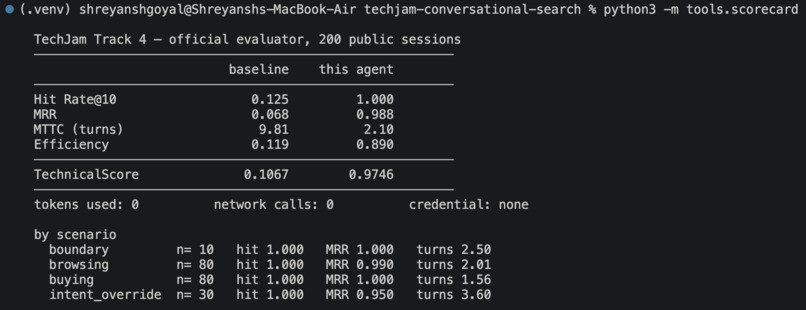
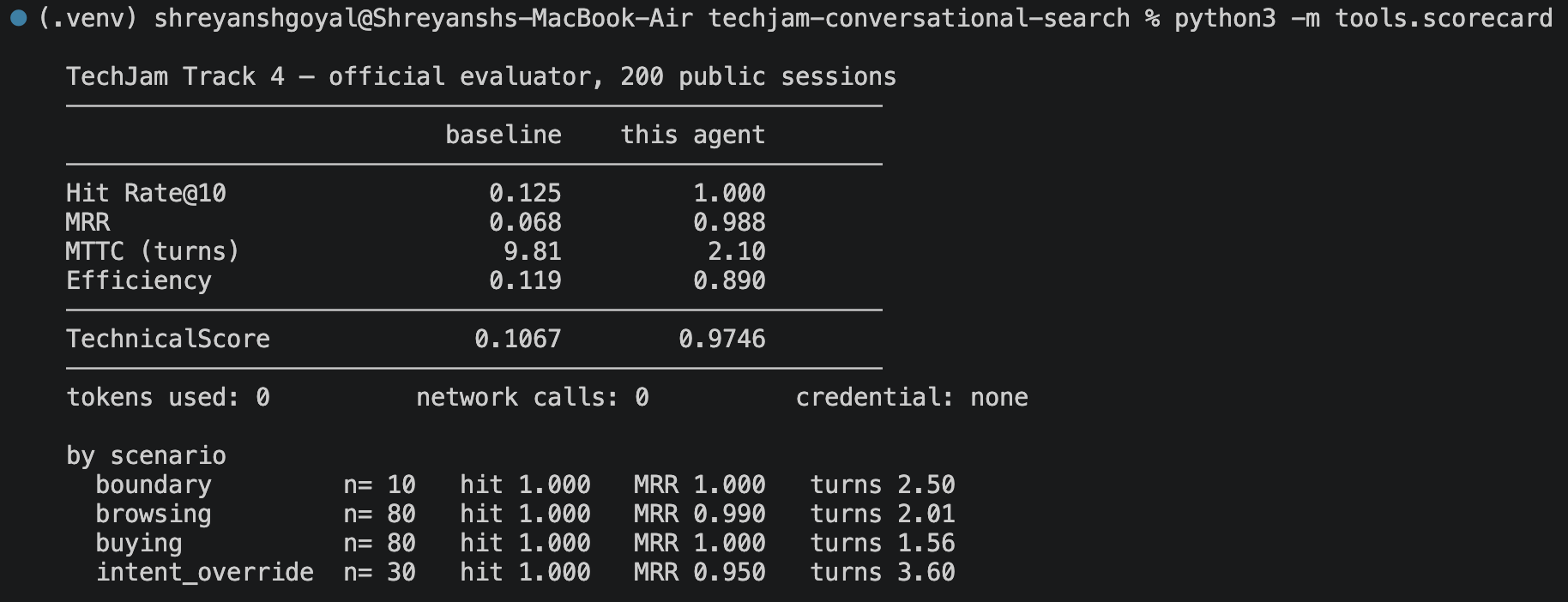
Official evaluator, 200 sessions: 0.9746 against the 0.1067 baseline. Zero tokens, no network, no credentials, standard library only.
-
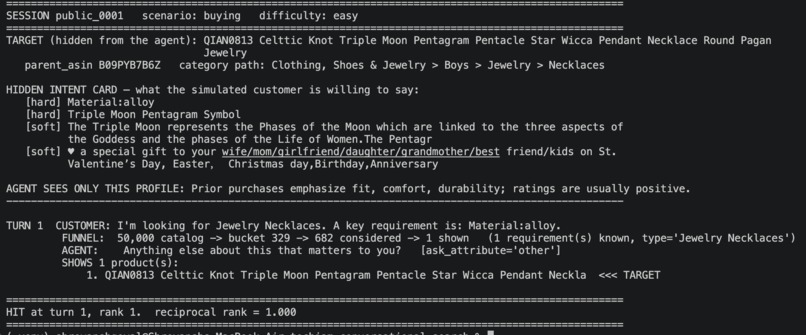
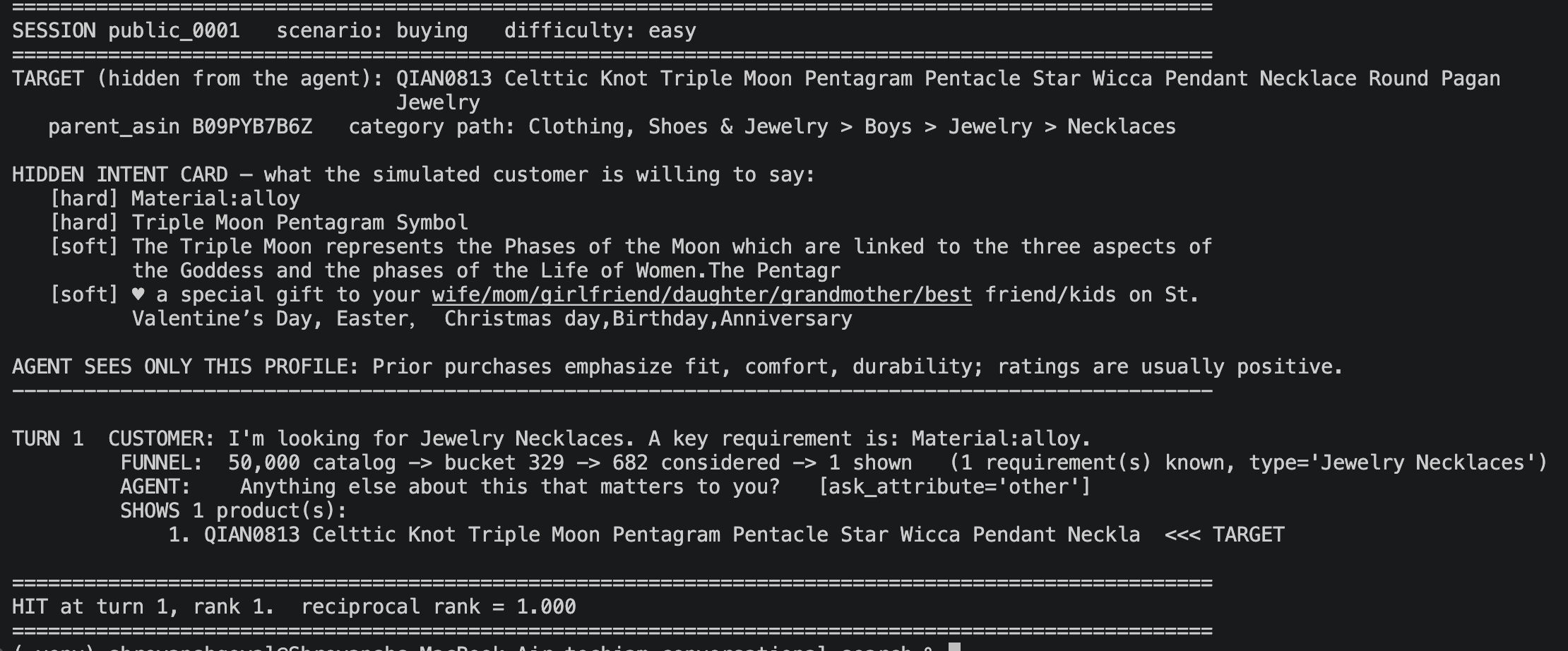
One session end to end: 50,000 products narrowed to a 329-item category bucket, then to a single confident pick. Hit at turn 1, rank 1.
-
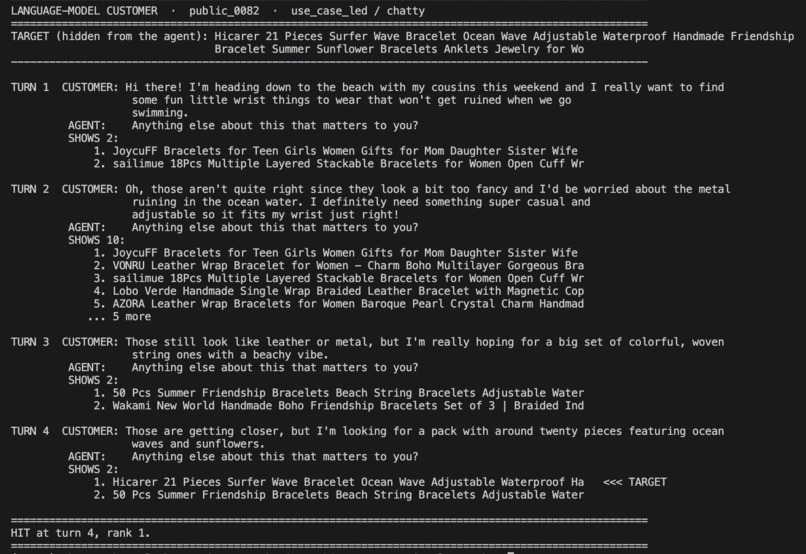
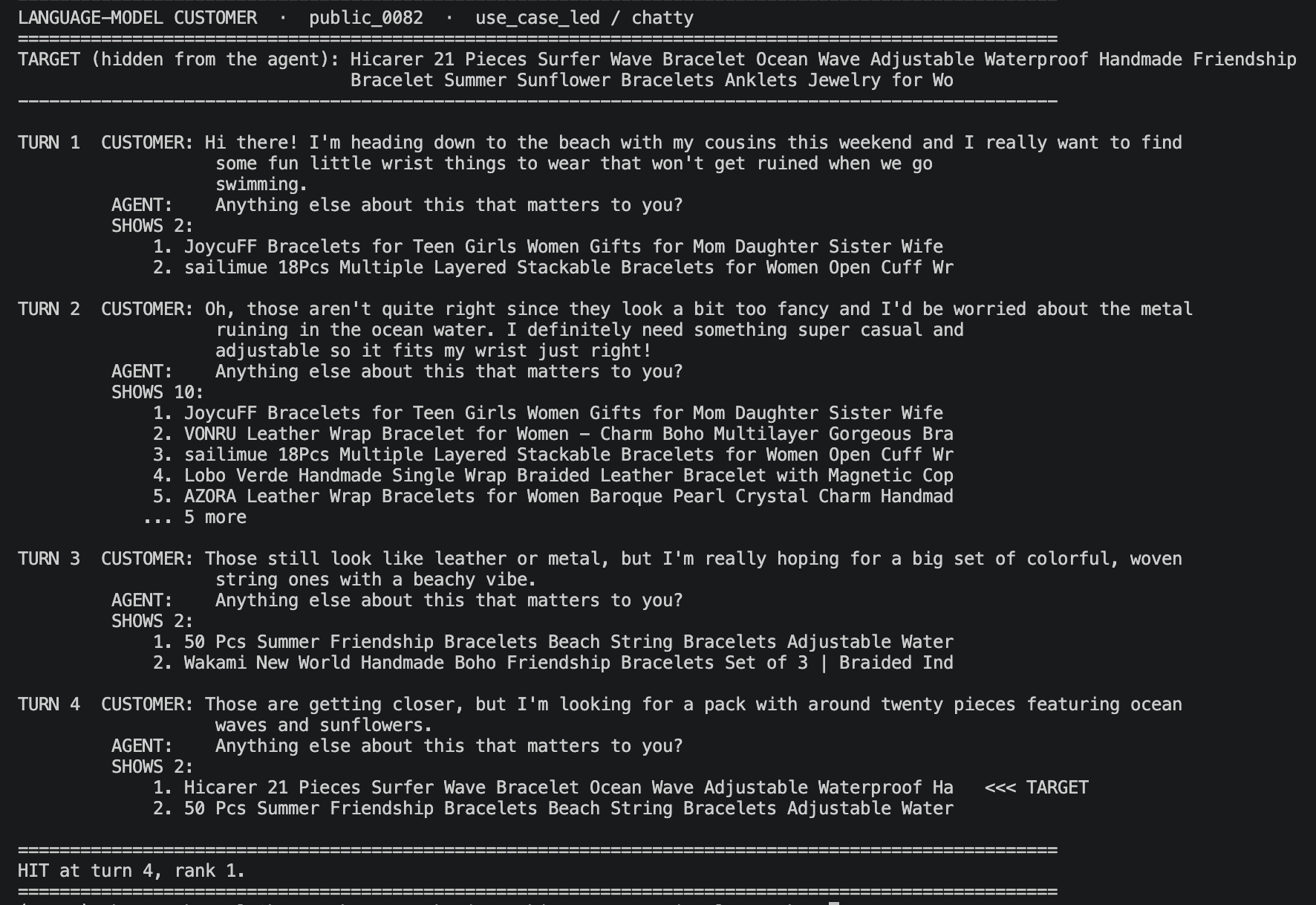
A customer who never quotes the catalog: "wrist things that won't get ruined swimming" finds Surfer Wave Bracelet at rank 1, turn 4.
Inspiration
The challenge ships its own evaluator, so I read it before writing code. The "customer" isn't a language model - it's a deterministic program that derives everything it will ever say from the target product's own metadata, then quotes those strings back at you.
That reframed the task. A high score against a customer who quotes catalog text proves string matching, not understanding. So I built two things: an agent that maxes the official benchmark, and a second benchmark to find out whether that score meant anything.
What it does
Finds one hidden product in a frozen 50,000-item Amazon catalog within ten turns.
0.9746 on the official evaluator against a weak-BM25 reference of 0.1067
- on the Python standard library alone. No dependency, no model file, no network, no credential, zero tokens, 0.5 ms per turn. Verified from a fresh clone with credentials stripped and network unavailable.
How I built it
A structured frame, not a transcript. A sticky product-type slot, accumulating attributes, and negatives. An earlier bag-of-words version drifted badly - 17 of 24 sessions collapsed into the catalog's largest category while the customer typed "I want shoes, not shirts!". Making type a slot that must be contradicted, rather than a tally that can be outvoted, made that impossible.
Four fused retrieval routes: the stated category, a vocabulary lexicon mined
from 50,000 product titles, a rare-term lexical route, and optional dense
embeddings (bge-small-en-v1.5 via ONNX, 50,000 × 384, in memory).
Withholding, not padding. Rank is worth about six times a turn under this metric, so the agent shows one product when confident and commits to ten only once the customer has nothing left to disclose.
The honest test
Same targets, same metrics - but the customer is Gemini 3.5 Flash Lite, told never to quote the listing. 120 stratified sessions.
| tier | official evaluator | paraphrasing customer |
|---|---|---|
| lexical (submitted) | 0.9746 | 0.348 |
| + dense retrieval | 0.9724 | 0.7054 |
| + listwise reranking | 0.8740 | 0.7903 |
The tiers move in opposite directions. The layer worth +0.085 against a paraphrasing customer costs 0.098 against a quoting one. The offline configuration is submitted - the organiser confirmed final scoring uses the published evaluator - but both columns are reported, because only one is about understanding.
Challenges I ran into
The second benchmark killed nine ideas, each measured against a pre-registered bar:
| attempt | result | why |
|---|---|---|
| entropy-based question planner | −0.011 | optimised splits over a drifting pool |
| model-written contrastive questions | −0.055 | narrow questions extract less per turn than open ones |
| cross-encoder reranking (twice) | −0.047, −0.015 | fed a frame description, not natural language |
| adaptive slate widening | −0.034 | converting earlier locks in a worse rank |
The one I think about most: once the open probe returns nothing, no further question can teach anything - yet committing immediately still scored worse, because showing one product per turn eliminates it, cleaning the shortlist the agent eventually commits to.
What I learned
The optimal questioning policy here is a constant. The simulator never reads the question text, and one probe dominates all others by construction. That's an uncomfortable finding for a track about asking good questions, and reporting it beats shipping something that looks clever and measurably loses.
The ceiling is in the data. An oracle test - handing the agent the true category - lifts rank-1 placement from 34.5% to 61.3%. But that category is inferable only about half the time, because the catalog files a crew-neck t-shirt under Underwear Undershirts. Arbitrary filing, not a retrieval failure.
Built with
Python 3.10+ standard library for the graded path; optional numpy,
onnxruntime, tokenizers. Models: bge-small-en-v1.5 (ONNX, CPU),
ms-marco-MiniLM-L-6-v2 (rejected, kept with its negative result), Gemini 3.5
Flash Lite. APIs: Google Vertex AI - used only for the customer simulator
and optional tiers, OAuth via gcloud, no key in the repository. The submission
makes zero API calls. Data: the organiser's frozen catalog and 200 public
sessions, from Amazon Reviews 2023 (McAuley Lab, UCSD) - no external training
data. Tools: Claude Code, VS Code, git.
Cost: graded path 0 tokens, ~840 MB, ~20 s for all 200 sessions. Development used roughly 1.06M input tokens per benchmark run, cached by request.
Built With
- claude-code
- git
- macos
- vs-code


Log in or sign up for Devpost to join the conversation.