How the solution addresses the problem statement
Traditional e-commerce search is static keyword matching. This track needs an agent that handles buying vs browsing, multi-turn slots, intent override, and efficient conversion, scored by Hit@10 / MRR / MTTC on a frozen Amazon Clothing/Shoes/Jewelry catalog.
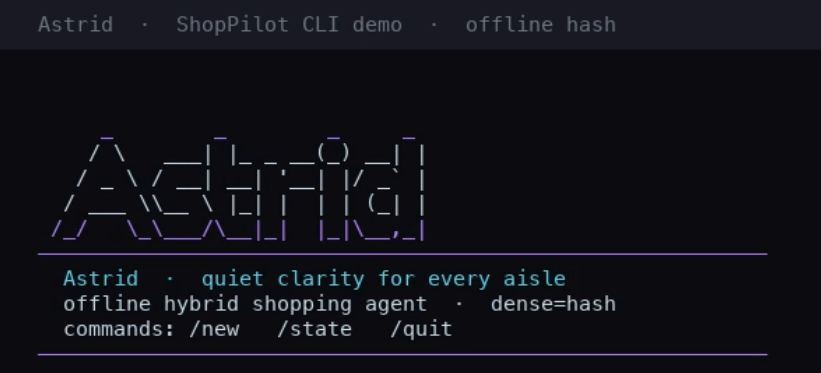
ShopPilot is offline-first. The scored path and default Astrid demo run entirely on-device: in-memory FTS5 + rules (+ optional local dense). No external API key is required. Optional cloud LLMs exist only as fail-open experiments and stay off for judging.
ShopPilot maps the four pillars as follows:
I. Intent routing & hybrid pipeline
- Buying vs browsing from first-turn cues (hard “key requirement” vs “still exploring”).
- Product-family intent so “dress” ≠ “dress sandals” / “dress shoes”; gift audience only on explicit relationship phrases.
- In-memory multi-lane retrieval: SQLite FTS5 (OR session terms + AND constraint lane) plus optional dense lane:
- default hashed char n-grams (NumPy, local), or
- opt-in MiniLM (
all-MiniLM-L6-v2) as a local sentence encoder — weights downloaded once, then embedded offline; not a hosted chat API.
- Rank: constraint coverage × exact evidence, category-tail, family/audience, full-match jackpot, weak profile priors; margin-gated Top‑1 vs Top‑10 emission (first hit freezes MRR).
II. Dialog strategy — multi-turn evolution
- SessionState: category, family, constraints with sources (
soft/disclosed/override),filled/dont_care/asked. - Intent override: soft-only wipe (keep simulator-disclosed hard facts), block discarded tokens, cut pre-override retrieval history, reset asks so
othercan re-fire. - Clarification: one official
ask_attributeper turn; first ask =other(catch-all, ≤2 hidden facts); optional secondotherwhile thin; then static ladder skipping filled / dont_care. Pool max-IG ask order was A/B’d and rejected. - Message facet hints can ground wording in the live candidate pool; the simulator scores ASINs + ask_attribute, not prose.
III. Self-evolution / dynamic context
- Short-term: accumulate slots; rich freeform / “what matters is:” lines expand into multi-slot atoms.
- Latest-wins on short soft color/material; size-pole conflict resolution.
- Long-term: weak prior from
user_profile.preference_tags/ rating style (tie-break only; short-term constraints dominate). - Optional LLM slot parse / top‑k rerank: env-gated, default off, fail-open to rules — never on the critical path for TechnicalScore.
IV. Evaluation matrix
- Official local evaluator: Hit@10, MRR, MTTC →
TechnicalScore = 0.50·Hit + 0.30·MRR + 0.20·Efficiency. - Public 200, hash default (ship): Tech ~0.909, Hit 0.975, MRR ~0.872, MTTC ~3.01, 0 tokens.
- Public 200, MiniLM opt-in (local): Tech ~0.910, Hit 0.980, MRR ~0.867, MTTC ~2.98, 0 API tokens (local embed only).
- Override after hygiene: Hit ~0.967, MTTC ~4.2 (protocol floor on pivot turn).
Constraints respected: headless API only; catalog read-only; in-memory index; no foundation-model fine-tune required; ≤10 turns; typos/ASR out of scope per kit; scoring path needs no network and no paid API.
Real-world impact
Static site search still fails a large share of shoppers (e.g. Baymard on Search UX). Conversational commerce grows as dialogue collapses intent → purchase; large retailers productize catalog-grounded assistants. ShopPilot is the merchant-owned decision core—intent, state, hybrid recall, clarify, rank—as a measurable API mid-market teams can run on their own infra without metering every turn to a public LLM API.
Kit metrics as business KPIs: findability (Hit@10), rank quality (MRR), cost-to-serve / cognitive load (MTTC), plus zero token burn on the default path.
Development tools used
- VS Code / terminal (macOS)
- Git + GitHub
- Python 3.10+ stdlib + unittest
APIs used
- None required for TechnicalScore, public 200 eval, or default Astrid demo.
- Optional (off by default, not used in reported default metrics):
- Google Gemini or xAI — experimental slot NLU / top‑candidate rerank only (
SHOPPILOT_LLM*); fail-open to rules if missing key/network.
- Google Gemini or xAI — experimental slot NLU / top‑candidate rerank only (
- MiniLM is a local model file (Hugging Face weights cached on disk), not a runtime external API dependency for scoring once cached.
Libraries and frameworks used
- Required (default score path): Python stdlib (
sqlite3FTS5,re,json,unittest, …) - Optional dense hash:
numpy - Optional local MiniLM dense:
sentence-transformers(+torchas its backend) — on-device embeddings only - Not required for core score: cloud LLM SDKs, FAISS/Milvus clusters, full HF fine-tunes, pandas/sklearn pipelines
Datasets and assets used
- TechJam participant kit (Amazon Reviews 2023 — Clothing_Shoes_and_Jewelry):
- Frozen catalog 50,000 products
- 200 public development sessions
- Official weak BM25 starter + local evaluator + API contract
- Frozen catalog 50,000 products
- Upstream catalog docs: https://amazon-reviews-2023.github.io/
- Kit: https://github.com/TechJam2026/techjam-conversational-search
- No private 800-set used for reported numbers
- No injected/mock ASINs; catalog read-only
- Optional local weight cache:
all-MiniLM-L6-v2(first download only; eval runs offline thereafter)
ShopPilot’s default and reported scoring path is fully offline—no external API. Dense MiniLM, when enabled, runs as a local encoder; any cloud LLM is optional, default-off, and unused for the hash ship metrics (Tech ~0.909, 0 tokens).

Log in or sign up for Devpost to join the conversation.