🛍️ ShopMate
The shopping agent that knows when to ask and when to answer.






TechJam · Track 4 · Conversational E-Commerce Search
⚡ TL;DR
Every shopping bot answers immediately. ShopMate shuts up and asks one more question — and that single behaviour is worth more than everything else we built.
| Baseline | ShopMate | |
|---|---|---|
| Dev (150 sessions) | 0.1029 | 0.9536 |
| Holdout (50 sessions) | 0.1180 | 0.9461 |
| All 200 public sessions | 0.1067 | 0.9517 |
0.10 → 0.95. Zero LLM calls. Zero dollars. 17.7 ms per turn on a laptop CPU.
🎯 The insight
The evaluator ends the session the instant your list contains the target. So a hit at a bad rank is permanent — you never get to improve it.
That flips the usual assumption on its head:
Hit at turn 1, rank 7  →  0.5 + 0.3/7 + 0.2      = 0.743
Wait one turn, rank 1  →  0.5 + 0.3   + 0.18     = 0.980   ← better!
One extra turn costs 0.02. Moving a session from rank 2 to rank 1 is worth 0.15 — 7.5 turns. Turning a miss into a rank-1 hit is worth 1.00 — 50 turns.
Asking is nearly free. Answering too early is expensive.
So ShopMate computes, every single turn, whether recommending now beats asking once more and recommending next turn — and stays silent until the answer is yes.
Worth +0.062. And the untuned expected-value rule beats every hand-tuned
threshold we swept, which means the behaviour is derived, not fitted.
🎬 See it work
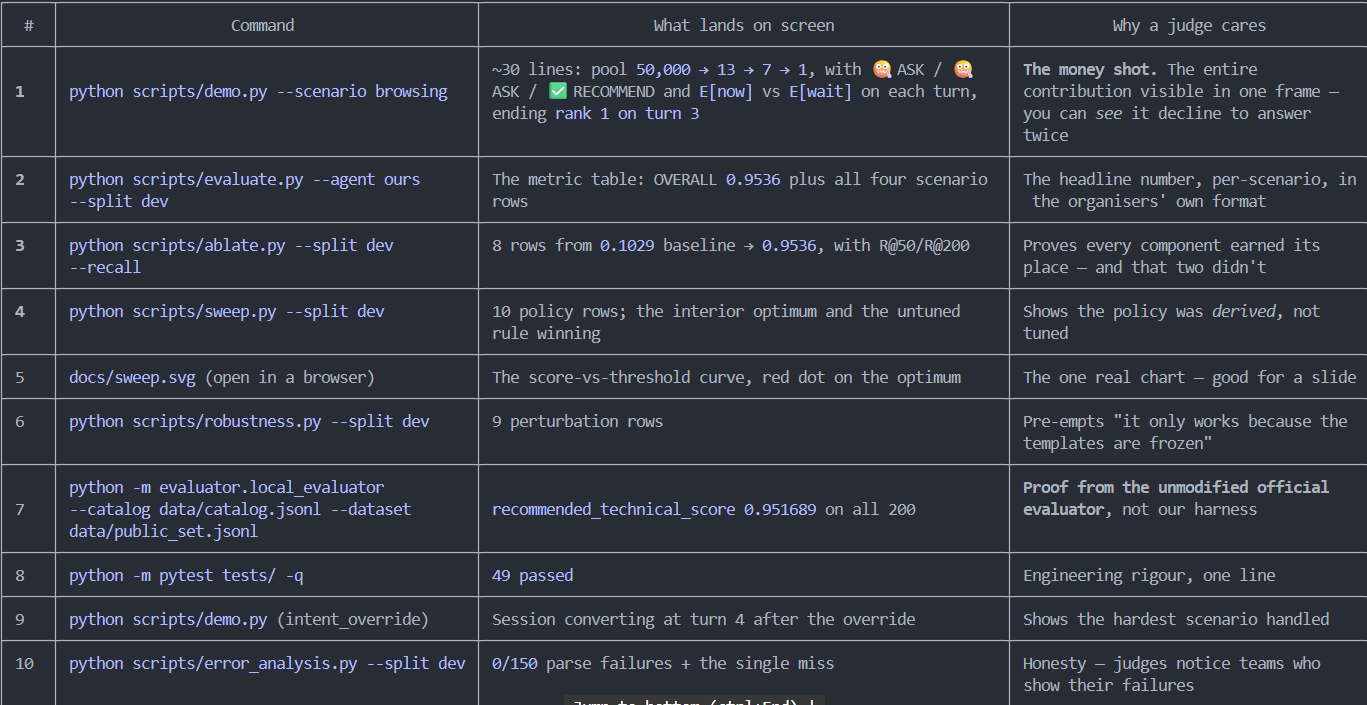
$ python scripts/demo.py --scenario browsing
target   : B071F2Z7JG  Pro Club Men's Heavyweight Mesh Basketball Shorts

TURN 1  shopper : I'm looking for Basketball Men, but I'm still exploring.
        parsed  : category='Basketball Men'
        pool    : 50,000 -> 13 candidates
        decision: E[now]=0.6522  E[wait]=0.8552  ->  🤐 ASK, stay silent

TURN 2  shopper : For that, what matters is: polyester; 100% Polyester.
        pool    : 13 -> 7 candidates
        decision: E[now]=0.7911  E[wait]=0.9386  ->  🤐 ASK, stay silent

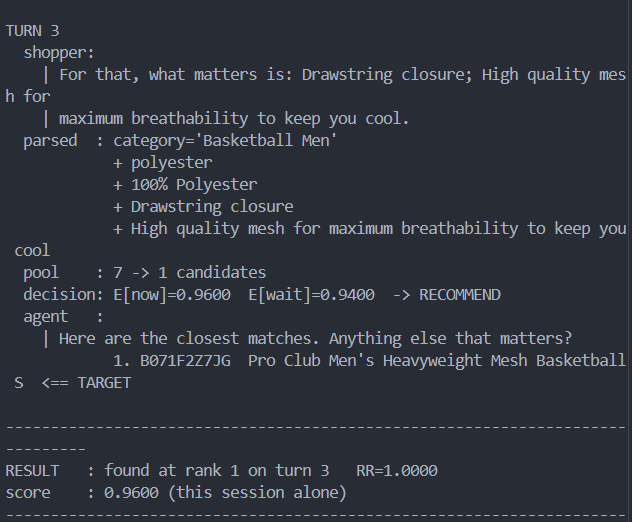
TURN 3  shopper : For that, what matters is: Drawstring closure; High quality
                  mesh for maximum breathability to keep you cool.
        pool    : 7 -> 1 candidates
        decision: E[now]=0.9600  E[wait]=0.9400  ->  ✅ RECOMMEND
                  1. B071F2Z7JG  Pro Club Men's Heavyweight Mesh...  <== TARGET

RESULT   : found at rank 1 on turn 3   RR=1.0000
Turns 1 and 2 are the contribution. ShopMate could have dumped ten products from that 13-candidate pool and probably scored a hit — at a mediocre rank, locked in forever. It works out that asking is worth more. Twice. Then converts at rank 1.
🚀 Quickstart
pip install -r requirements.txt   # numpy, rank_bm25, pytest. No torch.
python scripts/fetch_data.py      # 19 MB catalog, SHA256-verified, 50,000 rows
python scripts/evaluate.py --agent ours --split dev
That's it — ~17 s for a full 150-session evaluation. First run builds indexes (~40 s) and caches them; after that startup is ~5 s.
Every other command ```bash python scripts/ablate.py --split dev --recall # the ablation table python scripts/sweep.py --split dev # conversion-timing sweep python scripts/robustness.py --split dev # perturbation table python scripts/error_analysis.py --split dev # where it still loses python scripts/demo.py # one narrated session python -m pytest tests/ -q # 49 tests python scripts/evaluate.py --agent ours --split holdout ``` **The organisers' own command**, which is what actually counts: ```bash python -m evaluator.local_evaluator \ --catalog data/catalog.jsonl --dataset data/public_set.jsonl ``` ``` sample_count 200 | hit_rate_at_10 0.995 | mrr 0.956964 mttc 2.645 | efficiency 0.8355 | recommended_technical_score 0.951689 ``` 22 s end to end. `evaluator/` is byte-identical to upstream — `git diff --stat -- evaluator/` is empty.📊 The evidence
Ablation — every row is a real evaluator run
Same Agent class the submission ships, differing only in AgentConfig flags.
| Configuration | Hit@10 | MRR | MTTC | Score | R@50 | R@200 |
|---|---|---|---|---|---|---|
| Provided BM25 starter | 0.1200 | 0.0672 | 9.860 | 0.1029 | – | – |
| BM25 only | 0.8400 | 0.5555 | 3.847 | 0.7297 | 0.9267 | 0.9800 |
| Popularity prior only | 0.0400 | 0.0070 | 10.620 | 0.0297 | 0.1467 | 0.4267 |
| + RRF fusion of both | 0.8867 | 0.6231 | 3.273 | 0.7848 | 0.9400 | 0.9867 |
| + dense MiniLM + RRF ❌ | 0.8467 | 0.4285 | 3.607 | 0.6998 | 0.9533 | 0.9933 |
| + simulator inversion | 0.9933 | 0.7162 | 1.993 | 0.8917 | 1.0000 | 1.0000 |
| + conversion timing 🏆 | 0.9933 | 0.9665 | 2.653 | 0.9536 | 1.0000 | 1.0000 |
| full + dense ❌ | 0.9867 | 0.9672 | 2.660 | 0.9503 | 1.0000 | 1.0000 |
The popularity prior is useless alone and gold in combination. By itself:
0.0297 — no conversational signal at all. Fused with BM25: +0.055. Why?
Targets come from real purchase records, so they sit at the 95.6th percentile of
the catalog by rating_number (median 6,846 vs a catalog median of 12; 173/200
in the top decile). It's a prior over what people buy, not what this shopper
asked for — so it only works as a reranker.
Recall tells you where the loss lives. Retrieval alone puts the target in the top 200 for 98.7% of sessions but the top 10 for only 88.7% — a 10-point ranking gap. Inversion closes recall completely (R@50 = R@200 = 1.0000), after which every remaining loss is ordering within a pool.
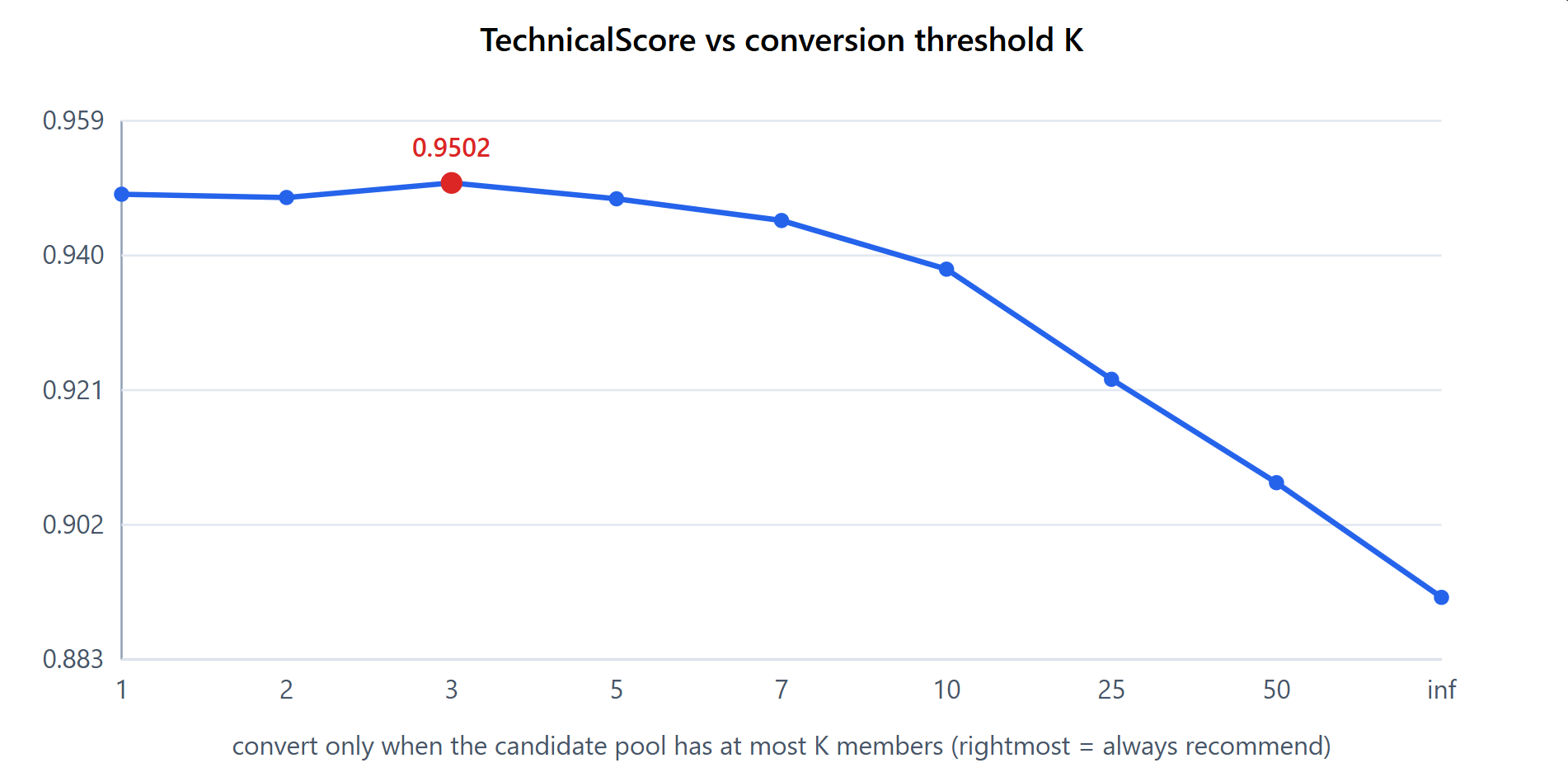
The conversion-timing sweep 📈

| policy | Hit@10 | MRR | MTTC | Score |
|---|---|---|---|---|
| K=1 | 0.9933 | 0.9598 | 2.800 | 0.9486 |
| K=2 | 0.9933 | 0.9498 | 2.673 | 0.9482 |
| K=3 (best swept) | 0.9933 | 0.9532 | 2.620 | 0.9502 |
| K=5 | 0.9933 | 0.9404 | 2.540 | 0.9480 |
| K=7 | 0.9933 | 0.9253 | 2.467 | 0.9449 |
| K=10 | 0.9933 | 0.8988 | 2.413 | 0.9380 |
| K=25 | 0.9933 | 0.8341 | 2.220 | 0.9225 |
| K=50 | 0.9933 | 0.7778 | 2.107 | 0.9079 |
| always recommend | 0.9933 | 0.7162 | 1.993 | 0.8917 |
| expected-value (untuned) 🏆 | 0.9933 | 0.9665 | 2.653 | 0.9536 |
A real interior optimum — and the parameter-free rule beats the best tuned threshold by +0.0033. That's the difference between a policy that was derived and one that was fitted to 150 sessions.
Robustness — we tried to break it 🔨
The fair criticism of modelling the organisers' deterministic templates is "it
only works because they're frozen." So we measured that, then fixed most of it.
scripts/robustness.py rewrites every customer utterance before the agent sees
it, leaving the evaluator's own scoring untouched.
| Perturbation | Before | After |
|---|---|---|
| none (control) | 0.9536 | 0.9536 |
| trailing period dropped | 0.9488 | 0.9536 |
"Hi! " prepended |
🔴 0.3268 | 0.9541 |
"; " → ", " |
0.8605 | 0.9531 |
opener reworded (I'm looking for→I need) |
0.9394 | 0.9394 |
| double spaces throughout | 🔴 0.4891 | 0.8985 |
| all lowercase | 🔴 0.4891 | 0.8985 |
| trailing chatter appended | not measured | 0.7989 |
| last word of every message dropped | 🔴 0.5824 | 0.6947 |
Worst case: 0.327 → 0.695. Control unchanged to four decimals — the exact path is bit-for-bit what it was.
What actually fixed it 1. **Locate markers, don't anchor them.** Every template marker used `startswith`/`endswith`, so prepending `"Hi! "` broke recognition outright and cost **0.63**. Now found positionally. 2. **Three-tier resolution.** Exact → casefolded/whitespace-collapsed → fuzzy token overlap. The whole opener parse retries in normalized space if the raw pass finds no category, which is what rescues lowercase and double-spacing. 3. **Longest-prefix category matching.** The opener is `"I'm looking for {category}…"`, so when the trailing template is damaged the category is still the *start* of the remainder. The fuzzy tier returns **one** match, not two — swept and measured. At a cap of 1 the two hardest rows score 0.695/0.799; at a cap of 2 they fall to 0.679/0.791, and as low as 0.641/0.662. A second guess is usually a constraint the shopper never said, and unlike an unmatched string it *does* intersect the pool — so it narrows wrongly and can evict the target. The threshold itself isn't tuned: 0.5 through 0.9 land within 0.002 of each other. Two rows stay degraded, honestly so: dropping the last word of a *buying* opener deletes the whole disclosed constraint (`"…is: Material:alloy."` → `"…is:"`). Nothing recovers information that is gone.Held out, run once 🔒
data/splits.json fixes a seed-1337 150/50 split, stratified by scenario_type.
Every decision — the policy, the sweep, the dense keep/drop call — was made on dev.
The holdout was run once, at the end.
| split | n | Hit@10 | MRR | MTTC | Score |
|---|---|---|---|---|---|
| dev | 150 | 0.9933 | 0.9665 | 2.653 | 0.9536 |
| holdout | 50 | 1.0000 | 0.9283 | 2.620 | 0.9461 |
It scores lower than dev. That's the honest direction, and we're reporting it rather than the flattering number.
🏗️ How it works
Per turn:
utterance ──▶ 1. PARSE ──▶ 2. INTERSECT ──▶ 3. DECIDE ──▶ 4. RANK ──▶ response
              category      candidate        recommend      popularity
              + constraints  pool             or ask?        + BM25
ask_attribute is always "other"
In the evaluator's `customer_reply` the filter is
`attribute == "other" or classify_constraint(value) == attribute`. `"other"`
bypasses the classifier entirely, making it a strict superset of every specific
attribute — it always returns the two most informative undisclosed constraints.
The expected-value machinery *derives* this rather than assuming it.
4. Why there's no LLM anywhere in this system
Track 4 lists "LLM semantic ranking" as an allowed direction. We use none —
deliberately — because we **built the semantic route and measured it making things
worse**. MiniLM over all 50,000 products took the retrieval floor from `0.7848` to
`0.6998`, and the full system from `0.9536` to `0.9503`.
The reason is structural, not a tuning failure. The signal that wins here is
*exact agreement* between an utterance and catalog metadata; embeddings exist to
collapse exactly that distinction. **MiniLM cannot tell two cotton t-shirts
apart** — which is precisely the discrimination this task demands. An LLM would be
the same mistake with a bigger bill.
So this isn't "we couldn't be bothered", it's a measured negative result. A
17.7 ms CPU-only agent with no API key that beats its own embedding-based variant
is the stronger engineering claim.
🧪 Measured null results
Reported because we tested them, not because we assumed them.
| Hypothesis | Verdict |
|---|---|
| Asking costs turns, so ration questions | ❌ No such tension. ask_attribute and recommendations are independent fields; a question is free (FAQ §5). Sweeping an asking threshold gives a flat line. |
| Intent-override needs rollback / conflict resolution | ❌ No real contradiction. The "new" value is hard_constraints[0] — a true attribute of the target. Accumulating everything is always correct. Those sessions score MRR 1.0000. |
user_profile enables personalization |
❌ No signal. average_prior_rating correlates 0.18 with the target's rating; preference_tags is a 9-word generic vocabulary hitting 44% of target texts by chance. |
| Need a turn-8 safety stop | ❌ Never fires. Deadlines of 3 through 10 score identically; the intent card exhausts long before. |
| Dense retrieval helps | ❌ Actively hurts. 0.7848→0.6998 on the floor, 0.9536→0.9503 on the full system. Lifts recall (R@200 0.9867→0.9933), wrecks precision (MRR 0.6231→0.4285). |
That last one is why sentence-transformers and its ~2.5 GB of torch are not
in requirements.txt. The code path and both ablation rows stay reproducible via
requirements-ablation.txt + python scripts/build_index.py --dense.
📦 What's in the box
agent.py                  Agent + AgentConfig — submission entry point
src/simulator_model.py    verbatim copy of the evaluator's user model
src/inversion.py          posterior inference: utterances → candidate pool
src/retrieval.py          BM25 + popularity prior + RRF fusion
src/policy.py             threshold + expected-value conversion rules
src/state.py              per-session conversation state
src/catalog.py            immutable index-addressable catalog view
scripts/                  fetch_data · make_splits · build_index · evaluate
                          ablate · sweep · robustness · error_analysis · demo
tests/                    smoke · simulator equivalence · retrieval · inversion
baselines/starter_bm25.py the organisers' starter, preserved for the ablation
1,336 lines of shipped agent · 1,053 lines of measurement tooling · 528 lines of tests. Heavily commented, so the executable footprint is a lot smaller than that suggests.
💡 BM25 is hand-rolled.
rank_bm25'sget_scoreswalks all 50,000 documents per query term at ~200 ms/query — that alone would blow the eval budget. Since k1 and b are fixed, the per-posting weight is precomputable, reducing scoring to a scatter-add over the query terms' postings: ~0.6 ms/query, a 335× speedup. It's numerically identical torank_bm25.BM25Okapi(k1=1.5, b=0.75)— right down to its negative-IDF flooring and its lack of query-term dedup — andtests/validates that against the library every run.
💸 Cost, latency, footprint
Zero API keys. Zero network calls. Zero tokens. Measured on a CPU-only Windows 11 laptop, Python 3.11, warm cache:
| Agent startup | 5.9 s (40 s first run, then cached) |
| Full 150-session dev evaluation | ~17 s |
| Mean latency per turn | 17.7 ms |
| Peak working set | 604 MB (incl. the evaluator's own catalog copy) |
| Disk cache | 64 MB |
⚠️ Limitations
- The primary path models the organisers' templates. Quantified, not just
disclosed: worst perturbation
0.695, retrieval-only fallback0.7848. Dropping the last word of a buying opener deletes the constraint outright, and nothing recovers information that's gone. - No semantic paraphrase handling. Tier 3 is lexical token overlap. A shopper saying "made of cowhide" instead of "100% Leather" falls through to BM25. Fixing it properly needs a semantic model — and we measured that route hurting.
- Irreducible ties. Some products share a byte-identical intent card. Our one
dev miss (
public_0083) plateaus at a pool of 20 identical cards; nothing in the conversation separates them. Seedocs/error_analysis.md. - Intent-override sessions have a hard MTTC floor of 3–4 turns — the evaluator discards hits before the override is revealed. Ours sit at 3.636, on the floor.
- Boundary sessions burn their first question by design. Nothing to optimise.
- Single-process, single-threaded, matching the evaluator's sequential design.
With more time: the expected-value rule uses one-step lookahead. Sessions like
public_0020 (converted at rank 4 on turn 2 when one more question would likely
have given rank 1) suggest a multi-step rollout recovers ~0.004 more. We'd also
make the belief over the pool popularity-weighted rather than uniform, which is
closer to how targets are actually sampled.
👥 Team
| Member | Contribution |
|---|---|
| @d4zb | |
| @Brendan-Lim |
Catalog and sessions derived from Amazon Reviews 2023 (McAuley Lab, UCSD).
See DATA_ATTRIBUTION.md.


Log in or sign up for Devpost to join the conversation.