
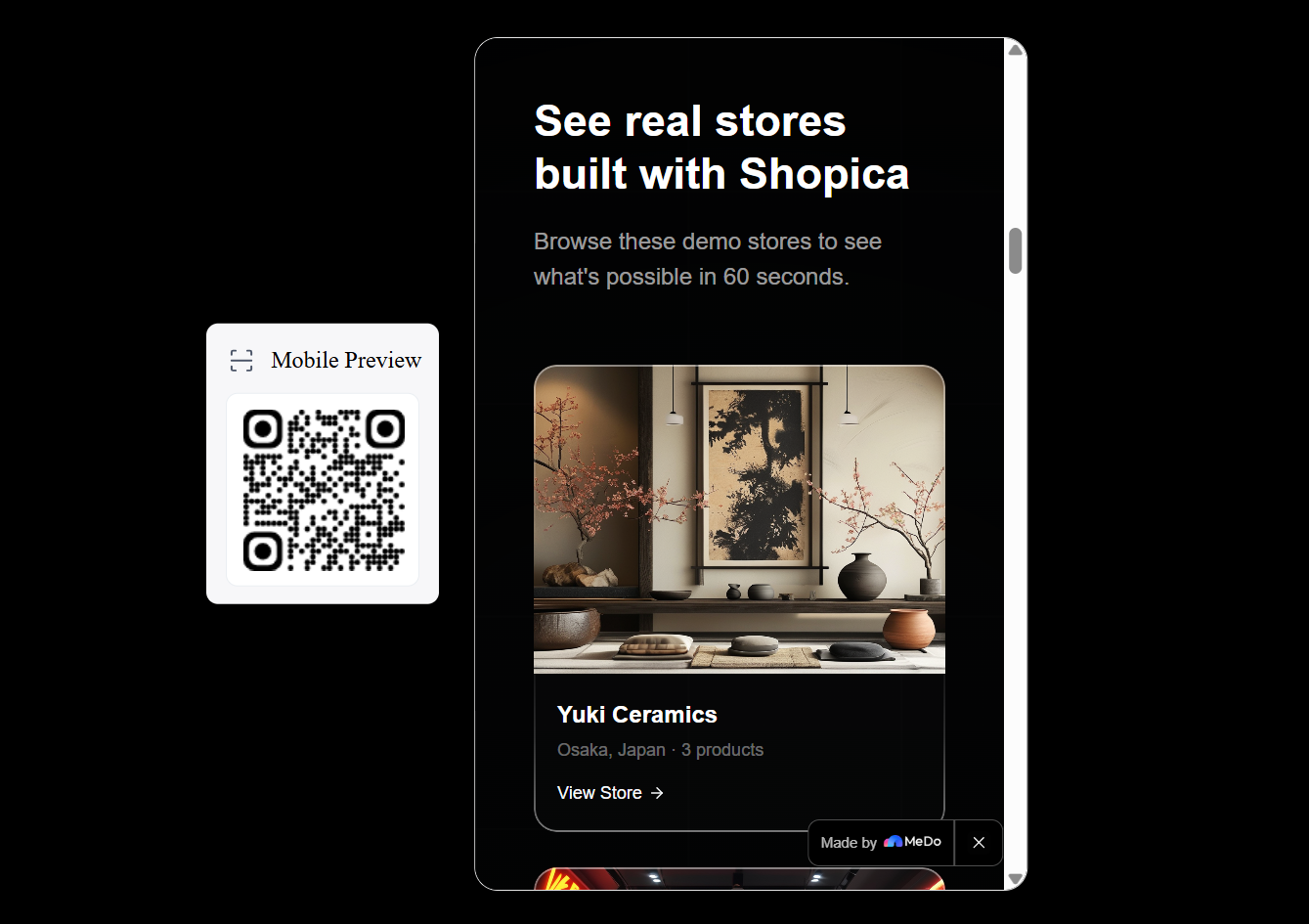
The Problem No One Talks About 300 million small business owners across Japan, Korea, China, Vietnam, and Thailand have no online store. Not because they don't want one. Because Shopify costs $39/month and requires hours of technical setup. Wix requires choosing templates, uploading photos, writing descriptions. For a market vendor earning $800/month, this is both financially and practically impossible. They currently share product photos in LINE groups and WeChat chats. That is their "online store." A chat message that disappears in hours.
What SHOPIKA Does Describe your business in Japanese, Korean, Mandarin, Thai, or English. SHOPIKA builds your live store in 60 seconds. The result: A real, shareable URL with professional product photos, product descriptions, and Stripe payment processing — ready to paste into LINE, KakaoTalk, or WeChat.
How I Built It — The Multi-Agent Pipeline SHOPIKA runs five AI agents in sequence using MeDo's multi-agent collaboration system: Agent 1 — PARSER: Reads the business description. Extracts business name, product type, price range, and key qualities using Baidu ERNIE LLM. Agent 2 — LISTER: Generates 3-6 product listings with names, descriptions, and prices tailored to the vendor's market context. Agent 3 — IMAGER: Calls the Kling Image Generation plugin for each product. A vendor types "handmade ceramic bowls, blue glaze, artisan" — Kling generates a professional product photo instantly. Agent 4 — TRANSLATOR: Uses Google Text Translation plugin to render the entire storefront in the vendor's language. Japanese input produces a Japanese store. Agent 5 — PUBLISHER: Assembles the live store with Stripe payment processing and generates a unique shareable URL.
What MeDo Made Possible I structured the entire build through Deep Build mode conversations. The most impressive moment: I described the Kling image generation requirement in one sentence — "generate a professional product photo from the product description" — and MeDo wired the Kling plugin, handled the API calls, and embedded the generated images directly into the product cards. What would have taken days of API integration happened in minutes. The multilingual storefront was the second breakthrough. I described the requirement — "the store should display in the same language the vendor used to describe their business" — and MeDo connected the Google Text Translation plugin and applied it to every UI element automatically.
Challenges The biggest challenge was making the store generation feel instant to the user while five agents ran sequentially. I solved this with a live progress indicator that updates after each agent completes — vendors see their store being built in real time rather than staring at a loading spinner. The second challenge was product image quality for specific Asian product categories. Generic prompts produced generic images. I added category-aware prompt engineering — when Agent 1 detects "food" products, Agent 3 uses food photography prompts; "handmade" products get artisan photography prompts. The quality difference was significant.
What I Learned The no-code constraint forced clarity. Every feature had to be justifiable in plain language. That discipline made SHOPIKA genuinely simpler than competitors — because I could not hide complexity behind code, there was no complexity to hide.
Impact Every vendor who gets their first online store through SHOPIKA is a business that previously existed only in a chat group. SHOPIKA gives them a permanent, shareable, professional presence that grows their customer base beyond their immediate social network.
Built With
- baidu-ernie-llm
- custom-plugins
- google-text-translation
- kling-image-generation
- medo
- stripe


Log in or sign up for Devpost to join the conversation.